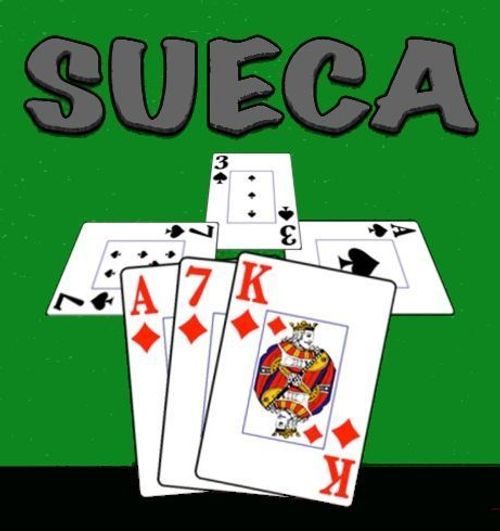
Sueca
Sueca Rulebook
Table of Contents
Table of Contents
Players and Teams
Sueca is a game for four players playing in teams, two against two, with partners sitting opposite each other. Players sitting across from each other form a team, and the two teams compete to take more card points than the other team by winning tricks containing valuable cards.
No talking between players is allowed, and no signals between partners are permitted. (In casual play the signal rule is often overridden, and partners negotiate signs before play.)
The Deck
Sueca is played with 40 cards. Remove the 8s, 9s and 10s from a standard 52-card deck.
The rank of the cards in each suit, from high to low, is:
Ace, 7, King, Jack, Queen, 6, 5, 4, 3, 2
- The 7 is the second-highest card of each suit and is known as the manilha (also called bisca or sete).
- The Jack beats the Queen. This is common in Portuguese card games and reflects the old Portuguese deck, where the Jack was a knight and the Queen was a maid.
- Some players replace the 7 with the 10, which also counts as 10 points.
Each suit sums to 30 card points, so there are 120 points in the deck altogether.
Card Values
| Card | Points |
|---|---|
| Ace (Ás) | 11 |
| Seven (Manilha, Sete, Bisca) | 10 |
| King (Rei) | 4 |
| Jack (Valete) | 3 |
| Queen (Dama) | 2 |
| 6, 5, 4, 3, 2 (A palha) | 0 |
Deal
The first dealer is chosen at random. The turn to deal passes to the right after each hand.
The player to the dealer's right shuffles the cards, and the player to the dealer's left cuts.
Method 1 (single batch, as in the blog text): The dealer gives 10 cards to each player in a single batch, beginning with the player to the dealer's left, going around clockwise, and ending with the dealer. The bottom card of the deck, which belongs to the dealer, is turned face up, and its suit becomes trumps.
Alternatively, the dealer can deal the first ten cards to himself, the next ten to the player to his right, and so on counter-clockwise. In this case the dealer's first card (the top card of the deck after the cut) is turned up and determines the trump suit.
Method 2 (one card at a time, as in the Wikipedia text): The game is played counter-clockwise. The dealer gives 10 cards to each player, one at a time, beginning with the player to the dealer's right, circling counter-clockwise until each player has ten cards, and ending with the dealer. The next card from the deck is turned face up, and its suit becomes trumps. (While point cards are allowed as the trump card, some players redraw the trump until a non-point card is chosen.)
Transcriber's note: the two sources differ on the dealing direction, the batch or one-at-a-time method, and which card is turned up as trump. The blog describes the clockwise single-batch method as the Brazilian variant, and the Wikipedia text says the game is clockwise in Brazil. Both methods are reproduced here as printed; neither has been resolved.
The Play
The player to the right of the dealer (the one who shuffled the cards) leads to the first trick.
- Players must follow suit if they can.
- A player who has no card of the suit led may play any card.
- If any trump cards are played to a trick, the highest trump wins.
- Otherwise, the trick is won by the highest card of the suit led.
- The winner of each trick leads to the next trick.
Scoring
The object of the play is to win tricks containing more than half the card points. The team that takes more than 60 card points scores one game.
- Taking 61 to 90 card points on a deal scores one game.
- Taking 91 or more card points on a deal scores two games instead of one.
- If a team takes all the tricks (all 40 cards), it scores four games and wins the rubber immediately. This is called dar uma bandeira ("to give a flag"; idiomatic translation: "brush off" or "white wash").
- Taking 120 points but losing a trick (with no counting cards in it) is not enough for a flag. In this case the winning team scores two games for having more than 90 points.
The first team to score four games wins the rubber.
Ties
If there is a tie, with both teams taking exactly 60 card points in tricks, no one scores on that deal. The next hand is worth an extra game: the winners of the next hand score two games if they take 61 to 90 card points, and three games if they take 91 or more.
If the next hand is also a tie, the following hand is worth two extra games, so the winners score at least three games.
Transcriber's note: the Wikipedia text states "In case of a tie, neither team wins any points" in its main scoring section, and gives the extra-game rule in its alternative scoring section, noting that it "can be often overlooked". The extra-game rule above is the blog's version and is the one used here.
Transcriber's note: the Wikipedia text also says "If the team gets 30 points exactly then a triple win for the other team." This is not in the blog text and is not explained in the source, so it is reproduced here only as printed and is not confirmed.
Keeping Score
Traditional score cards use two crosses, one marked "Nós" ("we" or "us") and one marked "Eles" ("they" or "them"). A dot is painted on the outer points of the arms of a cross to mark each game won. A more modern method is to use a "comb" or "picket fence" to tally four games per set.
Score is kept by tracking the games won, and the first partnership to reach four games takes the rubber.
Alternative Scoring Rules
Several scoring rules differ from country to country and from region to region. The most common are:
- 120 points to win: Some play that 120 points is enough to win a rubber (four games), rather than having to take all the tricks.
- Taking all tricks in the north of Portugal: In the north of Portugal, a team must win all the cards in the deck to win a rubber (four games). Some places in the north also give the other team the four-point win if one team does not reach the 30-point threshold. When this happens, the losing team is said to have got a pente (comb), a reference to one of the score-keeping methods above.
- Longer games: A full rubber is 10 games, and a half rubber is 5 games (frequently played in the north of Portugal).
- Cork stopper (rolha): If a team scores more than 90 points, the defeated team loses 2 games. This is often played in the southern regions of Portugal, such as Alentejo and Algarve.
- Tie: If there is a tie, with both teams taking exactly 60 card points in tricks, neither team scores, but the next hand is worth an extra game. This rule is often overlooked.
Transcriber's note: the Wikipedia text describes a five-player "Sueca Italiana" game with bidding. That is a different game, so it is not transcribed here.