Sudoku Moyo
Sudoku Moyo Rulebook
Table of Contents
Table of Contents
Glossary
- Moyo = influence. In Go: strong regional influence.
- Azumaya = small house. An Azumaya is open on all sides, like a roof on posts.
- Sudoku Moyo: the neutral area in the middle of the playing field; this is where the game is opened.
- Shima = own land; garden, island. Sudoku Moyo: the areas of the two players.
- Horikomi = throw-in. In Go: playing a (sacrificial) stone into the opponent's formation in order to prevent an eye forming there.
Components
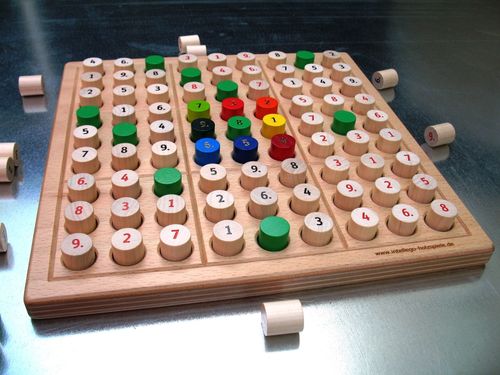
- 81 Sudoku stones, printed with the numbers 1–9. One player plays with the 4 light sets, the other with the 4 dark sets. The black set is neutral.
- 15 round Moyo stones, used to mark spaces that can no longer be occupied.
The playing field contains 9 areas (Shima) of 3x3 spaces:
- 4 light Shima for the player with the light stones;
- 4 dark Shima for the player with the dark stones;
- 1 Azumaya in the centre of the playing field: this is the area for the neutral black stones.
Setup
Together, the players choose a Sudoku puzzle from the appendix and prepare the playing field, in which they first place the puzzle:
- The Azumaya stones of the Sudoku puzzle are placed in the Azumaya (centre). The players' stones are placed in the outer areas.
- The remaining player stones are sorted next to the playing field so that it is always visible which unplayed stones belong to which Shima.
- The remaining Azumaya stones go at the top right, next to the playing field; the Moyo stones go at the bottom left.
Orientation of the numbers: Since it is easier to recognise the numbers upside down than from the side, the stones are placed so that one player sees them the right way up and the other sees them upside down. Which orientation a player uses for the stones they have not yet placed on the board is up to them. On the board, however, all numbers are placed in the same orientation.
Course of Play
The older player begins by choosing a colour and the four corresponding Shima. The younger player then decides which of the two takes the first turn.
Opening
First, the neutral Azumaya is filled with stones. Only when no further stone can be placed there may the players fill their own Shima. At no time is a stone placed in an opponent's Shima.
Turn
Whoever is on turn places a stone on the board according to the Sudoku rules: the same number may not appear twice in the same row, column or Shima. However, stones may be placed in such a way that the Sudoku puzzle can no longer be solved.
If a space can no longer be occupied by a stone, a Moyo stone is placed there. If a stone can no longer be placed in its own Shima, it is turned over so that the number faces down.
Neither placing a Moyo stone nor turning over a stone is a turn in its own right. Both serve only to keep the board clear and can be done at any time.
End of the Game
The game ends as soon as a player can no longer place a stone. The player who placed the last stone in their Shima wins the game.
If several games are played, the winning player receives 1 victory point for each stone that they can legally place on the board after the opponent's last turn.
Revenge?
The Sudoku puzzle can, through its structure, subtly favour one of the two players. A player who attributes their defeat to this may challenge the partner to a rematch and play the same puzzle with the roles swapped. The player with the most total points wins.
Variants
Sudoku Horikomi
Whoever is on turn may also place their stone in an opponent's Shima. The game ends when no further stone can be placed. All remaining empty spaces are then filled with Moyo stones.
The player in whose Shima the fewest Moyo stones lie at the end of the game wins the game. In case of a tie, the player who has the most Shima completely filled with Sudoku stones wins. If there is still a tie, the player with the most Shima filled with 8 Sudoku stones wins (then with 7.6 ...). If no tie-break decides the game, the game ends in a draw.
Other Area Division
The area division above has proven itself in practice. Naturally, other divisions can also be used; for example, one player receives the Shima in the corners and the other those at the edge centres (which is harder to play).
Alternatively, the players choose alternately (first Player A chooses 1 Shima, then Player B 2 Shima, Player A 2 Shima, Player B 2 Shima, Player A 1 Shima).
It is also possible to divide the Shima by rows and/or columns instead of 3x3 blocks.
Sudoku Puzzles from Other Sources
Of course, Sudoku puzzles from other sources can also be used. The following selection criteria are sensible for this:
- The puzzle should not be too difficult. If there are several starting points for solving the Sudoku, there are also several ways to play it.
- However, not too many spaces should be occupied already.
- The puzzle should not contain a completely empty block (but do as you wish ...).
- Few stones should be in the Azumaya (about 1–4 is optimal).
- Neither in the Azumaya nor in any Shima should there be 3 stones directly next to each other in a row or line, because completely filled rows block possibilities of influence.
Handicap
The weaker player places one or more stones into the neutral zone at the start. Or: the weaker player receives the Shima in the corners, and the stronger player those in the edge centres.
If the difference in strength is too great, it is better to play a different game.
Appendix: Sudoku Puzzles
The rulebook prints six Sudoku puzzles, which the players may choose from for setup. They are not titled in the source; they are numbered here in reading order (left to right, top to bottom). A dot (.) is an empty space. The shading of the printed grids marks the area layout and is not reproduced here.
Puzzle 1
. . . 8 . . . . 9
1 6 . . . 9 2 . .
. 5 9 . 1 . . 6 .
. . . . . 1 7 . 4
3 . 1 . . . 5 . 6
2 . 4 6 . . . . .
. 1 . . 6 . 8 9 .
. . 2 1 . . . 7 5
9 . . . . 8 . . .
Puzzle 2
4 5 . . 9 . . 3 2
. . 7 3 . . 1 . 9
. . . . . 7 5 . .
. . . . 3 8 . 6 .
. . 8 . . . 3 . .
. 6 . 4 2 . . . .
. . 6 5 . . . . .
2 . 5 . . 3 4 . .
1 3 . . 7 . . 5 8
Puzzle 3
2 . 8 6 . 3 1 . 4
. 5 4 . . . . . .
1 . . . . 4 . . 3
. . . . . . . . 5
9 . . 1 . 6 . . 7
4 . . . . . . . .
5 . . 3 . . . . 1
. . . . . . 4 6 .
8 . 1 7 . 2 5 . 9
Puzzle 4
. . . 6 3 . . 1 9
1 . 2 4 8 . 3 . 6
. . . . . . 4 . .
. . . . 7 . . . .
. 2 5 . . . 7 6 .
. . . . 6 . . . .
. . 7 . . . . . .
3 . 4 . 2 8 6 . 7
2 8 . . 4 7 . . .
Puzzle 5
. . . 2 . . 6 . .
6 . 3 8 . 9 5 1 .
. . . . 3 5 . . .
8 4 . . . 2 7 3 .
. . 6 . . . 4 . .
. 9 2 4 . . . 5 8
. . . 7 4 . . . .
. 6 4 5 . 1 8 . 2
. . 7 . . 6 . . .
Puzzle 6
. 6 . 3 . 9 8 . .
. . 8 . 4 . 7 5 3
2 . . . . . . . .
. 1 . . . 2 . 8 4
. . . 9 . 1 . . .
7 8 . 6 . . . 3 .
. . . . . . . . 7
8 3 1 . 6 . 9 . .
. . 7 1 . 3 . 6 .