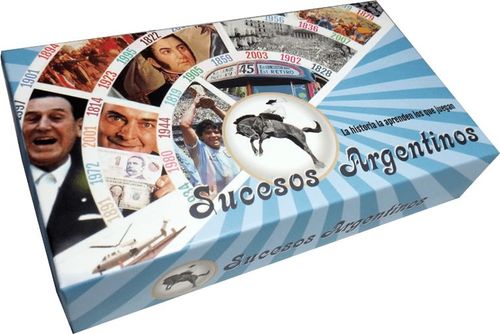
Sucesos Argentinos
Sucesos Argentinos Rulebook
Table of Contents
Table of Contents
Contents
In the game box you will find:
- This manual.
- 75 unique double-sided cards representing notable events of Argentine history.
- 1 illustrated card / mate (the first-player marker) to indicate the first player of each round.
The front of each card shows the name by which the historical event is known and an illustrative image. The back shows a description of the event and the year in which it occurred. CAUTION: the cards must be shuffled and seen face-front, keeping the back hidden until the rules indicate otherwise.
There are 4 different decks of Sucesos Argentinos: "I: Política y Conflictos" (Politics and Conflicts), "II: Economía y Sociedad" (Economy and Society), "III: Ciencia y Cultura" (Science and Culture), and "IV: Cambalache". Two or three different decks can be combined to create a game with greater variety and to allow up to 6 people to take part in a game. The cards of each deck carry an icon that distinguishes them, in case you want to separate them again, although it is perfectly possible to play with the combined decks.
How to Play
At the start of the game, the oldest player is in charge of shuffling the deck (always keeping the deck face-front), dealing one card to each player, and placing in the center of the table a number of cards equal to the number of players plus one.
Each player turns over the card they received, reads its name and year, and places it back-up in front of them, so that the year of their event is visible. This is their starting card, around which they will place the new cards they obtain. Once everyone has laid out their starting card, the player to the left of the dealer takes the mate card, places it in front of them to indicate that they are the first player of the round, and begins their turn.
On their turn, each player must choose one of the cards in the center of the table and choose whether to place it to the right (after) or to the left (before) of their starting card, according to the year they believe the event occurred. After placing the card, it is turned over. If its position is correct, the card stays in its place; if it is incorrect, the player must read aloud the text describing the event and place the card back-up on a discard pile next to the deck. The player to the left of the first player repeats the same procedure, continuing until everyone has completed their turn.
NOTE: If two events occurred in the same year, any position is considered valid between them.
At the end of each round, one card will be left over in the center of the table. The first player must place it at the bottom of the deck, put as many cards from the deck as the number of players plus one back in the center of the table, and pass the mate card to the player on their left. A new round then begins.
As more events accumulate in their personal timelines, players must place the new cards they choose in the position they believe is correct among all their cards, so the revealed year must be later than or equal to that of the card to their left, and earlier than or equal to that of the card to their right.
At the start of each game, a target length must be chosen for the timeline to be built. We recommend starting with 5, but 6 or 7 cards may be used as the target. When a player manages to build a sequence of that many correctly ordered cards, the round continues until all players have had their turn. If at the end of the round there is a player whose line has more cards than the rest of the players, that player is the winner!
In case of a tie between two or more players, the Elimination phase begins: the mate card passes to the player on the left for the last time and is not moved again. In this phase, players no longer have cards to choose from; instead, following the turn order, each player must take the top card of the deck and place it in their timeline. If they placed it incorrectly, that player is eliminated (unless all the other players also failed to place their event correctly in this round). This continues until all players are eliminated except the last one, who is now the definitive winner.
Variants
No-discard variant: to increase the difficulty of the game, the group may agree not to discard the leftover card of each round, and to add it to the new round (so there will only be as many new cards as players, plus the card not chosen).
Note for Parents and Teachers
Sucesos Argentinos is designed as an educational game for children from age 10. However, some events may be inappropriate for some ages. It is up to the teacher or adult in charge to remove the cards they do not consider suitable for the group.