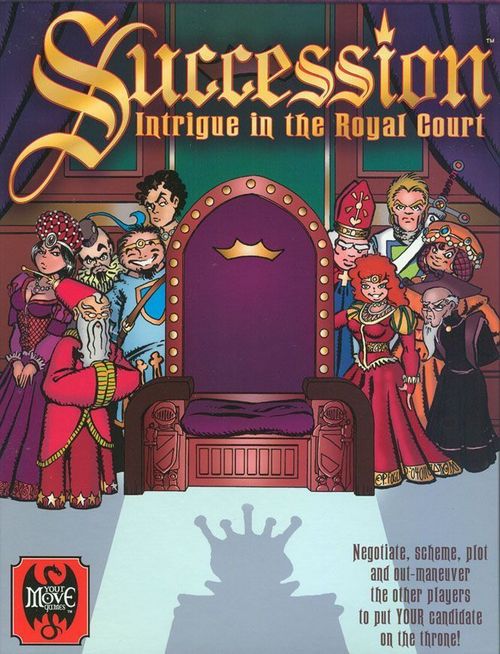
Succession: Intrigue in the Royal Court
Succession: Intrigue in the Royal Court Rulebook
Table of Contents
Table of Contents
Overview and Object of the Game
Succession: Intrigue in the Royal Court is a game of strategy, politics, bluffing and resource management for two to five players, typically lasting from one to three hours.
The best political games come from four or five players, although three works fine. Succession can also be played with just two players, although in that case the politics disappears and the game becomes an aggressive and fast-paced struggle of bluffing and resource management in which just one or two mistakes can cost you the game.
Succession ends when the aging King chooses a successor to the throne. Five candidates – leading citizens of the land – hope to be named that successor. You are not one of them. Instead, you win the game by having the successful candidate think that you're responsible for the King's choice.
As a courtier, master of palace politics, you will manipulate the King's opinion of the candidates through intrigues – bits of gossip, good and bad reports, etc. Just as important, you will manipulate the opinions of the candidates by taking credit and avoiding blame as much as possible every time the candidates gain or lose standing with the King. To do this you'll have to out-guess and out-maneuver the other players, manage your resources carefully and decide when to fight and when to sit on the sidelines and watch your opponents beat each other up. Figuratively, that is…we at Your Move Games rarely condone actual violence.
Succession is a game of politics and deal-making. You can offer other players money, cards, or promises of future behavior in exchange for what you want. You may even decide to keep those promises! Be creative.
Contents
- One large game board for tracking candidate standing with the King
- Five player boards for tracking player standing with the candidates
- Deck of 55 cards
- 112 cardboard chips
- 10 "gain/lose chips" to track the effect of intrigues on the main board
- 5 "character chips" of the candidates for use on the main board
- 25 "character chips" of the players (five each) for use on the player boards
- 50 of one gold (each representing one gold piece)
- 22 of five gold (each is worth five gold pieces)
- Pencils and paper
- This rulebook
The Boards
One large main board for tracking candidate standing with the King and and five smaller player boards for tracking the player standing with the candidates.
Standing
Succession is ultimately all about standing. No, not that kind. Sit down. Standing as in esteem, regard, favor.
The candidates for succession want desperately to be in high standing with the King, since that's how he'll decide who his successor will be. The players want to be in high standing with the candidates because they're trying to become the successor's right hand man1. When the King chooses one of the candidates as his successor, the player with the highest standing with that candidate wins the game. But even the unsuccessful candidates (sometimes known as "losers") are important during the game because they hand out money (called patronage) to those players who have high standing with them. (They're providing financial backing to those they think are best supporting them in their quest to become the next monarch.) If you reach high standing with Archie, for example, you can use the money he gives you to push his suit with the King…or you could use it to increase your standing with another candidate instead!
The standings of the various candidates with the King are scored on a single board. Each player tracks their own standings with the candidates on their own board. (Players don't have standing with the King.) Standings can never fall below one. Player standings can never go above five, and candidate standings can't go above ten.
Getting Started
First, each player must choose a 'character.' There are five characters to choose from: a worthy squire of good reputation, a cunning ambassador, the court wizard, the King's senior tax collector, and a noble whose family has served the king's family for generations. (In a game of two or three players, we recommend not playing with Ambassador. In a game with only one player, we recommend a different game.) Each character has a special advantage, discussed in more detail below.
Once everyone is seated, choose randomly who gets to make first choice of characters. The person to that player's right chooses the next character and so on, until everyone has chosen a character. When play begins, the person who chose last will play first and play will go to the left, so that people will take their turns in reverse order of choosing characters.
After each player has chosen a character, mark initial standings by putting character chips on the green spots on the player and main boards.
Then each player collects patronage (discussed on page 8 under turns) and is dealt four cards. (In a two player game, the player going first starts with only half of his or her normal patronage, rounding up. In addition, the card Big Jerk, Little Jerk should be removed from the deck before starting.)
Detail: Put the character chips on the green "starting position" spots.
Player Characters
There are five player characters to choose from:
Squire
Squire earned his place at court by valiant service in war, and the King holds him in high esteem. Because of this esteem, Squire is able to reduce the cost of each of his votes by 2 for free. (Squire's ability only reduces the cost of votes actually made – he cannot vote zero and collect gold from the bank!)
Taxman
No one knows how to get gold better than Taxman. During the Patronage step of his turn, Taxman collects an additional three gold. (This is also counted when figuring Taxman's starting gold, so he begins with ten gold.)
Royalist
Royalist's family has served at court for generations, and few are better at currying favor. Whenever Royalist gains standing with a candidate because of a card or an intrigue she may immediately pay three gold to the bank to gain one additional standing with that candidate. She may do this with more than one candidate if she gains standing with more than one at a time, but she may not pay twice in one instance to gain two standings with a single candidate.
Wizard
The court Wizard may not be able to cast spells, but he has dedicated his life to the pursuit of knowledge. As a result, Wizard is able to buy one additional card during his turn for three gold. He may do so at any point during his turn but only once per turn.
Ambassador
Ambassador has made a career out of soothing ruffled feathers and avoiding being blamed for bad news. As a result, while Ambassador can be blamed for intrigues, his standings with the candidates never goes down as a result. His standings can go down as a result of a card saying so.
The Candidates
There are five people aspiring to the throne, and each has a special ability that affects intrigues.
Sir Galahad, a worthy Knight of the Realm
Galahad isn't of royal blood, but his reputation for leadership and chivalry is such that the King is inclined to believe good things about him and to be skeptical of scandals in which he is named. As a result, any intrigue that would increase Galahad's standing has an extra "Pass 5" vote and every intrigue that would harm Galahad's standing has a "Fail 5" vote. (These votes do not belong to any player and have no effect on control of credit or blame – they simply reflect the King's disposition to believe a particular story.)
Ulysses, the King's son
Normally Ulysses would have a big edge, but his poor judgment and general laziness have earned his seldom-spoken nickname of "Useless" and the King knows it. Ulysses begins with a big lead but he is vulnerable. Any time Ulysses loses standing from an intrigue he automatically loses an additional standing. Moreover, Ulysses can never gain more than one standing per intrigue.
Arianna, the King's daughter
Smart and of good reputation, Arianna is generally regarded as fit to rule. The King knows it and is inclined to believe good things about her, but can't shake the image of her as his little girl. Arianna starts at the bottom of the standings, but she can rise quickly – any time Arianna gains standing from an intrigue she automatically gains an additional standing. Moreover, Arianna can never lose more than one standing in an intrigue.
Archie, the Bishop
Archie has been the King's personal cleric for decades and has carefully seeded the idea of a theocracy in the pious monarch's heart. While the King isn't sure that he likes the idea, his faith in Archie's honesty and godliness is unshakeable. As a result, Archie's standing with the King can never go down as a result of intrigues. (He can be chosen to lose standing, but there will be no effect.) As a result of Archie's special ability, Archie never assigns blame, since no scandal would lower his standing.
Venetia, a wealthy merchant
Although not of noble birth, Venetia is willing to invest a great deal of her fortune in her quest to become the next Queen. Not only does she pay the most patronage to those who serve her interests, Venetia pays 3 gold as a bonus whenever a player receives credit for an increase in her standing. Since Venetia pays this money as part of the assigning of credit, it may be used to pay for any deals made for the credit (i.e. if another player controlled the credit and you offered to pay them money for it), and Royalist may use the gold to pay for her special ability.
Cards
Cards are an important tool by which players attempt to control their own standings and those of the candidates. There are three types of card:
Event
Event cards each do something different, described in the text. Unless they say otherwise, events can only be played during the main stage of your turn, but you may play as many during a turn as you wish.
Influence
Influence cards represent political capital, your ability to sway court politics and, ultimately, the King's opinion. Each influence card has a number representing its voting power. (The titles are just for fun.) Influence cards may be played during intrigues to pay for votes.
Intrigue
Intrigue cards represent rumors, scandals and good reports that might change candidate standings with the King. They also include a small amount of political capital and can be played as though they were influence cards during other intrigues. Regular text is the "story" of the intrigue. Bold text states the intrigue's game effects, if it passes, and italic text (if any) denotes any special points. Some intrigues specify that gold does not count for voting or that gold counts double for voting. In this case, the card will also be marked by a symbol to make sure everyone notices! Aren't we helpful?
- Symbol: "Gold does not count for voting"
- Symbol: "Gold counts double for voting"
Playing and resolving intrigues is discussed in greater detail on page 9.
Turns
Play goes in turns, going clockwise. Each player's turn is broken down into three stages:
-
Draw. Either draw one card and continue your turn, or discard all cards in your hand, draw four cards, and end your turn immediately, without collecting patronage or playing cards. (If your hand is empty at the start of your turn, discarding all your cards isn't so painful.)
-
Patronage. You receive money from the candidates based on your standings, i.e. on how much they think you're helping them with the King. Above the standing trackers on your player sheet is the amount of gold each candidate pays you at each level of standing. For example, if your standing with Galahad is 3, he pays you one gold piece. Collect the total amount.
-
Main. Intrigues and most events can only be played when it's your turn and only in this part of your turn. You may play as many events as you like, but may play only one intrigue per turn. You may negotiate with other players as you play cards, even in the middle of resolving a card's effects. You may also exchange, give or receive cards and money from other players as a result of negotiations.
Example: Squire begins at standing 4 with Galahad (worth three gold pieces in patronage), 2 with Ulysses (worth one), 3 with Arianna (worth two), 2 with Archie (worth nothing) and 2 with Venetia (worth one). He starts with seven gold (his starting patronage) and four cards. Now he's ready to take his first turn. Note: if Squire were going first in a two-player game he would begin with just four gold (half of seven, rounded up), but still get four cards.
Squire begins his first turn by drawing a fifth card. Instead of drawing a fifth card, he could have discarded his hand and drawn four new cards, but then he would give up the rest of his turn. No need to do that at this point! Next he collects seven gold in patronage. (Remember, the first seven was just his starting money.) If he's able to improve his standings with the candidates he'll collect more in the future.
Now Squire enters the main stage of his turn. He decides to improve his standing with Archie, the only candidate not currently giving him any patronage. He plays Good Graces, choosing Archie as the candidate. Naturally he plans to increase his own standing with Archie, but he would like to get some money from the other players, if possible!
Event card: Good Graces. "Choose a candidate. Then for each player (including you) choose whether or not he or she gains one standing with the chosen candidate."
Having announced that he's playing Good Graces on Archie:
- Squire announces that he will include any other player that gives him four gold. Ambassador and Taxman both accept.
- Wizard points out that his standing with Archie is poor (making it less dangerous for Squire to boost him) and offers two gold; Squire declines.
- Royalist offers Squire a "Vote 4" card instead, and Squire accepts.
- Money and cards change hands and true to his word Squire increases everyone's standing with Archie except for Wizard.
- Royalist must immediately decide whether to use her special ability and pay three gold to the bank to gain a second standing with Archie. She does so.
Squire is happy with his turn so far. Other players have gained as much or more standing as he has, but at the cost of one card he has collected eight gold and a "Vote 4" card, and he suspects that he now has much more voting power than any other player. Time to play an intrigue…
Intrigues
Intrigues are the main tool by which players cause changes in standings – both the candidates' with the King and theirs with candidates. A player may play at most one intrigue per turn and only during the main stage of his or her own turn. Once an intrigue has been played, no event cards may be played until the intrigue is resolved, unless they specify that they may be played during intrigues.
First the person playing the intrigue announces it and makes all choices required, i.e. which candidates will be affected and how, if applicable. Each candidate has a portrait in front his or her standing track, and by putting a red "gain" or a green "lose" chip on the picture you can keep track of who stands to gain (green) and who to lose (red).
Example: Squire plays Out of Tune as his intrigue for the turn. Having already improved his standing with Archie once, he's hoping to do so again. He chooses Archie to benefit and Ulysses to lose. If the intrigue succeeds, Archie will gain two standing and Ulysses will lose three – two from the intrigue and then one extra because Ulysses always loses one extra standing whenever he loses standing.
Then each player votes in secret by writing down either "Pass" or "Fail" and a number representing the total value of gold, influence and intrigue cards he or she is investing in the intrigue. Check to see that everyone has written down their votes and then see if anyone wants to play one of the sneaky events that can be played before votes are revealed (but after they are locked in place). When everyone is ready, the votes are revealed, beginning with the person who played the intrigue and then clockwise. As each player reveals their vote they must "pay" for it with a combination of influence cards, intrigue cards and money. (Cards are discarded and money is paid to the bank.) The number in the intrigue card counts toward the vote of the player playing the intrigue.
Example: Squire decides to vote "Pass 10" for his intrigue. As he reveals his vote he must pay a total of 10 in gold and votes, including the 3 in the intrigue itself and the 2 free votes he gets for his special ability. He pays 5 gold to make up the difference. The other players all reveal their secret votes in turn. Wizard and Royalist decided not to fight over this intrigue and both voted "Pass 0." (There's no difference between "Pass 0" and "Fail 0.") Ambassador voted "Fail 13" and pays with an "Influence 9," an intrigue card worth 2, and two gold. Taxman voted "Pass 6" and pays with two gold and an "Influence 4" card.
Next, the intrigue is resolved. If the total "Pass" votes are greater than the total "Fail" votes, the intrigue succeeds and all of its effects take place. On a tie vote, or if the "Fail" votes are greater, the intrigue fails.
Example continued: The vote passes with total Pass votes of 16 (Squire and Taxman) and total Fail votes of 13 (Ambassador). Normally Archie would gain two standings and Ulysses would lose two. However, Ulysses automatically loses one extra standing on any intrigue that hurts his standing (see The Candidates), so he loses three standings, falling from 7 to 4. Archie moves up from 2 to 4. Had the intrigue failed, neither candidate would have changed standing.
Credit and Blame
Finally, credit and/or blame are assessed. After all, the candidates are paying close attention to court politics and they will reward or punish those they think are trying to help or hinder them! Part of your job is making sure the candidates think you're helping them even when you're not and convincing them it was one of the other players when you stab them in the back.
Whenever an intrigue would, if successful, cause one or more candidates to gain in standing, the player who receives credit for the intrigue with each candidate gains one standing with that candidate. (Even if an intrigue causes a candidate to gain more than one standing, the player who receives credit gains only one.) It is possible for one player to gain standing with one candidate while another gains with a different one, but only one player may gain standing with each candidate for a given intrigue.
Blame is handled identically to credit. So long as an intrigue would have caused a loss in standing if it succeeded, the candidates will attempt to punish whoever they think is responsible. Since a candidate with standing one cannot go lower, no intrigue would cause a candidate of standing one to lose standing. Thus, candidates that far out of the King's favor don't assign blame. They've got better things to do than make enemies.
Credit and blame is assigned by the player who made the largest vote. It doesn't matter if you voted pass or fail, or if the vote went your way; if you invested the most political and financial resources you control the spin. For each candidate who stood to gain or lose standing, the player who controls the spin decides who that candidate thinks was responsible for the intrigue. If two (or more) players tie for largest vote, they may either negotiate an agreed outcome or flip a coin for each candidate to determine who controls the spin with respect to that candidate.
Example concluded: Because his vote of 13 was the highest, Ambassador controls the credit and blame. He must choose who will gain one standing with Archie and who will lose one with Ulysses. He takes the credit for himself, advancing from 3 to 4 (he already moved from 2 to 3 as a result of Galahad's Good Graces card) and announces that he will not blame anyone who pays him one gold. If they accept, he can blame himself safely, since his special ability means blame has no effect on his standing. If any or all refuse, he will have to decide who he wants to hit and that player's standing with Ulysses will go down one.
It's still Squire's turn at this point (once Ambassador has assigned blame). He can't play another intrigue this turn, but he could play other event cards if he chooses. Instead he decides to pass to the next player.
Vote diagram (page 10):
- Wizard: Pass 0. Royalist: Pass 0. Squire: Pass 10 (pays as though he voted Pass 8). Taxman: Pass 6. Ambassador: Fail 13.
- Total Pass: 16. Total Fail: 13. Intrigue passes.
- Note on diagram: "Even Though Ambassador 'lost' the vote, he controls the spin (credit and blame)."
Important Points on Deals and Timing
Whenever players must act on something the first to act is the "active player", with subsequent action going clockwise. Normally the active player is the person whose turn it is. However, once votes are revealed in an intrigue, the player who controls the spin is considered the active player until credit and blame are assigned. The timing rule applies most commonly for revealing and paying for votes, but can be important if two players are considering playing a card before votes are revealed but each want to see if the other will act first. In that case, for example, the active player must say whether he wants to play any cards first. If everyone passes then go on to reveal votes, but if someone does play a card then people who originally passed get another chance to play cards.
Players can make deals at any time, including during resolution of cards or intrigues. However, exchanges of assets (gold or cards) can only be made if one of the people involved is the active player. Thus, if the active player plays Fortune's Fool to make you discard your hand, you can't lend or sell your hand to a third player to avoid the effects.
There is a lot of flexibility in the way cards are played. You can show a card in your hand to the table or to a single opponent and try to make deals. You can also announce that you intend to play a card like Big Jerk, Little Jerk and try to extort money from people who don't want you to play it on them! However, once you say you are playing a card or you announce a choice regarding that card, you've made it. So if you say, "I'm playing Good Graces on Galahad," you can't change your mind to have it affect standings with Venetia just because Taxman is willing to pay you a lot of money to gain standing with Venetia.
What if a Player Makes a Vote but Can't Pay for It?
Sometimes a player will make a vote and realize that he or she can't pay for it, either exactly or in full. This may be due to a counting error, forgetting that money doesn't count for voting in a particular intrigue or misreading a card. Or it could just be that there's a reason the King doesn't consider you worthy of the throne.
In any case, illegal votes are handled as follows. If a player is able to pay for the vote but can't pay exactly, he or she must overpay and the vote remains what was named. So if Royalist has two gold and an Influence 9 card but votes "Fail 8," she must discard the Influence 9 card and her vote remains "Fail 8." If a player can't pay for his vote in full, the player must show his or her hand to all players (to prove that he or she can't pay in full) and their vote is reduced to zero. Thus, if Royalist had voted "Fail 13," she would reveal her hand, showing that her total voting power is 11 (Influence 9 plus two gold) and her vote would be changed to "Fail 0."
Winning
The game can end in two ways:
-
If any candidate reaches standing 10, he or she is the new successor and the game ends immediately. (Credit and blame is still assigned for the intrigue that brought the candidate to 10 and players must pay for their votes.)
-
If the last card in the deck is drawn, the game continues until the end of the current player's turn. If the deck is emptied by a player choosing the "Draw 4" option the game ends immediately. The King chooses the candidate with the highest standing as his successor.
If, in either case, two or more candidates are tied for the highest standing, there is one final vote. Instead of "Pass" or "Fail" the players each choose an individual candidate. The candidate with the highest total vote2 becomes the new successor, and the player who voted the most (regardless of which candidate he or she voted for) gets to assign one credit for the new successor.
So who wins? If only one player has the highest standing with the new successor, he or she wins. If more than one player is tied for highest standing, those players compare their total remaining vote power (from influence cards, intrigues and gold – Squire's special ability doesn't help here). The player with the highest total wins. (If you're still tied, then the game is a tie.)
Rule Variants
-
Hourglass timer. Some groups may find that negotiations or resolution of cards drags on too long. While such negotiations are part of what makes the game fun, putting a time cap on them can save enough time that you can play twice! Although no timer has been provided, many lesser games include one, or you can use a stopwatch to track an agreed-upon length of time. At any point during the play of a card or a negotiation, any player may "start the timer," in which case the card or negotiations are finished when the timer runs out.
-
Missing cards. Serious gamers who know the deck may start to calculate which cards are still "out there" as the deck gets close to empty. If this happens to you and you don't like it, remove two random cards from the deck at the start of the game. Now no one knows for sure what's out there. They can guess, but they may guess wrong!
Strategy Tips
-
There's a deal there, somewhere. Succession is a very open-ended game of negotiations, and you should consider every opportunity to squeeze out some extra cash or cards for yourself. About to play Petty Thief? Try announcing that you won't play it on anyone who gives you two gold. If even one person pays, that's extra money in your pocket. If everyone pays you can even play it on yourself (in which case it has no effect) and you've collected eight gold instead of a random card.
-
Consider selling credit instead of taking it for yourself. Let's say you invest a lot of money and influence and win an intrigue with credit for all candidates. You could just take the credit for yourself…but what happens then? First, until your next turn your resources are probably lower than those of the other players. This means that you probably can't compete in the next few intrigues. Worse, if there is blame to be handed out it may come at you, since your standings are now highest.
Instead, suppose you take credit for two candidates and sell off the remaining credit to other players in exchange for money and/or cards. Now you have more resources (and some of the other players have fewer resources) so you're able to keep competing, and your standings aren't such a lightning rod.
- It's often better to be in second place than in the lead…or at least it's better to look that way. Succession offers players lots of ways to help or hinder each other, and if it looks like you're winning the game you're a target for other people's harm and are likely to get shut out of any deals. For this reason it's often good to appear to be doing a bit less well than you actually are. If you have better standings than anyone but Royalist, more cards than anyone but Wizard and more money than anyone but Taxman, you may be in the best overall position but look like you're just doing OK.
You sneaky person, you.
For rules updates and clarifications see our online FAQ at www.yourmovegames.com/succession/faq
House Rules
The final interior page of the printed rulebook is headed "House Rules" but contains no text.
Footnotes
-
Except for Royalist, who wants to become the successor's right-hand woman. There are rumors that one of the candidates is left-handed, but, like Royalist's gender, this has no relevance to the game. ↩
-
If this vote is a tie, a final final vote is held. If that vote is a tie, the King decides to ignore your advice and chooses his successor at random from the candidates with the highest standing. No player gains standing as a result of his choice. ↩