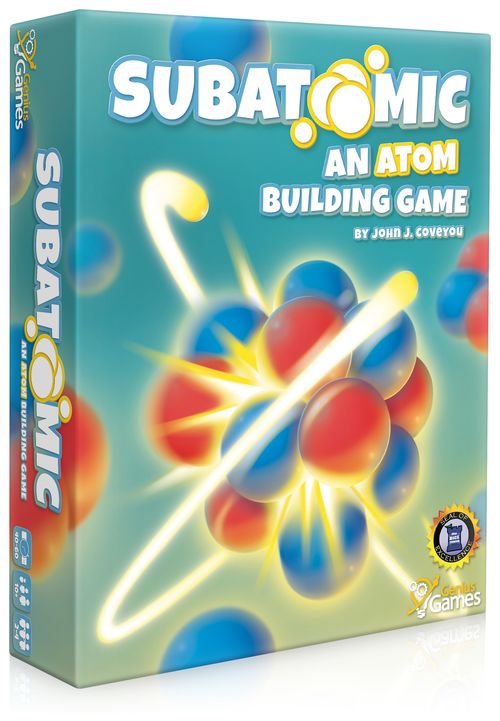
Subatomic: An Atom Building Game
Subatomic: An Atom Building Game Rulebook
Table of Contents
Table of Contents
Components
Element Cards (24)
- 6 Helium Cards
- 6 Lithium Cards
- 6 Beryllium Cards
- 6 Boron Cards
Scientist Cards (21)
- 3 Joseph J. Thomson Cards
- 3 Erwin Schrödinger Cards
- 3 Ernest Rutherford Cards
- 3 Albert Einstein Cards
- 3 Maria Goeppert-Mayer Cards
- 3 Marie Curie Cards
- 3 Niels Bohr Cards
Starter Decks (4 sets)
- 16 Up Quark Cards
- 16 Down Quark Cards
- 12 Photon/Gamma Ray Cards
Single Subatomic Cards (29)
- 9 Neutron Cards
- 8 Proton Cards
- 6 Electron Cards
- 6 Wild Cards
Larger Subatomic Cards (17)
- 6 Double Neutron Cards
- 5 Double Proton Cards
- 4 Proton & Neutron Cards
- 2 Double Proton & Neutron Cards
Other Components
- 40 Goal Markers
- 1 Annihilation Marker
- 1 First Player Marker
- 4 Player Mats
- 12 Particle Markers (Proton, Neutron and Electron markers)
- 32 Energy Tokens
- 7 Bonus Tiles
- 1 Game Board
Game Setup
-
Place the Game Board near the top of the play area.
-
Place the Annihilation Marker on the left-most space of the Annihilate track (on the Game Board) that corresponds to the number of players.
-
Place the seven Bonus Tiles face-down and mix them up. Randomly place one Bonus Tile face-up on each of the End Goal spots. Place the remaining Bonus Tiles back in the box.
-
Place all the Energy Tokens near the Game Board.
-
Separate the Scientist Cards, Element Cards, Single Subatomic Cards, Larger Subatomic Cards (with the deck-building icon in the corner), and Starter Cards into separate decks.
-
There are seven different Scientists. Each Scientist has three cards, and each of these three cards has a different energy cost (located in the bottom right corner of the card). Randomly choose four of the seven Scientists to create four face-up stacks above the board. Each stack should include all three cards for that Scientist. Then, arrange each stack face-up from lowest to highest energy cost, so that the lowest is on top and the highest is on the bottom. Place the unused Scientist Cards back in the box.
-
Shuffle the Element Deck, and place it face-down on the Draw Pile spot on the left side of the Game Board. Draw three cards, and place one face-up in each of the three Element spots in the center of the Game Board.
-
Shuffle the Single Subatomic Cards, and place them face-down as a deck below the left side of the Game Board. Draw four cards, and place one face-up in each of the spots directly below the Game Board, one in each column.
-
Shuffle the Larger Subatomic Cards (with the deck-building icon in the corner), and place them face-down as a deck below the Single Subatomic Deck. Draw four cards, and place one face-up below each of the Single Subatomic Cards.
During Setup only, if any three of the face-up Element, Single Subatomic or Larger Subatomic Cards are exactly the same, replace that face-up card (starting with the leftmost duplicate card in any row) with a new card from its respective deck. Shuffle any removed cards back into the respective deck.
Each player should place their three Particle Markers on the three holding places in the upper left of their Player Mat, and their Goal Markers above their Player Mat.
Finally, each player should draw 5 cards from their Draw Pile to form their hand.
Give the player who most recently did a science experiment the First Player Marker.
You are now ready to begin gameplay!
Gameplay
Introduction to Deck Building
Subatomic is a deck building game. In a deck building game, rather than sharing a common deck, players have their own personal Draw Pile and Discard Pile. At the beginning of the game, each player's deck will start with the same 10 Starter Cards that provide basic resources. Players will draw 5 cards to use each turn and discard them when the turn is over. When a player's Draw Pile runs out, they will shuffle their personal Discard Pile to form a new Draw Pile.
As the game progresses, players will have chances to add more powerful cards (or remove weaker cards), improving the quality and strength of their deck. The heart of Subatomic's gameplay is the strategic challenge of how and when players choose to improve their decks.
Summary of a Turn
The player with the 1st Player Marker takes the first turn, and then play continues clockwise.
The active player's turn consists of two steps: (1) playing cards to take actions, and (2) refreshing the play areas.
Step 1: Play Cards
On a player's turn, they may play cards from their current hand to take as many actions as they wish until they no longer have enough resources to take additional actions, or they decide their turn is over. Cards will generally be played face-up into that player's Cards in Play area (directly below their Player Mat) to gain the benefit on the card. Alternatively, any card may be played face-down to pay 1 energy.
Played cards may be used to take four main actions:
- BUILD Up Your Atom to claim an Element Card
- CLAIM an Element Card to score points
- BUY Deck Building Cards to strengthen your deck
- TAKE Energy Tokens to store for use on later turns
Note: If at any time a player has three identical cards in their current hand, they may show them to all other players, place one of the three identical cards into their Discard Pile, and replace it with a card from their Draw Pile.
Note: A single card may NOT be split and used over multiple actions. For example, a player may not use a Double Neutron Card to add 1 neutron to their atom and spend 1 neutron to purchase a Larger Subatomic Card.
Step 2: Refresh
Refresh the Player's Area
At the end of a player's turn, they must move all cards from their Cards in Play area to their Discard Pile, face down. (A player may choose to keep any unplayed cards in their current hand). That player should then draw cards from their Draw Pile until they have 5 in their hand. Whenever a player has no cards left in their Draw Pile, even while drawing a new hand, they immediately reshuffle their Discard Pile to form a new Draw Pile.
Refresh the Board
Fill any empty spots from purchased Element, Single Subatomic or Larger Subatomic Cards by sliding each remaining face-up card in that row to the rightmost empty spot. Then, fill each empty spot by placing a card face-up from the respective deck, beginning with the rightmost empty spot.
The active player's turn is now complete. The player to the left of the active player may now begin their turn.
The Four Main Actions
Build Up Your Atom
Building up an atom is the process of incrementally adding subatomic particles (protons, neutrons, and electrons) to the atom on your Player Mat. The goal is to build an atom that matches one of the face-up Element Cards, so you can claim that Element Card to score points. (See Claiming an Element Card for more details.)
To build up your atom, you may play cards from your hand face-up in your Cards in Play area to add the corresponding subatomic particle(s) to your atom. The cards used may either be the Subatomic Cards showing the particle(s) you wish to add (proton, neutron, electron) or Starter Cards which form those particles (see Summary of Card Values table). The Starter Card equivalent costs are also shown on the Player Mat.
Summary of Card Values
Costs involving one or more subatomic particles (protons, neutrons, and electrons) may be paid using Subatomic Cards showing the particle, the Starter Cards which form the particle, or any combination of the two.
- 1 Proton pays for: 2 Up Quark Cards + 1 Down Quark Card, OR 1 Proton Card
- 1 Neutron pays for: 1 Up Quark Card + 2 Down Quark Cards, OR 1 Neutron Card
- 1 Electron pays for: 2 Photon/Gamma Ray Cards, OR 1 Electron Card
For example, if you currently have no protons, neutrons, or electrons in the atom on your Player Mat, you could add 2 electrons by playing 2 Photon/Gamma Ray Cards and 1 Electron Card and 1 proton by playing 1 Proton Card. You would indicate this on your atom by moving your Particle Markers accordingly.
On your next turn, you might gain 1 electron by playing a 1 Electron Card, gain 2 neutrons by playing 2 Neutron Cards, and gain 1 proton by playing 2 Up Quark and 1 Down Quark Cards. You now have 2 electrons, 2 neutrons, and 2 protons on your Player Mat.
Any proton(s), neutron(s), or electron(s) a player adds to their atom remains there until that player claims an Element Card, and clears their atom. (See Claiming an Element Card for more details.)
Claim an Element Card
Claiming Element Cards scores a player points. The point value of any Element Card is equal to its Mass Number, the number in the lower right corner of the card.
To claim an Element Card, a player must have accumulated on their Player Mat at least the number of protons, neutrons, and electrons shown on the Element Card they wish to claim. They must then:
- Pay the energy cost directly above the Element Card they are claiming.
- Place all three of their Particle Markers back onto the holding locations in the upper left of their Player Mat (any extra subatomic particles are lost.)
- Place that claimed Element Card face down above their Player Mat.
- Place two of their Goal Markers on End Goals. (See End Goals for details.)
If either of the End Goals on which a player just placed their Goal Markers has a Bonus Tile remaining, that player may immediately take one of the Bonus Tiles. (See End Goals and Bonus Tiles for details.)
Note: Empty spots left by claimed Element Cards are not replaced with new Element Cards until the end of that player's turn. (See Step 2: Refresh for more details)
End Goals
There are five End Goals (Helium, Lithium, Beryllium, Boron and Element Set) on which players may place their Goal Markers to potentially earn additional points at the end of the game.
Each time a player claims an Element Card, that player must place two of their Goal Markers on available End Goals. A player may never place a Goal Marker on the End Goal that matches the Element Card they just claimed; however, they may place both of their Goal Markers on the same End Goal or on two different End Goals. A player may always place their Goal Markers on the Element Set End Goal. Players may never move Goal Markers placed on previous turns.
When a player places a Goal Marker on any one End Goal, they may choose to take the Bonus Tile on top of that End Goal. However, they may only take one Bonus Tile per Element Card claimed. They may use that Bonus Tile immediately or any time on one of their future turns. (See Bonus Tiles for details.)
For example, if Player C just claimed a Helium Card, they might place their Goal Markers on the Lithium and Element Set End Goals, and take the Bonus Tile from Lithium.
At the end of the game, the player with the most and second most Goal Markers on each End Goal will score additional points for Element Cards they claimed throughout the game, as shown on the End Goals (See Scoring - Points from End Goals for details.)
Buy Deck Building Cards
On their turn, a player may play cards from their hand to buy deck building cards (Scientist, Single Subatomic, or Larger Subatomic Cards) to build up the power of their deck. This helps them to build up their atom more quickly later in the game, and thus claim Element Cards more efficiently! The cost to buy any available deck building cards is shown on the bottom of each card.
Scientist Cards have only an energy cost listed on the bottom right. However, many of the Single Subatomic and Larger Subatomic Cards have both an energy cost and a particle cost listed on the card itself, in addition to the energy cost corresponding to the column on the Game Board in which the card is located.
To buy a deck building card, a player must pay at least the particle cost (quarks, protons, etc.) and the energy cost listed on the card. If a played card produces more of any resource than is necessary, the extra is lost and may not be used for anything else. Newly purchased cards are not active, rather they are immediately placed into that player's Discard Pile.
Empty spots left by purchasing cards are not refreshed until the end of the current player's turn. (See Step 2: Refresh for details.)
IMPORTANT: Players may NOT use protons, neutrons or electrons from their Player Mat to pay for deck building cards, they must use cards from their hand.
Example 1: This Single Neutron Card has a cost of 2 down quarks and 1 up quark, shown on the bottom of the card itself, as well as an additional 2 energy shown above the card in the column header. To purchase this card, a player must play a number of cards equaling at least 2 down quarks, 1 up quark, and 2 energy (they may not pay a Neutron Card in place of the Quark Cards).
Example 2: If a player wishes to purchase a Double Proton Card located in the 1 energy column, a player must pay 1 energy in addition to the cost on the bottom of the card they intend to purchase. In other words, the player must play cards equaling at least 2 protons and 3 energy. (See Summary of Card Values for details.)
Note: If all cards in a row of Element, Single Subatomic, or Larger Subatomic Cards are identical, the active player may choose to swipe (for free) all cards from that row and replace them with new cards from the top of the respective deck. New cards should be placed face-up starting with the rightmost empty spot. Then, shuffle the replaced cards back into their respective deck.
Take Energy Tokens
Energy Tokens provide a way for players to store energy from turn to turn. A player may play any card from their hand face-down into their Cards in Play area to take an Energy Token. They may likewise play a Subatomic Card with an energy benefit face-up to take a corresponding number of Energy Tokens. Energy Tokens cost 1 energy to take and are worth 1 energy when spent to pay costs.
Additional Energy Actions
In addition to paying energy costs on cards or column headers, the following Energy Actions may be taken at any time during a player's turn (using face-down cards, energy from face-up cards, Energy Tokens, or any combination):
1 Energy - Swipe Any Row: A player may spend 1 energy to remove all the cards from any one row of Single Subatomic, Larger Subatomic, or Element Cards, and replace all cards in that row with new cards from the respective deck. New cards are drawn from the top of the respective deck and placed face-up starting with the rightmost open spot. Then, cards that were replaced are shuffled back into their deck.
2 Energy - Draw 1 Card: A player may spend 2 energy to draw an additional card from their Draw Pile.
X Energy - Annihilate 2 Cards: A player may spend the amount of energy shown on the Annihilation track to remove two cards in their current hand from the game.
To Annihilate, a player must:
- Pay the energy cost indicated by the current position of the Annihilation Marker on the Game Board.
- Choose up to 2 cards from their current hand to remove from the game. (A player may not annihilate a card they have already played that turn, nor any cards from their Draw or Discard Piles.)
- Move the Annihilation Marker one space to the right on the Annihilate track, unless it is already on the rightmost space.
Ending the Game
Repeat rounds of play until one player places their last two Goal Markers, signaling that this is the final round. Play continues clockwise to finish that round, ending with the player directly to the right of the First Player (ensuring that all players had an equal number of turns).
Then, starting with the First Player and going in turn order, any player with Goal Markers remaining may place exactly two of them on any End Goal(s). Players then calculate their final score.
Scoring
There are two ways for a player to score points (1) from Element Cards they claimed during the game and (2) from End Goals that correspond to those Element Cards.
Points from Element Cards
A player scores points for each Element Card they claimed during the game equal to the Mass Number of the Element (the number in the lower right corner of each Element Card).
- Each Helium Card = 4 points
- Each Lithium Card = 7 points
- Each Beryllium Card = 9 points
- Each Boron Card = 11 points
Points from End Goals
The players with the most and second most Goal Markers on each End Goal will score a number of points for each Element Card they claimed during the game that matches that End Goal.
| End Goal | Most Goal Markers | 2nd Most Goal Markers |
|---|---|---|
| Helium | 4 points per Helium Card | 2 points per Helium Card |
| Lithium | 3 points per Lithium Card | 2 points per Lithium Card |
| Beryllium | 3 points per Beryllium Card | 1 point per Beryllium Card |
| Boron | 2 points per Boron Card | 1 point per Boron Card |
| Element Set | 2 points per unique Element Card | 1 point per unique Element Card |
Example of Element Set: A player who claimed these Elements, and had the most Goal Markers on the Element Set spot, would receive 6 End Goal points for this End Goal. (2 points for each unique Element, and 0 for the additional Lithium and Helium).
If players tie for either most or second most Goal Markers on an End Goal spot, they add the number of points for the tying position and the position below it, and divide those points as equally as possible (rounding down) between the tying players.
Example 1: Players score bonus points for completed Lithium Cards (7 points). Player A claimed 2 Lithium Cards and had placed 3 Goal Markers on the Lithium End Goal. Player B claimed 3 Lithium Cards but had only placed 2 Goal Markers on the Lithium End Goal. Player A (most Goal Markers on Lithium) will score 3 additional points for each of their Lithium Cards while Player B (2nd most Goal Markers on Lithium) will score 2 additional points for each of their Lithium Cards.
Example 2: Players score bonus points for completed Helium Cards (4 points). Player C claimed 3 Helium Cards and had placed 2 Goal Markers on the Helium End Goal. Player B completed 2 Helium Cards and had also placed 2 Goal Markers on the Helium End Goal. Player A completed 2 Helium Cards and had placed 1 Goal Marker on the Helium End Goal. Players C and B tie for the most Goal Markers on the Helium End Goal, and will split the points for most (4 points) and 2nd most (2 points) Goal Markers, each receiving 3 points per Helium Card they've claimed. Player A will score no additional points for the Helium End Goal.
Final Score
Add all points from the Element Cards and the End Goals. The player with the most points wins! If two or more players tie, the player with the most atomic mass (sum of protons and neutrons) remaining on their Player Mat wins that tie. If there is still a tie, the player with the most quarks left in their deck wins that tie.
Deck Building Cards
Subatomic Cards
Each Single Subatomic and Larger Subatomic Card has a cost (shown on the bottom of each card) and a benefit (shown on the top of each card).
There are four different types of Single Subatomic Cards. Single Subatomic Cards are purchased by playing specific combinations of Up Quark Cards, Down Quark Cards, Photon/Gamma Ray Cards, and energy. Their costs may not be paid with Single or Larger Subatomic Cards.
- Single Neutron — Benefit: Play face-up as 1 neutron. Base Cost: 2 Down Quark Cards and 1 Up Quark Card.
- Single Proton — Benefit: Play face-up as 1 proton. Base Cost: 2 Up Quark Cards and 1 Down Quark Card.
- Single Electron — Benefit: Play face-up as 1 electron. Base Cost: 2 Photon/Gamma Ray Cards.
- Wild — Benefit: Play face-up as either 1 neutron, 1 proton OR 1 electron. Base Cost: 1 Down Quark Card, 1 Up Quark Card, 1 Photon/Gamma Ray Card and 2 energy.
There are four different types of Larger Subatomic Cards. Larger Subatomic Cards are purchased by playing specific combinations of Up Quark Cards, Down Quark Cards, Proton Cards, Neutron Cards, and Energy.
- Double Neutron — Benefit: Play face-up as either 2 neutrons OR 2 energy. Base Cost: Equivalent of 2 Neutron Cards and 2 energy.
- Double Proton — Benefit: Play face-up as either 2 protons OR 2 energy. Base Cost: Equivalent of 2 Proton Cards and 2 energy.
- Proton & Neutron — Benefit: Play face-up as 1 proton AND 1 neutron. Base Cost: Equivalent of 1 Proton Card, 1 Neutron Card, and 2 energy.
- Double Proton & Neutron — Benefit: Before each use, pay 2 energy. Then play face-up as 2 protons AND 2 neutrons. Base Cost: Equivalent of 2 Proton Cards, 2 Neutron Cards, and 4 energy.
Scientist Cards
There are seven different Scientist Cards, each with a cost (shown on the bottom of each card) and a benefit (written in the middle of each card).
Joseph J. Thomson Playing a Joseph J. Thomson Card allows a player to immediately take any one Subatomic Card from their Discard Pile or Draw Pile and place that card into their hand.
If a player looks through their Draw Pile, they must shuffle the Draw Pile before continuing play.
Erwin Schrödinger Playing an Erwin Schrödinger Card allows a player to place any number of cards from their current hand into their Discard Pile and immediately replace those cards with new cards from their Draw Pile equal to the number of cards discarded plus 1.
For example, if a player plays an Erwin Schrödinger Card and then discards 2 cards from their current hand, they will immediately draw 3 new cards from their Draw Pile. If a player plays the Erwin Schrödinger Card but has 0 other cards in their hand, the player still draws 1 card from their Draw Pile.
Ernest Rutherford Playing an Ernest Rutherford Card allows a player to either: Draw two additional cards from their Draw Pile, and add them to their hand. OR Draw three additional cards from their Draw Pile and add them to their hand. All other players will immediately draw one card from their Draw Pile to add to their hand.
Albert Einstein Playing an Albert Einstein Card allows a player to spend up to 3 energy to add the same number of subatomic particles to the atom on their Player Mat. An Albert Einstein Card must be played BEFORE playing any other cards that turn.
All other players may immediately spend 1 energy to add any one subatomic particle to the atom on their Player Mat.
Maria Goeppert-Mayer Playing a Maria Goeppert-Mayer Card allows a player to "mimic" (gain the benefit from) any two Single Subatomic cards or one Larger Subatomic card from the face-up selection below the Game Board. The mimicked card must then be placed at the bottom of its respective deck.
Marie Curie Playing a Marie Curie Card allows a player to immediately look at another player's current hand and "mimic" (gain the benefit from) any two of that player's Subatomic cards. (Scientist cards may not be mimicked.)
All other players may immediately discard one card from their current hand and draw one new card from their Draw Pile.
Niels Bohr Playing a Niels Bohr Card allows a player to immediately "mimic" (gain the benefit from) and use any one Subatomic card in another player's Cards in Play area in order to build up their atom (if mimicking a Double Proton & Neutron Card, the player may play additional cards from their hand to pay the energy cost). The Niels Bohr Card must then be placed into their Discard Pile and they may draw 1 new card from their Draw Pile. A Niels Bohr Card is the only card that may be played as a non-active player.
Bonus Tiles
One Bonus Tile is placed on each End Goal at the beginning of the game. A player may take a Bonus Tile by placing on an End Goal with a remaining Bonus Tile. (A player may only take one Bonus Tile per Element Card claimed.)
Each of the seven Bonus Tiles awards a single action or benefit to the player who took it and may be used immediately or on one of their future turns.
- Gain 4 Energy — This Bonus Tile allows a player to take 4 Energy Tokens for free.
- Draw 3 Cards — This Bonus Tile allows a player to draw 3 cards from their Draw Pile and add them to their hand.
- +2 Points — This Bonus Tile awards a player +2 points at the end of the game.
- Gain 3 Subatomic Particles — This Bonus Tile allows a player to add any three subatomic particles to the atom on their Player Mat.
- Draw 2 Cards, Gain 2 Energy — This Bonus Tile allows a player to draw 2 cards from their Draw Pile and add them to their hand, as well as taking 2 Energy Tokens for free.
- Annihilate for Free — This Bonus Tile allows a player to Annihilate up to 2 cards from anywhere in their Draw Pile, Discard Pile or current hand for free.
- Take 1 Single Subatomic Card — This Bonus Tile allows a player to take one face-up Single Subatomic card from below the Game Board for free and place it in their Discard Pile.