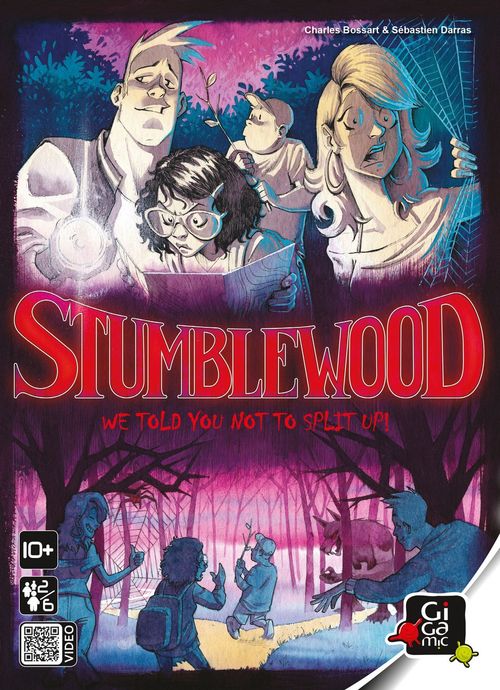
Stumblewood
Stumblewood Rulebook
Table of Contents
Table of Contents
Contents
- 1 double-sided board
- 50 Path cards (20 4x4 cards and 30 6x6 cards)
- 1 Start token
- 1 hourglass
- 1 GO tile
- 1 Direction tile
- 3 foam objects (bone, knife, first-aid kit)
- 1 First Player card
- 5 Player Aid cards
Player Aid cards: each card lists the trap and the action required to cross it:
- Hole: jump onto your chair
- Water: pinch your nose
- Encounter: say "It's [active player's name]"
- Cobweb: grab the knife
- Wolf: grab the bone
- Injury: grab the first-aid kit
Setup
Place the board in the centre of the table. For games with younger players, or with more than 5 players, it is advised to play with the 4x4 side up. Otherwise, use the 6x6 side.
Place the 3 foam objects (bone, knife and first-aid kit) beside the board so that everyone can reach them.
Deal one Player Aid card and one Path card, face down, to each player (or one per team with 4 and 6 players; see p. 10).
Warning: deal the Path cards that match the side of the board in use (same number of squares).
The most cowardly player is designated first player. They receive the Direction tile, the GO tile and the First Player card. The player to their left takes the hourglass and the Start token.
Playing the Game
Each player must find their way through the forest. The player seated to their left will be their guide for the whole game. The Path card each player receives shows the route to be taken by the player seated to their right.
In turn, each player becomes the active player, and the player to their left becomes their guide.
(Diagram labels on the page: Start, Arrival, Actions. The active player does not see this Path card and moves across the board while the guide tells them whether they are on the wrong track.)
The guide takes their Path card in hand (without showing it to the active player) and orients it in the reading direction of the Start panel. This orientation stays the same until the end of the game. The guide places the Start token on the square indicated by the Start square of their Path card. They then place the hourglass on this token.
The hourglass represents the player. Their movement ends when it runs out. To win, the player must follow the route imposed on them without mistakes and before the hourglass runs out. They will probably need several attempts to succeed.
When both players are ready, the guide turns the hourglass over. The active player now has thirty seconds to discover as many squares as possible that will lead them to the Arrival square.
To move the hourglass one square, the active player turns the Direction tile. The arrow indicates the square to which they wish to move the hourglass. The hourglass always moves one square orthogonally, never diagonally.
To confirm their choice, the active player taps their GO tile. The guide then immediately moves the hourglass and tells the active player whether they made the right choice.
-
If, after the move, the hourglass is still on the path shown on the guide's card and there is no trap, the guide confirms by saying "OK!" and the active player may continue moving.
-
If, after the move, the hourglass is outside the path, the guide tells the player that they are lost and puts the hourglass back on the Start token. If there is time left, the player may start again.
Example: the active player places the Direction tile pointing to the right, then taps their GO tile. This move takes the hourglass into the forest. The guide says "You're lost" and puts the hourglass back on the Start token. The active player must remember that this was not the right direction to take, and resumes their turn if there is time left.
- If, after their move, the hourglass lands on a trap square, the guide tells the player the nature of the trap and puts the hourglass back on the Start token. To cross a trap, the player must remember the trap they met and perform the required action on their next attempt.
Example: the active player places the Direction tile pointing upward, then taps their GO tile. This move takes the hourglass onto a Hole square. The guide says "Hole" and puts the hourglass back on the Start token. The active player resumes their turn if there is time left, and to pass this square they must perform the Hole action on their next pass (see Incidents on the Way, p. 8).
Once the hourglass has run out, the active player immediately stops playing; their turn is over.
They pass the Direction tile and the GO tile to the next player, clockwise. That player becomes the active player and the player to their left becomes their guide. The guide places the Start token and the hourglass in the correct place on the board, according to their Path card, and a new turn begins.
The first player to reach the Arrival square with the hourglass ends the game.
Each player must therefore remember their route and the traps along it in order to have a chance of winning when their turn comes around.
Incidents on the Way
Wrong Track
When a player moves off the path, they get lost in the forest… and the hourglass returns to the Start token.
Traps
The squares showing the icons below are traps. To get past them, the player must perform an action before tapping their GO tile to overcome them: either grab an object, or do something.
Grab an object:
- Injury: to pass this square, the active player must have the first-aid kit in hand. Running in the dark, they have hurt themselves and must treat themselves in order to continue!
- Cobweb: to pass this square, the active player must have the knife in hand to tear through the cobwebs. There really are some monstrous spiders in this forest!
- Wolf: to pass this square, the active player must have the bone in hand. This will keep the wolf busy long enough to get past.
The object must always be put back beside the board afterwards.
Do something:
- Water: to cross this square, the active player must pinch their nose.
- Hole: to cross this square, the active player must jump onto their chair. They must not fall into the hole.
- Encounter: to cross this square, the active player must state their name by saying "It's [active player's name]", so as not to be confused with the awful thing that is chasing them.
Clarifications
- The active player may accompany their movement with only one action. For example, they cannot pinch their nose while holding a knife.
- When the active player performs an action on a Path square that requires none, nothing happens and the turn continues normally.
- When the active player performs the wrong action, for example taking the first-aid kit instead of the knife, they go back to the starting point.
End of the Game
As soon as a player or a team reaches the Arrival square, they trigger the end of the game. All players who have not yet played during this round are entitled to one last attempt (use the First Player card to keep track of the round). If, at the end of this last round, only one player (or one team) has reached the Arrival square, they win the game.
If several players or several teams reached the Arrival square during the same round, a final round is played to decide between them. The players concerned exchange their Path cards and have the time of one hourglass to cover as many squares as possible. The player who manages to cover the most squares wins the game. If a tie persists, the players concerned share the victory.
Version for 4 and 6 Players
With 4 or 6 players, the game can be played in the same way as explained above, but we recommend playing in teams. The rules are exactly the same, except that the players play in teams of two. Each team has only one Path card, showing the route of the team to their right. During a team's turn, one of the two players starts; as soon as they make a mistake, the hourglass returns to the starting point and the other member of the team tries their luck. This continues until the thirty seconds are up. Team members may not communicate while the hourglass is running.
Variant
To vary the game, the orientation of the Path cards may be changed at the start. But be careful to use the same orientation throughout the whole game.