Stuff and Nonsense
Stuff and Nonsense Rulebook
Table of Contents
Table of Contents
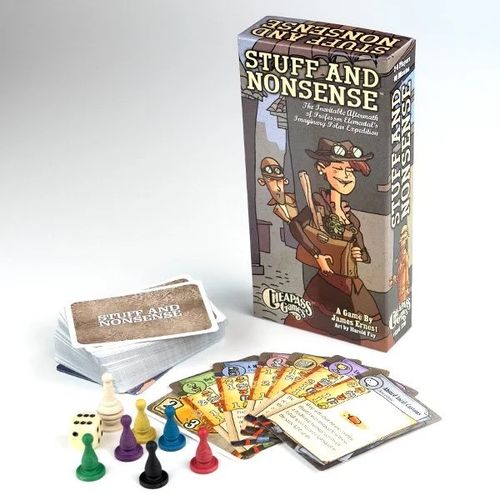
Included In The Box
- 84 Adventure cards (the main deck)
- 8 Map cards (Pub, Café, etc.)
- 5 Bonus cards (Africa, China, etc.)
- A Pawn for every player
- One larger Pawn (Professor Elemental)
- One 6-sided Die
You Also Need
- 2 to 6 Players
- 40 Minutes Time
- A way to keep Score, such as a pencil and paper.
About the Board
Stuff and Nonsense works like a board game, but the map is made of cards.
Place the Adventurer's Club and the Market in the center of the table, and arrange the six Shop cards in a ring around them, in any order. The shops are the Café, the Antique Shop, the Pub, the Gift Shop, the Junk Shop, and the News Stand.
Beside the board, arrange the five Bonus cards as shown. These cards act as dials, and will rotate from time to time, to show different values. To read each dial, look at the number that is upright in relation to the "bottom" of the board. For example, Africa currently shows a value of 3.
For movement, the shops are connected like a wheel around the outside, and like spokes into the center, as shown by the dotted lines.
It takes one step to move along any of these lines, and it's also one step from any shop to either of the cards in the center. It is also one step from the Club to the Market.
Setting Up
Place every player's pawn in the Adventurer's Club. Place Professor Elemental in a random Shop, as follows: Choose any Shop to begin, and then roll the die and move the Professor that many steps clockwise. (This is the only time he moves like this.)
Roll the die to determine who will take the first turn, and after that, turns will proceed to the left.
Shuffle the main deck and deal one card, face down, to each player. This deck contains all the things you collect to tell your tales of adventure: Anecdotes, Artifacts, Facts, Photographs, Heroes, and Specimens.
Deal eight more cards face up, and sort them into their appropriate locations: Heroes at the Pub, Artifacts at the Gift Shop, and so on.
There will always be eight cards in play, so you'll add a new card each time someone takes a card from the board.
On Each Turn
At the start of each turn you may take one step, or you may stay where you are.
The board is connected as follows: the Shops are connected in a loop, and the Market and Adventurer's Club are one step away from everything.
After your move, you may do whatever is appropriate for the place where you landed, as follows:
At a Shop: At any of the shops, you may pick up one of the cards in that shop, and add it to your hand. There is no upper limit to the size of your hand.
At the Market: When you visit the Market, you must trade one card. Discard that card (into a discard pile beside the deck) and draw a new card from the deck.
You must make a trade if you go to the Market, and you can't go to the Market if you have no cards.
At the Adventurer's Club: If you visit the Adventurer's Club, you must turn in cards to tell a story of adventure. Specifics of this are described below. If you visit the Adventurer's Club, you must turn in an adventure.
Between Turns
Each turn should start with a total of eight adventure cards on the board. If a card was removed, another one must be added before the start of the next turn.
Sometimes this card will cause the Professor to move one step clockwise around the board.
The Professor moves if the card has a movement arrow, but only if the number on that arrow is equal to or greater than the number of players. For example, in a 4-player game, the professor moves only on arrows of 4 or higher.
The Professor doesn't move if there is no arrow, or if the number is lower than the number of players.
You'll note that we have used numbers up to 8 on these cards, even though the game is rated for only 6 players. If you are so inclined, you can include 7 or 8 players; we just felt that 6 was the upper limit for a comfortable game.
Meeting the Professor
If Professor Elemental moves into the same location with you, or if you move into the same location with him, you must pay a penalty. (If you begin your turn on the same space as the Professor, you do not suffer the penalty again.)
The penalty is your choice: you may either discard one card, or lose one point for every card in your hand. (Yes, your score can track into the negatives.)
If you have no cards, there is no penalty.
Scoring an Adventure
When you visit the Adventurer's Club, you will discard cards from your hand to tell a tale of your adventures in the far corners of the globe. Telling an actual tale is optional, but feel free at least to read the text on your favorite cards.
You are not required to play your entire hand; only those cards that make up your adventure. Your adventure must follow these rules:
1: A minimum number of cards as marked on that bonus card. For example, to go to China, you must use at least four cards.
2: No more than one card of each type. One Artifact, one Hero, etc. Note that in order to go to the Amazon you will need six cards, which means exactly one of each type.
3: Each card must have a point value for the destination you choose. For example, if you go to Africa, each of your cards must have a point value of at least 1 for Africa.
To score your adventure, total up the point values on each card, and then add the current bonus for that destination. For example, the starting bonus value for Africa is 3.
Record your score and discard your cards. The winning score varies with the number of players (see below).
A Sample Adventure
Deirdre has just been to Mount Everest, or so she claims. Her hand contains the following cards: Frosty Morning Air, The Pike Twins, Love is Blind, and Climbing Gear.
All four cards are different types, which is good. But The Pike Twins have no value for Everest, so they can't be a part of this story. Luckily, three cards is still enough to go to Everest, so Deirdre can turn in those three cards for 4 points, plus the current Everest bonus value.
After the Adventure
1: Move Professor Elemental one step clockwise. If he lands on anyone, they must pay the penalty.
2: Reduce the bonus value for your destination by one stop. This represents the Adventurer's Club getting slightly bored with tales of that locale. (This value can't be reduced below its minimum value.)
3: Increase the bonus value of a random destination, as determine by a die roll. (These values can't be increased above their maximum values.) If you roll the same destination you just visited, or if you roll a 1, then no bonus value is increased.
4: If your adventure emptied your hand, draw a card.
Emptying the Deck
If the deck is ever empty, shuffle the discard pile and replace it.
Winning the Game
To win the game, you must be the first player to reach the required score, which depends on the number of players.
| Players | 2 | 3 | 4 | 5+ |
|---|---|---|---|---|
| Target Score | 80 | 60 | 50 | 40 |