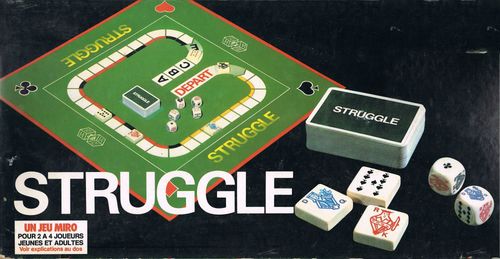
Struggle
Struggle Rulebook
Table of Contents
Table of Contents
Principle of the Game
The players each use, in turn, 5 common pieces and move them forward along the track by means of the dice.
But each player seeks a different order of arrival, which is imposed on him at the start of the game by a secret card.
As soon as the five pieces have taken their places at the finish, each player scores ten points for each correctly placed piece.
The winner is the one who, over one or several games, totals the greatest number of points.
Contents of the Game
- 1 game board
- 5 pieces: King, Queen, Jack, Ten and Nine
- 5 poker dice
- 20 objective cards
Preparing the Game
Place the five pieces on the starting space.
Give one "objective" card, face down, to each player. This card shows the order of arrival of the pieces. There are twenty cards in the game, which correspond to the five figures of the pieces (the Ace is used as a Joker), but in a different order.
Draw lots for the player who starts.
Play
The first player rolls the five dice. He is entitled to two more rolls to improve his throw. He may re-roll all or some of the dice. The second and third rolls are optional.
He thus has a "hand", that is, the set of figures obtained on the five dice after one, two or three rolls.
Each figure shown on a die allows the corresponding piece to advance one space.
Example: At the start, a player has as his objective: Jack, Ten, Nine, Queen and King.
On his roll he gets 3 Jacks and 2 Tens on the dice. He advances the Jack piece 3 spaces and the Ten piece two spaces.
Or: he gets 3 Jacks, 1 Ten and a Queen. He advances the Jack 3 spaces. Now he must choose between advancing the Ten or the Queen, because 2 pieces cannot be on the same space at the same time. In this case he chooses the Ten and places it on the first space. He does not move the Queen.
Or: he gets 2 Jacks and 3 Tens. He is obliged to carry out the "hand". He advances the Ten 3 spaces and the Jack 2 spaces.
Note: piece moved, piece played!
Function of the Ace
The Ace on the die is not found on any piece. It serves as a JOKER, but it can never replace just any figure: it takes the value of one of the figures in the throw.
Example: The player gets 2 Jacks, 1 Ten, 1 Nine and 1 Ace. The Ace can only be worth 1 Jack, 1 Ten or a Nine.
Note: A throw of 5 Aces has no value.
Clockwise, each player in turn rolls the dice, trying to improve his throw, and carries it out in the movement of the pieces, even if the throw does not suit him.
Movement of the Pieces
Their movement is dictated by each player's "hand", but it is also subject to other obstacles.
Yellow spaces
A moving piece cannot occupy a space that is already occupied: IMPASSE. Its movement is cancelled.
Red spaces
A piece arrives on a space that is already occupied. In this case it stays there and moves the piece that was there to the space it occupied before the move.
Example: a Jack advances 2 spaces and lands on a red space occupied by a Queen. Compulsorily (even if it is not in the player's interest), the Jack goes to the Queen's place, and the Queen in turn moves back two spaces, occupying the Jack's starting place.
Black spaces
No piece may stop on these. They must be passed over. They do count as a space.
Therefore a piece that would land on one of these spaces has its movement cancelled: it is the IMPASSE.
Interpreting the "Hand"
The player interprets his "hand" in his own best interest: he advances some pieces, makes others move back, or seeks the impasse. But he does not have the right to abstain, even if the "hand" does not suit him. The movements are dictated to him.
Example: A player has as his objective: Queen, Jack, King, Nine and Ten. Jack and Queen are ahead as shown in the drawing (Queen on a space followed by a black space; Jack two spaces further on a red space; then a further red space and a black space at the bend).
The player gets a "hand" of: 1 Jack, 1 Queen and 3 Aces. If he assigns 1 Ace (Joker) to the Jack and 2 Aces (Joker) to the Queen, and if he plays the Jack first:
a) This Jack stays in place, since a move of two spaces would take it to a black space.
b) The Queen advances 3 spaces and joins the Jack. As the latter is on a red space, the Queen takes the Jack's place and the Jack moves back 3 spaces.
Thus the player made good use of the "hand".
Arrival
As soon as the first piece reaches the last space, it goes directly onto space "A". The next piece goes directly to space "B", and so on. As soon as the fourth piece takes its place, the fifth piece is immediately placed "D" [as printed in the Portuguese rules]. And the points are counted.
Note: At the end of the game, the Joker can only be used for a piece still in play and never for one that has already gone out.
Scoring
10 points for each piece placed in the correct place. Each player shows his "OBJECTIVE" card and thus begins counting the points.
Winner
The one who, over one or more games, totals the greatest number of points.