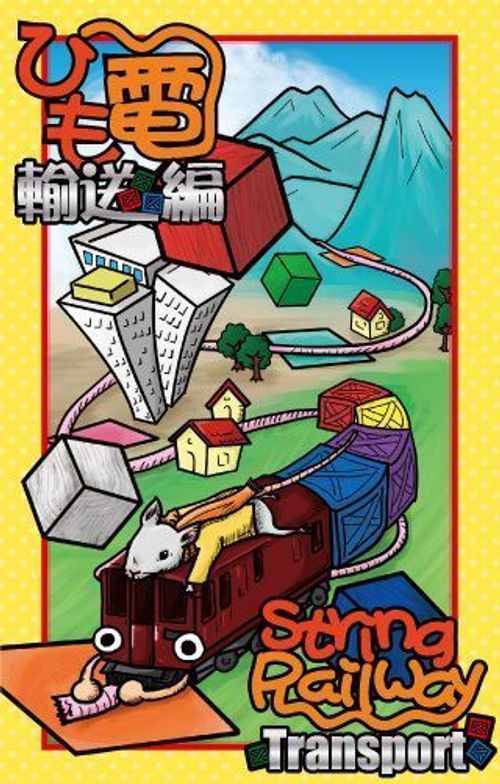
String Railway: Transport
String Railway: Transport Rulebook
Table of Contents
Table of Contents
Translator's Notes
I translated this from the original Japanese rules and this translation may be a bit rough and wrong in places. I did refer to the videos on the game’s page on Board Game Geek and used a few test plays to refine them. Text in italics is my interpretation and may not be entirely correct.
Game Overview
String Railway Transport is a game where strings are used for the railroad. Everything from the board to the mountains is formed from strings. Players will be the railroad company’s management, with its own line (string), expand the business, and transport freight. The player who builds the most comprehensive route and transports freight will win the game.
Contents
- Track String: Orange, pink, pale purple, brown, and olive green. Five colors with five of each color. The strings form each player’s own line. Each color has four short (30 cm) strings and one long (60 cm) string.
- Black Board String: The black string is used to form the board. The board is the area inside the string.
- Mountain String: The gray string is used to form a mountain. The area inside the mountain string is the mountains, the area outside is the plains.
- 94 Cargo Cubes: Score points by transporting the cubes to the stations of the same color as the cargo cubes. The number of each is listed below.
18 each of red, blue, purple, and yellow 10 green cubes 12 white cubes
The white cubes are long-distance freight and are a bit special. If you transport white cubes through the stations listed on the long-distance tile in the order listed and then to your new station, you will gain the benefits indicated on the long-distance tile.
-
30 Station Tiles: There are four types of station tiles listed below.
-
City Stations: There are three each of red, blue, purple, and yellow. Score by moving cargo cubes to a station of the same color.
-
12 Outskirts Stations: Cargo cubes are placed on outskirts stations when they are connected to new routes.
-
1 Mountain Station: Green cubes are scored by moving them to the outskirts station during the game.
-
New Stations: There is one each of orange, pink, pale purple, brown, and orange green. These tiles are dealt to the players at the start of the game based on the player’s game color.
-
12 Long-Distance Tiles: The table on the front has the effects of transporting long- distance freight cubes. The back has +5 written on it.
-
Locomotive Tiles: There are five locomotives of four different types. Each type of locomotive provides a different number of action points (3, 4, 5, or 6).
-
5 Player Order Tiles: These tiles are numbered 1 through 5. Each round, tiles are dealt to the players indicating the order of play.
-
New Station Chips: There is one of each in the colors red, blue, purple, and yellow. During the game, after a new station is placed, put a chip on the new station. The station will be treated as the same color as the chip.
Game Preparation
- Each player chooses a color.
- Each player gets the line string and the new station tile of their color. Each player takes a 3 AP locomotive. The other locomotives and new station chips are set aside.
- Place the black board string on the table. Arrange it so the string forms a single closed area. For your first game, we recommend that you make it as close to a square as possible. The area inside this string becomes the game board.
- Place the mountain string on the table.
- The city stations, the outskirts stations, and the mountain stations are placed on the board. The number of city stations and outskirts stations used is based on the number of players. Return the extra city and outskirts stations to the box. a. 2 Players 1 city station of each color and 8 outskirts stations b. 3 Players 2 city stations of each color and 8 outskirts stations c. 4 Players 2 city stations of each color and 12 outskirts stations d. 5 Players 3 city stations of each color and 12 outskirts stations Spread the city stations and outskirts stations evenly over the plains section of the board. Place the mountain stations in the mountain section of the board.
Notes Please do not place the station tiles so that they touch each other or any of the board strings. For your first game, it is better to avoid placing the mountain station near a city station.
Example Caption: Setup for three players. 6. All the cargo cubes go into the bag. Without looking, place two cargo cubes on each city station and three on the mountain station. None are placed on the outskirts stations. 7. Distribute a player order tile to each player.
a. 2 Players Use tiles 1 and 2 b. 3 Players Use tiles 1, 2, and 3 c. 4 Players Use tiles 1, 2, 3, and 4 d. 5 Players Use all 5 tiles Mix the player order tiles well and distribute one to each player. Players move in the order of the tile numbers they have received. 8. Shuffle the long-distance tiles and deal two to each player. Set the remainder aside as a deck. 9. In player order, each player selects one of the long-distance tiles and places it on the table. The remaining tile is placed on the bottom of the long-distance tile deck.
Game Play
The game is played over five rounds. Each round consists of one turn for each player, in order as determined by the player order tiles.
Starting the Turn
Players will have the number of action points based on their locomotive at the start of the turn. The turn is divided into the following three phases.
- Route Phase
- Transport Phase
- Locomotive Phase These phases are carried out in order until the end of the game. There are also special actions that may be taken in any phase. • Place a new station • Replenish cargo cubes • Draw a long-distance tile • Consume cargo cubes to increase action points
Route Phase
During the route phase, the player will extend his line by placing a route string. One route string is placed per turn. Select the string to place from those available. The following rules apply: • No string may be placed outside the play area. • Each end of the string must be placed on a station tile. • The line string may not cross the same station twice in a row. • Line string that has been previously placed is never removed. • Line string is not placed on or over the field string. • Placing a line string does not generally consume action points. It costs one action point per location if a line intersects another line outside a station tile. • Route strings do not need to all connect with each other (gleaned from the videos). • It costs one action point to lay a string that crosses the mountains. After placing the line string, if you have connected to an outskirts station, you draw three cargo cubes from the bag and place it on the outskirts station.
Transport Phase
In the transport phase, you transport cargo cubes. You perform the following two actions: • Transport cargo cubes • Resolve the long-distance tile Actions may be performed as many times as action points permit.
Transporting Cargo Cubes
This action consumes one action point. The cargo cube is moved from its current station to another station along your line string. There should not be another station tile between the source station and the destination station. Example Caption:
- Move one station for one action point.
- Moving to a second station for one more action point. Basically, it costs one action point per string used, not per station crossed. You can cross multiple stations on the same string for a single action point. If the cargo cube moved is the same color as its destination station, place the cargo cube in your score pile. Cargo cubes in your score pile earn points at the end of the game.
Notes: A cargo cube that was moved that is the same color as the source station cannot be earned. For example, a red cube on the red city station must be moved elsewhere before returning to the red city. It is possible to move long-distance cargo cubes in this action.
Resolve Long-Distance Tiles
Move a long-distance freight cube to your new station as directed by the long-range tile. This action is long-distance freight cube his new station as directed by long-range tiles (white cube) carries an action to obtain various effects. Select one of the distances on the long-distance tile. Move the long-distance cargo cube (white cube) one to three cities in order and gain the effect indicated on the tile. Example Caption: • +5 = Flip the tile over and get 5 points at the end of the game • White Cube = Collect the white cube • -2 = Escape the 2-point deduction at the end of the game Select one of the three departure stations written on the long distance tile. If you select city station A, the long distance cargo cube (white cube) must be moved to the new station across the specified color tiles in order A -> B -> C. The resulting effect is to collect the long-distance cargo cube (white cube) and score 5 points at the end of the game. If you select city station B, the long distance cargo cube (white cube) must be moved to the new station across the specified color tiles in order B -> C. The resulting effect is to
collect the long-distance cargo cube (white cube) and avoid the -2 point penalty at the end of the game for the unsatisfied long-range tile. If you select city station C, the long distance cargo cube (white cube) must be moved to the new station from the city station C. The long distance cargo cube (white cube) is returned to the bag and the -2 point penalty at the end of the game is avoided. The long distance cargo cube is moved along the player’s line string to his new station. Each station moved through will consume one action point.
Notes: The long distance tile shows the order that the cargo cubes must be moved through. Long distance cargo cubes can be moved through additional stations along your line string (paying 1 action point for each). The new stations are considered the same color as the new station chip that is on them. If you move through a city station C (e.g. A -> C -> B) you must return to C using a different route.
Long distance cargo cubes (white cubes) that start on one of the stations on the card don’t need to move through that station again. Example: A has a long-distance tile similar to that on the left. If you move the long-distance cargo cube to the new station through the yellow city, the long-distance tile is removed from the game and the cargo cube is placed in the bag. If you move the long-distance cargo cube to the new station through the blue and the yellow cities, the long-distance tile is removed from the game and the player keeps the long-distance cargo cube. If you move the long- distance cargo cube from the red city through the blue and then the yellow cities, turn over the long-distance tile and keep the long-distance cargo cube.
Locomotive Phase
The player’s current locomotive tile is removed from the game and the player gets a new locomotive. • If you own the 3 action point locomotive, it costs 1 action point to obtain the 4 action point locomotive. • If you own the 4 action point locomotive, it costs 2 action points to obtain the 5 action point locomotive. • If you own the 5 action point locomotive, it costs 2 action points to obtain the 6 action point locomotive. You can get do multiple upgrades in the same turn if action points permit. Example: A has the 3 action point locomotive. For one action point he can get the 4 action point locomotive. For two additional action points, he can get the 5 action point locomotive.
Notes: The additional action points provided by the new locomotive cannot be used during the same turn.
Special Actions
Special actions can be done anytime during the turn. However, an action cannot be interrupted to perform a special action.
Place a New Station
This action may be done by each player only once during the game. This action does not consume any action points. Place the new station from your play area onto the field. The following rules apply: • The new station tile cannot overlap or touch any other stations. • The new station cannot be located on an existing line string, in the mountain region, or outside the play area. After placing the new station, draw three cargo cubes from the bag and place them on the new station tile. Choose a new station chip from among those remaining at the side of the table and place it on the new station. If there are no new station chips left, you do not put one on the new station. A chip on a new station has the same effect as a city station of the same color. Other players can connect to and use your new station.
Replenish the Cargo Cubes
This action consumes one action point. You can do this twice in one turn. Pull two cubes from the bag and put them on the selected station tile.
Use Cargo Cubes to Increase Action Points
Gain one action point by returning a single cargo cube to the bag. You can perform this action twice in one turn.
Draw a Long Distance Tile
This action does not consume any action points. Draw two long distance tiles from the deck. Choose one of the two and place it in your play area. Place the other face down at the bottom of the deck.
Notes: If you choose this action and there is only one tile in the deck, you get that tile. If there are no tiles in the deck, you cannot choose this action.
End of the Turn
After each turn, play move to the next player in order. Excess action points are not saved for the next turn. The round ends after everyone’s turn is over. At the end of each round: • Collect all the player order tiles. • All players count the number of cargo cubes in their play area. • The player with the smallest number of cargo cubes gets the number 1, the player with the next smallest number gets 2, and so on. • If some players have the same number of cargo cubes, the appropriate number tiles are shuffled and dealt randomly to them.
Example: A, B, C, and D are playing a four player game. At the end of the fourth round, the players have the following numbers of cargo cubes: A: 7, B and C have 8 each, and D has 9. A has the smallest number of cargo cubes and gets the number 1 player order tile. A will go first in the fifth round. B and C have the same number of cargo cubes. The 2 and 3 player order tiles are shuffled and B and C each get one randomly. C gets the number 2 and will play second in the fifth round. D gets the number 3 and will play third in the fifth round. D has the most cubes and will go fourth in the fifth round.
Scoring and Victory Conditions
Players will score points for the cargo cubes and tiles in their play area at the end of the game.
Cargo Cube Scoring
Divide the cargo cubes into sets of different colors. A set of: 5 different colors scores 15 points 4 different colors scores 10 points 3 different colors scores 6 points 2 different colors scores 3 points 1 color scores 1 point A long distance (white) cargo cube is wild and can be considered as any of the other colors (red, blue, yellow, green, or purple). If you have more than one long distance (white) cargo cube, each one can be considered to be a different color.
Long-Distance Tile Scoring
If the long distance tile is face up, score -2 points. If the long distance tile is face down, score 5 points. The player with the most points wins the game. If there is a tie, the victory goes to the player with the fewer cargo cubes. If there is still a tie, the players share their victory. Example: A has 2 red cubes, 1 blue cube, 1 green cube, 3 yellow cubes, and 2 white cubes. One white cube is considered a purple cube, the other as a green one. One set of 5 different colors: 15 points One set of 3 different colors: 6 points One single cube: 1 point Total score 22 points