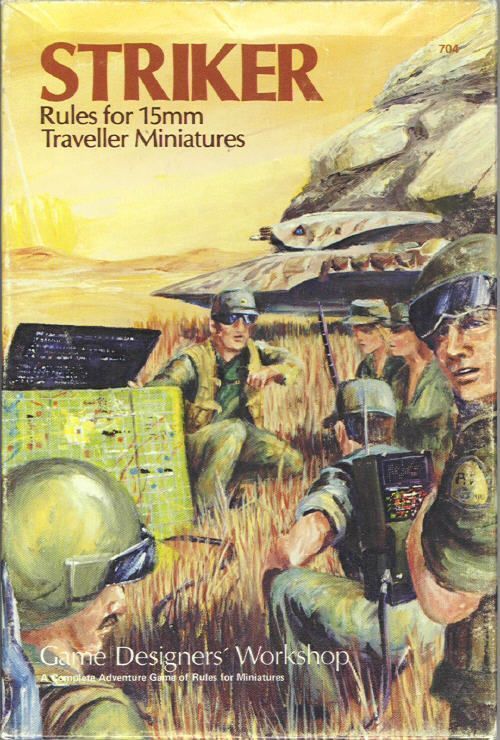
Striker
Striker Rulebook
Table of Contents
Table of Contents
- Book 1: Basic Rules
- Introduction
- SECTION I: PRELIMINARIES
- Rule 1: Game Scale and Environment
- Rule 2: Die Rolling Conventions
- Rule 3: The Referee
- Rule 4: Set-Up and Terrain Representation
- Rule 5: Force Composition
- Rule 6: Organization of Units
- Rule 7: Initiative and Morale Determination
- Rule 8: Unit Cards
- SECTION II: PLAYING THE GAME
- Rule 9: Turn Sequence
- Rule 10: Command
- Rule 11: Communication
- Rule 12: Morale
- Rule 13: Movement
- Rule 14: Visibility and Spotting
- SECTION III: FIRE COMBAT
- Rule 15: Introduction to Fire Combat
- Rule 16: Direct Fire Procedures
- Rule 17: Direct Fire Hit Determination
- Rule 18: Grenades
- Rule 19: Tac Missiles
- Rule 20: Indirect Fire Procedures
- Rule 21: Fire Missions
- Rule 22: Deviation
- Rule 23: Firing Sheaf and Beaten Zone
- Rule 24: Indirect Fire Hit Determination
- Rule 25: Direct Fire by indirect Fire Weapons
- Rule 26: Counter Battery Fire
- Rule 27: Lasers
- Rule 28: Personnel Wounds
- Rule 29: Vehicle Damage
- Rule 30: Weapons Damage
- Rule 31: Damage to Structures
- Rule 32: Combustion
- Rule 33: Smoke
- Book 2: Advanced Rules
- Integration with Traveller: These rules provide information specific to the universe of Traveller and aid in integrating Striker battles into a continuing Traveller
- Book 3: Equipment
- Design Sequence Tables
Book 1: Basic Rules
Introduction
Striker is a set of rules for science fiction ground combat using 15mm miniature figures. Each player will command a force ranging from a platoon to several companies, consisting of from a few dozen to over a hundred men, plus artillery, armored vehicles, and aircraft. The rules are intended to be easy for the beginning player to understand while at the same time providing a comprehensive and detailed treatment of ground combat from the beginning of this century to the far future.
One important aspect in which Striker differs from previous miniatures rules is the role assigned to the player. In most games, a player simultaneously plays the role of every member of a military unit; no orders need to be given, and every man performs as the player likes. In Striker, realistic limitations have been put on the abilities of officers to command their units. Giving orders to subordinates is a time-consuming process; commanders will find it advisable to devise a simple plan and to give most orders in pre-battle briefings. Changes to this plan in the heat of action will be difficult except through on the spot leadership. For a more detailed discussion of this point, read Firefight, at the beginning of section II of this book.
The science fiction background of Striker is drawn from the universe of Traveller. All weapons and military technology described in Traveller (including Book 4, Mercenary) are included in Striker. These rules may be used in conjunction with Traveller or by themselves; no familiarity with Traveller is required.
In Striker, as in Traveller, technology is rated by tech levels; these rules cover weapons and equipment ranging from tech level 5 (about World War I ) to tech level 15 (the level of Traveller's Imperium). Present-day Earth is about tech level 7.
The rules of Striker are divided into three books. Book 1 contains the basic rules of play. Book 2 includes advanced rules to add to the basic rules at the players' option, plus campaign rules to allow players to integrate Striker into a Traveller campaign or to fight an extended miniatures campaign. Book 3 includes rules for designing vehicles and heavy weapons, plus extensive lists of infantry weapons, equipment, and a number of representative heavy weapons and vehicles.
SECTION I: PRELIMINARIES
Rule 1: Game Scale and Environment
The basic Striker rules assume an Earthlike environment. That is, they assume a breathable atmosphere with the same atmospheric pressure as Earth, and the same temperature range, surface.gravity, and approximate planetary size. Advanced rules in Book 2 deal with the effects of different planetary characteristics on the game.
Striker uses the following scales:
A. Figures: Each miniature represents one actual soldier, vehicle, or weapon.
B. Distance: One millimeter equals one meter; one centimeter equals ten meters. If English measurements are more convenient to use, multiplying distances given in centimeters by 0.4 will give the value in inches.
C. Time: One turn equals 30 seconds of real time.
Rule 2: Die Rolling Conventions
The same die rolling conventions are used in Striker as in previous Traveller volumes. Specifically, the following procedures are referred to in the rules:
A. Throw: The dice roll required to achieve a stated effect. If only a number is stated, it must be rolled exactly. A number followed by a plus (such as 8+) indicates that that number or greater must be rolled. Similarly, a number followed by a minus (such as 3-) indicates that the number or less must be rolled.
B. Number of Dice: Generally, a dice throw uses two dice. Throws requiring more (or fewer) dice are clearly stated. For example, a roll of four dice would be expressed as 40. All rolls are made using 6-sided dice.
C. Die Modifiers: Die roll modifiers (abbreviated DM) are always preceded by either a plus or minus. Thus the notation DM+3 indicates that three is added to the die roll before it is compared to the required throw. When a die roll modifier is called for, the dice are rolled and the modification made to the die roll before consulting the appropriate table.
Example: A weapons table indicates that a certain weapon will hit a target on a throw of 8 or better. In addition, the firing soldier receives a DM of +1 for being skilled with the weapon, and a DM of -2 for the target soldier being concealed. The net DM is -1. The dice are rolled, with a result of 8; the DM is then applied, reducing the result to 7, which indicates the target was missed.
Rule 3: The Referee
Although Striker can be played without a referee, having one (who should be someone other than one of the players) will make play faster and easier as well as allowing use of rules for limited tactical intelligence. The duties of a referee are:
A. Preparation For The Battle:
-
The Battlefield: The referee should determine the layout of the battlefield, including the location of fords across rivers and streams, armor classes of the various structures, and the characteristics of any unusual terrain features. Any or all of,the above may be concealed from one or both of the sides.
-
The Forces: The referee should determine the forces available to both sides, the time of arrival of any reinforcements, the limits of original troop dispositions, and the missions of the two sides. Again, any of these may be concealed from the players, up to depriving a player of exact knowledge regarding his own reinforcements if the situation so warrants.
B. Game Management: The referee should supervise the conduct of the game, settling rule disputes, adjudicating matters such as whether a unit has an unblocked line of sight to a target unit, and, by his constant attention to the flow of the game, expediting play. Disputes may arise regarding rules interpretations a referee may make during a game. The best policy is to note the issue for discussion after the game and proceed with play without immediate argument. Even the most conscientiously honest of players often has trouble objectively viewing the merits of a situation when the survival of one of his own units rests in the balance; a dispassionate discussion is much more likely after the game is concluded.
C. Limited Intelligence: A referee may act to limit players' knowledge of their enemy's forces and dispositions. This may be done by allowing players to hold off the table such troops as have not yet been spotted (such as behind a hill, in a woods, town, etc. - see rule 14). Their positions may be indicated either by entering them on a small map of the battlefield in the referee's possession, or by placing a small card in the position occupied by the unit on the battlefield. If cards are used, the identification of the unit should be written on the reverse of the card, and the referee should allow each player a number of dummy cards. At times, the referee may require opposing players to turn away from the board while a range is measured or a line of sight is determined to a hidden unit, in order to preserve the secrecy of its location; in other circumstances, it may be useful to roll dice to determine if a nonexistent unit has been hit by fire, in order to avoid giving the firing player any information about the enemy's location.
D. Creative Input: Extensive as these rules are, they cannot cover every possible situation. The referee should feel free to expand upon or change any aspect of the rules to cover special circumstances, unusual weapons or tactics, alien races, and so on. Remember that Striker is a science fiction game; there doesn't have to be a meteor shower in every scenario, but it's a good idea to do something occasionally that will remind the players that they're not on Earth.
Rule 4: Set-Up and Terrain Representation
Before beginning a battle players must determine the terrain of the battlefield. Given the lethality of the weapons covered in Striker, too few major terrain features will make the battle short, bloody, and dull; too many terrain features will make the battle a game of sudden-death hide-and-seek. Generally speaking, the defender will attempt to chose the most defensible terrain along an attacker's most likely route of advance, while the attacker's route of advance will intentionally bypass hopelessly constricted terrain. Thus, a middle ground should generally be sought when setting up the playing area.
Inspiration for terrain set-ups can be obtained by consulting actual maps of suitable areas. Most libraries have a map department with a variety of maps covering different regions of the Earth, which can be studied for ideas. If desired, these maps can be used for actual terrain areas by tracing them on paper and superimposing a square grid, with each square equal to a 50 cm square on the gaming table. The table below indicates the size of the grid superimposed on the tracing to yield 50 cm (500 meters) on the table. Note that if a 1:1000 map is available, the game may be played directly on it.
| Map scale | Grid |
|---|---|
| 1:10,000 | 50 mm grid |
| 1:50,000 | 10 mm grid |
| 1:100,000 | 5 mm grid |
| 1:250,000 | 2 mm grid |
There are two goals of terrain representation in a miniatures game: first, the indication of terrain features and areas affecting combat and movement; second, aesthetic appeal. It is possible to play Striker by drawing terrain features on a flat map; at the other end of the spectrum, it is possible to produce a convincing scale representation of a battlefield. The following descriptions give the terrain types used in the rules and provide functional descriptions of how to represent them. For suggestions on how to build an attractive game board, see Book 2.
A. Ground Contour: Hills, gullies, bluffs, and other ground contour features are important as barriers to sight and movement. They may be represented either as labeled contour lines (in the fashion of a topographic map) or may be actual built-up models of the terrain, with contour lines drawn on them. The intervals may be of any height, but should be constant within a game.
B. Buildings: On the ground scale used in Striker, scale models of each actual building in an area would appear grotesquely out of scale. As a result, buildings should be selectively thinned out: one model building is used to represent a cluster or complex of buildings, although in the game it will be treated as a single building. When representing a specific built-up area, choose one important building from the area. The height of each building (in number of stories) and the material from which it is constructed should be recorded by the referee.
When placing buildings, enough room should be left between them for easy passage of troops and vehicles, about 3 to 5 cm. In large urban areas, the spacing of buildings can be used to indicate major and minor thoroughfares through the city.
C. Vegetation: For game purposes, vegetation is of four types: dense trees, sparse trees, dense undergrowth, and sparse undergrowth. In addition, some areas may have both trees and undergrowth, and would combine the effects of both types. Areas of vegetation should be clearly delineated with borders or colored areas and defined by type. Model trees and bushes may be scattered throughout the area for visual effect. Even in areas representing dense growth the models should be spaced widely enough to allow easy placement of troops and vehicles, and players should feel free to move trees and bushes if necessary to position a unit. When mapping an area, remember that even dense forests are likely to have small clearings and sparse areas scattered throughout them. Areas of trees should be defined as having a particular height, decided before the game. On Earth, trees range from less than 10 to over 100 meters.
D. Rivers and Streams: These should be clearly represented; the easiest way is with strips of blue paper (or some other appropriate color). Many rivers will also have steep banks, which should be indicated. The referee should also determine where the river is fordable by men and ground vehicles.
E. Roads: Roads may be represented by tape or paper strips, 3 to 5 cm wide. The layout of roads should take into account the nature of surrounding terrain. Roads through steep slope areas will be built up in some places and cut into the ground in others to reduce the grade; roads going up long slopes may have switchbacks for the same reason. When planning roads on a game map it is necessary to make sure that they are not too steep for ground vehicles to travel on. Roads travelling over soft ground (a low-lying area near a river, for instance) are often on built-up causeways.
F. Other Man-made Structures: Bridges, walls, fences, fortifications, railroads and monorail lines, and other man-made structures may be represented. Their heights (if over a few meters) and their construction materials should be recorded.
G. Fields: Fields, hedges, orchards, and other cultivated vegetation may be represented in a manner similar to natural vegetation and will have similar effects.
H. Ground Characteristics: The nature of the ground surface, unless otherwise specified, is assumed to be normal, i.e. relatively firm and level, allowing easy going for ground vehicles and infantry. Areas of the playing surface (or, in some cases, the entire playing surface) may be represented as one or more of the following types: broken ground (firm, but very uneven), boulder field (entirely covered by large rocks), sand, soft ground, mud, glacier ice, or pools of water. By combining vegetation with different ground types, a variety of other terrain types can be achieved. A typical swamp, for example, would consist mostly of pools of water, broken by occasional islands of soft ground containing both trees and undergrowth; desert oases often consist of low areas of soft ground with sparse undergrowth and widely spaced trees surrounding a central pool of water.
I.Other Worlds: Since Striker is a science fiction game, the nature of terrain is limited only by players' imaginations. A battle might take place in a forest of giant trees with trunks 100 meters in diameter, or on a living island floating in the sea. Perhaps the apparently solid ground is honeycombed with animal burrows and will collapse if driven across by heavy vehicles. Representation and game effects of these and other terrain features must be left to the players.
J. Armor Values: Certain terrain features provide partial protection against enemy fire. They are assigned armor values to indicate their degree of resistance to weapons penetration. The values listed below are merely suggestions; the referee may assign any values he wishes to terrain features. No value is given for ground; it is assumed that any target protected by a significant distance of solid ground (for instance, one behind a hill) is completely protected from fire.
| Type of Cover | Armor Value |
|---|---|
| Trees | 7 |
| Boulder field | 6 |
| Sandbags | 6 |
| Log and earth bunker | 24 |
| Concrete bunker | 28 |
| Wood frame building | 4 |
| Brick or stone building | 8 |
| Reinforced concrete building | 15 |
| Heavy steel frame building | 20 |
Rule 5: Force Composition
At the beginning of the game, the referee determines the composition of each player's units, including the number of troops, their quality, and their equipment. Equipment is listed in Book 3. There are four basic qualities of forces from which a player's troops may be drawn: militia, conscripts, long service professionals, and picked troops. There are also four quality levels of individual soldiers: recruit, regular, veteran, and elite. Each force type contains a different proportion of men from each troop type, as given on the table below.
| Recruit | Regular | Veteran | Elite | |
|---|---|---|---|---|
| Militia | 84% | 10% | 5% | 1% |
| Conscript | 55% | 25% | 15% | 5% |
| Long Service | 25% | 40% | 25% | 10% |
| Picked | 0% | 45% | 30% | 25% |
For example, a force consisting of 200 soldiers drawn from a long service professional army would have 50 recruits, 80 regulars, 50 veterans, and 20 elites. If the force is not evenly divisible into percentages, the referee distributes the excess.
After the composition, in men and equipment, of his force has been determined, each player organizes his own unit, as described in rule 6.
Troop types differ mainly in their morale ratings. Elite troops have the best morale, and recruits the worst. For further details see rule 7.
Rule 6: Organization of Units
After the referee has specified the equipment and the number and qualities of the troops available, each player organizes his own unit. The basic building block of unit organization is the infantry fire team, the weapon crew, or the individual i" vehicle. These are organized into higher level units as outlined below.
A. Mounting Troops: Each soldier should be mounted on a base made of cardboard, wood, plastic, or any other suitable material. Most soldiers must be mounted on fire team bases. A fire team base is 25 mm by 25 mm (one inch by one inch) and contains four soldier figures. Leaders, elite troops, veterans, and adventurer characters may be mounted individually on bases 12.5 mm by 12.5 mm (% inch by % inch). Vehicles crews (for use when outside their vehicles) and weapons crews of less than four men may be mounted on 2 or 3-man bases; 2-man bases are 12.5 mm by 25 mm (% inch by 1 inch); 3-man bases are the same size as fire team bases. Weapons crews of more than four men should be broken up into two or more groups of about equal sizes. Each soldier will thus take up a scale area on the playing surface of about twelve by twelve meters. Obviously, more than one person could be placed in this area, but this is intended to represent the normal dispersion of soldiers in a combat situation.
Vehicles and weapons need not be mounted on bases, although antigravity vehicles and aircraft are much more visually attractive if mounted on pedestals attached to small bases.
Note that in all cases below in which it is stated that soldiers may be individually mounted, they must be veterans or elites to do so.
B. Unit Organization: Troops, in addition to being mounted on stands, must be organized into military units. Players have some flexibility in forming units, within the following guidelines.
Units are made up of officers, NCOs (non-commissioned officers), and men. There are three types of units: infantry, weapons, and vehicle; it is possible to mix the three together in a single unit.
-
Team: A team (or fire team) is the smallest organizational unit. In the case of infantry, it consists of four men, mounted on a single base. In the case of a vehicle or crewserved weapon, the size of the crew varies. If the crew is four or fewer men, they are considered a team. If the crew is five or more men, they are divided into as many teams as necessary to avoid having a team larger than four; all teams should be as close to the same size as possible; thus a weapon crew with ten men would be divided into two teams of three and one team of four. An infantry team may be formed by two soldiers plus a weapon with a crew of two.
-
Vehicle Crews: Vehicle crews don't have to be represented by figures (unless the crew dismounts during the game), but personnel must be assigned from the player's available troops. The size of each vehicle's crew is listed in Book 3. There are four crew positions defined: driver, gunner, loader, and commander. On some vehicles there are two gunners, and on others there is no loader. One soldier must be assigned to each crew position. A vehicle commander may also be an officer or NCO.
-
Squad: A squad consists of two or three teams. A vehicle or weapon crew with two or three teams is automatically a squad. Types of teams may be mixed within a squad; for example, a squad might consist of one infantry team, one weapon crew (with four men), and one vehicle with a crew of two carrying the other two teams. There may be no more than one vehicle in any squad; in a vehicle unit, each vehicle is a squad, even if it has only a crew of 4 or fewer.
Each squad has one NCO, who may 'be either individually mounted, separate from the squad, or may be one of the men in one of the teams of the squad.
-
Section: A section consists of two squads. Players are not required to group their squads into sections, but have the option. A section has an NCO, who may be either one of the squad NCOs or a separate individual.
-
Platoon: A platoon consists of from two to five squads. If the platoon has four or five squads, four of them may be grouped into two sections, if desired. In addition to its squads (or sections), the platoon contains a command group of from one to six men. One of these is the platoon officer; another may be an NCO (the platoon sergeant) but is not required. The rest are additional command group personnel: radio operators, runners, extra weapons teams, etc. In the command group, teams may consist of two, three, or four men (as always, elites and veterans may be mounted separately). For instance, a platoon command group could have a platoon commander, a platoon sergeant, two radio operators, and the two-man crew of an anti-tank missile launcher. One radio operator could be assigned to the commander and one to the sergeant, making three teams in the command group.
In vehicle units, the platoon command group consists of the crew of a single vehicle (thus a platoon consists of a command vehicle and from two to five other vehicles); the platoon officer is included in the crew.
Any weapons platoon capable of indirect fire (see rule 15 for definitions) may also include one individually mounted forward observer in addition to the command group.
- Company: A company consists of from two to five platoons and has a command group of from one to ten men, mounted in the same manner as a platoon command group. One of these is an officer (the company commander); another may be an NCO (the company senior sergeant) but this is not required.
In vehicle units, the company command group consists of the crews of from one to three vehicles, totaling no more than ten men. One vehicle contains the company officer; another may contain an NCO (the senior sergeant) but this is not required.
In weapons units, a company is usually referred to as a battery; in armored units, a company is sometimes referred to as a troop.
- Battalion: It is unlikely that a full battalion will be employed on the game table in a Striker game, but a battalion headquarters may be present if two or more companies are present. A battalion consists of from two to five companies and has a a command group of from eight to thirty men, organized in the same manner as a platoon command group. One of these is the battalion commanding officer, one is another officer (the battalion executive officer), and one is an NCO (the battalion senior sergeant).
In vehicle units, the command group may have as many vehicles as can be crewed by its men. The commander, executive officer, and senior NCO each ride in a different vehicle.
In armored units, a battalion is sometimes referred to as a squadron.
- Large Crews: Very large vehicles and weapons crews may have more than three teams; in such cases the crew must be organized as a section, a platoon, or even a company, depending on the number of men in the unit.
C. Marking Stands: Each stand (team or individual) and each vehicle should be uniquely identified. The simplest way is to glue a small circle of colored paper to the stand, with a number and/or letter code written in it. If the stand is to be part of a permanently organized unit, a combination of paper color and code can be used to identify each team's place in its battalion organization. For example, B company of a battalion might be identified by a blue circle. One of its teams might have the code 31A, meaning third platoon, *t squad, fire team A.
Rule 7: Initiative and Morale Determination
After a unit has been organized and the soldiers mounted as individuals and teams, players should determine the morale and initiative levels of the various stands. Each stand (individual or team) is rated separately for its level of initiative and morale based on the morale levels of the soldier or soldiers on the stand.
A. Morale: Morale levels of the four qualities of troops are given in the table below. In the case of a soldier mounted individually, his game morale is his individual morale. In the case of a team mounted on a single stand the stand's game morale is the average of the individual morales of the soldiers making up the team. Fractional results are rounded to the nearest whole number; in the case of a fractional result of exactly ½, round up.
| Morale Values | |
|---|---|
| Recruit | 4 |
| Regular | 7 |
| Veteran | 10 |
| Elite | 13 |
For example, a fire team composed of one veteran (morale level 10) and three recruits (morale level 4) would have a team morale of 6 (10+4+4+4/4= 5.5, rounded to 6). The morale of a vehicle crew is not determined by averaging the morale of its members; its morale is the morale of the vehicle commander.
B. Initiative: The morale level of a stand determines its initiative level. There are three initiative levels in the game: low, average, and high. All stands with a morale of 5 or less have low initiative. All stands with a morale of 6 through 10 have average initiative. All stands with a morale of 11 or higher have high initiative. As an exception to this, any stand containing an officer has the initiative of the officer, although its morale is determined by the procedure above. Thus a stand with an elite officer (morale 13) and three recruits (morale 4) would have high initiative, even though it only has a morale of 6.
No low initiative stand may be used as an officer or NCO; all stands containing officer or NCO figures must be organized so as to have at least average initiative.
Initiative and morale are very important in Striker. See subsequent rules for their effects.
C. Example of Determining Initiative: The process of determining unit morale and initiative is fairly involved, and understanding it is essential to playing the game. Therefore, the following example of a small unit organization is provided to illustrate the process.
The referee informs a player that his force will consist of a 46-man infantry platoon drawn from a conscript army, and so consisting of 55% recruits, 25% regulars, 15% veterans, and 5% elites. Since the total of regulars, veterans, and elites does not come out to even numbers, the referee determines how they are rounded and gives the player a total of 25 recruits, 12 regulars, 7 veterans, and 2 elites. The player organizes them into a platoon headquarters, a weapons squad, and three rifle squads, as follows:
The platoon headquarters consists of four men: the platoon commander (an officer), the platoon senior NCO, and two radiomen. The officer and senior NCO are elites; the two radiomen are regulars. The officer and senior NCO are each mounted with one of the radiomen, for two teams of two men each.
The weapons squad is composed of two light machinegun teams, each with one veteran and one recruit, and one tac missile team with one regular and one veteran serving as squad NCO.
All three rifle squads consist of three fire teams, each of four men mounted as a team (a total of nine rifle teams). Two of the teams are of four recruits each. One of the teams has one regular and three recruits. Three of the teams consist of two regulars and two recruits. Two of the teams have one veteran and three recruits. The last team consists of two regulars and two veterans. The last three listed fire teams each contain the NCO of one of the three squads.
The player now determines morale and initiative levels. The officer's team, with one elite and one regular, has a morale of (13+7/2=) 10, but has high initiative since it uses the officer's initiative. The senior NCO's team also has a morale of 10, but only average initiative. The weapons squad NCO's team has a morale of (10+7/2=) 9
Sample unit card (handwritten in the rulebook, shown on the facing page): an infantry section.
1st Platoon, 2nd Section                      GR = gauss rifle
17: Morale 10, average initiative             GL = grenade launcher
  Section NCO; veteran; GR

3rd Squad                                     4th Squad
12: Morale 6, average initiative              3: Morale 6, average initiative
  Squad NCO; regular; GR                        Squad NCO, veteran; GR
       regular; GR                                    recruit; GR
       recruit; GR                                    recruit; GR
       recruit; GL                                    recruit; GL

9: Morale 5, low initiative                   41: Morale 4, low initiative
       regular; GR                                    recruit; GR
       recruit; GR                                    recruit; GR
       recruit; GR                                    recruit; GR
       recruit; GR                                    recruit; GR

Weapons          Effective     Long          Extreme      Targets
Gauss Rifle      60(7)+3       120(3)+2      --           1/2
Grenade Lchr
  HEAP           37(36)        75(36)        150(36)      1
  HE             37(11)        75(11)        150(11)      1; burst: 1(2)
  Flechette      25(3)+4       50(3)+3       100(3)+2     35 cm

Other equipment: each man:  cloth armor (AC 6)
                            helmet radio (power 10)
                 Section NCO: map box
and average initiative. The two machinegun teams each have a morale of (10+4/2=) 7 and average initiative. The two rifle teams consisting of four recruits have a morale of 4 and low initiative. The rifle team consisting of one regular and three recruits has a morale of 5, and low initiative. One of these three fire teams is
assigned to each squad. The three fire teams consisting of two regulars and two recruits have a morale of 6, and thus average initiative. One of these fire teams is assigned to each squad. The two fire teams consisting of one veteran and three recruits have a morale of 6 and average initiative also. These two teams contain the squad NCOs for the first and second squads. Finally, the team consisting of two regulars and two veterans has a morale of 9 and average initiative, and contains the squad NCO for the third squad.
Rule 8: Unit Cards
After a player's force is organized, its characteristics should be recorded on cards for easy reference during the game. As a general rule, one card should be able to contain the information for one to three infantry squads, several crew-served weapons, or a vehicle platoon. The card should contain an entry for each man in the unit, listing his troop quality (recruit, regular, veteran, elite), his position weapons crewman, gunner, infantryman, squad NCO, vehicle commander, etc.), weapons he is carrying (including ammunition type), and space for recording wounds. In addition, the morale, initiative, and identification code of each team should appear on the card. Players will also find it useful to copy the information provided for each vehicle and weapon used in the game from Book 3 for ready reference.
A typical card for an infantry section is shown on the facing page.
SECTION II: PLAYING THE GAME
Striker in Action: a Firefight
It's the sort of ticket that you hate: a jerkwater tech 8 world where there hasn't been a serious fight for forty years, a banana republic without enough money for a standing army, and now a real shooting war. And you're in the middle of it, as a mercenary cadre for the militia that's supposed to track down and drive out the other side's mercenary strikers. It's the sort of ticket that could get you killed.
You hired on because you were short of cash, needed a job, and know your business. So now you find yourself the commander of a platoon of militia in a sweep through woods tracking down a report of an enemy border incursion. Another platoon is off on your left, but too far away in the dense foliage to be much help in a firefight. In the event of serious trouble, your company's reserve platoon will back you up; then again, in the event of serious trouble you doubt that your platoon will survive long.
There are forty-one men in your platoon, including yourself and your platoon sergeant. None of them, other than yourself, has ever heard a shot fired in anger, but two of the three squad leaders and your platoon sergeant have been in a long time and seem to know their jobs well. You deploy the platoon in a skirmish line to sweep through the woods on a two-squad frontage. You keep them fairly close together, so that verbal orders can be passed down the line and men won't straggle off. You put the two squad leaden at either end of the line and you walk a couple of meters behind the center. You leave your platoon sergeant with your least reliable squad as a small reserve force about fifty meters behind the line.
Suddenly there's automatic weapons fire off on the right, the area covered by your first squad. You call the squad leader on your helmet radio to find out what he's run into.
"Tiger One, this is Tiger Leader. What's your status, over?" (Tigers: a good example of wishful thinking, you think to yourself.)
"Tiger Leader, this is Tiger One. We're catching some small caliber autofire from up ahead in the trees. I've got some men down here and a couple took off, but I think we're keeping their heads down, over."
"OK, Tiger One, hold on. I'm on my way. Tiger Leader to all Tigers. Code X-ray. Acknowledge, over." You give a codeword you worked out with the squad leaders before moving out, meaning stop the advance and hold in place.
"Tiger Leader, this is Tiger Two. Wilco, over." That's second squad on the left flank.
"Tiger Leader, this is Tiger Four. Wilco, over." That's your platoon sergeant with the third squad in reserve.
Once the acknowledgements come in and you're sure there's been no screw-up, you begin making your way through the undergrowth toward the sound of gunfire. On the way, you make a brief situation report to the company commander on the company radio net.
"Ringleader, this is Tiger Leader. I have a couple hostiles on my right and I'm taking automatic weapons fire. Some casualties already. I'm going to sort things out over there now, over."
"Roger, Tiger Leader. Do you need help, over?" Help? Probably, but what can Company do right now?
"Negative, Ringleader, but stay on the line. Out." If you could see anything you could call for fire support from the company mortars that are set up about half a klick to the rear, but by the time you radioed them the fire coordinates, they put rounds near the target, and you adjusted the fire to where you wanted it, you could be commanding an ex-platoon. Or you could have the second squad pivot to the right in line and try to hit the ambush party in flank, but it would take time to explain to these militia men what you wanted them to do, what axis to move out on, what to do once they got where you wanted them, what to expect, probably when to breathe. That takes time, and all of a sudden time is what you don't have.
Three men from first squad break through the undergrowth, heading for the rear. You yell at them to stop, but they vanish into the undergrowth almost as soon as you see them. You could follow them, stop them, and get them turned around with a quick pep talk, but you'll probably do more good over on the line with your first squad leader.
"Tiger Four, this is Tiger Leader. Code Olympic. I say again, code Olympic. Acknowledge, over." This is the code word to your platoon sergeant to bring the reserve squad up on line. By now you're thinking ahead, and the reserve squad's firepower might be handy a little closer to the action, especially if it starts to spread.
Finally you get to first squad, just as the firing dies down. There are just four men remaining out of the thirteen in the squad: the squad leader and three of his troopers. Two men are down with minor wounds and the rest have become separated during the confusion of the firefight. There's no sign of the hostile troops, and the first squad is visibly shaken. The enemy has withdrawn into the dense woods, and you're left with the job of putting your platoon back into some sort of order.
You take the first squad in tow and head back toward the original center of the platoon's skirmish line. On the way, you find four of the missing men; after they stopped running, they just sat down and waited for someone to come along and tell them what to do. It figures. There's no sign of the other three who ran off; they don't answer a radio hail. Later they will no doubt claim they never heard you.
When you link up with your platoon sergeant and third squad, you give your NCOs a quick briefing on the new platoon formation. First squad goes into reserve with the platoon sergeant, third squad takes the right, second squad stays where it is. When everyone's on line, you move out.
The above action took place in a Striker game, and serves to illuminate the essential nature of the Striker system and how it differs from previous miniatures rules. When attempting to understand these differences, it will help to keep in mind that Striker, as a part of Traveller, has been designed to be, to some extent, a role-playing game. Miniatures players may initially have difficulties coming to grips with the basic assumptions of Striker, perhaps more so than a role-playing gamer would. The essential difference is that Striker addresses the problems of battlefield command and control more directly and emphatically than any other rules yet publish-ed; actions which would be commonplace in many other miniatures games simply cannot be done in Striker due to the constraints of the command and initiative rules.
Consider, for example, the short action described above. A platoon is moving through dense woods, two squads in line and one in reserve. The right-hand squad blunders into an ambush, takes casualties, returns fire, and about two-thirds of the survivors (inexperienced militia) run away. So far, most miniatures rules will produce similar results. It is in the player's reaction to this that Striker departs from the rest. With most rules systems, the player would begin to move the rest of his platoon in order to bring fire to bear on the ambushers. Assuming that they could reach the area in two turns, they would begin firing at the enemy in the third turn. A brief firefight would ensue, ending with the withdrawal of the ambushers. On about the fifth turn, the platoon would again be moving out, gradually taking up a new formation to compensate for the losses it had sustained. The emphasis is on the actions of the platoon.
In Striker, by contrast, the emphasis is on the actions of the platoon commander. The intent of the rules is to put the player in the role of a small unit commander and force him to think about what he would be doing with his time if he were actually present on the battlefield. Here is the action again from the platoon commander's viewpoint, described in game terms and broken into 30-second Striker turns :
On turn 1, the enemy fired upon first squad. On turn 2, as first squad halted to return fire (an action within the abilities of the squad leader), the platoon commander gave a brief order to the remainder of the platoon to stop the advance; the chatter back and forth, with acknowledgements, took all his time in that turn. On turn 3 the officer began making his way toward the site of the firefight, receiving a situation report from first squad's leader on the way. On turn 4, he was encountered by routing militiamen, and was forced to decide whether to rally them, bring up his reserves, call for support from the company mortars, or keep moving; he decided to move the reserves into the line, again a simple, previously agreed upon code. On turn 5 he reached the right flank squad, in time to find the ambushers gone. On turn 6 he personally led the remnants of first squad back toward the center of the line. On turn 7 he encountered the stragglers and, still moving, attached them to his retinue. He arrived back in his original position, followed by first squad, on turn 9, finding both his platoon sergeant and the second squad leader there. He held a short orders briefing to explain the new order of advance to the three NCOs, an unforeseen situation for which no ready-made code word existed, explaining to each of them their positions in the new line, their new objective, speed of the advance, and a place to rally in case of disaster. The briefing took four minutes in all, or 8 turns. Then, on turn 18, the squads moved to their new positions and on turn 19 the advance resumed. Total elapsed time, a little under ten minutes, or 19 turns instead of 5.
It may sound complicated, but the game system doesn't really require the player to account for every second of his life or every word that comes out of his mouth. Instead, it gives a limited number of command actions an officer can perform in a turn and states the time required to perform them in game turns. Most actions (like rallying troops, calling in a fire mission, giving single code word orders, or leading by personal example) take only one turn, but giving new orders, to be executed outside the officer's sight, takes more time. (Consider the difficulty of communicating anything in 30 seconds, much less under combat conditions.)The above detailed description was provided to give players, especially experienced miniatures players, an understanding of the rationale behind the command and initiative rules, which form the center of the Striker system. That understanding is important to a full enjoyment of the game.
Some of the playtesters, who have been playing miniatures for years, experienced a great deal of frustration when first playing Striker because the rules would not let them do what they wanted to do; opportunities appeared and disappeared before the troops could be turned around to take advantage of them. Much of that frustration disappeared once they understood that they were playing the part not of their troops, but rather of just a few high initiative officers and NCOs, and that the rest of the troops were in many respects more controlled by events around them than by the wishes of the player. For role-playing gamers, the notion of non-player characters is easier to cope with.
A good way for players to learn the feel of the game (and the proper outlook) is to play a short scenario in which the referee moves all average and low initiative troops in response to orders from the players (or at least his interpretation of those orders). Players move only their high initiative units directly. This puts the player right in his role as unit commander and reinforces his perception of the dichotomy between high initiative troops (whose actions he controls directly) and all others (whose actions he does not control, but has the power to influence). This course is not recommended in regular play, solely because of the extra burden it places on the referee, but is excellent as a learning device.
Rule 9: Turn Sequence
Play in Striker is divided into turns, each representing 30 seconds of time. Each turn is divided into six phases. During a turn, the phases are performed one at a time in the order given below; all actions and events take place during the phase specified by the rules, and no activity may be performed out of sequence. At the beginning of the game, one player (or group of players) is designated the first player, and one is designated the second player. Throughout the rules, the terms friendly and enemy phase (movement phase or fire phase) are used. For the first player, the friendly phases are the first player movement and fire phases, and the enemy phases are the second player movement and fire phases; for the second player, the opposite is true.
Each turn consists of the following phases:
-
Command Phase: Both players decide what command functions their officers and NCOs will engage in during the turn, and issue any orders which are called for.
-
First Player Movement Phase: The first player moves his units.
-
First Player Fire Phase: This phase is resolved in three stages.
a. All indirect fire by the second player's artillery.
b. Direct fire by the second player's units (some units may be unable to fire if they moved in the second player's movement phase of the previous turn).
c. Direct fire by the first player's units.
-
Second Player Movement Phase: The second player moves his units.
-
Second Player Fire Phase: This phase is resolved in three stages.
a. All indirect fire by the first player's artillery.
b. Direct fire by the first player's units (some units may be unable to fire if they moved in the first player's movement phase).
c. Direct fire by the second player's units.
- Panic Morale Check Phase: Both players' units which are subject to panic now check morale.
Rule 10: Command
During the command phase both players secretly decide what, if any, command functions their officers and NCOs will engage in during the turn. There are three command functions possible: lead, order, and rally. An officer/NCO may perform only one of these functions at a time. Leading is the exercise of command by means of continuous direct personal supervision. Ordering is the exercise of command through orders to units or to other officers/NCOs, which are executed without direct supervision by the ordering officer/NCO. Rallying is the use of an officer/NCO's personal presence to return routed troops to combat.
A. Officers and NCOs: Differentiation is made in the organization rule between officers and NCOs. The distinction is important as their command abilities differ in several ways, as explained below. The abilities of officers/NCOs also differ depending on their initiative levels, also explained below.
B. Initiative: Troops of the three initiative classes respond differently to command. High initiative troops do not require orders or leading; they will act independently and are directly controlled by the player. Average initiative troops must be ordered or led in order to perform most actions. Low initiative troops must be led to perform most actions; they will not respond to orders.
If low initiative troops are not being led, they may fire at any enemy troops within 10 cm and perform actions mandated by adverse morale check results. If average initiative troops have no orders and are not being led, they may, in addition to the actions described above, fire at any enemy troops who have fired at their squad.
C. Leading: Troops who are being led by a high initiative officer/NCO may perform any action the player wishes. Troops who are being led by an average initiative officer/NCO may perform any action consistent with the orders under which the officer/NCO is acting.
-
Who May Lead: Any officer may lead any soldiers. Any high initiative NCO may lead any soldiers. Any average initiative NCO may lead any soldiers normally under his leadership. (For example, a platoon senior NCO could lead any soldiers from his own platoon, but could not lead soldiers from another platoon.) While leading, an officer/NCO may freely move and engage in combat. A single officer/NCO may lead any number of units at once; he may lead subordinate officers/NCOs, who may in turn be leading others.
-
Requirements: In order to lead, an officer/NCO must be able to see the soldiers being led and must be in constant communication with them. See rule 11 for details on communication.
D. Orders: Orders are given by officers/NCOs to average initiative squads, teams, and officers/NCOs, and allow them to act without the direct leadership of a superior; orders must be written and consist of specific, simple instructions. Orders to squads, teams, and squad NCOs must be very specific; orders to higher level NCOs and to officers may be somewhat more general, as explained below. Squads and teams following orders will perform the stated action; officers/NCOs following orders will lead their troops in performing the action or will issue appropriate orders to their subordinates. Orders take time to give and receive, sometimes a great deal of time; for this reason, orders are often explained to troops before the beginning of the game and initiated by short code words; see 6 below. During a turn in which he gives or receives orders, an officer/NCO or squad/team may not perform any other action.
-
Who May Order: All officers may order anyone except an officer of superior rank (a company commander is superior to his executive officer and all platoon commanders; a company executive officer is superior to all platoon commanders). A high initiative NCO may order anyone normally under his leadership, but not others. An average initiative NCO may not order.
-
Requirements: To give orders, an officer or NCO must be in communication with the unit he is ordering. The time required to receive an order varies according to the officer, NCO, or unit receiving it, as shown in the table below.
| Unit | Turns |
|---|---|
| Team/squad | 4 |
| Squad NCO or Platoon NCO | 4 |
| Section NCO or Company NCO | 8 |
| Platoon Officer | 16 |
| Company Officer | 32 |
Times apply to units in direct contact: the stands must be touching. If stands are not in direct contact, the time is twice that stated. If two stands possess battle computers (or are in direct contact with a stand possessing a computer) they are considered to be in direct contact. If all stands concerned have map boxes (or are in direct contact with a stand possessing a map box), the time is halved. These effects are cumulative; for example, if an officer gives an order to a squad NCO by radio, but both of them have map boxes, the time required is 4 turns, doubled and halved, or 4 turns.
Generally, an officer/NCO may give only one order at a time, to any one officer, NCO, or squad/team. However, any number of officers in direct contact with the officer giving the orders may receive their orders at the same time. A single code word may also be given to several units at once; see 6 below .
An officer/NCO or unit giving or receiving orders may interrupt the process at any time (and is required to if he suffers any adverse morale check result), in which case the order has not been received and all time spent giving the order up to that point is wasted.
- Orders to Squads, Teams, and Squad NCOs: These orders must be very specific, and allow little freedom of action. Orders given directly to a squad may be given to the NCO at the same time; the NCO performs his normal function, but the squad will be capable of operating under its orders without him. A single order may consist of up to three components: a movement order, a fire order, and a rally point order.
a. Movement: A movement order must state an objective which is clearly definable on a map; it must list a route of travel (if other than a straight line); and it must state a speed of travel. For example, "move to the crest of hill 17, through the forest, at fastest speed" or "move to the northern village, through the valley, at NOE". As an alternative, a unit may be ordered to maintain position relative to another unit of the same platoon, which must be visible at all times; in this way, a platoon may assume a formation. For example, "10 cm to the left of 1st squad" or "5 cm behind platoon commander". The unit may also be ordered to move toward its objective and halt at a recognizable point. For example, "stop at the edge of the woods" or "stop when encountering friendly troops". To aid in writing orders, players may use a small map of the area, with landmarks indicated by letter or number codes, as was done in the case of hill 17 above, b. Fire: A fire order must state the conditions under which a unit will fire; this must consist of a simple and unambiguous sentence. For example, "fire as soon as enemy come within 30 cm", "fire if enemy armored personnel carriers come within 60 cm", "fire at enemy units which are able to fire at 3rd platoon", or "fire at any enemy units within long range".
c. Rally Point: A rally point order gives a location easily recognizable on a map, to which a unit will move, by a safe route if possible, if the code order to retreat to the rally point is given, or if they recover from a rout and receive no orders. For example, "rally point: stone farmhouse".
d. Delays: An order may also contain a statement delaying its execution until a specific turn or until an orders briefing is over. For example, "delay execution until turn 15" or "delay execution until completion of platoon briefing".
e. Attachment: Instead of the orders in a to c above, a squad or team may be attached to another squad or higher level unit; it then becomes part of the other unit for all game purposes. For example, "the platoon antitank team is attached to 3rd squad" or "1st squad is attached to 2nd platoon, B company".
f. Discretionary Actions: A unit or NCO under orders has some ability to make choices. If the squad is fired upon, or if an enemy is visible within 10 cm, the squad may return fire, halt, and/or move to the nearest covered position, if there is one within one turn's movement; as soon as it is no longer receiving enemy fire, the unit must resume following its orders. A unit may change its facing at will and may make minor course changes to avoid serious obstacles to movement. The referee may decide that certain other minor demonstrations of initiative are reasonable, but should take care not to allow too much freedom.
- Orders to Officers and Higher NCOs: These orders are somewhat less restrictive than squad/team level orders. An order to an officer or higher NCO may consist of one simple declarative sentence plus one simple conditional statement. All statements must be clear and unambiguous, as determined by the referee. Locations mentioned must be easily identifiable on a map. Orders to platoon and company NCOs should also state what unit they are to command. Here are a few examples of possible orders:
"Advance on hill 79, proceeding north of the forest. When hill 79 has been taken, give supporting fire to B company."
"Withdraw to point C. If point C is occupied by enemy, withdraw to point D." "Defend the town. If casualties are suffered, withdraw to the edge of the woods." "Move at half NOE speed to point 8. If enemy are sighted, execute code bravo."
When an officer/NCO has no other orders, he will defend his current position.
An officer/NCO may lead his troops and an officer may give orders; troops may be ordered or led to perform any action relevant to the orders under which the officer/NCO is operating, but no others. For example, if a platoon commander were under the first sample order above, he could not make a detour to attack an enemy unit which was holding up the advance of another platoon; he could only engage enemy units which were directly preventing his platoon from taking and holding hill 79. The referee's judgement is necessary in doubtful cases.
An officer/NCO is allowed a certain degree of flexibility regarding the performance of his orders. An officer ordered to move his unit is not required to move each squad every turn; however, he must, over the course of several turns, keep the unit moving. If an officer is ordered to defend a position, he doesn't have to keep every squad stationary; however, every movement must contribute to the defense of that position.
-
When Orders Are Changed: Orders (of all types) remain in effect until the unit or officer/NCO is given a new order, has completed his current order, or a morale check result of forced back or routed. Orders are not changed if a unit is led for a period, although they are suspended for that time. If a unit has a fire order it will continue to be in effect after its movement order has been completed.
-
Code Words: An order (of any type) may be identified with an execution code, and will then only be performed when the code is given. Giving a code word counts as an order, but takes only one turn. Up to four code words may be defined for each officer/NCO or unit capable of receiving orders. The same code word may be given to several units in one turn. For example, an officer might say, "2nd section and weapons squad, execute code alfa." A single code may be defined as having different meanings for different units. Note that orders to higher level officers/NCOs may contain code words as part of their conditional statements.
-
Automatic Orders: There are four simple orders which any unit (or several units at once) may be given in one turn.
a. Halt: The unit will stop in its current position, and remain until further orders are received.
b. Resume: This order is given to a unit previously ordered to halt, or which has ceased to follow its orders due to a forced back or routed morale check result. The unit will return to following its previous orders.
c. Retreat: The unit will move to its rally point or, if it has none assigned, to the closest cover away from the enemy.
d. Flee: This is a general order, given by a commander to all units under his command. It announces that the battle-is-last and troops must attempt to save themselves however they can.
E. Rallying: During the course of the game, troops may become routed due to enemy action. A capable officer or NCO may rally such units during the command segment. For an explanation of routing and rallying, see rule 12.
-
Who May Rally: Any officer may rally any troops. High initiative NCOs may rally troops normally under their leadership. Average initiative NCOs may not rally any troops.
-
Requirements: In order to rally troops, an officer/NCO must be visible to them and within 10 cm of them during the command phase. Neither the rallying officer/NCO nor the troops being rallied may move or fire during the turn.
Rule 11: Communication
In order to exchange commands, fire corrections, or other information, two stands must be in communication. There are several means possible.
A. Direct Verbal Communication: This includes hand signals and verbal commands. Any two stands which are touching are always in communication; any two stands connected by a chain of touching units, up to 10 cm long, are in communication. Finally, any two stands which can see each other and are within 10 cm of each other are in communication.
B. Radio: Stands equipped with radios are in communication with each other as long as both are within the stated range of each other's radios and are not being successfully jammed. Each radio has a power rating, which gives its range in km and determines its ability to resist jamming; radios and their ratings are listed in Book 3. Radios may be jammed by radio jammers, also listed in Book 3. Each radio jammer has a power which depends upon its distance from the receiver (the unit receiving orders); if the distance is less than or equal to the jammer's listed range, the jammer uses its listed power; if the distance is up to twice the jammer's listed range, it uses half its listed power. Communication is prevented if the strength of the jammer is greater than the strength of the sender (the unit giving orders).
C. Lasers: Stands equipped with tight beam laser communicators are in communication if stationary and if an unobstructed line of sight exists between them. If one of the two communicators is linked to a battlefield computer, the stands may remain in communication while moving, as long as an unobstructed line of sight exists. If the line of sight is obstructed, communication is terminated until the line of sight is reestablished. If two communicators are not linked to a computer and one of them moves, one turn must be spent in the new position before communication is restored. In addition to obstacles listed in rule 14, a laser's line of sight is blocked by anti-laser aerosols. However, as tech level increases, lasers become able to see through smoke and aerosols. See rule 27.
D. Masers: Maser communicators function in the same way as laser communicators, except that smoke and anti-laser aerosols have no effect on the line of sight.
E. Wire Telephones: Stands equipped with telephones are in communication with each other if a wire link exists between them. Wire may only be placed before the start of a game, and thus only troops in prepared positions may have telephones, and the telephone must remain in place; if a stand moves, its telephone does not move with it. There are two possible types of connection: direct and switchboard. A direct connection requires two telephones, one at each end, and neither telephone may be part of another connection; thus, a company HQ with direct phone links to three platoons would require three separate phones. A switchboard can link up to 20 phones to each other; a master switchboard can link up to 20 switchboards. Each switchboard requires an operator unless noted otherwise in Book 3. Before the game, the player or referee must determine the locations of all telephone wires, telephones, and switchboards. If the wire is cut, communication is interrupted. Wire may be cut by indirect fire or by enemy units who discover it. If an artillery sheaf falls on the wire, roll once for each 5 cm of wire covered by the sheaf. A contact hit destroys the wire. Enemy units who move across the wire will discover it on a roll of 5+, DM -1 per 2 cm of movement in the turn in excess of 10; if the wire is discovered it is destroyed.
F. Meson Communicators: Meson communicators are available at very high tech levels. They cannot be jammed and do not require a line of sight between the sender and receiver. Two communicators may not communicate while either is moving unless one of them is linked to a battlefield computer. One complete turn is required to regain communication after moving if a computer is not linked.
G. Battle Computer Links: For a communicator to be linked to a battle computer, they must be in physical contact. Beam communicators (lasers, masers, and meson communicators) may not communicate if either sender or receiver is moving unless one of them is linked to a computer. For example, suppose a company commander and his three platoon commanders all have laser communicators; the company commander's laser is linked to a computer. If all four are moving, the platoon commanders may all communicate with the company commander, but not with each other.
Rule 12: Morale
As explained in rule 7, each stand (or vehicle crew) has a basic morale value number representing its general ability to stand up under stress. At various points in the game units will be required to take morale checks. The player rolls two dice and compares it to the unit's morale number. The die roll must be less than or equal to the unit's morale number for it to pass the check. If the number rolled is greater than the unit's morale, it will suffer adverse results.
A. Morale Modifiers: A stand's morale number may be modified, either instantaneously (for a specific morale check) or permanently (for the rest of the game). In either case, modifications will be expressed in terms of plus or minus modifications to the checking stand's morale number. All morale modifiers are cumulative, but a stand's morale number may never go below two.
-
Instantaneous Modifiers: These are dependent on circumstances at the time of a specific morale check and never permanently alter a unit's basic morale number. A list of instantaneous modifiers may be found on the morale modifier chart.
-
Permanent Modifiers: These alter a stand's basic morale number, and should be recorded on the unit card. A stand's morale is reduced by one each time it suffers a forced back or routed morale check result. A stand containing several soldiers has its morale reduced by one for each casualty the stand suffers.
B. Conditions Under Which Morale Must Be Checked:
-
Proximity to the Enemy: Whenever a unit is within 10 cm of an enemy unit (and can see it), the unit must check morale. This check is done at the end of each movement phase.
-
Casualties: Whenever casualties are suffered, friendly units which are in close proximity (and can see the event) must check morale. A casualty is defined as any wound or death of any soldier, or any vehicle or weapon suffering a minor or major penetration or any surface damage result that renders it unable to move. Close proximity is defined as within 5 cm of a personnel casualty or 10 cm of a vehicle or gun. Casualty checks are made at the end of each step of each fire phase.
-
Panic: Often a unit will be influenced by events not directly affecting it, but having an effect on the overall course of the battle. A unit must make a panic check (during the panic morale check phase) under each of the following circumstances:
a. If a stand at any time in a turn was within 15 cm of a friendly stand which routed, and which was of equal or higher initiative. Note that a unit which routs due to a panic check may cause other stands to rout.
b. If a personnel stand at any time was within 15 cm of a friendly combat vehicle which routed.
c. If a stand during one of the fire phases was within 15 cm of a friendly vehicle which suffered a catastrophic hit.
d. If a stand was fired upon by friendly units.
- Frequency of Checks: A unit will never be required to check morale more than once in a phase (or step of the fire phase). Thus, if a unit took casualties from several sources in a single fire phase, it would check morale at most once in the indirect fire step, once in the enemy direct fire step, and once in the friendly direct fire step (if it received fire from friendly troops).
C. Morale Results: Four results are possible if a unit fails its morale check, depending upon the type of check and the amount by which the die roll exceeds the unit's morale. See the morale tables.
-
Suppressed: The unit may not fire. If under cover or concealment it may not move. If not under cover or concealment it must fall back in the direction of the closest cover or concealment, away from the enemy, at its fastest ground movement rate (running for infantry, NOE for grav vehicles). This effect lasts for one complete turn.
-
Fall Back: As above, but if already in cover/concealment, the unit will move in the direction of the next closest cover/concealment. The effect lasts for one complete turn.
-
Forced Back: As above, but if the unit does not reach cover/concealment in one turn, it will continue to move until it reaches such a position or rallies. The unit's morale is permanently reduced by 1.
-
Routed: As above, but after the unit reaches cover/concealment it will continue to move away from the enemy until rallied.
-
Movement: If a unit is forced to retreat as a result of morale failure, it moves as soon as it fails the morale check. The unit may not move in its next movement phase, but is considered to be moving for fire purposes.
-
Surrender: In some cases, a unit which routs will surrender. In the basic rules, troops which surrender are removed from the game. A routing unit will surrender under the following circumstances:
a. If an enemy unit is visible within 10 cm of it at the end of its rout move or at the end of any movement phase.
b. If it is fired upon by enemy direct fire while routed and there is no unrouted friendly officer/NCO within 10 cm.
c. If it routs while in physical contact with an enemy unit.
d. If it routs while within 10 cm of an enemy unit and does not reach a covered/concealed position during its rout move.
- Rallying: Units which rout or which are forced back and do not reach a covered position will continue to retreat until rallied. Each turn in the command phase the unit checks morale. If it passes the check, it has rallied; it may not move or fire in the turn but returns to its normal capabilities in the next turn. If it fails the check it remains in its previous condition. If an officer/NCO rallies a unit, as specified in rule 10, no die roll is required. An average initiative unit which rallies is without orders and will move toward its rally point or, if there is none assigned, the nearest cover/concealment.
D. Officers and NCOs: In addition to being required to check morale themselves, and their ability to rally units as stated above, officers and NCOs may influence the morale checks of others. Troops mounted on the same stand (or in the same vehicle) as an officer/NCO are included in his morale check, and the effects stated below do not apply to them.
The list of morale modifiers notes that the presence of an officer/NCO visible within 10 cm allows the checking stand a favorable morale modification of 1 for an NCO or 2 for an officer. An officer may provide this modification to any troops, but an NCO may provide it only to a unit normally under his leadership. The highest ranking officer on a side (the supreme commander) provides a morale modifier of 3. Several officers/NCOs may influence a single unit's morale check, in which case their modifiers are cumulative.
Whenever an officer/NCO is required to check morale, that check is conducted before the checks of any unit he may be influencing. If he fails the check, his morale modifier becomes an unfavorable modifier for all units visible within 10 cm.
An officer/NCO may influence the morale check of a subordinate officer/NCO.
E. Routing Off the Battlefield: If a unit routs off the battlefield, it may return in a later turn. Low initiative units will never rally; they are gone. The referee should roll for each other unit until it rallies, counting the number of rolls it takes. The unit will rally in that many turns. If an officer rallies, he is also assumed to have rallied any of his men who routed off with him. An average initiative unit must then be ordered to return to combat; this is possible only if it has a radio. The number of turns a unit spent routing is also the time it will take to return to the battle.
Rule 13: Movement
Units move and conduct various movement-related operations (such as setting up heavy weapons, dismounting from vehicles, etc.) during their own movement phase. All units have a movement allowance expressed in centimeters which may be used for movement or movement related operations.
A. Movement Allowances
-
Personnel: Men on foot (infantry, gun crews, dismounted vehicle crews, and so on) have a movement rate of 2.5 cm per turn if evading (taking full advantage of cover), 5 cm per turn if walking, and 10 cm per turn if running. Troops will generally not run unless there is a pressing reason: a dash to cover when receiving enemy fire, a rush to assault an enemy position or cross a space of open ground under fire, movement to leave the near vicinity of artillery impact, and so on; the referee must decide in questionable cases. High initiative troops may run at any time. However, no soldier may run for more than two turns in a row. Troops in battle dress (powered armor) are an exception and may always run every turn.
-
Ground Vehicles: All ground vehicles have both a road speed and a cross country speed, as listed in Book 3. Road speed is the number of centimeters it may move if the entire movement phase is spent on a road, while the cross country speed is used in all other cases.
-
Grav Vehicles: Grav vehicles have three listed speeds: maximum, cruise, and NOE (nap of the earth), and three flight modes: high, terrain following, and (again) NOE. Infantry wearing grav belts move like grav vehicles.
a. Maximum Speed: This is the fastest the vehicle may travel; it may use this speed only in high mode. A vehicle travelling at maximum speed may not make any changes of direction.
b. Cruise Speed: This is the fastest the vehicle may travel in terrain following mode. A vehicle travelling at cruise speed may turn up to 8 times during its movement; each turn may be 45° or less and consumes 10% of the vehicle's movement allowance.
c. NOE Speed: This is the fastest the vehicle may travel in NOE mode. A vehicle travelling at NOE speed may turn without limit.
d. High Mode: A vehicle in high mode must be at least 10 mm above the highest terrain feature on the battlefield.
e. Terrain Following Mode: A vehicle in terrain following mode is following the contour of the land, and is always 10 mm above the terrain feature (ground, trees, building, etc.) which is directly beneath it.
f. NOE Mode: A vehicle in NOE mode is flying close to the ground, dodging around terrain obstacles rather than flying over them.
g. Popup: A grav vehicle which is otherwise stationary in a phase may execute a popup. The vehicle rises straight up to whatever altitude it wants and drops back down in the same turn.
- Towed Weapons: Each vehicle may tow one light or heavy crewserved weapon. Infantry weapons are carried by the troops. Each weapon's type is stated in Book 3. Towed and carried weapons move at the rate of the vehicle or men towing or carrying them.
B. Terrain Effects on Movement: Terrain affects the movement ability of units differently depending on the terrain type and mobility type of the unit, as noted below.
- Slopes: Slopes are divided into five general categories: flat, gentle, moderate, steep, and sheer. Slopes are defined by the change in elevation per horizontal distance. An area is considered flat if the change in elevation between contours is one quarter or less the distance between contours. For example, if contours on the battlefield represent 25-meter elevation changes (or 2.5 cm in game scale), a slope is flat if the distance from one contour to the next is 10 cm or more. A gentle slope is one on which the change in elevation is between one-quarter and one-half the distance between contours. A moderate slope is one on which the change in elevation is more than one-half but less than the distance between contours. A steep slope is one on which the change in elevation is greater than the distance between contours but less than twice the distance. A sheer slope is one on which the change in elevation is twice the distance between contours or more.
Personnel are unaffected by gentle slopes, pay double movement costs (that is, pay two cm of movement for each cm moved) to climb moderate slopes, pay quadruple movement costs to climb steep slopes, and may not climb sheer slopes.
Ground vehicles pay double movement costs to climb gentle slopes and may not climb moderate, steep, or sheer slopes.
Grav vehicles ignore slopes.
-
Trees: Trees may be either dense or sparse. Personnel are unaffected by trees. Ground and grav vehicles pay double movement costs to move through areas of sparse trees and may not move through areas of dense trees. Troops with grav belts may move through dense or sparse trees at double cost. Grav vehicles are unaffected when flying over trees.
-
Undergrowth: Undergrowth may be either dense or sparse. Personnel are unaffected by sparse undergrowth and pay double costs to move through dense undergrowth. Tracked ground vehicles are unaffected by undergrowth. Wheeled ground vehicles pay double costs to move through sparse undergrowth and pay quadruple costs to move through dense undergrowth. Grav vehicles are unaffected by undergrowth.
-
Ground Characteristics: Normal movement distances assume firm, even ground. There are six other possible ground types: broken ground, boulder field, mud, sand, soft ground, and ice.
Personnel pay double movement costs to move through all special ground types except soft ground; they are unaffected by soft ground.
Wheeled ground vehicles pay double movement costs to move through sand and soft ground, pay quadruple movement costs to move through broken ground, mud, and ice, and may not move through boulder fields.
Tracked ground vehicles pay double movement costs to move through broken ground, mud, and ice, and may not move through boulder fields; they are unaffected by sand and soft ground.
Grav vehicles are unaffected by special ground types except that they pay double movement costs when moving through boulder fields. They may fly over boulder fields at normal movement rates.
-
Water Barriers: Streams, rivers, lakes, and pools of water constitute water barriers. Personnel and most ground vehicles may cross water barriers only at bridges and fords. Ground vehicles listed as amphibious may cross at their listed amphibious movement costs. For example, a vehicle might have a listed amphibious movement cost of x20; this means that the vehicle pays 20 times normal movement costs when moving across water. Grav vehicles are unaffected by water barriers.
-
Roads: Roads have no effect on personnel and grav vehicles. Ground vehicles move on roads at their listed road speeds; in general, slopes will be the only type of terrain modifying road movement speeds, since obstacles will have been cleared away and a road base laid down to modify ground types.
C. Movement Effects on Fire: Whether (and how far) a unit moves may have an effect on its ability to fire in subsequent fire phases; see rule 16 for details.
E. Dismounting: Troops require one full movement phase to mount or dismount from a vehicle. To mount, they must begin the movement phase within 2.5 cm of the vehicle. Troops who mount may not fire in the next friendly and enemy fire phases. Troops who dismount may fire in the next enemy fire phase.
F. Facing and Backing Up: The direction a vehicle is facing is important in determining its target configuration when resolving direct fire. The direction any
"C, unit is facing also determines its field of e. A unit may change its facing at the beginning of the friendly movement phase; is is not considered movement.
When it moves, a personnel unit or ground vehicle always faces the direction it is moving; at the end of its movement, it faces the direction it moved during the last 5 cm of its movement. As an exception to this, personnel and ground vehicles may back up. A vehicle's movement allowance is quartered, and a personnel unit's allowance is reduced to 2.5 cm (it is not evading). At the conclusion of its movement, the unit faces in the direction from which it came.
Grav vehicles moving NOE may face in any direction at any time; grav vehicles moving at cruising or maximum speed must face in the direction they are moving.
G. Movement Markers: It is often necessary to remember whether (and how far) a unit moved in order to determine movement effects on firing and spotting; the easiest way to maintain a record is by using a small marker placed on the vehicle or team stand. The marker is placed on the unit at the end of the friendly movement phase and remains until the beginning of the next friendly,movement phase. Markers may be made from half-inch cardboard squares (boardgame counters are useful for this). Depending on the information it is necessary to remember, markers may indicate a vehicle or team's movement status (up to % movement, over % movement), actual distance moved (90 cm, etc.), or flight mode (NOE, terrain following, high flight, popup). The simplest course is to make a marker only when it is needed.
Rule 14: Visibility and Spotting
At a ground scale of 1:1000, few gaming tables will cover an area more than 3000 meters long, well within normal visibility ranges. As a result, the primary limitations on visibility will be blocks to the line of sight and target concealment.
A. Line of Sight: A unit, in order to be able to see another unit, must trace an unblocked line of sight. The line of sight is a straight line from one unit to the other. Most of the time, whether the line of sight is blocked can be determined by examining the units on the battlefield. Remember, however, that actual units at the scale of the game are much smaller than the models representing them; the same is true for trees, buildings, and other obstacles to the line of sight. Only hills (if the terrain is represented by actual built-up contours) will be the correct height on the board. The actual game heights of units and obstacles are listed below.
In cases where precise determination of the line of sight is necessary, a simple diagram can be constructed out of graph paper, as shown at the right. The vertical axis corresponds to altitude and the horizontal axis to distance. Place marks on the diagram for the two units at the proper altitudes and horizontal separation. Then examine the line between
[Diagram: graph-paper line-of-sight diagram; vertical axis altitude 0-50, horizontal axis distance 100-800, with points A and B joined by a line and obstacle points C, D, E marked.]
them on the battlefield for possible obstacle to sight, and mark their positions and altitudes on the diagram too. If an obstacle's position on the diagram falls above the line connecting the two units, the line of sight is blocked.
The following factors may affect the line of sight, either by blocking it or by determining the altitude of a unit.
-
Units: Units do not block line of sight. A personnel or light weapon unit is about 2 mm tall, a ground vehicle or heavy weapon about 3 mm. A grav vehicle in NOE mode is 4 mm above the ground; a grav vehicle in terrain following mode is 10 mm above the surface beneath it (whether ground, trees, or some other obstacle); a grav vehicle in high mode is at any altitude at least 10 mm higher than the tallest obstacle on the battlefield; a grav vehicle in a popup is at whatever altitude it wishes.
-
Hills: Hills block the line of sight.
-
Vegetation: Trees block the line of sight, with certain modifications. Units on the ground (or NOE) can see through up to 3 cm of dense trees and up to 10 cm of sparse trees. Units in tree areas are protected from observation from above. In dense tree areas, the sky is considered entirely blocked by branches, leaves, or equivalent; thus units in dense trees may not see or be seen if the line of sight passes through this canopy. In sparse tree areas, this canopy is broken; a vehicle in the air may see through the canopy (and be seen) for a radius on the ground equal to one fifth its altitude above the ground; for example, a vehicle at 250 mm altitude can see (and be seen by) a unit on the ground up to 50 mm away from the point directly below the vehicle. Trees vary in height, but average about 10 to 30 mm; the leaf canopy may begin at varying heights, but should average half the height of the trees. In many cases, the canopy at the edge of a densely wooded area reaches down to the ground, blocking the line of sight completely.
Undergrowth has no effect on the line of sight.
-
Buildings: Buildings block the line of sight. Troops in buildings may be able to see over obstacles because of their higher positions. Buildings are 4 mm tall per story; a soldier on the third floor of a building would therefore be 10 mm above the ground (4 mm each for the first two stories plus 2 mm for his own height).
-
Smoke Screens: There are two types of smoke screens, dense and mist. The line of sight terminates 3 cm after first encountering a dense smoke screen and 15 cm after encountering mist. Smoke screens are 15 mm high.
B. Concealment: Terrain features which do not block the line of sight may make a unit harder to see. Personnel and light weapons are concealed if they are in an area of trees or undergrowth, or are being seen through smoke. Vehicles and heavy weapons are concealed in areas which contain both sparse trees and dense or sparse undergrowth.
Units may also be camouflaged. If a unit is in concealment at the beginning of the game, the referee .may declare that it is camouflaged. If so, it remains camouflaged until it moves for the first time.
C. Hidden Units: In some terrain, units may choose whether they are hiding or exposed. This choice is possible for personnel and light weapons in buildings, gullies, or field fortifications, or directly behind walls or hillcrests. Vehicles and heavy weapons may make this choice if directly behind hillcrests or stationary in buildings. The decision is made in a unit's movement phase and applies until the next movement phase. Units which are exposed are visible but concealed. Units which are hiding may not be spotted; if already spotted they remain spotted as long as they do not move, but are concealed. Hiding units may not spot, fire, or perform any other activities requiring observation of the area; they are keeping their heads down. If a unit is exposed and becomes suppressed, it immediately hides.
D. Spotting Procedure: Units which have not been spotted by the enemy may be kept off the board; their positions (and movements) should be recorded and known to the referee. This may be done on a small map of the area, with written descriptions, or by using small cards or markers on the battlefield in place of the unit. In the last case the players should also have several dummy markers to confuse the enemy.
When a unit is spotted, it is placed on the battlefield; if it later becomes unspotted (that is, no enemy unit is in a position to see it), the unit may again be removed from the battlefield. A unit which has not been spotted may not be fired upon (although see reconnaissance by fire, rule 16D).
-
When Spotting Occurs: Spotting attempts by both sides occur in each movement phase and fire phase. A unit which is spotted during a movement phase may be fired upon in the next fire phase. A unit which is spotted during a fire phase may not be fired upon in the same fire phase. A unit may be spotted in its movement phase at any point in its movement; it may be spotted even if it doesn't move; it may be spotted in the fire phase only if it fires.
-
Spotting Procedure: Whenever a unit is in the line of sight of any enemy unit there is a chance it will be spotted. To attempt to spot, roll two dice and consult the spotting table; the dice are rolled once for each unit (each vehicle, crew-served weapon, or infantry stand) the player is attempting to spot, regardless of how many units are in a position to see it.
To spot units on the ground, in NOE mode, or performing a popup, use the ground spotting table. The dice roll to spot a unit on the ground depends upon its distance, its concealment status, and whether it moved in its last movement phase.
Vehicles and heavy weapons may be spotted with a DM of + l . Units firing are spotted with a DM of +2 during the fire phase; some weapons have a pronounced "signature" and are easier to spot when firing; signature DMs are listed in Book 3.
To spot units in terrain following or high flight mode, use the air spotting table. Units in the air spot other units in the air on a roll of 3+, as do any units using radar to spot. The referee may also declare some high vantage points on the ground to have this excellent visibility also. All DMs from the ground spotting table are used; vehicles in terrain following mode have a DM of -2.
SECTION III: FIRE COMBAT
Rule 15: Introduction to Fire Combat
There are two varieties of fire: direct fire and indirect fire. Direct fire is aimed at targets the firing unit can see; indirect fire is aimed at targets the firing unit cannot see, and the procedure is therefore more complex. Rules 16 through 19 cover direct fire, while rules 20 through 26 cover indirect fire. The rest of the rules are applicable to both.
Although they differ in many respects, the basic procedures for both types of fire are similar. A die roll is necessary in order to hit the target, with many possible DMs for specific circumstances; after a target has been hit, the damage inflicted on it is determined: the weapon's penetration value and the target's armor value are used as DMs on a second die roll on one of the damage tables; if the target's armor sufficiently exceeds the weapon's penetration, it will not be damaged.
A wide variety of weapons is available, ranging in size from the body pistol to the 30 centimeter hyper-velocity gun, and in sophistication from the bolt action rifle to the rapid-pulse fusion gun. Their various characteristics are listed in Book 3, along with rules for constructing many weapons types to order. In Book 3, and elsewhere in these rules, weapons are divided into three major categories: infantry weapons, light crew-served weapons, and heavy crew-served weapons. Any troops carrying infantry weapons are referred to herein as (no surprise) infantry. The characteristics of all weapons used in a game should be recorded on cards, in order to avoid the need for constant reference to the book.
Rule 16: Direct Fire Procedures
Direct fire combat takes place during both fire phases of a turn. The following general rules govern direct fire.
A. Movement Effects on Firing: A unit's ability to fire in a fire phase may depend upon whether (and how far) it moved in its last movement phase. Effects, if any, are either a total inability to fire in that phase or an unfavorable DM on the roll to hit, as detailed below.
-
Infantry: If troops on foot move at all in their movement phase, they fire with a DM of -2 in the next friendly fire phase and may not fire at all in the next enemy fire phase. Some infantry weapons are designated heavy recoil weapons; troops armed with these, if they move, may not fire at all in the next friendly fire phase or enemy fire phase.
-
Vehicles: Most vehicles may fire regardless of whether or not they move. However, some vehicles are restricted in their ability to fire if they move; this information is given in the vehicle listings in Book 3. A vehicle which does not move is unaffected; separate effects may apply to vehicles which move half their allowances or less and to those which move more than half their allowances. Effects may consist of a DM to fire during the next friendly fire phase, and a DM or a complete inability to fire during the next enemy fire phase. For example, a vehicle listing might read "move half or less: -2 EFP; move more than half: -2 FFP, no fire EFP". This indicates that if the vehicle uses half its movement allowance or less, it receives a DM of -2 when firing in the next enemy fire phase and no penalty during the next friendly fire phase. If the vehicle uses more than half its movement allowance, it suffers a DM of -2 to its fire during the next friendly fire phase and may not fire at all in the next enemy fire phase.
-
Crew Served Weapons: Some towed or carried weapons require time to ready them for firing. This time, in complete turns, is listed in Book 3 with the other data for the weapon. No movement or fire is allowed while a weapon is setting up. The same amount of time is required after a weapon has set up to ready it for movement again. Complete turns are counted from friendly movement phase to friendly movement phase: if a weapon requires three turns to set up, it is ready after having spent three consecutive friendly movement phases in the same position.
Vehicle-mounted weapons require no set-up time for direct fire.
B. Who May Be Attacked: In order to be attacked, an enemy unit must be in the line of sight of the firing unit, it must be spotted before the fire phase, and it must be in the firing unit's field of fire. Line of sight and spotting are covered in rule 14.
The field of fire is defined as an arc of 45° to either side of the axis of facing (see diagram below). Vehicles with turrets or other 360° traversing weapons mounts may have them facing in a different direction from the facing of the vehicle. In a unit's friendly fire phase, it may fire and be fired upon at any position (or positions) it occupied during its movement. In the enemy fire phase, it fires and is fired upon at its current position. Thus a
[Diagram: Field of Fire — an arc of 45° to either side of the axis of facing.]
vehicle executing a popup fires and is fired upon from its highest position in the friendly fire phase and from its NOE position in the enemy fire phase.
C. Allowed Number of Attacks and Danger Space: During the course of a single fire phase, most weapons are capable of engaging only one target. One target is a single stand of troops (team or individual), or one crew-served weapon or vehicle. A weapon's crew is considered to be the same target as the weapon. Different weapons carried by a team or vehicle may fire at different targets, but a single person may help to fire only one weapon in a phase (thus if a soldier is armed with a rifle and is also part of a tac missile team, he may fire either the missile or the rifle, but not both).
Some weapons with high rates of fire are capable.of engaging more than one target in a phase. However, the time required to select a target and re-position the weapon after firing means that all targets engaged must be within a narrow arc, called the danger space. The number of targets each weapon can fire at in a phase, if greater than one, is listed in Book 3. Some weapons have two rate of fire settings, single shot and automatic; if there is only one listing for number of targets it applies to automatic fire.
One of the targets being engaged is designated the prime target. The danger space is a line 2 cm wide (and 2 cm high) from the center of the firing unit through the center of the prime target. Other targets which the danger space passes through are engaged, up to the allowed number of targets. The target closest to the prime target is attacked first, then the second closest, and so on. The high rate of fire (and its hit bonus) results in a loss of precision in aiming any single shot; thus, friendly units in the danger space are attacked in the same way as enemy units. The full allowed number of attacks must be made if there are enough units in the danger space. If firing during the enemy fire phase, enemy units which moved through the danger space at any time during their movement may be attacked; if firing during the friendly fire phase, friendly units which moved through the danger space may have to be attacked. Previously unspotted units in the danger space are also attack-ed; the procedure is the same as for recon by fire, below.
Flechette rounds constitute a special case. The weapons data for a flechette round, instead of listing allowed number of targets, gives the length of the danger space of the round in centimeters. The firing player announces the point along its flight that a flechette round will explode and release its flechettes. The danger space of the round starts at that point and affects all units along its danger space.
D. Recon by Fire: Generally, units may not fire at enemy units that have not been spotted. However, if a player has reason to believe that enemy troops may be in an area (the referee's judgement is necessary to avoid abuse), he may direct fire into that area. Fire is against a single area 2.5 cm square. If enemy units are in the area, one of them is attacked. Fire is resolved by the referee (with the dice rolled out of the player's sight) with a DM of -4. If the result is a hit and there are troops present, the hit is resolved and the troops are spotted. If there are no troops present or the result is not a hit, the player does not discover anything.
E. Ammunition: In the basic game, for the sake of simplicity, all weapons are assumed to have an unlimited supply of ammunition available. The only restriction is on small arms: for those weapons capable of firing more than one type of ammunition, the player must write down, before the game begins, which single type each weapon is using. The available ammunition types are listed in Book 3. The advanced rules in Book 2 introduce considerations of ammunition supply and depletion.
Rule 17: Direct Fire Hit Determination
The likelihood of hitting a target is primarily a function of the range to the target and the type of weapon being fired. This is modified by a number of factors, including the skill of the firing soldier and the movement and cover status of both the firing soldier and the target.
A. Range: Each weapon has three ranges: effective range, long range, and extreme range. Range is determined by measuring the distance from the center of the firing unit to the center of the target in centimeters. This is then compared to the weapon's listed ranges to determine the range used to resolve the fire. The first number listed in each range column is the maximum distance the weapon may fire to qualify for that range. For example, an ACR (advanced combat rifle) firing high explosive ammunition at any target up to 30 cm away is at effective range. Any target over 30 cm and up to 60 cm away is at long range. Any target over 60 cm and up to 90 cm away is at extreme range. A weapon may not fire beyond extreme range.
B. Required Die Roll: The basic die roll to hit at effective range is 8+,at long range 10+, and at extreme range 12+. One additional hit is achieved on the target for each two higher than the basic hit number rolled (with DMs). For example, if a soldier fired at effective range and rolled a 13 (a DM would be required here), he would get three hits on his target. The following DMs are used:
-
Weapon Skill: Weapon skill is assumed to parallel the quality of the soldier. Elites add 3 to all fire die rolls, veterans add 2, and regulars add 1. Recruits do not add anything to the die roll. When firing crewserved or vehicle-mounted weapons, the troop quality of the gunner is considered.
-
Automatic Fire: Certain weapons receive an automatic fire bonus, as indicated by a plus sign and a number following the penetration value on the weapons table. For example, a submachinegun receives an automatic fire bonus of +4 at effective range, +3 at long range, and +1 at extreme range.
Shotguns and flechette rounds recieve an automatic fire bonus even if they are not automatic fire weapons. This represents the effects of multiple pellets fired from the weapon. Those weapons which receive this bonus and also are capable of automatic fire (as indicated by the presence of an asterisk after the auto fire bonus number) double their auto fire bonus when firing on the automatic fire setting. Thus, a 4 cm RAM grenade launcher firing flechette rounds on the automatic fire setting will receive a DM of +8, or enough to ensure a hit at most ranges unless other factors adversely modify the die roll.
-
Concealment: If a unit is concealed (for definition see rule 14) all fire against it is with a DM of -1.
-
Evasion: If the target is evading, the fire is resolved with a DM of -1. An evading target may also receive the benefit from concealment, if appropriate.
-
Movement: If the firing unit moved in its previous movement phase, it may be subject to a DM on its fire. See rule 16.
Fast-moving vehicles are more difficult to hit. Vehicles travelling at over 100 kph receive a DM on fire against them, as stated on the DMs to fire chart. The DM depends on the actual distance moved, not on a vehicle's available or expended movement allowance.
- Size: The basic rolls to hit are designed for man-sized targets. Most vehicles and heavy weapons are considerably larger, and are easier to hit. A weapon may fire at a vehicle either low (at the chassis) or high (at the turret or superstructure). There are different DMs for the two areas; see the listings in Book 3.
C. Explosive Rounds: The procedure for resolving hits by HE rounds includes an additional complication. Each HE round (of sufficient size) has a burst size, listed in Book 3; the burst area is a square with each side of the indicated size. The normal die roll to hit is for a contact hit, and is directed against the intended target. Regardless of whether the round hits its target, each unit within the burst area (including the target unit) is subjected to a fragmentation attack. When firing at personnel, the center of the burst area is the center of the stand. Each individual in the burst area is attacked; the roll is 8+, with all DMs as above. Weapons with no listed burst sizes do not make fragmentation attacks.
Plasma and fusion guns also have burst sizes and make fragmentation attacks.
D. Hit Assignment: If the dice throw, as modified, is equal to or greater than the required number to hit, the indicated number of hits are scored on the target. If the target is an individual, all hits are on that individual. If the target is a team of more than one individual, the hits are distributed evenly, with uneven numbers of hits distributed randomly by die roll. For example, if five hits were received by a four-man fire team, each man would be hit once and a die roll would determine which soldier received the fifth hit. All stands which are touching each other and are under the same degree of cover and concealment are considered as a single target when resolving hits. Weapons units are treated the same as personnel units except that the weapon itself is treated as another individual when allocating hits. All hits against a vehicle hit the vehicle.
E. Damage: For each hit a target receives, the player determines if it has been damaged, and if so to what extent. For damage procedures see rules 28,29, and 30.
Rule 18: Grenades
Grenades may be thrown or fired from a grenade launcher or specially equipped rifle. In most cases, grenades function in the same manner as other direct fire weapons. HE grenades with a listed burst size function as normal HE rounds. HE grenades without a listed burst size work differently. There is only one roll to hit. The first hit received is a fragmentation hit, the second is a contact hit, and all further hits are fragmentation hits. For example, if a 14 is rolled in an attack at effective range, the target would receive 4 hits: one contact hit and three fragmentation hits. These hits are distributed randomly among the soldiers on the target stand. Penetration values for the two types of hits are different, as listed in Book 3.
Rule 19: Tac Missiles
Several types of tac missiles are included in the Book 3 equipment lists; in most respects they function like other direct fire weapons, with the exception that each missile fired counts as a separate attack. Therefore, regardless of how high the die roll to hit is, at most one hit may be achieved. The various types of tac missiles have different capabilities and limitations. These types are explained below.
A. Operator Guided: An operator guided missile is flown to the target by the gunner. The gunner must be able to see the target to direct the missile, and thus operator guided missiles are like other direct fire weapons with the following exceptions:
-
The hit bonus for operator guided missiles is (instead of an auto fire bonus) an accuracy bonus for precise guidance. Only one operator guided missile may be fired by a single gunner in a phase, since he is required to control the round until it hits its target. Operator guided missiles have only a single range (effective range) listed.
-
The command link between the gunner and the missile is listed as being wire, radio, laser, or maser. Wire guided missiles are not subject to jamming. Radio guided missiles may be jammed (see rule 11);the range to the jammer is calculated from either the target or the launcher, whichever is closer. Laser guided missiles are affected by smoke, but may fire at targets protected by anti-laser aerosols; see rule 27. Maser guided missiles may not be jammed.
-
Operator guided missiles may not be fired by a vehicle performing a popup, nor may they be fired at a vehicle performing a popup, unless the vehicle is visible in its NOE position.
B. Target Designated: Target designated tac missiles will guide themselves to targets which are "painted" by a spotting laser. The procedure for designating targets by laser is explained in rule 27. The designator must have a clear line of sight to the target and laser designation may be prevented if the target is concealed by smoke or anti-laser aerosols; again, see rule 27.
The following special rules apply to laser designated missile fire.
-
The gunner may fire an unlimited number of missiles in a fire phase (one per launcher under his control), provided a separate laser designator is available for each target. More than one missile may be fired at the same target and guided by the same laser.
-
There is no die roll to hit; a laser guided missile will always hit its intended target unless shot down by a point defense system (see Book 2) or obscured by smoke or aerosols (see rule 27).
-
Target designated missiles may be fired from a popup, but may not be designated from a popup. They may not be fired at a vehicle performing a popup unless the vehicle is also visible in its NOE position.
C. Homing: Homing missiles contain sensors designed to detect and home in on sources of magnetic or thermal emissions. The following special cases apply:
-
Only a single range band, effective range, is listed for homing missiles. All fire is considered to be at effective range. Homing missiles may be fired only at vehicles. The gunner may fire one missile per launcher under his control.
-
There is a DM on the roll to hit equal to twice the difference in tech levels between the target vehicle and the missile; the DM is positive if the missile has a higher tech level and negative if the vehicle has a higher tech level.
-
If the target vehicle has ECM capability, subtract 2 from the die roll to hit. If the target vehicle has extensive ECM capability, subtract 4. This DM is reduced by 1 for each tech level by which the missile exceeds its target, down to a minimum ECM value of zero.
-
Homing missiles may be fired from popups, but may not be fired at vehicles performing popups unless the vehicle is also visible in its NOE position.
D. Teleguided: Teleguided missiles are essentially the same as operator guided missiles, except that the gunner does not have to have a clear line of sight to the target after the missile is fired; a TV camera in the missile's nose presents him with a continuous target picture. Therefore teleguided missiles may be fired freely by and at vehicles executing popups. Teleguided missiles are possible only with radio command links.
E. Target Memory: Target memory missiles contain both a TV camera and thermal and magnetic sensors, and are more commonly called "fire and forget" missiles. The following special rules apply:
-
The missile has an accuracy bonus, similar to that for an operator guided missile. The gunner may fire one missile per launcher under his control.
-
Target memory missiles are easier to confuse by movement than other types. Book 3 lists a movement multiplier for each missile; the target vehicle's speed is multiplied by this number before determining the DM for target movement on the DMs to fire chart.
-
Target memory missiles may be fired from popup, but may not be fired at a vehicle performing a popup unless the vehicle is also visible in its NOE position.
G. IR Follow-up: An IR follow-up missile will follow another missile launched in the same phase within 5 cm of it, hitting the same target in the same spot. The listed penetration of a follow-up missile is for both the lead missile and the follow-up missile, and thus only one attack is run for both missiles with a single larger penetration. If the lead missile misses or is shot down, the follow-up missile will miss; if the lead missile hits the follow-up missile also hits.
The lead missile of a follow-up missile system may have any of the guidance types listed above. The follow-up missile may be fired by the same gunner (from a different launcher under his control) or by a different gunner. Even if the gunner may usually fire only one missile per turn (operator guided and teleguided), he may also fire a follow-up missile.
Rule 20: Indirect Fire Procedures
Indirect fire is defined as fire directed at any position the firing unit cannot see. Indirect fire may be performed by any weapon listed as indirect fire artillery in Book 3; these weapons are chemical propellant artillery (mortars, howitzers, and field guns) and mass driver guns. In most cases, these units will not be present on the battlefield, but will be firing from several kilometers away. A unit may fire indirectly only if it receives a fire mission order in the command phase (see rule 21).
A. When Units Fire: A unit which is ordered to conduct indirect fire will fire only once per turn, in the enemy fire phase. Indirect fire is resolved at the beginning of the fire phase, before any direct fire is resolved. In addition, units moving into or through the beaten zone of friendly artillery are attacked during the movement phase; units in the beaten zone at the beginning of the phase are not attacked.
B. Targets: Indirect fire is aimed not at a specific vehicle or stand, but at an area, and will affect any and all units in the target area. The center of the target area is designated by the person who ordered the fire mission; see rule 21. This point may deviate from its intended position; see rule 22. The size of the target area depends on the number of rounds fired and their degree of dispersion; see rule 23.
C. Set-Up: Weapons must be set-up before they are capable of indirect fire. The time required to set-up, in complete turns, is listed in Book 3. No movement or fire is allowed while the weapon is setting up. For towed weapons, the same amount of time is required to ready the weapon for movement after it has been set-up.
Vehicle-mounted weapons, as noted in Book 3, require only half the set-up time as a towed weapon, and require no time to prepare for movement.
D. Off-Map Artillery: Much of the time, because of its great range, artillery will not have to be present on the playing surface, being able to perform its mission from several kilometers to the rear. The following rules are required:
-
Placement: Before the game the referee should draw small maps of the terrain beyond each end of the playing surface, showing roads and major obstacles to movement. A convenient method is to draw the map on graph paper at a greatly expanded scale (which will depend on the distance that must be accommodated). The referee will then inform each player how much, if any, artillery he has and where it is located (or players may be allowed to determine some of this themselves). The artillery's position on the map will determine its range to targets on the battlefield. Artillery will be located in positions close enough to the battlefield for reasonable accuracy but far enough to be safe from shorter-ranged weapons.
-
Displacement: A player may find it desirable to move his artillery to a different location. This may be to put it in range of some newly-located target or to move it out of a position already located by the enemy. The player may move it to another location off the playing surface or he may move it onto the battlefield. Moving units pay the same movement costs as they would moving on the battlefield; distance moved on the map depends on its scale. Units which set-up or leave firing positions must pay the regular set-up time costs.
-
Fire: Units which are off the battlefield may not be spotted and may not be fired at by direct fire. They may be spotted only by counter-battery radar and may be fired at by indirect fire. See rule 26.
Rule 21: Fire Missions
Artillery may conduct indirect fire only if it has received a fire mission order during the command phase. Once it has received the order, the weapon crew will begin to carry it out; actual arrival of the fire at the target will always be delayed by at least one turn. When the fire arrives it may miss the target area (see rule 221, and another order may be necessary to correct the aiming point.
A. Ordering a Fire Mission: A fire mission consists of an order to an indirect fire unit, specifying its target and other necessary information. This order takes one turn, during which time neither the officer/NCO or forward observer (FO) giving the order nor the unit receiving the order may perform any other action. Even high initiative units require orders to perform indirect fire missions. A fire mission order may not be given to a unit while it is performing another fire mission, although it may be ordered to stop its current fire mission. A fire mission order may not be given to a unit unless it has already set-up for indirect fire.
- Who May Order a Fire Mission: Any officer may order a fire mission from any unit; a high initiative officer may order any fire mission;,an average initiative
officer may order fire missions which are consistent with the orders he has been given. Any high initiative forward observer may order fire missions to be performed by his own company or battery. Any high initiative NCO may order fire missions to be performed by any unit normally under his leadership.
-
Requirements: To order a fire mission, an officer/NCO or FO must be in communication with the firing artillery unit. A forward observer or NCO of the firing unit must be able to see the intended target point. An officer must either be able to see the point or must be in communication with a qualified individual who can; qualified individuals are any high initiative NCO under the command of the officer or any average initiative FO of the same company or battery as the firing unit who has been attached to the officer's command. The individual who can see the target (whether or not he orders the fire mission) is called the observer.
-
Delay: During the turn the fire order is given the artillery will not fire, since it is receiving orders. After that the crews may require some adjustment time before they begin firing: high initiative crews take no time, average initiative crews take 2 turns, and low initiative crews take 4 turns. A mission is fired with the delay time of the worst crew firing. After the artillery begins firing there may be additional delay while the rounds are in flight: if the range is 5 km or less there is no delay; if the range is more than 5 and less than 10 km there. is 1 turn of delay; there is 1 additional turn of delay for each additonal 10 km or fraction thereof. The total delay is the sum of all these components. Thus, if an elite crew is ordered to fire at a range of 13 km, the fire will begin arriving on the third turn following (the current turn is spent receiving the order, and the rounds spend two further turns in flight).
-
The Fire Mission Order: The order calling a fire mission must contain several components.
a. The unit firing. This may be any section, platoon, battery, or in some cases a single weapon. The various weapons of a battery may be ordered (in separate orders) to conduct different fire missions (as many as one per weapon). This capability is limited by the capacity of its fire control system. See Book 3.
b. Intended target point. This point may be marked on a map of the battlefield or may be described with reference to an easily identified terrain feature.
c. Firing sheaf. The firing sheaf is described in rule 23.
d. Ammunition type. A single type of ammunition must be selected from among those the weapon is capable of firing. HE missions must also be declared as air burst or ground burst.
e. Duration. The order must l is t the number of turns the mission will last. Of course, a mission may be canceled by an order before this time.
f. Turn of impact. The order must state the first turn the mission will arrive on the battlefield, considering all delays. This is an aid to the referee.
g. Laser designated rounds have further requirements. See rule 27.
A typical mission order might read, "Battery B, six cm east of map coordinate 05, converged sheaf, CBU ammunition, four turns starting turn 7".
B. Adjusting Fire: Often the first rounds of a fire mission will miss the intended target. If so, another order may adjust the fire onto the target. The individual who called the fire mission, or any qualified observer subordinate to him, may adjust fire. In order to adjust, the observer must be able to see the intended target point (but not necessarily the point where the rounds actually hit), and must be in communication with the firing unit. The adjustment order from a subordinate may be relayed through the officer who ordered the mission, if by some chance the subordinate cannot communicate directly with the firing unit; they are both considered to be spending the turn giving the order. The firing unit may continue to fire while receiving an adjustment order. The only delay suffered is that caused by flight time, as above (thus an adjustment order given to a firing unit within 5 km of its target takes effect immediately).The effects of adjustment are covered in rule 22.
Rule 22: Deviation
Artillery fire will seldom hit its intended target on the first attempt, and thus it will be necessary to correct it onto target. Reference will be made throughout the deviation rule to the mean point of impact (abbreviated MPI). The MPI is an abstract point representing the center of an artillery mission's beaten zone (the area covered by impacting shells and their burst areas). If only one round is fired, its impact point is the MPI. If several rounds are fired they will cluster around the MPI, as determined by the firing sheaf (see rule 23).
A. General Procedure: When an artillery fire mission arrives on the battlefield, roll two dice and consult the deviation distance table. The die roll is modified by the distance to the target, the accuracy of the firing weapon, and by the quality of the weapon crew. Distance DMs are noted on the chart. The accuracy number of the weapon is listed in the weapon data charts and is applied as a positive or negative DM. Note that two accuracy DMs are given for each weapon. The first is used when the weapon is firing at up to half its maximum range, the second when firing at over half range. There is a DM of +4 for a high initiative crew and -4 for a low initiative crew; there is no DM for an average initiative crew. If the weapon has more than one stand of crewmen, use the initiative level of the highest initiative stand. If more than one weapon is firing in the mission, use the initiative level of the lowest gun crew (but with the initiative of that crew still determined by the best stand in the crew). Accuracy is also improved if the mission's observer has a map box; if so, there is a DM of +1. The result on the chart is the distance the MPI deviates, in centimeters, from the intended target point.
If any result other than on target is rolled, roll the dice again and consult the deviation direction table. Eight possible directions are given. The MPI is moved in the indicated direction the distance already determined. The fire is then resolved against any targets which may happen to be in the beaten zone. Note that not all possible directions of scatter have the same chance of being rolled. The axis of scatter shown on the chart is the line from the firing unit to the target.
B. Corrections: If no fire adjustment order is given (as described in rule 21), the fire will continue to fall where it originally hit, either until the weapons fire the number of turns specified in the original fire order or until ordered to cease fire. If a fire adjustment order is given, the deviation is rolled again. The observer must be able to see the intended target point. If he cannot see the actual MPI (because of deviation behind a hill or other obstructing feature) the roll is conducted just like the previous deviation roll. If he can see the MPI, there is a favorable DM, +1 if he has average initiative and +2 if he has high initiative. This DM is cumulative, and thus in the second turn in which corrections were given a deviation roll would have a DM of +2 if the observer was average and +4 if he was high initiative. Once an on target result is rolled, no further deviation is rolled for and subsequent fires hit the target. The player may at any time declare that no further corrections are necessary, and rounds will fall on the last point hit. (For example, a fire mission is targetted on a bunker. After two turns of correction, the MPI is not yet on the bunker, but the bunker is in the beaten zone of the fire, and so is a previously unspotted enemy unit. The player decides that this is better than his original intended target, and stops correcting.)
Rule 23: Firing Sheaf and Beaten Zone
When an artillery unit fires, the area covered by its shells and their bursts is referred to as its beaten zone. For simplicity, the beaten zone of an artillery fire mission is defined as square. The size of the beaten zone is determined by the number of rounds fired, the burst area of each round, and the type of sheaf selected by the firing player.
A. Burst Area: The data charts indicate the burst size of a shell from each listed weapon, in centimeters. The actual burst area on the map is a square with sides the length given on the chart. Thus a weapon with a listed burst size of 2 cm would have a burst area covering a square 2 cm by 2 cm in size. Air burst HE missions have a burst size twice that listed, CBM missions four times that listed. HEAP rounds use the burst size to determine their firing sheaf, even though they have no actual burst.
B. Number of Rounds: The beaten zone of a unit is found by determining how many rounds are fired by the unit in a turn. The data charts indicate the rate of fire of each weapon in terms of the number of rounds fired per turn. For example, a weapon with a listed rate of fire (ROF) of 3 would fire 3 rounds in each turn in which it fired. The total number of rounds fired by a unit is determined by multiplying the number of weapons firing by the ROF of the weapon. For example, a battery of four guns, each with an ROF of 5, would fire a total of 20 rounds in a turn. A weapon with a fractional ROF fires less than one round per turn; for example, a weapon with an ROF of 114 fires once every 4 turns. The ROF may be modified by the initiative of the crew; a low initiative crew fires with the printed rate of fire of an otherwise identical weapon four bore sizes larger; a high initiative fires at the rate of a weapon two bore sizes smaller; the ROFs of autocannons and weapons with automatic loaders are not modified.
C. Beaten Zone: The beaten zone of a fire mission is a multiple of the burst area of a single round; the multiple depends on the number of rounds fired, as shown on the beaten zone table. If the exact number of rounds fired is not shown on the table, use the multiplier corresponding to the highest value on the table which is lower than the number of rounds actually fired. The beaten zone is a square with each side equal to the multiplier times the burst size of a single round. For example, if the battery noted above fires (a total of 20 rounds), the beaten zone multiplier used would be the one for 16 rounds, which is 4. Thus, if the weapon's single-round burst area was 2 cm by 2 cm, the unit's beaten zone would be 8 cm by 8 cm.
D. Firing Sheaf. The beaten zone table lists only the beaten zone of a normal firing sheaf (the pattern of rounds falling around the MPI). TWO other types of sheaves are available, a dispersed sheaf and a converged sheaf. A dispersed sheaf's multiplier is determined as if twice the actual number of rounds had been fired. A converged sheaf's multiplier is determined as if half the actual number of rounds had been fired (round fractions down). For example, the battery described above would have a converged sheaf 6 cm on a side (multiplier of 3) and a dispersed sheaf 12 cm on a side (multiplier of 6). The effects of different sheaf types are defined in rule 24.
A third type of sheaf, the scattered sheaf, occurs only as a result of point defense fire; see Book 2.
Rule 24: Indirect Fire Hit Determination
Five types of ammunition may be fired in indirect fire: high explosive (HE), cluster bomblet munitions (CBM), high explosive armor piercing (HEAP), incendiary, and chemical smoke. HE may be either ground burst or air burst. Incendiary and smoke rounds are treated in rules 32 and 33. The other three types are treated similarly, as described below:
A. Types of Rounds: Rounds differ in several respects.
-
Ground Burst HE: This type of round may inflict contact hits and fragmentation hits. All ground burst HE fired into dense trees becomes air burst HE.
-
Air Burst HE: This type of round (actually the same round as ground burst with a different fuse) inflicts fragmentation hits only, but its burst size is twice that specified for the weapon.
-
HEAP: This type of round inflicts contact hits only.
-
CBM: This type of round inflicts both contact hits and fragmentation hits. Its burst size is four times that specified for the weapon.
B. Hit Procedure: Each target in the beaten zone rolls once for each applicable hit type (contact or fragmentation). Unlike direct fire, each individual soldier is a separate target.
-
Contact Hits: Roll for each target in the beaten zone. On a modified die roll of 11+ it receives one contact hit. Only CBM rounds may achieve more than one contact hit; they get one additional hit for each 2 higher than 11 rolled. The following DMs are applied, and are cumulative: converged sheaf, +1; dispersed sheaf, -1; scattered sheaf, -2; CBM ammunition, as listed for the weapon.
-
Fragmentation Hits: Roll once for each target in the beaten zone (even those which have already received contact hits). On a modified die roll of 10+ the target receives one fragmentation hit. The round achieves one additional fragmentation hit on the target for each 2 higher than 10 rolled. The following DMs are applied, and are cumulative: converged sheaf, +2; dispersed sheaf, -1; scattered sheaf, -2; CBM ammunition, as listed for the weapon.
C. Damage: For each hit a target receives, the player determines if it has been damaged, and if so to what extent. For damage procedures see rules 28,29, and 30.
Rule 25: Direct Fire by indirect Fire Weapons
Indirect fire weapons are also capable of direct fire. Most weapons have direct fire information listed for them in Book 3, and their fire is resolved as described in the direct fire section. Weapons which do not have any direct fire information (mortars and any other weapon without direct fire control) may still conduct direct fire, but the fire is resolved like indirect fire; that is, the unit is firing with the same high angle involved in indirect fire, but the gunner is directing the fire himself, without fire mission or adjustment orders. An intended target point is selected, in the phase in which the weapon is fired, and deviation takes place. In the next fire phase (not necessarily the next turn) the fire may be corrected. Instead of a DM for observers there is a DM to the deviation die roll of +2 per phase of firing, including the first.
Indirect fire weapons with direct fire statistics may choose to fire in this manner instead. Some types of ammunition (notably CBM) have no direct fire statistics and may only be fired directly in this manner. When using indirect fire information to fire directly, a weapon's rate of fire is cut in half.
Rule 26: Counter Battery Fire
If counter battery radar is available, it can be used to locate enemy indirect fire weapons. Location of the site of the enemy weapons allows a player to use that site as the intended point of impact of an artillery fire mission.
A. Location: The die rolls to locate various types of weapons are listed for radars of each tech level in Book 3. If the rounds fired have variable ballistics (see Book 3) there is a DM (either + or -1 of twice the difference in tech levels between the radar and the weapon; if the rounds fired do not have variable ballistics, the weapon's tech level is considered to be 7 (even if it is actually less). There is an additional DM of +2 per turn after the first that the weapon fires from the same position. Each radar in use is allowed one die roll per turn against each firing position.
B. Fire: Counter battery fire requires a fire order, just like any other fire mission. All usual indirect fire procedures are followed, with these additional accuracy DMs: +1 per turn that the weapon fires from the same position after it has been located, plus the accuracy DM listed for the radar in Book 3 (if more than one radar has found the weapon, use the best DM and add +1 for each additional radar). However, no fire adjustment orders are possible unless a friendly observer is able to see the target.
C. Off-Map Artillery: For missions against artillery not on the battlefield, deviation is resolved in a simplified manner: do not roll for the direction of deviation; if the deviation distance is less than half the size of the firing sheaf, the enemy battery is in the beaten zone; resolution proceeds as for any other fire mission. If the enemy unit has moved since firing, it may not be hit if it has moved a distance equal to more than half the size of the beaten zone; otherwise, it may be hit as if it had not moved.
Rule 27: Lasers
Lasers are used in a number of different roles in combat: as weapons, communications links, rangefinders, tac missile command links, and target designators. Most of these functions are subsumed in other rules; however, a few points require special consideration.
A. Laser Target Designation: Target designated tac missiles and artillery rounds are capable of seeking a target which has been illuminated with laser light by friendly troops. Laser carbines and rifles, or vehicle-mounted lasers of similar power, are used; when designating targets they are on a low power setting and do no damage. The Procedures differ somewhat for direct and indirect fire.
-
Direct Fire: Each laser paints a target (a specific stand, weapon, or vehicle) within its extreme range. Before firing, any missiles, the player must state which missiles will follow which lasers; any number of missiles may be designated by a single laser. There are restrictions on who may designate targets. In order to designate for a gunner, a soldier must be in communication with him. The gunner may designate for himself. Anyone in the same vehicle or in direct verbal communication may designate. Any high initiative soldier or any average initiative soldier who has been ordered to do so may designate. In addition, any soldier being led by an officer/NCO capable of designating may designate.
-
Indirect Fire: For indirect fire with laser designated rounds, a fire mission order is given as usual, rounds are fired, and deviation is determined. After the MPI has been determined, the actual point of impact will move up to 35 cm in the direction of the spot being designated by the laser. Note that the original MPI is the point at which the rounds will fall if laser designation ceases; fire adjustment orders will change the original MPI. A fire order for laser designated rounds may contain two additional pieces of information.
a. Designating Laser: The order must state which lasers will designate for the mission. Each laser capable of designating should be identified by a unique code (a single letter is enough). More than one laser may be stated in an order; in this case there are two different options. The rounds fired by the mission may be divided evenly among the lasers mentioned; or all rounds may be assigned to each laser mentioned, in which case only one may designate at a time (the rest are backups in case the first laser is silenced before the rounds arrive). If a laser listed in the fire order is not operating, its rounds will fall at the original MPI.
There are restrictions on who may designate targets. The designator need not be in communication with the firing unit. The individual who called the mission, or anyone capable of adjusting fire for that mission, may designate, as may any soldier in direct verbal communication with or being led by one of these. Of course, only a laser specified in the fire mission order may designate in any case.
b. Point Attack: Instead of specifying a sheaf, the mission may be declared a point attack. All rounds will impact exactly on the target designated by the laser. Each round is resolved individually, as a normal sheaf with the burst size of a single round; in addition, if the target is a vehicle, building, or fortification, it receives one automatic contact hit per round. If the target is more than 35 cm from the original MPI, the rounds land instead in a converged sheaf.
B. Obscuration: In addition to the usual blocks to the line of sight, there are three forms of obscuration which have a special effect on lasers: dense smoke, anti-laser aerosols, and prismatic anti-laser aerosols; mist smoke has no effect. All these are completely transparent to lasers of tech level 13+. At lower tech levels, lasers may be stopped.
-
Release: Units may release aerosols from aerosol bottles. One bottle protects one stand or vehicle; stationary units are protected for four turns, moving units for one turn. Both players may release aerosols at the start of either player's movement phase; in addition, if a vehicle has laser sensors, it will automatically release one aerosol bottle each time the sensor successfully detects a laser. Smoke is fired by artillery (see rule 33).
-
Effects on Non-Weapon Lasers: Lasers which are not being used as weapons (communicators, target designators, etc.) may go through up to l cm of smoke without effect and are completely stopped by any greater amount. Weapons equipped with laser rangefinders (all those with tech level 7-12 direct fire control) suffer a DM to hit of -1 at effective range, -2 at long range, and -3 at extreme range if the laser is blocked. Units protected by aerosols may not be designated by laser target designators, and all non-weapon laser fire in or out is blocked. However, an operator guided missile with a laser command link may still hit a vehicle protect-ed by aerosols.
-
Effects on Weapon Lasers: Smoke, aerosols, and prismatic aerosols are treated as armor against laser weapons (including laser carbines used as weapons). Each centimeter of dense smoke has an armor value of 25 against lasers of tech level 78,and 20 against lasers of tech level 9-12. An anti-laser aerosol protecting a unit has an armor value of 50 against tech level 7-8 lasers, and 45 against tech level 9-12. A prismatic aerosol has an armor value of 80 against tech level 7-12 lasers.
C. Laser Sensors: Certain vehicles are equipped with laser sensors which will detect the fact that a laser is contacting the vehicle. The vehicle listing will indicate the die roll necessary to detect the laser; if successful, the unit firing the laser is automatically spotted. In addition, if the target vehicle is equipped with anti-laser aerosols, it may immediately discharge them if contacted by a non-weapons laser. Laser sensors will not enable discharge of aerosols against a weapons laser; the laser does its damage before the sensor can react.
Rule 28: Personnel Wounds
Once a target soldier has been hit, it is necessary to determine what, if any, damage was done. This is done by rolling two dice, modifying the roll as explained below, and comparing it to the results listed on the damage table.
A. Cover: If the target soldier is under cover, he is partially protected from fire. Personnel are under cover if inside a building or fortification, behind a wall or hill-crest, or in a gully, or, if they did not move in their previous movement phase, in an area of trees or a boulder field. A unit under cover must declare in its movement phase whether it is hidden or exposed. If it is hidden, it may not fire, attempt to spot, or observe for artillery fire, but all hits against it strike the cover. If the unit is exposed, it may fire and observe normally, and half of all hits against it (rounded up) strike the cover. See 83 below for effects.
A unit under cover from direct fire may not be under cover from indirect fire. A unit is under cover from fragmentation hits by ground burst HE and CBM only if its cover provides 360° protection; it is under cover from all contact hits and from fragmentation hits by air burst HE only if it has overhead protection (in which case all such fire strikes the cover).
B. Dice Roll Modifications:
-
Weapon Penetration: Each weapon has a penetration rating listed for it at each of its ranges. This is the number in parentheses on the weapons chart. For example, a carbine has a penetration of 2 at effective range, 1 at long range, and 0 at extreme range. Add the penetration number to the die roll.
-
Armor: A variety of body armor types are available, each with an armor class rating. Battle dress, for example, has an armor rating of 10. The armor class of the armor being used is subtracted from the dice roll.
Example: A soldier fires an advanced combat rifle (ACR) using discarding sabot ammunition at a target in combat armor, not under cover. The firing player obtains a hit and rolls a 9 on the damage table. To this, the penetration of the weapon (4 at effective range) is added and the value of the combat armor (8) is subtracted, for a net DM of -4, thus reducing the roll to a 5 and causing a light wound.
-
Cover: If a shot hits the protected portion of a man under cover, he receives the benefit of the cover's armor value as well as his personal armor. See multiple armor DMs, below. If a shot hits the exposed portion of a man under cover, he gets no benefit from the cover; instead a DM of +2 is applied to the die roll, since the exposed areas (notably the head and upper torso) are more susceptible to injury than the body as a whole. This DM is not added if it would alter a no effect result to a wound.
-
Multiple Armor DMs: If a target is protected by more than one type of armor (for example, a soldier in a stone building who is also wearing battle dress), he receives the benefit of both; however, since armor value is determined on a logarithmic scale, the two are not simply added together. The larger armor value is increased by from +1 to +8 (if at all). To determine how much the larger armor value is increased, subtract the smaller armor value from it; using the remainder, consult the armor combination table to determine the modifier.
For example, suppose a soldier is in a building of armor class 25, wearing battle dress of armor class 10. The difference is 15; consulting the armor combination table gives a modifier of +2, so the total armor class is 27.
C. Types of Wounds: There are three types of wounds: light wounds, serious wounds, and death.
- Light Wound: A light wound on a recruit removes him from play immediately. A light wound on a regular allows him to remain in play to a limited extent. All of his fires are conducted with a DM of -1 and he may not move. If part of a fire team, he is removed from play as soon as the fire team moves. He is also removed if he receives a second light wound. A light wound on a veteran allows him to continue functioning with a DM of -1 on all fires; a second light wound gives him an additional DM of -1 and otherwise affects him in the same way as the first light wound on a regular. A third light wound removes him from play. A light wound on an elite allows him to continue functioning with a DM of -1 to all fire. An elite may suffer an unlimited number of light wounds and continue functioning for purposes of the game, but each wound causes an additional DM of -1 for firing.
Regardless of whether a soldier continues to function as a result of a light wound, he is considered a casualty for morale purposes.
-
Serious Wound: A serious wound removes a soldier from play. The difference between a serious wound and death is unimportant in the basic game.
-
Death: A result of death removes a soldier from play, not surprisingly.
D. Exploding Rounds: All contact hits on a soldier from exploding rounds which cause wounds become one level more serious than rolled. Light wounds become serious wounds; serious wounds become death. No effect remains no effect. Exploding rounds are HE, HEAP, KEAPER, CBM, lasers, and plasma and fusion guns. All direct fire hits not otherwise specified are contact hits.
E. Recording Casualties: Casualties should be marked on the player's unit card and shown on the figures as well. Casualty caps, washers, gummed paper reinforcing rings, or any of a variety of means are available to designate which soldiers on a stand have been hit and removed from play. In the case of individually mounted soldiers, simply remove the figure from the board.
F. Effects of Casualties: Each casualty suffered by a stand or vehicle crew gives it a permanent morale modifier of -1. Its morale and initiative are not otherwise changed. If an officer or NCO is eliminated, the stand he was on is no longer capable of exercising command.
-
Effects on Infantry: If an officer is eliminated, the stand he was on retains its previous morale but its initiative changes to that normally associated with its initial morale. If a soldier is eliminated, another soldier may pick up and use his weapon.
-
Effects on Weapon Crews: If a gunner is eliminated, another member of the crew must take over that position. If crew members are eliminated, a weapon's fire may be slowed. If a crew is reduced to less than its normal crew size (listed in Book 3) its indirect fire ROF is halved; if it is reduced to less than its minimum crew size, it may not conduct indirect fire and it may not achieve multiple hits in direct fire.
-
Effects on Vehicle Crews: If any crew member is eliminated, his place may be filled by another crew member. If the commander is eliminated, the crew member with the highest morale takes over; his morale and initiative determine that of the crew. The commander may command from any crew position, but he may not command while performing his other function (gunnery, for instance); none of the other crew members may do anything while the commander is not commanding. To replace a crew member other than the commander, the crew member replacing him must move to the proper station, which takes two turns. For example, if the driver is killed, the loader may replace him by moving to the driver's seat in two turns; of course, he is no longer a loader. If the driver is eliminated, the vehicle may not move. If the gunner is eliminated, his weapon may not fire. If the loader is eliminated, his weapon may be fired only in the friendly fire phase and may achieve at most one hit.
Rule 29: Vehicle Damage
In order to resolve damage to vehicles, a number of factors must be considered.
A. Hit Location: A vehicle may be hit either high or low, as decided by the player before he fires. If hit high, it has been hit in the turret or superstructure; a low hit impacts against the chassis. The vehicle data section of Book 3 indicates the different DMs to hit for high and low shots. Any shot against the bottom of a vehicle must be a low shot.
[Diagram: Angle of Attack. A top view of a vehicle labelled Front, Rear, Side (upper), Side (lower), and a side view labelled Deck and Belly, each with arrows showing the five angles of attack.]
B. Angle of Attack: Since vehicles generally have varying thicknesses of armor on their various sides, the angle of attack is important. There are five possible angles of attack: front, rear, side, bottom, and overhead. The angle of fire against an armored vehicle will determine which angle of attack is used, as illustrated in the diagram above. Most shots will be against the front, sides, or rear of the vehicle; overhead shots are generally achieved by contact hits from indirect fire weapons, shots delivered from the upper story of a building at a vehicle in the street below, or by grav vehicles against vehicles below them. Bottom shots are generally only made by mines or against grav vehicles flying directly overhead.
C. Cover: If a vehicle is under cover, it is partially protected from fire. Vehicles are under cover directly behind hillcrests or, if they did not move in their previous movement phase, inside buildings. A vehicle behind cover must declare in its movement phase whether it is hidden or exposed. If hidden, it may not fire, attempt to spot, or observe for artillery fire, but all hits against it strike the cover. If the vehicle is exposed, it may fire and observe normally, and all low hits strike the cover. Cover adds to the armor class of a vehicle, as explained in rule 28.
D. Damage Tables: Vehicle damage is a two step process. First, roll one die on the correct vehicle penetration table for the round being used. There are three tables: one for hits by HE rounds, one for KEAP rounds, and one for all other rounds (including lasers and plasma/fusion guns). Weapon penetration and vehicle armor are used as DMs on these tables. There are three possible results (in addition to no effect): major penetration, minor penetration, and from 1 to 3 surface damage results. Then roll again on the correct vehicle damage table; in the case of multiple surface damage results, roll 2 or 3 times. The surface damage table uses two dice; all others use one die. For minor penetration there are several tables, one for high hits and one each for low hits at every angle of attack. There is only one table for all major penetrations. Results are explained on the tables.
Rule 30: Weapons Damage
Hits on light and heavy crew served weapons are resolved in two steps. The procedure is similar to that for vehicles. First, roll on the vehicle penetration table; all weapons have an armor value of 10. Then roll again on the correct weapon damage table to determine the final result.
If a weapon is equipped with a gun shield, the crew is considered to be under cover against all direct fire from the front; all hits strike the shield, which has an armor value of 10.
Rule 31: Damage to Structures
Each square cm of ground area of a building has 10 structural points. Weapons hits cause damage, depending on their type and penetration. Hits from KEAP cause no damage. Hits from other rounds and from energy and laser weapons, if they penetrate, cause damage according to the table below. The first value is the value by which the weapon's penetration exceeds the armor class of the building. For example, a building area with armor class 5 loses 2 structural points if hit by an HE round with a penetration of 15 through 19.
| Penetration minus Armor | HE | Other |
|---|---|---|
| 1 to 9 | 1 | 0 |
| 10 to 14 | 2 | 1 |
| 15 to 19 | 4 | 2 |
| 20 to 24 | 8 | 4 |
| 25+ | 10 | 6 |
All direct fire aimed at a building, or at a target inside the building, hits the building (whatever else it may do). If a building is in the beaten zone of indirect fire, it suffers one hit per single-round burst area it covers; for example, if the burst area of a single round is 2 cm by 2 cm or 4 square cm, a building which is 3 by 6 cm, or 18 square cm, will be hit 4 times. Each hit is against a different square cm of the building. This figure is doubled for a concentrated sheaf and halved for a dispersed sheaf. Units inside the building roll for hits separately.
If a square cm of a building takes 10 points of damage, it collapses; each cm is affected separately, but if a cm collapses each adjacent cm takes 1 point of damage. When a building collapses, each man or vehicle inside is attacked (and automatically hit) with a penetration equal to half the building's armor class (rounded up), +1 per story above the first. Units which survive are buried; grav vehicles extricate themselves on a roll of 8+ per turn, ground vehicles on 10+, and individuals on 12+, DM +1 for each unburied individual assisting the attempt.
After a building has collapsed, some sections of exterior walls are still standing, much reduced in height, and the area is otherwise filled with rubble. The walls provide concealment and cover to infantry and light weapons; there is no cover or concealment from overhead. Movement costs are the same as for broken ground.
Rule 32: Combustion
Flammable buildings and vegetation may be set on fire by incendiary rounds, energy weapon or laser hits, or deliberate arson.
A. Buildings: Any building except a military bunker or pillbox may be set on fire; wood frame buildings are easiest and burn completely; other buildings are more difficult and only their interiors will burn. Incendiary rounds which hit wood frame buildings ignite them automatically; other types are unaffected. An energy weapon or laser will ignite a building if its penetration is at least 16 greater than the building's armor class. The procedure for determining hits on buildings is described in rule 31. Deliberate arson may be accomplished by personnel stands touching a wooden building or inside any other building on a roll of 12+, DMs +1 per person in excess of one attempting to start the fire, +1 per turn spent after the first.
B. Vegetation: The referee must determine the die roll required for vegetation to be set on fire; the roll will depend on how dry the material is, its thickness, and other imponderables. Generally, undergrowth will be easier to ignite than trees. In most cases, vegetation will not ignite sufficiently to influence the game.
C. Spreading: A fire in a wood frame building initially occupies a 1 cm square centered on the point of ignition (of course, there may be several such points); every 6 turns, one square adjacent to each square already on fire will ignite; if all adjacent squares on the same floor are already on fire, the fire spreads to the square one story up or down; if both these squares are already on fire, nothing further happens. Any other building which catches fire follows the same course, but the fire spreads every 12 turns instead of every 6. Fires in vegetation spread in a similar manner; the roll needed to ignite is the number of turns between turns of spreading.
D. Effects of Fire: Only soldiers in battle dress may enter or remain in an area which is on fire; other soldiers must leave in their next movement phase or be eliminated. Each square cm of fire does 1 points of damage to a frame building every 6 turns and 1 point to others every 12 turns. When damage equals 5 points the interior collapses; further fire damage has no effect on non-wood frame buildings. When damage equals 10 points for a wood frame building, it collapses entirely. See rule 31.Fires also create a smoke screen. See rule 33.
Rule 33: Smoke
Some weapons are listed as having a smoke round available. There are two types of smoke rounds: incendiary and chemical smoke. Smoke rounds are delivered in the same manner as other rounds, except that each shell impact point is marked separately. Generally, a single weapon will fire only one or two smoke rounds in a turn. The fire order for a smoke mission should specify the pattern in which its rounds will fall; deviation is from the center of this pattern.
A. Types of Smoke Screens: There are two types of smoke screens: mist and dense smoke. Line of sight terminates 15 cm after encountering mist, and all targets in and behind the mist receive the benefits of concealment, whether stationary or moving. Targets which would have been concealed without the mist become completly hidden if in or behind the mist.
Line of sight terminates 3 cm after encountering a dense smoke screen.
B. Procedure: Three items of information are important to determining smoke screens: number of rounds fired, build time, and screen length.
-
Number of Rounds Fired: Each weapon may fire either one or two rounds in a turn. If two rounds are fired, they both impact in the same location. One smoke round will create mist; two smoke rounds will create dense smoke.
-
Build Time: All incendiary smoke rounds have a build time of 0.That is, they do not require any time for the smoke to build. In the phase in which the round impacts, place a smoke marker on the impact point. The marker should be labeled either mist or dense, depending on whether one or two rounds were fired. The size of the smoke marker depends on the weapon, as stated in Book 3.
All chemical smoke rounds have a build time of 1 turn for mist and 2 turns for dense smoke. On the fire phase of impact, place a building marker at the impact point. On the same fire phase of the next turn, replace the marker with a mist marker. If two rounds were fired, on the same fire phase of the turn after that replace the mist marker with a dense smoke marker.
- Screen Length: All incendiary rounds have a screen length of 2. On the phase of impact, one marker is placed on the table, as stated above. On the same fire phase of the next turn, a second marker is placed adjacent to and downwind of the first marker. (The referee determines wind direction, at such time as it becomes necessary or desirable to know.) Once the screen has reached its screen length, the round ceases to generate smoke and the screen begins to dissipate. On the same fire phase, of the third turn after impact, remove one marker from the upwind end of the screen. On the fourth turn, remove the other marker.
Chemical smoke rounds have different screen lengths, as noted in Book 3. The procedure used, however, is the same. Add one smoke counter of the correct type to the screen per turn until the maximum length is reached. Then remove one counter from the screen per turn until the screen is gone.
C. Fires: Brush fires and structural fires will produce mist smoke. In both cases the length of the screen is 12 cm. As with a conventional smoke round, one 2 cm square smoke marker is added to the screen downwind of the fire each turn until the maximum length is reached. Unlike a conventional smoke round, the screen is not removed after it reaches its maximum length, but rather remains in place for the rest of the game (or until the fire stops burning).
Large areas of trees and/or structures which become ignited will produce a much heavier smoke screen to a total length of 12 cm. One marker is added each turn as with any other screen. The first three markers, however, are dense smoke, while the last three are mist.
Book 2: Advanced Rules
Introduction
Book 2 of Striker is divided into four sections.
Advanced Rules: It is strongly advised that referee and players incorporate the advanced rules into the game as soon as they have mastered the basic rules. Not all the advanced rules will be used in every game but each advanced rule considers an important aspect of future warfare.
Optional Rules: The optional rules are, for various reasons, less strongly advised for inclusion than the advanced rules. Some of the optional rules suggest changes to basic game procedures; others are used over a very limited range of tech levels; others cover circumstances which occur too rarely to warrant treatment in the basic or advanced rules.
Campaign Rules: These rules introduce considerations important only outside the context of a single battle and provide information to aid in setting up an extended campaign.
Integration with Traveller: These rules provide information specific to the universe of Traveller and aid in integrating Striker battles into a continuing Traveller
campaign.
SECTION I: ADVANCED RULES
Rule 34: Meson Accelerators
Battlefield meson accelerators are introduced at tech level 15. Although technically a direct fire weapon (the beam travels in a straight line), a meson gun's ability to fire through intervening obstacles and the need to know the distance to target makes it functionally an indirect fire weapon.
Meson accelerators follow the same rules as other indirect fire weapons with the following .exceptions.
A. Fire Missions: Each meson accelerator is given a separate fire mission order.
Because the meson beam travels at nearly the speed of light, meson accelrators suffer no delay for flight time (although they do suffer delays resulting from crew quality). The firing sheaf is a circle centered on the MPI (after deviation), with a radius equal to the weapon's burst size. For example, if a weapon had a burst size of 10 cm, every unit within 10 cm of the MPI would be affected. A meson accelerator may fire with less than its stated burst size; if so, the fire mission order must state the new burst size.
B. Effects: All personnel within the burst area of a meson accelerator are killed; all vehicles and weapons are destroyed; all buildings collapse and any smooth ground surface becomes broken ground.
C. Spotting: Meson accelerators may not be spotted by counter battery radar; they may not be spotted during a fire phase, only in a movement phase.
Rule 35: Multiple Rocket Launchers
Multiple rocket launchers (MRLs) are available at tech level 6 and above, and form an important component of most forces' indirect fire capability. MRLs are treated the same as other indirect fire weapons with the following exceptions.
A. Rate of Fire: For an MRL, the rate of fire equals the number of launch tubes in the launcher. All tubes are fired at once, and the weapon may not fire again until it is reloaded. Reloading takes 20 game turns unless extra rockets are carried on the launch vehicle, in which case reloading takes only 10 game turns. If the launcher has less than a full crew, reloading time is doubled; if it has less than half a full crew, it may not be reloaded.
B. Firing Sheaf: The firing sheaf of a single launcher is always a normal sheaf. The firing sheaf of a unit is determined by combining the firing sheaves of the individual launchers. A converged sheaf may be obtained by superimposing the sheaves of two launchers.
C. Minimum Range and Direct Fire: MRLs may not fire direct fire, and may not fire at any unit closer than 30cm.
D. Point Defense: Because MRLs fire all of their rounds in a very short space of time, and may thus overload enemy point defense weapons, divide the number of rounds destroyed by 2 (rounding fractions up) when point defense weapons fire at MRL rounds.
E. Remote Launchers: Properly equipped MR L units may be aimed and fired by communicator signal, and are termed remote launchers. Remote launchers are disposable, and cannot be reloaded once fired. Only one gunner is needed to fire any number of remote MRLs; one gunner may fire only one fire mission per turn. He must have the proper control equipment, and must be in communication with both the MRL and the unit's fire direction center (generally, he will be stationed at the fire direction center).
Rule 36: Point Defense
Point defense weapons are designed to protect a friendly unit from hostile fire by engaging and destroying incoming enemy missiles and artillery rounds. This is generally accomplished by the use of a fairly small energy weapon (although a variety of rapid fire weapons will do, from auto cannons to heavy rapid-pulse fusion guns), linked to a sophisticated computerized target acquisition and fire control system. The equipment lists in Book 3 provide the pertinent data for point defense systems at various tech levels. The following rules apply to point defense weapons.
A. Missions: A point defense weapon system may be .assigned one of three missions in any game turn. If the system has a high initiative crew, the player may freely choose the mission desired during the command phase. If it has an average initiative crew, the player must follow the order procedure to assign the weapon a mission, and may change the mission only by giving a new order. If it has a low initiative crew, the crew must be led to conduct any mission. The three possible missions are target fire, overwatch, and dedicated support. Because of the high accuracy required, ground vehicles mounting point defenses may not move if they are performing overwatch or dedicated support missions; grav vehicles are under no restrictions.
-
Target Fire: When committed to target fire, the point defense system may use its weapon to engage enemy units, in the same way as any other direct fire weapon. Because of its superior fire control system, it ignores the hit DM due to target speed when firing at vehicles in terrain following or high mode.
-
Overwatch: When committed to overwatch, the point defense system may engage any incoming enemy indirect fire rounds within its effective range and attempt to shoot them down. It makes one attempt per turn, as outlined below.
-
Dedicated Support: When committed to dedicated support, the point defense weapon is locked onto a specific friendly vehicle or stand and will follow its movement. Any missiles, rockets, grenades, or indirect fire rounds aimed at the friendly unit or at any target within 10 cm of it may be engaged by the point defense weapon in an attempt to destroy them. The weapon makes one attack against indirect fire rounds per turn, and one attack against direct fire rounds per phase, as outlined below.
B. Point Defense Against Direct Fire: Point defense weapons may engage incoming direct fire rockets, missiles, and grenades. Two conditions are required; first, the range from the enemy unit firing to the target must be 15 cm or more; second, the point defense weapon must be able to see both the target and the last 15 cm of the round's trajectory. The weapon fires once per phase; the die roll to hit incoming rounds is the same as that for conventional direct fire at that range. Each hit destroys one round; if there are multiple hits, the player firing the point defense weapon decides which rounds are destroyed.
Example: A point defense system is dedicated to support a friendly grav tank. The enemy player fires a tac missile and two RAM grenades at the grav tank, all of /
which can be engaged by the point defense system. The point defense system is at effective range and has an auto fire DM of +4. The player rolls a 6 which is modified to 10, indicating two hits. The point defense player chooses to destroy the tac missile and one of the RAM grenades. The remaining RAM grenade is undamaged and may roll to hit the tank.
C. Point Defense Against Indirect Fire: Point defense weapons may engage incoming indirect fire rockets and artillery rounds. Artillery rounds are any rounds fired from a mortar, howitzer, gun, mass driver, or MRL.
- Procedure: The value of a point defense weapon against indirect fire, listed in Book 3, is stated in terms of the number of dice it rolls; for instance, if its listing reads 30, the weapon rolls three dice. In the friendly fire phase, each die is allocated against an enemy fire mission whose beaten zone lies at least partially within the weapon's effective range; several dice may be allocated against the same mission. Each die is rolled, and receives a DM (+ or -) equal to the difference in tech level between the point defense weapon and the artillery round; the modified roll of each die may not be reduced below zero. The sum of all dice allocated against the fire mission is the number of rounds destroyed. Because MRLs fire all their rounds in a very short space of time in order to overload enemy point defense weapons, divide the number of rounds destroyed by 2 (rounding fractions up) when firing at MRL rounds.
For example, a tech level 10 point defense weapon rolls 6 dice. In one turn, two enemy fire missions fall within its range: one tech level 10 mission and one tech level 15 mission. The weapon fires 2 dice at the first mission and 4 dice at the second. Against the first mission, each die receives a DM of +2; the player rolls 3 (+2) and 5 (+2), shooting down 12 rounds. Against the second mission, each die receives a DM of -3; the player rolls 1 (-3, but not below zero), 3 (-3), and 4 (-3), shooting down 3 rounds.
- Effects: Point defense fire does not affect the size of an artillery mission's beaten zone; it affects the type of firing sheaf, changing it to a less concentrated type and thereby reducing its chance of. hitting. A converged sheaf becomes a normal sheaf if enough rounds are destroyed to reduce the total to less than twice that required for a normal sheaf of that size; a normal sheaf becomes a dispersed sheaf if the total is reduced to less than that required; a dispersed sheaf becomes a scattered sheaf if the total is reduced to less than half that required for a normal sheaf. Of course, if all its rounds are shot down, a fire mission has no effect.
For example, suppose a fire mission consists of 60 rounds fired in a Converged sheaf; it has a beaten zone equal to that of a normal sheaf with 25 rounds. If 11 rounds are shot down, reducing the mission to 49 rounds, it is reduced to a normal sheaf. If 36 rounds are shot down, reducing the mission to 24 rounds, it is reduced to a dispersed sheaf. If 48 rounds are shot down, reducing the mission to 12 rounds, it is reduced to a scattered sheaf.
Rule 37: Tac Missile Launchers
No distinctions are drawn in Book 1 among types of tac missile launchers; this rule introduces four types, with differing capabilities: launch rails, package launchers, tube launchers, and magazine launchers.
A. Launch Rails: Launch rails are mounted only on vehicles. A rail holds one missile, and must be reloaded manually. It requires two movement phases (one friendly phase and one enemy phase) to load one missile; none of the vehicle's launch rails may be fired while a missile is being loaded, or in the first fire phase after a missile is loaded.
B. Package Launcher: A package launcher is a simple man-portable system that consists of the guidance package for the missile and the missile in a container. The missile container serves as a disposable launch tube. Once a missile is fired, the empty container is discarded and a new container may be linked to the guidance package. Linking a new container to the guidance package takes two movement phases.
C. Tube Launcher: A tube launcher is a reusable launch system found on either vehicles or field mounts. It takes one movement phase (friendly or enemy) to load one missile; thus a tube launcher may fire every fire phase.
D. Magazine Launcher: A magazine launcher is a magazine-fed tube launcher. It may fire one shot per phase without being reloaded until the magazine is empty. It takes two movement phases to load a missile into the magazine, and the magazine may be loaded while the launcher is firing.
E. Crew: One gunner may fire several launchers, as explained in Book 1. The missile crew also requires one loader if the missile weighs 50 kg or less, or two loaders if it weighs more than 50 kg. If not enough loaders are available, no missiles may be loaded. One loader or crew of loaders may serve several launchers, but may load only one launcher at a time. The gunner may also act as a loader, but it takes him two movement phases (one friendly and one enemy) after he finishes loading to return to his firing position. The crew of a vehicle mounted missile launcher is considered to be inside the vehicle even while loading, and the vehicle may move while missiles are being loaded.
Rule 38: Drone Vehicles and Missiles
At advanced tech levels, semi-intelligent drones may be produced, equipped with sophisticated guidance systems which allow them to seek out and attack targets without the necessity for direct human control. There are two types of drones:
drone vehicles and drone missiles.
A. Drone Vehicles: Drone vehicles operate in the same way as other vehicles, and are constructed using the vehicle design rules in Book 3. They mount weapons which they fire at enemy units in the same manner as a crewed vehicle.
- Orders: A drone vehicle operates under orders received from the gunner who launched it. The vehicle is given an order covering its movement and fire; orders have the same description as those given to average initiative squads/teams, as covered in rule 10. Each turn that the gunner is in communication with the vehicle, he may either control it directly (it moves and fires as he wishes) or he may give it a new order. Giving a new order takes one turn, during which time the gunner may not do anything else and the drone continues to execute its previous orders. There are some additional types of movement orders which may be given to drones.
a. A drone may be ordered to go to a position located by counter battery radar.
b. A drone may be ordered to go to a position and orbit; it will continue to move around the point in a circle of a specified radius.
c. A drone may be ordered to go to a position and begin a search pattern; it will move around the point once in a circle of a specified radius, then move to twice that distance and circle again, then three times that distance, and so on.
- Spotting: Drone vehicles spot enemy units in the same fashion as a manned vehicle, with a DM of -1; drones are spotted in the same way as other vehicles.
B. Drone Missiles: Drone missiles are constructed using the tac missile design rules in Book 3, and attack by exploding on target in the same way as other tac missiles. However, they differ in that they may remain airborne for several turns while searching for a target.
-
Orders: Drone missiles receive orders in the same way as drone vehicles. In addition, a drone missile may be ordered to impact against a particular side of a vehicle (front, rear, deck, or side, high or low, but not the belly of a ground vehicle or grav vehicle flying NOE); an HE missile may be ordered to explode as an air burst or ground burst.
-
Spotting: A drone missile spots in the same way as a drone vehicle. It is difficult for the enemy to spot; use the popup row of the ground spotting table.
-
Movement: A drone missile moves in the same way as a grav vehicle. It ends its movement as soon as it sees a target.
-
Attack: A drone missile attacks during either fire phase, acting as a tac missile launched from the position it occupied after its movement. All attacks are at effective range, and the missile has a hit DM as specified in Book 3. Missiles ordered to hit a vehicle's deck, or any side of the vehicle which is not facing toward them, attack with a DM of -2.
-
Firing at Drone Missiles: Any weapon may fire at a drone missile in any fire phase before it attacks, with a DM of -5; point defense systems on target fire or dedicated support missions fire with no DMs. During the phase in which a drone missile attacks, it may be fired upon only by point defense systems on dedicated support missions. Any hit eliminates the missile.
Rule 39: Nuclear Rounds
Nuclear warheads are available for CPR guns, mass driver guns, tac missiles, and MRLs. Standard nuclear warheads range from 0.1 kilotons up to 100 kilotons; their use and effects are described in A and B below. Collapsing rounds are a special type, smaller than standard warheads, and are described in C below.
A. Fire Procedure: Nuclear rounds are fired in the same way as other rounds. When firing in indirect fire, the firing player decides whether the warhead will be set to detonate in the air over the target (air burst) or impact on the ground (ground strike). All direct fire is treated as a ground strike, and automatically hits its target (or comes close enough to make no difference). Each round is considered separately. The point on the ground directly under the detonation point is called ground zero.
-
Effects: Book 3 indicates the effect radius, in cm from ground zero, of several different effects, with different listings for ground strikes and air bursts.
-
Crater: Only ground strikes produce craters. No ground unit may enter the crater of a nuclear explosion for the remainder of the game.
-
Primary Blast Radius: All targets within the inner half of the primary blast radius are destroyed. All targets within the outer half of the primary blast radius are assumed to be hit and a damage roll is made against them with a penetration value of 60.
-
Secondary Blast Radius: All targets in the secondary blast radius are assumed to be hit and a damage roll is made against them with a penetration value of 20.
-
Tertiary Blast Radius: All targets in the tertiary blast radius are hit on a die roll of 6+. Personnel under cover receive a DM of -2 to hit. All targets which are hit have a damage roll made against them with a penetration value of 5.
-
Induced Radiation: For thirty minutes after the detonation of the warhead the area of the tertiary blast radius (and everything inside it) is considered to be contaminated with induced radiation. After thirty minutes, the area of contamination is reduced to the area of induced radiation listed in Book 3. Unprotected individuals may not enter a contaminated area and, if they find themselves in such an area, must leave within 10 turns or suffer a serious wound. Protected individuals may freely move through contaminated areas. Anyone in a combat environment suit, combat armor, battle dress, or any sealed vehicle is protected.
-
Blow Down: All vegetation within the primary blast radius ignites and burns for the rest of the game. All trees and frame structures in the secondary blast radius are blown down. For game purposes, all tree areas so effected are converted to areas of dense trees and undergrowth (with the height of the trees being drastically reduced).
C. Collapsing Rounds: Collapsing rounds are much smaller than standard rounds; this is made possible by using very unstable fissionable materials, such as californium, and by omitting the reliable but bulky detonation system found in standard rounds. Instead, they rely on impact with vehicle armor or a hard structure to collapse the hollow round quickly into a critical mass, resulting in unreliable performance. Collapsing rounds may only be fired from high or hyper velocity CPR guns or mass drivers. They may only be fired at vehicles or structures. Unlike other nuclear rounds, they have a die roll to hit, a penetration value, a burst area, and a fragmentation penetration value. If a round does not hit it has no effect. If it hits, roll one die. On a roll of 1 or 2, the round has detonated properly, and the explosion has full effect. On any other roll, detonation was incomplete; subtract 8 times the die roll from the penetration, half the die roll (rounded up) from burst size, and twice the die roll from the fragmentation penetration. The explosion does damage in the same way as an HE round, except that all targets in the burst area are automatically hit. Collapsing rounds, because of their short useful half-lives, must be carried in damper boxes; see Book 3. Because of the high radiation risk collapsing rounds pose to crews, they are generally used only in drone vehicles.
D. Restrictions: For various reasons not directly affecting the immediate battle, nuclear rounds are often placed under secure use restrictions or are banned altogether. The referee must consider whether restrictions are in effect and what the consequences may be to a side which ignores these restrictions. For one possibility see rule 78.
Rule 40: Nuclear Dampers
Nuclear dampers are capable of projecting a field which suppresses the strong nuclear force, which causes nuclear warheads to decay rapidly and renders them harmless; the projector must focus on a warhead for only a fraction of a second.
Dampers function as point defense weapons (see rule 36) against nuclear rounds ,only.
A. Configuration: A damper unit has three components: two separate damper projectors and a fire control system; these may all be on one vehicle or on separate vehicles. For details of construction see Book 3. For the damper to function, all three components must be in communication by any method other than verbal communication.
B. Range and Line of Sight: The range to target is counted from the point half way between the two projectors. At tech level 13, the maximum effective range is 100 times the separation between the two projectors; for example, if the projectors were 6 meters apart, the range of the damper would be 600 meters. At tech levels 14 and 15, the range is 1000 times the separation. However, range may never exceed the effective range of the fire control system.
Line of sight is determined from the fire control system; the target does not have to be visible to the projectors.
C. Firing: At tech level 13, nuclear dampers function exactly as point defense weapons (although against nuclear rounds only). At higher tech levels their capabilities increase, as explained in D below. However, when engaged in target fire, there is no die roll to hit; all nuclear rounds on the target vehicle or weapon are automatically destroyed.
D. Higher Tech Levels: At tech level 14, dampers roll twice as many dice against indirect fire rounds as a point defense weapon. They make two attacks per phase against direct fire rounds. They may make two target fire attacks per phase.
At tech level 15, dampers roll three times as many dice against indirect fire rounds as a point defense weapon. They make three attacks against direct fire rounds; in addition to missiles, grenades, and rockets, they may attack other rounds (those fired from CPR guns and other projectile weapons) under two conditions:
the firing weapon must be at least 50 cm from the target, and the damper fire control unit must be able to see both the target and the last 50 cm of the round's trajectory; one hit destroys all rounds fired from one weapon in a phase. They may make three target fire attacks per phase. In addition, the damper may be assigned to perform the dedicated support and target fire missions at the same time; the three allowed attacks per phase may be split between the two missions as the player wishes.
E. Radiation Suppression: Another use of nuclear dampers is to eliminate the radioactive contamination created by a nuclear weapon detonation. Instead of performing its usual missions, a damper may be assigned to eliminate the radiation from one nuclear strike per fire phase. Both the crater and the area of induced radiation are rendered permanently harmless.
Rule 41: Weapons Mounts
In the basic rules, little consideration is given to the nature of a weapon's mount. This rule goes into greater detail regarding the effects of their types and locations. There are six types of vehicle weapon mounts: chassis, turret, open, cupola, pintel, and remote. All have various design limits, as covered in Book 3.
A. Position: Weapon mounts are specified as being on a specific side of a vehicle's turret or chassis. Their ability to fire is limited by position.
-
Hull-Down: Any vehicle which is partially under cover behind a hill is termed hull-down. It may only be hit high, and only those weapons mounted on the chassis deck or on any part of the turret may fire. If a vehicle has any weapons mounted on top of its turret, the vehicle may choose to be turret-down, and only weapons mounted on top of the turret may fire or be fired upon.
-
Fields of Fire: Weapons in chassis mounts have a fixed field of fire, covering the area within 45° of a line extending from the side's center. Weapons in other mounts have wider traverse, with their ability to fire limited only by the bulk of the vehicle itself. For example, a remote mount on the left side of a vehicle would be unable to fire at targets very far to the right of the vehicle, and a turret-mounted weapon would be unable to fire at targets very far below the vehicle, although the gun would be able to be depressed a few degrees. The possible fields of fire of weapons in different mounts vary greatly, and the referee must judge if the question ever arises.
B. Vehicle Commanders: A vehicle commander may command the vehicle and operate a cupola or pintel mount weapon at the same time; however, his ability to carry out his primary function of directing the actions of the rest of the crew is curtailed to some extent. A vehicle commander is considered not to be operating his weapon (and may not fire it) unless the player states otherwise at the beginning of the friendly movement phase. If he is operating it, the vehicle may only spot targets within the field of fire of his weapon, and no other weapon mount may change facing except to face in the same direction as his weapon.
C. Firing at Weapons Mounts: Weapons mounts are affected in different ways by enemy fire. The basic rules assume a vehicle with a single main weapon, enclosed in a turret. All high hits strike the turret, all low hits the chassis. If a vehicle has only one weapon mount on the chassis deck, all high hits strike it. If a vehicle has more than one such mount, high hits strike the largest one. Surface damage results may affect smaller weapons.
The various weapons mounts are affected in different ways by hits:
-
Chassis: If large weapons are mounted in the vehicle chassis, the referee may consider inserting a weapon damage result for low hits on the minor penetration tables.
-
Open: A hit on an open mount (all high hits on a vehicle which has one) is treated as a weapon hit; see rule 30 in Book 1.
-
Cupola: A cupola is hit in the same manner as a turret, with the same effects. A cupola's armor value is the same as the vehicle's deck armor.
-
Pintel: A pintel mount may not be hit, but the gunner (usually the vehicle commander) must be exposed to fire in order to shoot. The gunner is assumed to be exposed unless the player specifically states otherwise at the beginning of the friendly movement phase; if not exposed he may not fire. A pintel gunner may be fired upon as a separate target; he is considered to be concealed and under cover.
-
Remote: A remote mount is treated as a turret, except that crew casualties are ignored if a minor penetration occurs. If remote mounts are placed on other than the chassis deck, the referee may consider inserting weapon damage results for low hits on the minor penetration tables.
Rule 42: Encumbrance
Infantry are limited in the amount of weight they can carry. A soldier can function normally while carrying a total weight of 10 kg. He can carry up to 30 kg, but will be encumbered; an encumbered soldier walks 2.5 cm and runs 6 cm. A soldier's armor is ignored for purposes of calculating weight carried. / A soldier in battle dress may carry up to 100 kg without being encumbered, and may carry up to 200 kg while encumbered.
Rule 43: Ammunition
Any weapon which fires a projectile uses up its ammunition; the player must keep track of how much ammunition is carried and how much is used during each turn.
A. Ammunition Use: Each phase in which a projectile-firing weapon fires it uses up ammunition; weapons use ammunition at different rates, as shown below.
-
Small Arms: Each time that a small arms slug thrower fires, it uses half a magazine of ammunition (a revolver uses half its cylinder). A weapon performing automatic fire uses a full magazine.
-
Belt-fed and Hopper-fed Small Arms: These weapons fire a number of rounds per fire phase dependent on their effective range auto-fire bonuses, as shown in the table below. When keeping track of expended ammunition, it is easiest to record the number of phases of fire available or expended, rather than recording individual rounds.
| Bonus | +2 | +3 | +4 | +5 | +6 | +7 | +8 | +9 |
|---|---|---|---|---|---|---|---|---|
| Rounds per Phase | 20 | 40 | 80 | 160 | 320 | 640 | 1280 | 2560 |
- Artillery: CPR guns and mass drivers fire a number of rounds equal to their ROF when performing indirect fire. When performing direct fire, mass drivers and autocannon fire a number of rounds equal to half their ROF (dropping fractions) in each phase. Nonautomatic fire CPR guns also fire at half their ROF, but not more than 4 rounds per phase.
B. Ammunition Supplies: Players must keep track of how much ammunition a weapon has available to fire.
-
Ready Supply: The ammunition a weapon has immediately available to fire is termed its ready supply. The ready supply of an infantryman's personal weapon is whatever the individual is carrying. The ready supply of a crewserved infantry weapon is whatever is carried by the crew. The ready supply of a towed crewserved weapon is whatever is carried in the towing vehicle. The ready supply of a vehicle-mounted weapon is whatever is carried on the vehicle. In addition, vehicle-mounted indirect fire weapons may have one ammunition carrier each (see Book 3). Finally, any rounds which have been unloaded onto the ground at a towed or infantry-carried weapon's position are part of its ready supply.
-
Ammunition Transfer: Ammunition may be transferred into a weapon's ready supply from other storage places. One soldier may pick up or put down up to 30 kg of ammunition in one turn, or he may both pick up and put down up to 15 kg. In order to transfer it from storage to a weapon's ready supply, ammunition must be picked up from the storage position and put down in the ready supply. For example, suppose a player wishes to resupply a towed mortar with ammunition; a grav carrier with ammunition lands next to the mortar and an infantry squad is ordered to transfer ammunition. Each man in the squad picks up 15 kg of ammunition from the carrier and deposits it on the ground near the mortar in the same turn. An 8-man squad could transfer 120 kg of ammunition per turn until the carrier was completely unloaded.
Rule 44: Transport Vehicles
Ground vehicles may transport cargo (weapons, ammunition, etc.) either in their internal cargo spaces or by towing them (in trailers or as field-mounted weapons). Grav vehicles may only carry cargo, not tow it.
A vehicle's available cargo volume is listed in Book 3; its maximum cargo weight in tons is equal to its cargo volume in cubic meters. A ground vehicle may tow field-mounted weapons or trailers. When doing so its speed is reduced; determine its new speed by recalculating its power to weight ratio (as described in Book 31, taking into account the weight of towed equipment. For simplicity, a vehicle should always be considered to be carrying its full weight of interior cargo, unless players really want to bother with recalculating its power to weight ratio with every change.
Rule 45: Animals
Low-tech armies may use animals to carry or tow cargo or weapons and as mounts for soldiers. Animal capabilities vary widely, but the following is a general average.
Animals bred as draft animals can carry a weight equal to 30% of their own weight at a run, and up to 60% of their weight at a walk. Draft animals can tow a weight up to their own weight at a walk and up to half of their weight at a run. Of course, several animals can be harnessed together to tow larger weights.
An animal should be assigned a speed multiplier, the average being 3. An animal's running speed is 10 cm times the multiplier; walking speed is 5 cm times half of the speed multiplier. For example, an animal with a speed multiplier of 3 would walk at a rate of 7.5 cm per turn and run at a rate of 30 cm per turn. An animal may run at any time, for up to 20 turns; after an animal has run for a combined total of 20 turns during a game, it may not run for another 20 turns.
Draft animals cost about Cr200 to 1000 each and require about Cr1000 each per 100 kg of weight in upkeep each year.
Rule 46: Electronic Detection
A variety of electronic devices are available for detecting enemy units. The spotting rule in Book 1 assumes unenhanced visual spotting. The following devices improve the chances of spotting enemy units.
A. Target Acquisition Radar: Book 3 lists prices, weights, and power of target acquisition radars at various tech levels. The range of a target acquisition radar in kilometers is equal to its power. A unit equipped with target acquisition radar automatically spots any enemy vehicle which moves, provided the vehicle is within range of the radar and an unobstructed line of sight can be traced to it. Target acquisition radars will not function if they are jammed by enemy radar jammers; they may be jammed in the same manner as radios. Vehicles equipped with ECM are partially protected from radar spotting. Vehicles with basic ECM are detected on a roll of 7+; vehicles with extensive ECM are detected on a roll of lo+; There is a DM of -1 for each tech level by which the ECM exceeds the radar, and a DM of +4 for each tech level by which the radar exceeds the ECM.
B. Target Acquisition Ladar: Ladar (laser-based radar) has the same characteristics as target acquisition radar with two exceptions.
- Ladar may not be jammed. / 2. Ladar may not be able to spot through smoke or anti-laser aerosols; see rule 27 in Book 1.
C. Thermal Image: Any unit equipped with thermal image devices may spot enemy personnel at 300 centimeters and vehicles at 600 centimeters, provided an unobstructed line of sight can be traced to the enemy unit (smoke does not block the line of sight of a thermal imaging device). Thermal imaging is prevented from spotting under the following circumstances.
-
The unit is a vehicle with extensive ECM equipment of any tech level.
-
The unit is a vehicle with basic ECM equipment of a tech level greater than the thermal image device.
-
The unit is a personnel unit in combat environment suits, combat armor, .or battle dress from a tech level greater than the thermal image device.
-
The unit is a personnel unit in combat environment suits, combat armor, or battle dress with a chameleon surface.
D. Image Enhancement: Computer-enhanced images increase a unit's ability to spot enemy units. All units equipped with computer image enhancement devices treat all spotting ranges as if they were half as long.
F. Passive IR: Any unit equipped with passive IR devices may spot enemy units at half the device's listed range. Passive IR has the same limitations and exceptions as thermal imaging devices.
Rule 47: Night
At night, visibility is severely reduced. The referee will have to determine the amount of background light (due to stars, moons, etc.) and its reduction due to atmospheric conditions (cloud cover, high dust content, etc.). This information should be used to determine a visibility multiple; under ideal night conditions this multiple should never be greater than 0.5, and will usually be much lower.
When spotting at night, all ranges on the spotting table are multiplied by the visibility multiple. Thus, if the multiple is 0.4, the distance at which a stationary, concealed man would be spotted on a roll of 8+ (normally 50 cm) would be reduced to 20 cm.
At night, there is also a maximum range at which any unit can be spotted. A stationary soldier can be spotted at a maximum distance of 100 cm times the visibility multiple; a stationary vehicle or moving soldier can be spotted at a maximum distance of 200 cm times the visibility multiple; a moving vehicle can be spotted at a maximum distance of'400 cm times the visibility multiple. In the example above the soldier could be spotted at a maximum distance of 40 cm.
A. Artificial Illumination and Vision Devices: A variety of night vision aids are available. Prices and weights are listed in Book 3.
-
Illum Rounds: Illum rounds may be fired from projectile weapons and will illuminate an area with a radius specified in Book 3. Any unit within the illuminated area is spotted as if it were daylight. Note that the spotting unit does not have to be in the illuminated area.
-
Searchlights: A searchlight will illuminate an area with a radius of 2 cm up to 200 cm away. Units within the area may be spotted as if it were daylight. A searchlight, when turned on, is automatically spotted by all enemy units within 500 cm.
-
Active IR: Active IR projects a beam of infrared light at a target and allows troops with IR vision devices to see the illuminated area as if it were day. An IR scope illuminates an area with a radius of 2 cm with a maximum range of 50 cm. An IR searchlight illuminates an area with a radius of 2 cm with a maximum range of 100 cm. Any troops equipped with active or passive IR or thermal imaging can spot the illuminated units and automatically spot the light itself at up to three times the light's range (150 cm for a scope and 300 cm for a searchlight).
-
Passive IR: Passive IR allows spotting of enemy units from their natural thermal image at night. Units are automatically spotted (if visible) out to the maximum range of the sensor (see Book 3). There are several ways to render a unit undetectable to passive IR, as explained in rule 46.
-
Radar and Ladar: Radar and ladar work normally at night.
-
Light Amplification: Light amplification techniques rely on taking the limited amount of light available and enhancing it. Thus, their effectiveness is dependent upon the amount of background light. Units equipped with light amplification count the visibility multiplier to be twice its actual value. Thus, in the example at the beginning of this rule the soldier could be spotted on a roll of 8+ at 40 cm.
-
Thermal Imaging: Thermal imaging is a very advanced form of IR and allows automatic spotting of personnel out to 300 cm and vehicles out to 600 cm, with various exceptions and restrictions as outlined in rule 46.
B. Effects of Fire: All weapons except mass drivers, gauss guns, and meson accelerators are automatically spotted at any range when they fire, if a line of sight exists to them.
Rule 48: Weather
The main types of weather affecting the game are fog and precipitation, which will affect both visibility and movement.
A. Visibility: Fog and precipitation affect visibility in the same manner as night (see rule 47). Light fog, drizzle, and light snowfall have a visibility multiplier of 0.5; dense fog, rain, and heavy snowfall have a visibility multiplier of 0.25.
Vision enhancement devices treat weather effects as night with the following exceptions.
-
IR devices (active and passive) do not work in drizzle, rain, or snowfall.
-
Thermal imaging devices may see personnel only out to 150 cm and vehicles out to 300 cm in rain. They do not work in snowfall.
-
Radar has its range cut in half in rain and heavy snowfall; all-weather radar may see normally.
-
Illum rounds, searchlights, and light amplification devices do not work in any reduced-visibility weather conditions.
B. Movement: After prolonged rainfall, normal ground will become soft ground, and soft ground will become mud. Wheeled vehicles pay double movement costs to move through snow; tracked vehicles pay 1.5 times normal movement costs.
Rule 49: Radar and Radio Location
Radio and radar direction finders may be used to locate enemy radios and radars which are transmitting. Radio direction finders locate radios and radio jammers.
Radar direction finders locate radars of all types, as well as radar jammers. A radio is transmitting if it is being used to place two units in communication; radar is assumed to be transmitting continuously unless a player specifically states he is not using it. Before tech level 9, two locator sets are required to pinpoint the source of a transmission; they must be separated by at least 20 cm. At tech level 9+, only one set is required. Each direction finder unit locates one transmitter per turn; it will locate the highest power unlocated unit within its range. If the located radio or radar is within the line of sight of any friendly unit, it is spotted; if it is not within the line of sight of a friendly unit, it is not spotted, but the player is told where it is and may use the position as the target point of an artillery barrage.
Rule 50: Chaff
Antiradar chaff artillery rounds are available at tech level 7 and above. Chaff rounds have no penetration, but blind all radar and ladar trying to spot through the area covered by the chaff. Chaff rounds have no effect on radar and ladar of a higher tech level. Effects of a chaff round last six complete turns.
Rule 51: Sound and Flash Ranging
Sound and flash ranging may be used to enable the location of enemy indirect fire weapons. Weapons located with sound or flash ranging are not spotted, but the player is told their location and may use it as the target point of an artillery fire mission. Both types follow the same procedure.
A. Procedure: Each set of equipment may attempt to locate one firing unit each turn. Each set has a die roll to locate, with a DM of +2 for each turn after the first that the enemy weapon fires from the same position. The subsequent fire mission has an accuracy DM, with an additional DM of +1 for each additional turn after the first that the firing unit is located. Location die rolls, and accuracy DMs are listed in Book 3.
B. Sound Ranging: Sound ranging requires sound ranging equipment, as described in Book 3. It must be emplaced before the game begins and will generally be off the battlefield. Sound ranging may be used to locate CPR weapons other than mortars and MRLs; it will not detect mass drivers or meson guns.
C. Flash Ranging: Flash ranging is useful only at night, and does not require a line of sight to the unit being located. It may be used to locate CPR guns, mortars, and MRLs. Flash ranging equipment is listed in Book 3. In addition, any soldier capable of giving a fire mission order may attempt flash ranging without equipment. The range is 10 km, and the soldier may not do anything else during the turn. He is allowed one attempt per turn, locates the enemy unit on a roll of lo+, and has an accuracy DM of -4.
D. Multiple Locations: If several different sets of ranging equipment locate a unit, use the accuracy DM of the best one and add +1 for each different type of set that locates the unit. The different types are radar, sound ranging, and flash ranging.
Rule 52: Vehicle Smoke
A vehicle may be equipped with smoke dischargers, used to provide a quick smoke screen. A vehicle may have several smoke dischargers and may have several rounds for each. Each time a smoke salvo is fired, one round is fired from each discharger; smoke rounds must be fired in a complete salvo. Each round creates a 1 cm square screen of mist with a burn time of 2 turns. A salvo of several rounds will fall in a continuous straight line 2 cm from the vehicle, perpendicular to the direction of fire. Smoke dischargers mounted on the chassis will fire in the direction the chassis is facing; dischargers mounted on the turret will fire in the direction the turret is facing.
Rule 53: Planetary Environment
The basic Striker rules describe conditions on an Earth-like planet (in Traveller terms, size 8, with a standard atmosphere). Planets with different sizes, gravities, and atmospheres will have various effects, as explained below.
A. Planetary Size: The distance to the horizon is the upper limit on spotting and direct fire range, and depends upon planetary size. The table below gives the distance to the horizon (in cm) for a man of average height on worlds of the radius specified (in km). The number in parentheses is the Traveller world size code. The horizon distance is intended as a general guide to spotting distances, but it should be remembered that the greater the elevation of either the spotting unit or its target, the farther away the horizon. For particularly important terrain features, the formula below may be used to determine the actual distance to the horizon, where R is the radius of the planet in meters and A is the sum of the altitudes of the spotting or firing unit and the target of the spotting attempt or fire.
| Radius | Horizon |
|---|---|
| 800 (1) | 179 |
| 1600 (2) | 253 |
| 2400 (3) | 310 |
| 3200 (4) | 358 |
| 4000 (5) | 400 |
| 4800 (6) | 438 |
| 5600 (7) | 473 |
| 6400 (8) | 506 |
| 7200 (9) | 537 |
| 8000 (A) | 566 |
H = sqrt(2AR + A²)
B. Gravity: Gravity affects movement of all vehicles and personnel, and the fire of all projectile (but not energy) weapons.
-
Movement: For the movement of all ground vehicles, divide the road and cross country movement rates by the G value (surface gravity) of the planet. No movement rate may be more than doubled, however. All personnel divide their movement allowances by the local gravity as well, and also may never more than double their movement. Grav vehicles require a more complicated determination of movement. The movement rate is determined as outlined in the vehicle design rules in Book 3,but instead of subtracting 1 from the G-rating of the vehicle's drives, the local gravity is subtracted instead. At low gravities, slope effects become less stringent. In gravities below 0.5 Gs, all slope categories are reduced by 1 (steep becomes moderate, and so on), and only slopes on which the elevation change is 4 or more times the horizontal distance remain sheer; at gravities less than 0.1 Gs, slopes are reduced by 2; those on which the elevation change is 4 or more times the horizontal distance are steep and those on which the elevation change is 8 or more times the horizontal distance are sheer.
-
Weapons: The ranges of projectile weapons are affected by changing gravity. Divide the weapon's ranges (indirect and direct fire) by the world's gravity. Any range which is under 50 cm is unchanged by gravity, except for grenades and grenade launchers. A weapon without fire control (generally small arms) may not have its range increased by low gravity. A weapon with fire control may not have its range increased by low gravity beyond the limit of its fire control system.
C. Atmosphere Type: Atmosphere type has a number of effects. The atmosphere types considered here are those found in Traveller. Thin, standard, and dense are all breathable; tainted atmospheres are breathable after poisonous gases have been filtered out. Very thin and trace atmospheres are too thin to breathe. Exotic, corrosive, and insidious atmospheres are very dense, unbreathable, and increasingly dangerous.
-
ACVs: When determining the speed of an ACV, halve its power to weight ratio on thin atmosphere worlds and double it on dense, exotic, corrosive, and insidious atmosphere worlds. An ACV will not work on trace or vacuum atmosphere worlds.
-
Energy Weapon Fire: The listed range of an energy weapon (laser, plasma gun, or fusion gun) is multiplied by the constants shown on the table below in the stated atmospheres. These constants affect range for purposes of penetration only, and do not alter the range at which a weapon may hit. For example, a laser carbine on a thin atmosphere world still rolls 8+ to hit at 150 meters and 10+ at 300 meters, but has a penetration of 7 at 300 meters and 3 out to 600 meters.
| Type | Constant |
|---|---|
| Vacuum | 1000 |
| Trace | 100 |
| Very thin | 10 |
| Thin | 2 |
| Standard | 1 |
| Dense | 0.5 |
| Exotic | 0.1 |
| Corrosive | 0.1 |
| Insidious | 0.1 |
- Protection: Personnel must be provided with protection from vacuum, trace, very thin, exotic, corrosive, insidious, and tainted atmosphere types, either by protective clothing or by remaining inside a protected vehicle. The following measures are possible.
a. Personal Protection: Troops in tainted atmospheres must wear filter masks. Troops in very thin atmospheres must wear compressor masks. Troops in vacuum, trace, exotic, and corrosive atmospheres must wear oxygen tanks, and those in other than exotic atmospheres must also wear vacc suits, combat armor, or battle dress. Troops in insidious atmospheres must wear oxygen tanks and suits, but the atmosphere will breach the suit in time.
b. Vehicle Protection: Vehicles may be closed to the outside by being sealed or by using overpressure. Overpressure is only effective against very thin or tainted atmospheres. Vehicles in other types of atmospheres must have life support. Generally, a vehicle with life support must also be sealed. However, life support may be used in an unsealed vehicle as a substitute for oxygen tanks (although the crew must still wear any required protective suits). For a description of personal and vehicle equipment, see Book 3.
A vehicle which suffers any penetration is no longer sealed. All wounds become one level more serious if personnel are in an atmosphere requiring a protective suit. Personnel without needed protection are killed.
- Air Breathing Engines: Air breathing engines may not be constructed for use on a world with an atmosphere type of vacuum, trace, exotic, corrosive, or insidious. They must have intake compressors to function on very thin atmosphere worlds. All pre-fusion engines, with the exception of rockets, are air breathers; a vehicle powered by batteries is not an air breather.
D. Aircraft: Airplanes and helicopters may not be used on worlds with vacuum, trace, or very thin atmospheres, and may not be used on any world of a different gravity or atmosphere type than their world of construction, except that aircraft designed for use in standard, thin, or dense atmosphere may be used on worlds with tainted atmosphere otherwise of the same type.
Rule 54: Surprise
In some games, the referee may wish to give one side the advantage of surprise. If one side or the other is caught unprepared for combat in an encampment, the following effects should be considered.
A. Vehicles: Vehicles are not usually parked with their engines running. Once the crew of a vehicle manages to reach and enter a parked vehicle, it requires two game turns to power up the vehicle and conduct a minimum of safety checks, provided the driver is an elite or a player character. For veterans, powering up requires three turns, for regulars, four turns, and for recruits, six turns. Note that a vehicle equip-ped with an energy weapon may not fire it until the vehicle is powered up.
B. Personnel in Quarters: Personnel in their quarters will not generally have their weapons at hand. High initiative stands require one turn of inactivity before being considered armed, average initiative stands require two turns, and low initiative stands require three turns.
C. Panic: All stands of the surprised side must take a morale check at the beginning of the game. Stands which fail the check do not begin arming themselves or starting their engines until a number of turns pass equal to the number by which they failed the check. For example, if a vehicle crew had a morale of 10 and a regular as driver, and the morale check roll was 12, he could not begin to start the engine until turn 3 (being panicked for two turns) and would not have it completely started until the end of turn 6. It would be able to move in turn 7.
Rule 55: Engineering
There are four aspects of combat engineering that will be addressed by this rule: fortifications, water crossing, mines, and obstacles.
A. Fortifications: Fortification construction can be carried out in the field prior to the scenario taking place. All construction times are given in terms of man-hours of work, and assume supervision by a competent engineer. In the absence of supervision by an engineer, only field fortifications may be dug, and all additional reinforcing (with wood, stone, etc.) requires double the amount of time listed. Each engineer may supervise ten nonengineers. Officers may not be used for the construction of fortifications, although NCOs may be.
- Time Required: Using hand tools, a soldier can move 1.5 cubic meters of earth per hour. When using bulldozers or explosives, a soldier can move 6 cubic meters of earth per hour. All heavier materials used in the field (wood and stone) require twice the time per volume moved and must be moved at the hand tool rate. Thus, it requires two hours to move 1.5 cubic meters of stone.
When constructing field fortifications, the amount of earth to be moved is determined by the size of unit to be sheltered. For infantry, nine cubic meters of earth must be moved to provide protection for one man. The protection provided is in the form of a basic ground-level dugout with no overhead cover. For crew-served weapons, 9 cubic meters per crew member and one cubic meter per ton of weapons must be removed to provide a basic dugout. For vehicles, a volume of earth equal to 1.2 times the volume of the vehicle chassis must be moved to provide a hull-down dugout. To provide a dugout capable of sheltering the entire vehicle, twice that amount must be moved.
To provide overhead cover for an emplacement, wood logs or timbers must be laid and, if desired, additional layers of stone or earth placed on top. The volume of material required to cover an emplacement to a specified depth is equal to the volume of earth removed from the emplacement times the depth of the overhead cover in meters, divided by 2. Thus, a four-man fireteam position (36 cubic meters of earth) would require .018 cubic meters of material for 1 cm of overhead cover. At least one third of the thickness of the overhead cover must be wood, with the remainder either earth or stone.
As an alternative to the above, prefabricated sheets of armor plate may be laid as overhead cover on a dugout. Armor plate may only be laid if a crane-equipped vehicle is used, with each vehicle emplacing armor at the rate of 6 cubic meters per hour. The formula for the required volume of the overhead armor plate is the same as for wood, earth, and stone cover.
If considerable time is available prior to the scenario, concrete bunkers may be constructed. Concrete may be poured as overhead cover in the same manner as for wood, earth, and stone cover, and also requires half that thickness of wood support under it or 5% of its thickness in armor plate. Concrete requires 24 hours to harden at tech levels 8 and below; at tech levels 9-10, it requires 12 hours; at tech levels 11-12,6 hours; at tech levels 13+ it requires 3 hours. In the case of permanent fortifications, the referee should decide how thick the walls of concrete bunkers are.
- Protection: The table of armor values in Book 3 lists the armor value of a given thickness of hard steel. To find the armor value for a given thickness of fortification material, multiply the thickness of the material by its armor multiple (listed in the table below) to determine its equivalent thickness of hard steel. Armor multiples for armor plate are found in the vehicle design sequence in Book 3. Then consult the armor table to determine its armor value. For example, a concrete bunker has a thickness of 25 cm. The armor multiplier of concrete is .25, which gives it an equivalent thickness of 6.25 cm of hard steel, or an armor value of 20.
| Material | Multiple |
|---|---|
| Loose dirt | .03 |
| Packed dirt | .15 |
| Stone | .15 |
| Wood | .025 |
| Concrete | .25 |
| Reinforced concrete | .5 |
| Masonry | .25 |
- Camouflage: If the basic construction times are used for a bunker, it is placed on the board at the start of the scenario and is automatically spotted by all enemy units. The bunker may be camouflaged by spending additional time on its concealment. This represents painting it, carrying away excess dirt, laying sod, covering it with brush or nets, etc. The time required to camouflage a bunker is equal to one man-hour per 3 cubic meters of earth moved to form the bunker. Thus, a four-man bunker, requiring 36 cubic meters of earth moved, would require 12 man-hours to camouflage. A camouflaged field fortification is treated for spotting purposes as infantry stationary under concealment. The addition of overhead cover to a field fortification does not add to the time required to camouflage it.
B. Water Barriers: While some vehicles are amphibious, others are not, and require engineering assistance to cross water barriers. This assistance can take the form of bridges, ferries, or assault boats.
- Bridges: There are two basic types of bridges: pontoon bridges and vehicle-launched bridges; their characteristics are listed in Book 3. Characteristics for both types include the bridge's weight, the length it can span, the maximum weight it can support, and the number of turns needed to emplace it. Crossing a bridge costs vehicles four times the normal movement cost.
a. Pontoon Bridges: Book 3 lists the number of men required to emplace a pontoon bridge. Several pontoon bridges may be linked together to cross barriers wider than the span of one bridge, and two bridges may be placed side by side to allow crossing by vehicles up to twice the weight of the bridge's listed capacity. Thus, if a bridge is 2 cm long and will support 30-ton vehicles, two bridges could allow 30-ton vehicles to cross a 4 cm water barrier or 60-ton vehicles to cross a 2 cm water barrier. Whenever multiple bridges are used, they must be installed one at a time; they may not be installed simultaneously.
b. Vehicle-Launched Bridges: Only one vehicle-launched bridge may be carried by a single vehicle. The bridge requires one man, who must be part of the vehicle crew, to emplace; he remains inside the vehicle during the operation. Vehicle-launched bridges may not be linked together. Vehicle-launched bridges may also be used to cross certain obstacles, as explained later in this rule.
-
Ferries: Ferries are amphibious vehicles capable of carrying either men or equipment across water barriers. Any amphibious vehicle may be used as a ferry, carrying its designed number of passengers and weight of cargo. An amphibious vehicle may also be specifically designed as a ferry; it must be open-topped, and may carry one man per square meter of deck area (length times width), or may carry equipment and vehicles weighing an amount up to the difference between the vehicle's weight in tons and its volume in cubic meters. If a ferry is in the water and suffers either a major or minor penetration result, it and its cargo sink and are removed from play.
-
Assault Boats: Assault boats are carried on vehicles, unloaded at the edge of a water barrier, and used to ferry troops to the other side. Several types of assault boats are listed in Book 3; the listing indicates the number of men the boat can carry, its speed in the water, and its weight.
C. Mines: A variety of mines may be laid prior to the scenario, and in some cases may be delivered during the scenario by artillery fire or airdrop.
-
Types of Mines: Mines are differentiated by three basic characteristics: trigger, warhead, and construction material. In addition, mines may be made to be scatterable by artillery or airdrop. Book 3 lists a variety of mines at different tech levels and specifies various available configurations. Three types of trigger are available: pressure, proximity, and remote. Three types of warheads are available: HEAP, HE, and flechette. Two types of construction material are available: metallic and non-metallic.
-
Emplacement: Only engineer units may emplace mines. The speed at which mines may be emplaced is determined by the weight of the mines and means of emplacement. Mines may be emplaced by hand or machine. Engineers emplacing mines by hand may emplace 100 kilograms of mines per man-hour. Minelaying machines (listed in Book 3) may emplace 1000 kilograms (1 ton) of mines per hour. The listing in Book 3 indicates how many mines must be placed to create a minefield 2 cm wide and 2 mm deep on the battlefield. Additional fields may be placed one behind the other to create a deeper minefield.
Two types of mines are emplaced differently:
a. Remotely Triggered Mines: Remotely triggered mines are emplaced individually, at the rates given above. Flechette mines may be emplaced only as remotely triggered mines; when emplacing these mines, the player must also indicate their direction of fire.
b. Scatterable Mines: Scatterable mines are not emplaced by engineers; instead, they are fired by artillery weapons or dropped from grav vehicles or aircraft. Book 3 indicates the number of rounds or bombs required to create a mine-field 1 cm square. Additional rounds may be added to increase the chance of an enemy unit moving through the field detonating a mine (see 4 below). Scatterable mines may never be laid in boulder fields, ice, or dense trees or undergrowth.
-
Triggering: Pressure mines are triggered by ground vehicles and personnel passing through the field. Proximity mines are also triggered by grav vehicles flying NOE over the field. However, antivehicle mines are not triggered by personnel. Remotely triggered mines are triggered by a designated control team (or vehicle crew), determined when the mine is laid. The team must be able to see the mine and must be in communication with it; remotely triggered mines are listed as having a specific type of communication link. The mine is activated during the enemy movement phase.
-
Attacks: Each vehicle or man moving through a minefield is attacked once for every 2 mm crossed, with a roll to hit of 7+. Each vehicle or man moving through a field of scatterable mines is attacked once for every 1 cm crossed, with a basic die roll to hit of lo+; additional fields of scatterable mines may be laid over each other, with each additional increment of the required number of rounds adding a DM of +1. Thus, if three times the required number of rounds were used on a scatterable minefield, the roll to hit would be effectively 8+. Remotely triggered HE and HEAP mines always hit if detonated while troops are passing directly over them; flechette mines attack in the same way as a flechette round.
-
Damage: Soldiers and vehicles which are hit consult the damage tables using the penetration values of the mine. A vehicle is automatically struck in the belly. A ground vehicle hit by an antivehicle pressure mine will automatically suffer a suspension damage result in addition to any other damage; a ground vehicle hit by an antivehicle proximity mine will suffer a suspension damage result half the time (roll 1 die).
-
Camouflage: A minefield may be either visible or camouflaged. If camouflaged, its location is not noted on the board, but only on a map held by the referee.
A player would not know that his troops were in such a minefield until one of them was attacked by a mine. A camouflaged minefield may only be laid by hand, and takes three times the listed time to emplace. All other minefields are marked directly on the playing area and are visible at all times to both players.
All minefields laid in plowed fields, except scatterable mines, are considered to be camouflaged, regardless of the means used to emplace them, and require no additional time to camouflage. Mines laid in boulder fields or ice may not be camouflaged. Scatterable mines may never be camouflaged.
- Clearance: Mines may be cleared by manual removal, explosive detonation, or contact detonation.
a. Manual Removal: Manual removal requires an engineer unit to move through the minefield, probing for individual mines and digging them out of the ground. An engineering team of four men may remove enough camouflaged mines to create a corridor wide enough for the passage of one vehicle or team at the rate of 1mm of depth every 4 turns, or may remove one remotely triggered mine every 2 turns. Non-camouflaged mines are removed at twice this rate. Scatterable mines are removed at a rate of 2 mm every turn, with 1 turn added to the time needed for every additional increment of the required number of rounds in the field after the first. The team may not do anything else while removing mines. Metallic mines are treated as non-camouflaged if the team is equipped with magnetic mine detectors, and all mines are treated as non-camouflaged if the team is equipped with chemical mine sniffers.
b. Explosive Detonation: Explosive detonation may be accomplished by fire or explosives. If any normal or converged artillery sheaf covers part or all of a minefield, the part covered is eliminated. Direct fire HE rounds will destroy any uncamouflaged minefield within their burst area. Engineer explosives are listed in Book 3, and include bangalore torpedos and line charges. One bangalore torpedo will clear a path 2 mm deep in the minefield and wide enough for one vehicle to pass. The engineer stand emplacing the torpedo must move to the minefield, spend two turns emplacing the torpedo, and then move at least 2 cm away. The torpedo explodes the turn after it is emplaced. Any unit within 2 cm of the detonation suffers a fragmentation hit (with a penetration of 1) on a roll of 8+. Up to 5 ban-galore torpedos may be emplaced at a time, to clear a gap up to 1 cm deep in a minefield, with each torpedo requiring two turns to emplace.
Engineer line charges are flexible tubes of explosives fired across a minefield and then detonated to clear a path 5 cm long and wide enough for one vehicle or team to cross. Book 3 lists the line charges available and their set-up times. Line charges are fired during the fire phase and immediately clear a path through the field.
c. Contact Detonation: Any ground vehicle may clear a path through a minefield by driving through it; the path is cleared up to the point at which the vehicle is halted. Infantry. can clear a path through an antipersonnel proximity minefield by walking through it, although this is seldom recommended.
D. Obstacles: Obstacles are artifically created barriers to movement of men and vehicles. Six types of obstacles are considered: ditches, wire, abatis, posts, steel and concrete obstacles, and craters.
- Ditches: Ditches are used to prevent vehicle movement, and thus are generally referred to as antiarmor ditches. No wheeled or tracked vehicle may cross an antiarmor ditch except on a bridge. Antiarmor ditches are constructed in the same manner as field fortifications; the construction of 1 cm of ditch requires the movement of 300 cubic meters of earth or an explosive charge of 300 demo points.
Antiarmor ditches may be neutralized or crossed through the use of vehicle-launched bridges, bulldozers, or demolitions. A vehicle-launched bridge may be used to cross an antiarmor ditch in the same manner as a water barrier. A bulldozer may create a breach in an antiarmor ditch wide enough for one vehicle or fireteam in 10 turns of work. A demolition charge with an explosive value of 100 or more points will sufficiently cave in the walls of an antiarmor ditch to allow passage of a vehicle or fireteam (see rule 56).
- Wire: Barbed wire entanglements are impediments to the movement of troops and wheeled vehicles. 5 cm of wire entanglements, 2 mm in depth, may be laid per man-hour of work. Wire may be laid by any personnel, not just engineers. Infantry who contact a wire entanglement must end their movement for the turn; after that, it takes one complete turn to move through each 2 mm of wire. A wheeled vehicle moving through a wire entanglement must check to see if its wheels have become fouled. On a roll of 10+ the vehicle's wheels have become fouled and the vehicle may not move until and unless the crew succeeds in untangling the wheels. To do so, the crew must dismount from the vehicle and attempt to remove the wire from the wheels and axles. Roll once per friendly movement phase spent attempting to free the vehicle; it is freed on a roll of 12.
Wire entanglements may be breached by bangalore torpedos and line charges in the same manner as are minefields. Additionally, any ground vehicle passing through a wire entanglement creates a breach, any demolition charge will create a breach, any personnel team with wire cutters may create a breach after 4 turns of work, and any vehicle-launched bridge may be emplaced across the entanglement.
- Abatis: Abatis consists of trees felled in the path of the enemy advance. Abatis may be created by the manual felling of trees or by the use of demolitions. An area of trees (either sparse or dense) may be converted to abatis. A demolition charge with a value of 50 will create an area of abatis 1 cm square. A similar area of abatis may be created by manual felling after 20 man-hours of work. Abatis is treated for all purposes as closely spaced trees with dense undergrowth.
Abatis may be cleared by bulldozer vehicles, demolition charges, or hand removal. A bulldozer can clear a 1 cm square of abatis in 10 minutes. A demolition charge or charges with a value of 500 can clear a 1cm square area of abatis upon explosion. Personnel can clear a 1 cm square area of abatis in 20 man-hours.
- Posts: Wooden posts of sufficient thickness provide an impenetrable barrier to the movement of ground vehicles, either wheeled or tracked. One engineer team with a pile driver can complete 1 cm of post barriers in 5 hours. Wheeled and tracked vehicles cannot move through wooden post barriers. Post barriers may be used by infantry for both cover and concealment, and have an armor value of 9.
Post barriers may be breached by use of explosives or direct fire by large weapons. A demolition charge with a value of 10 may clear a breach wide enough for a vehicle or team to pass through, as will 4 hits by an HE round, laser, or fusion or plasma gun with a penetration of at least 40. A demolition charge with a value of 20 may clear 1 cm of post barrier, as will 8 hits from a weapon.
-
Steel and Concrete Obstacles: Steel and concrete obstacles require too much construction time to be encountered on most battlefields; they make up part of permanent defense lines. Wheeled and,tracked vehicles may not move through steel and concrete barriers. Steel and concrete obstacles may be removed only by demolition charges. Any charge with a value of 100 may clear a gap wide enough to move one vehicle or team through, and 2 mm deep. Any charge with a value of 500 may clear a gap of 1 cm square. Steel and concrete obstacles may be used by infantry for cover and concealment, and have an armor value of 15.
-
Craters: Craters are used to deny the use of roads to enemy wheeled and tracked vehicles. Normal 2-lane roads may be blocked by the crater generated by a demolition charge of 200 or more points strength. A large multi-lane highway may be blocked by a charge of 400 or more points. Craters are treated as antiarmor ditches for purposes of vehicle movement, and may be breached in the same manner as antiarmor ditches. Breaching a road crater, however, does not restore the road to use; it merely allows passage of the point where the crater is at the normal off-road movement rate.
Rule 56: Explosives
There are three types of explosive charges: conventional, shaped, and TDX. A standard sized conventional explosive charge weighs 10 kg, a shaped charge weighs 20 kg, and a TDX charge weighs 1 kg. A conventional charge may be broken up into 10 one-kilogram blocks; shaped charges and TDX charges may not be broken into smaller charges.
All demolition charges have a demolition value per charge, which varies with tech level, as listed in Book 3. A conventional charge's value is divided evenly among its component blocks if it is broken down. For example, a tech level 6 demo charge has a demo point value of 10; thus each of its ten demo blocks would have a demo point value of 1. Each demo point is the equivalent in explosive power to one kilogram of TNT.
A. Emplacement of Charges: Each demo charge (conventional, shaped, or TDX) takes one man 30 turns to emplace. Larger charges are created by combining several standard charges; each component charge takes 30 turns to emplace, but if a different soldier emplaces each charge they may all be emplaced at the same time. A conventional charge may also be tamped; tamping takes another 30 turns for each standard charge. Thus, most demolition charges would have to be emplaced prior to the game. As an exception, a single, non-tamped charge (conventional, shaped, or TDX) which is not combined with any other charge may be emplaced in 2 turns; this represents a prepared satchel charge.
B. Tamping: If a conventional charge has been tamped, it explodes with twice its listed demolition value. Thus, a demo charge with a listed value of 15 would explode with a value of 30 demo points if tamped.
C. Detonating Charges: Charges may either be detonated by a time delay fuse or may be detonated by remote control. If set for delayed detonation, the charge explodes after a set number of turns, at the beginning of the friendly fire phase. I f detonated by remote control, it follows the same rules as remotely detonated mines (see rule 55).
D. Effects: In addition to those effects covered in rule 55, demolition charges may be used to demolish structures, create breaches in walls, and attack vehicles and personnel.
- Demolish Structures: The demolition penetration table in Book 3 lists the penetration value of a demolition charge of a given point value. Demolition charges demolish buildings in the same way as artillery rounds, as explained in Book 1. Conventional and TDX charges are considered HE rounds, while shaped charges are considered as HEAP rounds.
10 demo points will destroy 1 cm of wood bridge, 20 points will destroy 1 cm of stone bridge, and 30 points will destroy 1 cm of steel girder or suspension bridge.
-
Breaches: To determine the ability of a demolition charge to create a breach in a wall, first determine the size of breach required, the thickness of the wall, and its armor value. Add the thickness of the wall to the size of breach required and multiply by the armor value of the material used in the wall to find its equivalent thickness of hard steel. Then consult the armor table (in Book 3) to find the actual penetration value required to create the breach. For example, a player wishes to create a 1 meter breach in a reinforced concrete wall which is 3 meters in thickness. In this case, the charge must blast through the equivalent of 4 meters of reinforced concrete. Since reinforced concrete has an armor equivalence of 0.5, the charge must be capable of penetrating 2 meters, or 200 centimeters, of hard steel. To do so requires a penetration of 61. The demolition penetration table indicates that the player must use either shaped charges with a total demo point value of 200, or conventional charges with a total demo point value in excess of 2000.
-
Vehicles and Personnel: Demolition charges may be used as mines, detonated either by time delay or by remote detonation. Time delay charges explode in the friendly fire phase, while remotely detonated charges explode in the same way as remotely detonated mines. A conventional charge has the same effect as an HE mine; a shaped charge has the same effect as a HEAP mine. TDX charges work like conventional charges with certain differences, explained below. A conventional charge, in addition to its contact explosion, will make fragmentation attacks on nearby units.
All units within 1 cm of the mine are hit with a penetration equal to the charge's listed penetration minus 40 (but never less than 1). For each additional cm in distance away from the charge, subtract 8 from the charge's penetration. (If the penetration falls below 1, the attack has no effect and is not conducted.)
E. Special Charges:
-
Nuclear Charges: Most demolition work can be carried out quickly and effectively with nuclear devices. Nuclear devices are available in the same sizes as tactical nuclear warheads and at the same costs. Each device has a number of demo points equal to its kiloton rating times one million.
-
TDX: TDX is a gravitationally polarized explosive. The explosive energy of the charge is not directed in all directions, as with a conventional explosive charge, but rather on a plane perpendicular to the direction of the local gravitational field. As such, TDX is particularly useful in creating and clearing abatis, demolishing structures, and creating breaches in normal structures, as reflected by its greater listed penetration on the demolition penetration table. TDX may not be used to crater roads, create antitank ditches, or breach a horizontal surface. If used as a mine, TDX has no effect on ACVs or grav vehicles, but is treated as an HE mine for all other purposes. When determining fragmentation penetration, subtract 25 from its penetration at a radius of 1 cm and subtract 4 (instead of 8) from its penetration for each additional cm of range.
SECTION II: OPTIONAL RULES
Rule 57: Melee
If this rule is used, a melee phase is inserted into the sequence of play after each fire phase; the two phases are identical, and consist of one or two melee rounds. Melee, or close hand-to-hand combat, is fought between personnel stands in contact if either player wishes to. A stand may participate in melee if it is in contact with an enemy stand or if it is in contact with a stand which is in contact with an enemy stand; all stands which are connected to each other fight as a single melee group. Each soldier in a group will engage in a melee attack against one enemy soldier in the group.
A. Procedure: Melee is resolved in the following order.
-
Allocation: The player with the most soldiers in a group must allocate at least one of his soldiers against each enemy soldier in the group. Leftover soldiers are allocated as desired against enemy soldiers who are already being attacked. Each soldier of the side with fewer soldiers attacks one of the enemy soldiers who is attacking him. If both sides have the same number of soldiers, roll a die to determine who allocates the attacks.
-
Determination of Advantage: In each melee, one soldier will have the advantage, thus allowing him to strike first. For each soldier add his skill level with the melee weapon used to the weapon's melee range. All recruits are assumed to have a skill level of 1, regulars 2, veterans 3, and elites 4. If one soldier is fighting several enemy soldiers, subtract one from his total for each enemy soldier in excess of one fighting him. In the event of a tie, roll a die to determine which soldier has the advantage.
Example: An elite soldier with a bayonet on his rifle is fighting two enemy regulars, one with a bayonet and one with his rifle used as a cudgel. The elite soldier's bayonet has a range of 3, he has a skill level of 4, and he subtracts one for fighting one extra enemy soldier. Thus, his total is 6. The regular with a bayonet has a total of 6 as well, while the regular with the cudgel has a total of 5 (as his cudgel has a melee range of 2). Since the first two soldiers have the same advantage number, a die is rolled to determine who attacks first. If the regular wins the roll, the order of attacks would be 1) regular with bayonet, 2) elite with bayonet, 3) regular with cudgel.
- Determine Hit: The basic roll to hit with a melee attack is 7+, with DMs of +the skill level of the attacking soldier, +the attacking weapon's hit DM, -the skill level of the defending soldier, and -the defending weapon's defense DM.
Example: The regular with a bayonet rolls a 10. He adds his skill level (2) and bayonet hit DM (0) and subtracts the elite soldier's skill level (4) and bayonet defense DM (1) for a result of 7 exactly, a hit.
- Determine Damage: When a hit is achieved, roll two dice, add the weapon's melee penetration, and subtract the target's armor value. Using the modified total, consult the melee table and implement the results.
Example: Having hit the elite trooper, the soldier rolls the dice and obtains a result of 7. Assuming that the elite trooper is wearing a flak jacket, the player subtracts 4 for the armor value and adds 3 for the melee penetration of the bayonet for a total of 6, no effect.
B. Effects of Melee Wounds: Melees are resolved in the order indicated in step 2 and melee damage is inflicted immediately. All wounds have the same effect as gun combat wounds, with a light wound causing a -1 DM to hit in melee. For every two light wounds, subtract 1 from the soldier's damage roll as well. A soldier who suffers a light wound may not attack in the same melee round after the wound is suffered. Thus, a soldier who attacks first and inflicts a light wound on his opponent may not be counterattacked by that opponent in that round. If a soldier suffers a light wound after having attacked, no restriction is placed on his ability to attack in later rounds aside from the die roll subtractions already mentioned.
C. Subsequent Phases: If, after a melee phase, there are still enemy troops in contact, they are involved in a continuing melee. There is one melee round in the initial phase of a melee, and two melee rounds per phase in a continuing melee. Troops in melee may not be fired upon by troops not in the melee. Troops in melee may not fire except to fire at enemy troops in the same melee; crewserved weapons may not fire at all, and no HE rounds may be fired. All other weapons except pistols fire with a DM of -2. If a soldier fires while in melee, he may not attack and defends with a total skill and weapon defense DM of zero in the next melee round. Soldiers may leave a continuing melee in the movement phase, but may not fire in the next fire phase. Soldiers in melee may fire at soldiers leaving melee (as may soldiers not in the melee).
Rule 58: Barrages
Often an attacker will plan his indirect fire ahead of time without the benefit of direct visual observation of the target area. Use of map fires and timetables allows the attacking player to incorporate preparatory barrages and rolling barrages in front of his troops.
A. Fire Timetable: Before the game begins, and before any enemy troop locations are known, an attacking player may prepare a fire timetable, listing fire mission orders for each involved unit over the course of several turns. The timetable must start with the first turn and may continue as far into the future as the player wants. The timetable must include all delay times, and operates just as if fire mission orders were being given. Unlike other fire missions, missions given on the fire timetable do not have to give target points visible to friendly troops. Instead, the target point is stated in terms of two coordinates: starting from a reference point at the left corner of the attacker's side of the battlefield, the order must give the distance to the right and the distance forward to the target point. Once the fire timetable starts, it may not be altered, although it may be terminated at any time by order of the side's commander; once terminated, it may not be resumed, but the artillery units are then free to fire other missions. When a mission on the fire timetable is fired, it deviates normally, but may not be adjusted.
B. Rolling Barrages: A rolling barrage is a special type of fire timetable mission. In addition to the usual information required for a fire mission order (including the coordinates), the order for a rolling barrage also gives an incremental distance. The first turn of a rolling barrage arrives normally and deviates; on each subsequent turn of the fire mission, the MPI is moved forward (parallel to the edge of the battlefield) by the incremental distance. There is no further deviation.
Rule 59: Variable Sheaf Shape
In the basic rules, all sheaves of artillery rounds are assumed to be square. I f desired, a player may specify a different shape for the artillery sheaf. The total number of rounds fired by the firing unit, along with the burst size of each round, provides the necessary information to create a sheaf of any shape desired. For example, if a unit fired 100 rounds, each with a burst size of 1cm, the normal sheaf would be a square 10cm by 10cm. Instead, a sheaf could be constructed 4cm by 25cm, or 2cm by 50cm, etc. The important consideration is that the area of the sheaf as designated be the same as a normal basic game sheaf.
Rule 60: Ground Pressure
In the vehicle design procedure in Book 3, ground pressure is used as a factor in determining a vehicle's off-road speed. In addition, vehicles with high ground pressures suffer from other difficulties.
A. Movement: Whenever a ground vehicle moves into or through an area of soft ground, sand, or mud, roll to see if it becomes stuck. A vehicle becomes stuck in mud on a roll of 16+, in soft ground or sand on a roll of 18+. Add the vehicle's ground pressure to the die roll as a DM. In addition, add 1 if the vehicle is wheeled. Note that vehicles with low ground pressures never become stuck.
B. Maintenance: Vehicles with high ground pressures, especially tracked vehicles, tend to suffer more maintenance problems than others, due to suspension failures. Each vehicle's suspension requires one maintenance point (see rule 68) for each ground pressure number above 5, and breakdowns of suspensions are considered separately from other breakdowns.
Rule 61: Air Cushion Vehicles
Air cushion vehicles (ACVs) are treated in the same way as grav vehicles in NOE mode with certain exceptions. ACVs may never fly higher than NOE altitude. They pay double movement costs in broken ground or sparse undergrowth and when climbing gentle slopes. They may not enter areas of boulder field or dense undergrowth, and may not climb anything steeper than a gentle slope. ACVs must face in the direction of their travel, and back up in the same manner as a ground vehicle.
If an ACV receives a suspension damage result as a result of a minor or a major penetration, it is immobilized. If it receives one as a result of surface damage from a hit in the belly, it is immobilized; otherwise it is unaffected.
Rule 62: Aircraft
Aircraft include all fixed wing vehicles and helicopters. Aircraft operate in essentially the same manner as grav vehicles, with several exceptions. Sections B, C, and D below may also be applied to grav vehicles, at the players' option.
A. Movement:
-
Minimum Speed: All fixed wing aircraft except VTOL aircraft have a minimum speed. An aircraft which falls below its minimum speed crashes. Aircraft without a minimum speed (VTOLs and helicopters) may remain stationary in a turn if they wish.
-
NOE Mode: Only helicopters and VTOLs may move in NOE mode or execute popups. In NOE mode, they may not enter areas of trees,or move to within 1 cm of a building or structure.
-
Terrain-Following Mode: Fixed wing aircraft other than VTOLs may not travel in terrain-following mode unless equipped with terrain-following radar. Helicopters and VTOLs without radar move at NOE speed in terrain-following mode.
-
Turns: Fixed wing aircraft other than VTOLs, if moving at cruise speed, may make any number of turns in a movement phase, as long as the total is no more than 45'. That is, an aircraft could make one 45' turn, two 20' turns and a 5O turn, etc. Certain aircraft are noted as being highly maneuverable, and may make sharper turns; see Book 3.
Helicopters and VTOLs travelling at cruise speed may make an unlimited number of turns; each 45° of turns after the first 45° costs 10% of the vehicle's movement allowance.
Vehicles moving faster than cruise speed may not make any turns; vehicles moving at NOE speed may make any number of turns.
B. Fire by Aircraft Pilots: The pilot of an aircraft may fire certain weapons. The weapon must be in a fixed forward-firing mount (see Book 3) and may not be any missile other than a homing or target-seeking missile. The pilot may not fire while in NOE mode unless the vehicle is stationary. Fixed forward mounts have three important limitations.
-
Aiming Time: The aircraft must move in a straight line toward the target, with the target visible, during the 10% of its movement just before the point at which it fires.
-
Field of Fire: The field of fire of a fixed mount extends in a straight line toward the vehicle's front. Only targets within 1 cm of that line may be attacked.
-
Strafing: A fixed forward-firing mount may strafe. Strafing may be done with any automatic weapon (any weapon with both a hit bonus and a number of targets engaged greater than 1). When the vehicle fires, it picks an aiming point along its field of fire and within effective range. The vehicle must continue to move in a straight line while firing and the aiming point moves along with it. The weapon attacks every target within 1 cm of the aiming point until the weapon's allowed number of targets is reached.
C. Evasion: Aircraft flying in high mode may evade. An aircraft may not evade if moving at maximum speed, and may not evade at times when it is forced to fly straight (such as during an attack run). If an aircraft is evading, its agility rating is used as a DM on enemy fire against it instead of a DM for its movement speed. Point defense systems are affected by the agility DM, although they are not affected by the speed DM. Grav vehicles may also use the agility DM under the same circumstances; their agilities may be calculated as explained in the aircraft design rules in Book 3.
D. Dogfights: An aircraft in high mode may challenge any other aircraft in high mode to a dogfight, regardless of their relative positions, in either movement phase. Both aircraft are removed from the battlefield (or, if already off the field, remain there). Aircraft which engage in dogfights remain off the battlefield until they move back onto it during a friendly movement phase, and may not fire during the next fire phase; however, a challenged aircraft may decide to ignore its opponent, in which case, if it survives the dogfight, it returns to its previous position after the dogfight is over and may move and fire normally, as if it had not been challenged.
The following procedure is used in resolving dogfights:
-
Determine Advantaged Aircraft: If one aircraft is ignoring its opponent, the opponent is automatically the advantaged aircraft. Otherwise, both players roll one die and add to it the pilot's skill level and the aircraft's agility rating. Recruits have a skill level of 1, regulars 2, veterans 3, and elites 4. The aircraft with the higher total has the advantage; in the case of ties, roll again.
-
Fire: The advantaged aircraft is placed at any range and in any direction from the other aircraft the owning player wishes; in most cases this means that the advantaged aircraft will be able to fire and the other aircraft will not. Fire is con-ducted as in the fire phase with certain exceptions.
a. DMs: All DMs used in the fire phase are in effect except those for speed. Additional DMs are + or -each pilot's skill, +the target aircraft's agility (unless the target aircraft is ignoring the enemy). If the attacking weapon has a gunner, separate from the pilot, his skill is added also.
b. Return Fire: In a dogfight, both aircraft fire at the same time, and effects are simultaneous. An aircraft which is ignoring the enemy may return fire, but the pilot may not fire and any gunner who fires may not fire in the fire phase.
E. Damage: The standard vehicle damage rule is not used for aircraft. Instead, each aircraft has a damage point value. When it has taken damage equal to its damage point value it is totally destroyed, although most aircraft will crash considerably before that point. Each weapon which hits an aircraft inflicts damage points equal to half its penetration value; HE rounds inflict their full penetration values. I f a weapon achieves multiple hits in a fire phase, each additional hit may not inflict more than 8 points of damage.
Each time the aircraft's cumulative damage reaches 10% or a multiple of 10%, its maximum speed and agility are reduced by 10% of their original values, rounding all fractions up. An aircraft whose maximum speed is reduced below its minimum speed crashes. In addition, roll one die; on a roll of 5 or 6, the aircraft has sustained a critical hit. Roll again on the critical hit table below to determine the result.
Results are explained below. A result of Elect. is an electronics hit; a result of Cata. is a catastrophic hit.
| Die | Result |
|---|---|
| 1 | Crew |
| 2 | Crew |
| 3 | Elect. |
| 4 | Flight |
| 5 | Flight |
| 6 | Cata. |
-
Crew: A crew member has been seriously wounded. Roll randomly to determine which one. A wounded crew member may not carry out his function. An aircraft whose only pilot is wounded will crash.
-
Electronics: All electronics gear on the aircraft is rendered inoperable. This includes all radios, radar, ECM, computers, and so on.
-
Flight: The aircraft is no longer capable of flight and crashes.
-
Catastrophic: The aircraft is destroyed. All crewmembers are killed.
-
Other Damage Effects: If an aircraft crashes because of a critical hit or because its maximum speed falls too low, unwounded crewmembers may bail out and escape unharmed. If an aircraft has cockpit armor, ignore crew casualties to crew in the cockpit which result from a die roll of 1.
Rule 63: Bombing
Aircraft and grav vehicles may drop bombs. The various types of bombs are listed in Book 3. Vehicles which are bombing must be in high mode, travelling at any speed. Bombs may be dropped by a gunner or pilot.
A. Restrictions: A vehicle must move straight toward its target during the 50% of its turn's movement before the bombs are released. If the vehicle is moving slower than 600 km per hour (500 cm per turn), it must release its bombs directly over the target. If it is moving faster than 600 km per hour, it may release its bombs without passing over the target; bombs may be released at a distance from the target equal to the vehicle's total movement distance minus 500 cm. For example, an aircraft travelling 800 cm in a turn could release its bombs up to 300 cm from the target. Obviously, a vehicle's entire bombing run will often take place off the battlefield. A vehicle may conduct either a level bombing or a dive bombing attack. In both types, the vehicle may not evade during its straight run. In a dive bombing attack, the vehicle's speed must be 500 cm per turn or less and the DM to enemy fire due to its speed is halved, rounding fractions down.
B. Resolution: Bombing attacks are resolved in the same way as indirect fire attacks. The number of bombs dropped determines the sheaf size; every sheaf is a normal sheaf. If more than 9 bombs are dropped, the sheaf size is the size of a sheaf of 9 bombs; if 18 or more bombs are dropped, the sheaf is a converged sheaf. Deviation is rolled with a total DM ,of +8 for a level bombing attack and +14 for a dive bombing attack. When rolling for the direction of deviation of a level bombing attack, reroll any results of 10, 11, or 12.
Rule 64: Firing Missiles at Aircraft
The following special rules apply to missiles fired at aircraft and, optionally, to missiles fired at grav vehicles.
A. Guided Missiles: Operator guided, teleguided, and target designated missiles may not be fired at aircraft which are evading or which have a speed DM of 2 or more unless the firing vehicle also has target acquisition radar or ladar.
B. High-Performance Missiles: High performance missiles may be constructed as stated in Book 3. High performance missiles have a speed DM which is subtracted from the speed DM of the target aircraft (or from the agility DM if the aircraft is evading); the missile's speed DM may never do more than cancel the aircraft's speed. DM. Thus, if a missile with a speed DM of 3 were fired at an evading aircraft with an agility of 5, there would be a net DM of -2 to hit; if, however, the missile had a speed DM of 8, there would be no net DM to hit. A target-designated missile will automatically hit if its speed DM is greater than or equal to the speed or agility DM of its target, and will automatically miss otherwise.
Rule 65: Chemical Warfare
Chemical rounds are available for any weapon that has an HE round with a burst size (including CPR guns, MRLs, tac missiles, and mass driver guns). Chemical rounds create an initial gas cloud with a size determined by the number of rounds landing; the cloud will be a normal sheaf for that number of rounds.
A. Persistence: Chemical agents may be persistent or non-persistent.
-
Persistent Agents: On the turn the chemical rounds hit, the initial gas cloud appears. On the next turn, an additional gas cloud of the same size is placed immediately downwind of the initial gas cloud. That area is contaminated for the remainder of the game.
-
Non-Persistent Agents: On the turn the chemical rounds hit, the initial gas cloud appears. The cloud remains that size and drifts downwind 10cm per turn each turn thereafter until it leaves the playing area. Drift takes place during the owning player's fire phase.
B. Effects: Vehicles with a sealed environment or an overpressure system are immune to the effects of a chemical attack. Troops with combat environment suits, combat armor, or battle dress are immune to the effects of a chemical attack.
All other troops are assumed to have protective masks that they may be able to don in time to prevent exposure to chemical agents. The first time in a game that each such unit is in a gas cloud it must check morale. If the unit passes the check, the troops have successfully put on their protective gear; the unit is immune to chemical attack for the rest of the game, but its morale is permanently reduced by 2. If the unit fails the check, it has been affected by the gas. There are two types of agents: lethal and non-lethal. If a unit is affected by non-lethal agents, all troops are seriously wounded; if affected by lethal agents, all troops are dead.
Rule 66: Combat in Buildings
Occasionally, a scenario may call for detailed resolution of combat inside of buildings. Striker is not designed to cover this in any but the most abstract sense, and players should be aware that its time and distance scales are not appropriate to any such actions. Players who own Azhanti High Lightning, however, may find it useful to use the rules from that game to resolve interior combat situations. All rules for Azhanti High Lightning are used with Striker morale and weapon values. For each Striker game turn, two Azhanti High Lightning turns are played. To use the Azhanti High Lightning system in this manner, it will be necessary for the referee to make detailed floor plans of the structure on ½" grid paper. Each %" square is equal to 1½ meters, and thus each centimeter of building on the Striker playing surface is represented by approximately seven grid squares on the floor plan.
Rule 67: Conversion to 1:285 Scale Miniatures
Although Striker is designed for use with 15mm miniatures to take advantage of the figures available in this scale and their visual appeal, players may also wish to use 1:285 scale. A wide variety of 1:285 scale figures and vehicles are available from a number of manufacturers, and with a little careful selection and a little conversion work these can be used to fight science fiction battles. There are two general ways to make use of 1:285 scale figures. One way is to halve all ranges and movement rates (including base sizes); this enables battles to be fought over a much larger area than the standard scale, and allows a considerably larger action to be fought. The other way is to use the 1:285 scale figures but to retain all distances as in the standard rules; this produces units which are much closer to their scale sizes than are 15 mm figures, allowing a more natural determination of spotting and line of sight.
SECTION III: CAMPAIGN RULES
Rule 68: Support Personnel
The basic organization rules are intended to represent troops in a combat unit and who are important to actual tactical combat. If playing an extended campaign, however, a variety of additional troops are necessary to keep a combat unit functioning at peak efficiency.
A. Medical Personnel: A player's force requires one medic, with a medical kit, per 30 men, plus one company casualty clearing station per company with 1 medic for each 75 men, plus one battalion aid station per battalion, with 1 medic for each 150 men. All medics are non-combatants and may not bear arms. Failure to provide sufficient medics will cause the morale of the unit to go down after its first time in combat. Morale will drop by 1 if more than half the required number are in the unit, or by 2 if fewer than half of the required medics are provided).
B. Mechanics: All units must have mechanics to provide routine maintenance on vehicles and repairs of combat damage. There are three categories of equipment for maintenance purposes, and three categories of mechanics: vehicles, weapons, and electronics. Each piece of equipment requires a certain number of maintenance points to be maintained; each mechanic provides 50 maintenance points. If the maintenance points provided in a category by mechanics are less than the maintenance points required, equipment may break down.
- Requirements: Each mechanic must be provided with a tool kit (see Book
- and one workshop must be provided for each 20 mechanics. Each mechanic must also be provided with transportation; mechanics may provide the crews of their own vehicles. Equipment requires the following quantity of maintenance points. Equipment not mentioned requires little maintenance and may be ignored.
a. Vehicles: Each wheeled or grav vehicle requires 5 maintenance points; each ACV requires 6 maintenance points; each tracked vehicle requires 8 maintenance points; and each aircraft requires 12 maintenance points.
b. Weapons: Each meson gun requires 50 points; each point defense weapon requires 12 points; each laser, plasma gun, or fusion gun of l megawatt or greater input requires 5 points; each mass driver or tac missile launcher requires 3 points; and each CPR gun or MRL launcher requires 2 points.
c. Electronics: Each battlefield computer or fire direction center above tech level 6 requires 50 points; each nuclear damper requires 25 points; each point defense fire control requires 12 points; each indirect fire control requires 10 points; each direct fire control requires 6 points; each ECM unit, radio or radar jammer or direction finder, radar, ladar, or map box requires 5 points; each grav belt or suit of battle dress requires 3 points; each communicator (of any type) or night vision device requires 1 point.
- Maintenance Effects: Failure to provide sufficient maintenance crews will result in a large part of the vehicles and weapon systems becoming non-operational. For each 10% shortage of maintenance points in a category, a unit suffers a 1% breakdown rate each week. The referee chooses equipment with maintenance point requirements equal to 1% of the unit's total requirements and declares them to be broken down; if he chooses, he may give a percentage chance of breaking down to a piece of equipment with a larger number of required points; giving equipment requiring 50 points of maintenance a 10% chance of breaking down is equivalent to causing a certain breakdown of equipment requiring 5 points of maintenance.
In addition, during each week of intense combat, equipment totalling 5% of a unit's maintenance points will break down, regardless of the number of mechanics. Repair of broken down equipment takes 1 week and requires the same number of maintenance points as maintaining it. There is no cost.
C. Cooks: In order to provide hot meals to troops, one cook per 50 men and one field kitchen per 100 men is required. In a combat situation, cooks will generally be expected to provide one hot meal a day to the troops in the line.
Troops who do not receive a hot.meal for three consecutive days have their morale reduced by 1 until they do receive a hot meal. Troops in cold or inclement weather have their morale reduced by 1 after the first day without a hot meal.
D. Supply Troops: Supply vehicles are used both to ferry supplies to a unit from its main supply distribution center and to carry the unit's basic load of food, ammunition and provisions. The unit's basic load of food is equal to 14 kilograms per man (two weeks rations). The unit's basic load of ammunition is enough ammunition to supply each weapon in the unit with 80 fire phases. The The unit's basic load of fuel is enough fuel to supply the power plants of every vehicle in the unit at full output for 24 hours. After determining the weight of the unit's basic supply load, add 10% to the required vehicle tonnage for ferrying supplies and restocking supply points. The actual effects of a unit having insufficient supply vehicles are largely dependent on the situation, and the above figures are provided as a general guide to the referee.
E. Veterinarians: If the unit uses animals as beasts of burden, one veterinarian must be present for each 50 animals. If insufficient veterinarians are present in the unit, the unit will lose 1% of its animals a week until the number of animals is reduced to the correct veterinarian:animal ratio. In periods of intense heat, cold, or inclement weather, the required ratio is 1 veterinarian per 25 animals and the animal attrition rate for insufficient veterinarians rises to 5% a week.
F. Force Composition: The force compositions listed in Book 1 are for a combat force. If units are to be organized to include support personnel, the player will receive 10% fewer elites, veterans, and regulars, and 10% more recruits. These represent personnel not trained for combat (although they may be highly skilled in their jobs).
Rule 69: Wounded Troops
Over the course of an extended campaign, many of the casualties suffered by a unit will be able to return to duty. At tech level 5, 65% of all lightly wounded soldiers and 25% of all seriously wounded soldiers will eventually be able to return to action. Add 5% to each of these numbers for each tech level above 5, with a maximum return rate of 90%. All lightly wounded soldiers are fit for duty after 1D days, while all seriously wounded soldiers are fit for duty after 2D weeks.
For example, a unit suffers fifteen light wounds and eight serious wounds. The unit is a tech level 8 unit, and thus 12 soldiers (80%) recover from their light wounds and 3 soldiers (40%) recover from their serious wounds. Dice would then be rolled for each soldier to determine the length of his convalescence.
For each 10% deficit in medical personnel, treat the unit as one tech level lower for recovery purposes. All medical personnel must be equipped with medical equipment as listed in Book 3 to qualify as medics for recovery purposes.
Rule 70: Combat Damage Repairs
Vehicles and weapons damaged in combat are repaired by the unit's mechanics.
A. Vehicle Damage: A vehicle damage result involves damage to a specific piece : equipment on the vehicle as well as general damage to the vehicle itself.
-
The Vehicle: A surface damage result does not damage the vehicle; a minor penetration does damage requiring twice the vehicle's maintenance points to repair; a major penetration does damage requiring 4 times the vehicle's maintenance points to repair. The vehicle may not be used until this damage is repaired.
-
Surface Damage Results: Surface damage to weapons or electronics is repaired by the appropriate mechanic; repair requires the full maintenance points of the equipment. Surface damage to all other equipment is repaired by the vehicle mechanic; repairing all surface damage to a single vehicle requires the vehicle's full maintenance points. There is no monetary cost for repairing surface damage.
-
Minor and Major Penetrations: Minor and major penetrations destroy all or part of a particular piece of equipment. There is generally a monetary cost for repair. The repair requirements of specific damage results are given below.
a. Weapon: The weapon must be replaced; this takes twice the weapon's maintenance points and requires the purchase of a new weapon.
b. Electronics: The equipment must be replaced, using twice its maintenance points and requiring the purchase of new equipment.
c. Suspension: This is repaired by the vehicle mechanic, and requires the vehicle's full maintenance points; parts equal to 10% of a new suspension must be purchased for a tracked vehicle, 25% for other vehicles (25%of the cost of its grav modules for a grav vehicle).
d. Transmission: This is repaired by the vehicle mechanic, and requires twice the vehicle's maintenance points; a new transmission must be purchased for a ground vehicle, and 25% of its grav modules for a grav vehicle.
e. Power Plant: This is repaired by the vehicle mechanic, and requires twice the vehicle's maintenance points; parts equivalent to half a new power plant must be purchased.
f. Catastrophic Hits: If a catastrophic hit occurs, the entire vehicle is destroyed; no repairs are possible.
B. Weapon Damage: A weapon which is destroyed may not be repaired. A weapon which receives any other sort of damage requires its full maintenance points to repair. There is no monetary cost.
C. Aircraft Damage: An aircraft which crashes is destroyed and may not be repaired (although the referee may allow an aircraft which crashes at low speed and altitude to survive with a large number of additional damage points). Each point of damage on an aircraft requires one maintenance point to repair. An electronics hit requires 10% of the maintenance points and price of all electronic equipment on the aircraft to repair.
D. Parts: In most cases above, parts must be replaced. These must either be carried with the unit or obtained in some other manner, determined by the referee. There may be great difficulties or delays in obtaining parts, depending on the unit's situation. Parts for equipment are purchased as if buying complete equipment. Parts may be cannibalized from damaged equipment to repair other equipment, at the discretion of the referee.
Rule 71: Experience
Each soldier learns from his battle experience. If this rule is used, it is necessary to keep track of each soldier's individual morale and his current experience point total. One experience point is gained for every battle in which a soldier participates without routing off the battlefield. A recruit adds one to his morale for each experience point he gains; a regular adds 1 for every 2 experience points; a veteran adds 1 for every 4 experience points; and an elite adds 1 for every 8 experience points. A soldier becomes a regular, veteran, or elite when his individual morale rises to that point. For example, if a recruit (morale 4) survived 3 battles, his morale would go up by 1 after each; after the last his morale would be 7, making him a regular. After 6 more battles, his morale would rise to 10, making him a veteran, and so on.
Rule 72: Budget
A simple way for a referee to balance two sides' capabilities in a campaign game is to give each a yearly budget and allow them to purchase their own equipment. An army's essential limitation is the expense of maintaining a force, and therefore equipment may be purchased for its maintenance cost. Equipment costs 10% of its purchase to maintain each year; personnel cost (in salaries and other expenses) Cr10,000 per year for militia, Cr20,000 per year for conscripts, Cr30,000 per year for long service professionals, and Cr50,000 per year for picked troops.
SECTION IV: INTEGRATION WITH TRAVELLER
Rule 73: Military Spending
The following rule is a short description of incomes and expenses of planetary armies in Traveller. To find out the size of a country or world's military forces, first calculate its gross national product, and then determine how much is being spent on the army. Then equipment and manpower can be purchased and units organized.
A. Gross National Product: To determine a country or world's gross national product, multiply the per capita GNP by its population. A world's per capita GNP depends on its tech level and its trade characteristics, as shown in the tables below.
To find per capita GNP, multiply the base GNP at that tech level by any modifiers. For example, a rich, agricultural tech level 9 world with a population of 1 million would have a GNP of 10,000 x 1.6 x 1.2 x 1 million credits or 19.2 billion credits.
| Tech | Base |
|---|---|
| 5 | 2,000 |
| 6 | 4,000 |
| 7 | 6,000 |
| 8 | 8,000 |
| 9 | 10,000 |
| 10 | 12,000 |
| 11 | 14,000 |
| 12 | 16,000 |
| 13 | 18,000 |
| 14 | 20,000 |
| 15 | 22,000 |
| Trade Class | Mod |
|---|---|
| Rich | x1.6 |
| Industrial | x1.4 |
| Agricultural | x1.2 |
| Poor | x0.8 |
| Non-Agricultural | x0.8 |
| Non-Industrial | x0.8 |
B. Military Spending: The average expenditure of a nation or world on its military is 3% of its GNP; on worlds where the state of international tension is high, this may range as high as 15%; where little conflict has been experienced for extended periods of time the military budget may be as low as 1% of the GNP.
The total military budget must be divided between the army and the navy. The proportion allocated to the army averages 40% on most worlds, but averages only 6% on worlds with vacuum or trace atmospheres. Planetary defenses are jointly funded by the army and navy; the referee must decide what effect this will have on the army budget.
On Imperial worlds, roughly 30% of the total military budget goes to the Imperium for maintenance of the Imperial military. On independent worlds, the entire budget is available for local defense.
C. Expenses: An army's yearly budget is spent on three things: purchase of new equipment, maintenance of equipment, and support of personnel. New equipment prices are given in Book 3. Maintenance costs 10% of the equipment's purchase price per year. Personnel cost Cr10,000 per year for militia, Cr20,000 per year for conscripts, Cr30,000 per year for long service professionals, and Cr50,000 per year for picked 0 year for long service professionals, and Cr50,000 per year for picked troops. This cost includes upkeep on all supporting facilities, salaries, civilian support personnel, pensions, training costs, etc.
D. Imported Equipment: It is possible for a world to purchase and import military equipment of a higher tech level than may be produced locally. However, such equipment is both more expensive and more difficult to maintain. The army budget is received in local credits, and all purchases of equipment other than imported equipment are in local credits. Imported equipment must be purchased in credits of the exporting world. In such cases, consult the table below, which gives the value in Imperial credits of a local credit on worlds of various starport types and tech levels. Multiply the price of an imported item by the credit value of the world selling the equipment and divide by the credit value of the world buying the equipment. For example, if a tech level 6, B starport world purchased equipment with a Book 3 price of Cr1000 from a tech level 8, A starport world, the cost to the purchaser would be Cr1000 x 0.3/0.08 or Cr3750.
| Tech Level | A | B | C | D | E | X |
|---|---|---|---|---|---|---|
| F | 1.00 | .95 | .90 | - | - | - |
| E | .90 | .85 | .80 | .75 | .70 | - |
| D | .80 | .75 | .70 | .65 | .60 | - |
| C | .70 | .65 | .60 |
In addition to the higher price tag, all equipment of a higher than local tech level costs 20% of its import price to maintain each year and requires twice the normal quantity of maintenance points to maintain and repair.
Rule 74: The Major Races
The basic rules cover combat between human forces. This rule gives some general guides to the other major races (including the human but unusual Zhodani).
A. Aslan: Add 2 to the morale of all Aslan soldiers, and 2 to the morale required for each initiative level, giving the Aslan higher morale than human soldiers but not higher initiative.
B. K'kree (Centaurs): All K'kree must be mounted on team bases; no individually mounted figures are allowed. There are no K'kree militia units; the most commonly encountered type will be conscripts. Because of the K'kree caste system, the most experienced troops will not necessarily form the officer corps; thus the calculation of number of troops of each quality in a unit is made separately for officers and for the rest of the unit.
Because K'kree are very large and are also extreme claustrophobes, when designing K'kree vehicles multiply the interior space and weight requirements for crew and passengers by 6.
AS K'kree are both extremely herd-oriented and extreme claustrophobes, all vehicle crews have a morale and initiative level determined by the average of the morale levels of the crew members, not by the characteristics of the vehicle commander. In addition, all vehicle crews suffer an adverse morale modification of -2. This modification may be avoided by allowing 12 times the usual amount of space for crew and passengers, instead of 6.
K'kree infantry moves at the same rate as human infantry when walking, but at three times the rate when running. A K'kree is capable of carrying 4 times the amount of weight a human can, and ignores the penalties on high-recoil weapons.
C. Vargr: All Vargr recruits have a morale of 2 instead of 4; all Vargr regulars have a morale of 6 instead of 7; all Vargr veterans have a morale of 11 instead of 10; all Vargr elites have a morale of 15 instead of 13. All Vargr NCOs and officers have a morale modifier 1 greater than normal.
D. Droyne: Generally, a Droyne military unit will be made up entirely of warriors, with one leader as a supreme commander. All warriers are considered to be drawn from a long service professional army, and have the normal proportion of troops of each morale level of that force type. However, all troops, regardless of morale, will have average initiative. The supreme commander will have a morale equal to a throw of 3 dice, and has high initiative regardless of his morale level.
E. Zhodani: Since the Zhodani have a caste system the calculation of number of soldiers of each quality in a unit is made separately for officers and for the rest of the unit. However, on the average, a Zhodani force will consist of an additional 5% officers over and above normal command requirements. These officers do not function in command slots, and instead are termed "commissioned specialists", the term specialist in this case relating to psionic training. When using Zhodani forces, the psionics rules from Traveller Book 3 may be used as a general guide. All specialists have a psionic strength of 9 or higher, and their numbers are roughly broken down into commandos (20%), scramblers (20%), intelligence officers (20%), and recon specialists (40%).
Commandos are psionic teleporters, almost invariably in battle dress with plasma or fusion guns, who teleport to spots behind enemy lines. A commando group will always have a director present, who is a specialist with clairvoyance and telepathy. As the teleporters must have a clear mental image of the spot they are to teleport to, the director locates a suitable spot clairvoyantly and then telepathically impresses the image of the location on the minds of the commandos.
Scramblers are gifted telekinetics who are used to suppress fire from hidden enemy units in preparation for an assault. They accomplish this by telekinetically pulling pins on grenades, squeezing triggers, etc. Again, each group of scramblers is accompanied by a director who enables the scrambers to "see" what they are doing. Each scrambler has enough psionic power to suppress two enemy stands for one game turn.
Intelligence officers are very gifted telepaths used to conduct deep probes on enemy prisoners. Note that nearly all opponents of the Zhodani will routinely equip their soldiers with psi-helmets, and thus Zhodani telepaths will not be able to routinely discover enemy battle plans or orders.
Recon specialists are clairvoyants used to attempt to spot enemy units in likely areas of concealment. The average clairvoyant can locate up to three enemy concealed positions before exhausting his psionic energy.
The psi-drug double is standard issue to Zhodani officers, and thus each Zhodani specialist will have a combat psi strength 6 higher than his normal rating.
In addition to the commissioned specialists, all Zhodani officers have some limited psionic ability, most often telepathy. In game terms this manifests itself in an ability to give a stand under the officer's command a morale bonus of +6 twice during the game, or giving a normal order in one turn twice during the game, or one of each. In either case the stand affected must be within 5 cm of the officer (medium psionic range).
F. The Hive: Hivers are very seldom encountered in ground combat, as they are psychologically unsuited to situations requiring personal violence. If Hive Federation troops are encountered they will usually consist of other member races. If an actual Hiver unit is encountered, it will consist entirely of armor and artillery; there will be no infantry. Hiver troops suffer a -1 morale modifier whenever they are able to see the enemy, and must check morale for proximity to the enemy whenever they come within 50 cm of an enemy unit, not 10 cm.
Hiver-manufactured equipment will almost always be tech level 15 (except when lower tech levels are used to save expense). Since Hivers communicate largely by sight and touch, their communicators (all types except meson communicators) have twice the weight and cost as those of other races. However, Hivers are particularly skilled at computer technology; multiply the prices of their computers, drone controllers, and drone brains by 0.6 and their weights by 0.5; multiply the prices and weights of their fire control systems and fire direction centers by 0.6.
Rule 75: Naval Vessels
Starships and interplanetary vessels may occasionally be present to provide fire support. For the most part, even a moderate-sized military vessel will have sufficient firepower to seriously unbalance a game; nevertheless, rules for Traveller and High Guard ships are included for the sake of completeness.
A. Movement: The movement rate of a spaceship is determined in the same way as that for a grav vehicle; the ship's maneuver drive rating is used as its G value. A ship with a G rating equal to or less than the planetary gravity may not take part in combat actions except from orbit.
- Armor: A vessel's Striker armor rating depends on its High Guard armor rating, as shown on the table below. If a vessel is hit, roll damage on the High Guard damage table, using the weapon's penetration as a negative DM and the ship's armor rating plus 6 as a positive DM.
Armor Rating
| High Guard | 0 | 1 | 2 | 3 | 4 | 5 | 6 | 7 |
|---|---|---|---|---|---|---|---|---|
| Striker | 60 | 64 | 67 | 70 | 72 | 74 | 76 | 77 |
Add one to the Striker armor rating for each High Guard armor level over 7.
C. Weapons: The Striker equivalents of various spaceship weapons are given below. When conducting direct fire on the battlefield, ship weapons have the same capabilities and fire control limits as other direct fire weapons. When firing from orbit, a forward observer is necessary.
-
Lasers: A shipboard laser is a beam or pulse laser with an input of 250 megawatts. The pulse laser has 3 lenses.
-
Plasma and Fusion Guns: A ship's plasma gun has in input of 250 megawatts; a fusion gun has an input of 500 megawatts. Neither is a rapid-pulse weapon. A fusion or plasma gun bay is assumed, for game purposes, to contain 10 such weapons.
-
Missiles: Turret-mounted missiles have warheads equivalent to 15 cm CPR gun rounds; bay-mounted missiles have warheads equivalent to 25 cm CPR gun rounds. There are 25 launchers in a 50-ton bay, and 50 launchers in a 100-ton bay.
Ship missiles have the same guidance system types as tac missiles: they may be target designated, homing, or drone. A launcher may fire one missile per turn, in the friendly fire phase.
-
Meson Guns: Meson guns have a burst radius equal to their High Guard ratings in cm, with A counted as 10, etc. They are used in the same way as battlefield meson accelerators.
-
Particle Accelerators: Particle accelerators are devastating against planets with atmosphere types of trace or vacuum, but completely ineffective against other atmosphere types. If one side has a particle accelerator in orbit over a trace or vacuum atmosphere world, the other side should surrender.
-
Sandcasters: Sandcasters may be used as a sort of giant shotgun. They attack all targets within their danger space, which is 4 cm wide at effective range, 8 cm at long range, and 12 cm at extreme range. Effective range in a standard atmosphere is 50 cm with a penetration of 20 and an autofire DM of +8. Long range is 100 cm with a penetration of 10 and an autofire DM of +6. Extreme range is 200 cm with a penetration of 5 and an autofire DM of +4.
-
Forward Observers: The normal direct fire range of a ship's weapons is limited to that of the direct fire control of that tech level. However, ships high overhead (such as those in orbit), and ships with missiles and meson guns in any positions, may be guided in their fire by a forward observer. The observer must have a map box and a battle computer, and must be in communication with the ship. Each weapon on the ship may fire at a separate target, but one observer is necessary per target.
a. Lasers, Plasma Guns, and Fusion Guns: If in communication with a forward observer, these weapons may fire out to the limits of their weapon ranges, ignoring the limits of the direct fire control system. Fire is conducted as normal direct fire; the observer must see the target. All direct fire DMs apply, including the DM for concealment; in addition, there is a DM of -6 and +the level of forward observer skill of the observer; average initiative observers have a skill level of 1 and high initiative observers have a skill level of 3.
b. Meson Guns: These fire in the same manner as battlefield meson accelerators, and all indirect fire rules apply.
c. Missiles: Missiles must have fire mission orders written for them, giving a target point visible to the observer, number of turns duration, and delay time. Delay time is the same as for normal indirect fire. Missiles arrive in the enemy fire phase at the same time as indirect fire. However, there is no deviation, and each missile functions independently in the same manner as a tac missile in direct fire. Target designated missiles are directed in the same way as laser-designated artillery rounds, but may be displaced twice as far from the MPI. Homing missiles arrive at the target point and attack the closest vehicle, friendly or enemy, within 30 cm, in the same manner as a homing tac missile. Drone missiles arrive at the target point and begin to carry out their orders. Missiles, if desired, may also be fired as normal indirect fire missions; again, there is no deviation.
Rule 76: Planetary Defenses
It is not the purpose of this rule to specifically detail the multitude of data needed to define the exact defenses of a planet, but rather to provide general guidelines for Traveller referees to use in conjunction with the rules. Planetary defenses are of two types: active and passive. Active systems are designed to inflict damage on enemy starships attempting to bombard the planet or land troops, while passive defenses limit the ability of enemy forces to inflict damage on the world.
The most common form of active defense in the deep meson gun site. A deep meson gun is a meson gun of ship ordnance size burried in a deep underground chamber. As the planet itself is transparent to the meson beam, the meson gun can fire at any target desired, while the site itself is effectively impossible to locate. Only when the gun site's surface sensors and target acquisition devices have been destroyed or captured can the gun be silenced, this generally requiring the use of ground troops or extensive planetary bombardment. At lower tech levels, laser and missile sites are used as well, but are much less effective and more vulnerable.
Passive defenses center on major population concentrations, and take the form of damper projectors and large (city-sized) meson screens. The atmosphere of a planet itself provides an effective shield against long-range laser and particle accelerator fire, although vacuum worlds lack this protection and thus generally surrender if an enemy bombardment force penetrates its system defense boats.
Rule 77: Jump Troops
Jump troops are lightly armed infantry, generally equipped with battle dress and whatever support weapons can be man-carried. Their purpose is to assault from orbit, penetrating the planetary defenses in small one-man jump capsules. Generally, their landings will take place before a Striker game begins, but occasional landings directly into combat may occur.
Jump capsule launch facilities may be installed on any spaceship. Each launcher may launch one capsule in 30 seconds. A launch facility takes up 1 ton of displacement, costs Cr10,000, and stores 1 capsule. Additional launch-ready storage takes up ½ ton and costs Cr1,000 per capsule. Additional capsules beyond the capacity of the launcher may be carried as cargo, at % ton each.
There are three types of jump capsules: the basic capsule (Cr2000), the assault capsule (Cr10,000), and the high-survivability capsule (Cr50,000). The basic capsule includes only the small personnel compartment and a basic reentry package; it is used as an emergency lifeboat or for landings in areas without planetary defenses. The assault capsule includes extensive ECM equipment and generates a quantity of chaff. It has an armor value of 20 and enemy weapons (except point defense weapons) must roll 9+ to be able to fire at the capsule in descent, DM + or - the difference in tech level between capsule and fire control. The high survivability capsule, in addition to the capabilities of the assault capsule, releases a number of decoy capsules during its descent, and several of these will be present over the battlefield for each capsule. The capsule has an armor value of 28 and may not be fired upon except by point defense weapons.
Rule 78: The Imperial Rules of War
If playing Striker set in the Traveller Imperium, careful attention to the Imperial rules of war is necessary to avoid triggering Imperial intervention. Although the Imperium is, in principle, opposed to 'armed conflict within the realm, it realizes that there is no practical possibility of totally eradicating force of arms as a means of resolving disputes within and between the various member and client states. To mitigate the potentially most disastrous aspects of armed conflict, the rules of war have evolved as an accumulation of unwritten concepts established on a case-by-case basis. The roles of war have not been officially codified, both to prevent them being seen as an Imperial endorsement of war and to prevent formal precedent from preventing Imperial intervention whenever the Imperium deems it necessary. The main aim of the rules is to maintain the economic and military well-being of the realm, and the Imperium will intervene only when military action threatens this. The primary causes of instability, as viewed by the Imperium, are long-term economic dislocation and excessive extra-planetary influence.
Long-term social or economic dislocation is suffered when a region suffers some permanent or semi-permanent loss in its ability to carry on at its pre-war level of economic activity. Major causes of this include large-scale civilian casualties, contamination of agricultural land or raw material deposits, wide-spread destruction of industrial facilities or transportation systems, etc. For example, the destruction of merchant shipping engaged in the transport of strategic materials is an acceptable military tactic as it is directed at choking off industrial output by denying it required raw materials. Mass destruction of merchant shipping, regardless of its cargo or use, has a good chance of triggering Imperial intervention due to such an action's long-term effects. By the same token, small-scale destruction of specific transportation facilities vital to a war effort or of immediate military importance is acceptable, while general destruction of transportation systems with the goal of overall disruption of a state's wartime economy is not.
Broad as the above 'rule' is, the excessive extra-planetary influence concept is even more vague. The Imperium tolerates the use of force as a necessary outlet for built-up political and social pressures beyond the opponents' ability to mediate. In such cases, a short war is deemed preferable to continuing tension, sabotage, political agitation, etc. However, attempts by extra-planetary forces, such as off-world governments or large commercial interests, to seize control of a world's affairs are beyond the scope of the "safety valve" rationale. Recognizing that often some community of interest exists between a faction or state on a planet and some off-planet organization, "assistance" is tolerated, so long as it is deemed appropriate to the level of legitimate interest in the affairs of the world held by the extraplanetary organization. For example, the Imperium has often tolerated the provision by megacorporations of training cadre, arms, equipment, etc. on a limited scale, and even of fully-equipped striker units to local governments. However, when it has appeared that the primary burden for the conduct of the war has been carried by an extra-planetary power, the Imperium has intervened, claiming the power is using the misfortune of a local dispute as a pretext for aggression.
Unlike the above rules, one prohibition is clear and firm throughout the Imperium: use or possession.of nuclear weapons, if discovered, and regardless of size or type, will almost certainly trigger Imperial intervention. The Imperium alone retains the rights to such weapons, because of their extreme destructive powers and the possibility of great damage to the civilian population.
Rule 79: Integration with Mercenary
Striker may easily be used in conjunction with Traveller Book 4, Mercenary, to conduct a mercenary campaign.
A. Skills: Striker concerns itself primarily with action on the immediate battlefield, and thus many Mercenary skills (such as instruction, recruiting, survival, etc.) do not directly affect the game. When using Mercenary-generated characters, however, the following skill rules are used.
-
Gun Combat: Instead of the generalized DM to hit depending on troop quality, Mercenary characters use their specific skill level and dexterity modification for the weapon being used.
-
Battle Dress: Battle dress skill and its effects should be used as outlined in Mercenary, page 10.
-
Combat Engineering: A Mercenary-generated character must have combat engineering skill to build field fortifications, and the time required to build them is reduced by 5% for each skill level over 1. Nonskilled characters may build fortifications only if supervised by a skilled character. A skilled character may supervise up to five other soldiers per skill level, with all work done at the rate specified by his skill level, or ten soldiers per skill level with work done at the rate specified in the engineer rule. All changes in the time required for work are only for work time; high skill does not allow concrete to harden more quickly.
-
Demolitions: If playing with Mercenary-generated characters, the rules from Mercenary, page 11, on demolitions mishaps should be used.
-
Recon: For each level of recon skill, add 1 to a character's die roll to spot enemy units. For each two levels of recon skill, subtract 1 from the die roll to spot a character in concealment.
-
Vehicle: A Mercenary-generated character should not generally be assigned as a vehicle driver unless the character has at least vehicle skill 1. In an emergency, a vehicle could be driven by such a character, but using the rules for vehicle mishaps. When determining the NOE speed of a grav vehicle or helicopter, add 10%to NOE speed for each skill level above 1.
B. Recruiting: It will probably prove desirable to dispense with the use of Mercenary-generated non-player characters in large mercenary units, and the use of Striker rules allow this to be done fairly easily. When recruiting non-player characters and using the rules in Mercenary, pages 25-26, treat all raw recruits as recruits, all veterans as regulars, all veteran officers as veterans, and all mercenaries as elites. All raw recruits should be treated as morale level 3 (not 4) until they have received basic training (Mercenary, pages 26-27).
C. Morale: The morale system used in Striker is completely compatible with that used in Mercenary. Mercenary-generated characters may be used as generated.
Rule 80: Integration with Traveller
If using the Striker rules to resolve combat situations in an on-going Traveller campaign, the characteristics already generated for characters may be transferred to Striker.
A. Weapons Skills: Instead of using the Striker troop type as a modifier to fire combat accuracy, the weapon skills and dexterity modifiers of the characters and NPCs are used. To this end, required and advantageous dexterity modifiers are included in Book 3 for all small arms, even though these are not used when playing Striker itself.
B. Morale and Initiative: All player characters are automatically assumed to have high initiative and are not required to take morale rolls; it is up to the player whether he or she thinks the situation serious enough to beat a hasty retreat. NPCs have their morale rating (and thus their initiative) determined as follows:
NPCs who are veterans of the Scout, Merchant, Navy or Other branches have a morale equal to the roll of 1 D6.
Veterans of the Army or Marine branches have a morale equal to the roll of 1 D6, plus the number of terms served, plus 1. Thus, a veteran of three terms in the Marines would have a morale of 4 plus 1 D6.
C. Other Skills: Player characters and NPCs may only perform a specific function requiring a specialized skill if they have such a skill, provided the skill is available in Traveller. For example, a character could not be a forward observer without having a forward observer skill level of at least 1. A character with no vehicle skill assigned to be a driver would roll each game turn for a mishap, as covered by the Traveller rules. In the case of functions requiring a skill for which no provision is made in Traveller (such as mortar gunner) the character must have jack of all trades to enable him to perform the function at all, and is assumed to have a skill level in the function one less than his or her JOT skill level. Thus, a character with JOT-1 could operate a mortar, but it would take a JOT skill level of 2 to gain a +1 on accuracy.
Player characters and NPCs placed in a leadership position do not automatically receive the ability to apply a +1 to morale of troops under them, but instead apply their level of leadership skill (if any) as a favorable DM. Characters without any tactical skill take twice as long to issue an order as normal. Characters with tactics-1 take the normal time, and each level above tactics-2 halves the time required. (The time required will never be less than 1 turn, however.)
D. Wounds: For purposes of determining recovery time and actual damage sustained by characters, a light wound is assumed to do 3D damage and a serious wound does 6D damage.
APPENDICES
Appendix 1: Building Terrain
It is not possible to give a complete course on the construction of wargames terrain, but the following suggestions should get the novice started.
A. Hills: It is possible to represent hills in any fashion, so long as the contours are properly indicated (see Book 1, rule 4). We suggest that hills be represented by scale models of the actual hills shown on the map, if the board is taken from one. One of the easiest ways to represent hills is to build up the scale contours on the table using sheets of styrofoam, corrugated cardboard, or any other suitable or easily obtainable material. The contours used can be any height shown on the actual map used (if any) so long as the thickness of the material used is roughly the same, to scale, as the contour. That is, if the map used showed twenty-five meter contour lines, each sheet of material should be 2.5 cm thick. This gives an exactly proportional height-to-distance relationship for the lay of the land. A cloth sheet of suitable color may be laid down under the hills, or the tabletop may be painted to improve the overall appearance. Alternatively, modular sections of terrain can be built out of some suitable material (styrofoam or papier mache) laid over a plywood base, shaped as necessary, and painted or covered with artificial grass, sand, dirt, etc. Contours can be indicated with string or striping tape. This last method is not as flexible as the others, and is more expensive, but has considerably more visual appeal.
B. Buildings: A variety of N or TT gauge buildings are available which are attractive and approximately the right scale. More modern structures can be built from balsa wood, styrene plastic sheet, or other suitable materials. It is a good idea to construct the buildings slightly smaller than 15mm scale, to save space.
C. Vegetation: Vegetation can best be represented by lichen and model trees. Trees can be purchased or built from dowels or twigs and lichen or some other material. Unusual flora for alien worlds may be made from any material which looks alien. A few suggestions are artificial flowers and similar plant material from a florist shop, air fern, plastic aquarium plants, or natural plant material such as weed tops or hedge clippings. Since model vegetation does not represent a single plant, but a group, it should not be permanantly fixed into place, in order to permit players to move it when necessary to position a unit there.
D. Rivers, Streams, Lakes, and Oceans: These should be made of blue (or the appropriate color for the planet in question) paper or felt. If terrain modules are built out of wood and/or styrofoam, a very attractive water effect can be obtained by painting the area to be water the appropriate color, allowing the paint to dry thoroughly, and then covering it with a thick layer of white glue (such as Elmer's glue). When the glue dries, it will turn transparent and give both a glossy look and a sense of depth to the water.
Islands, shoals, reefs, and so on can be represented in a manner similar to hills.
E. Roads: These may be represented by tape or paper strips. Sunken roads should be differentiated by color or building up the terrain slightly on either side. Major roads are often on raised embankments to prevent flooding, and should be built up slightly to represent this. Roads should be from 3 to 5 cm wide.
F. Structures: Bridges, walls, fences, fortifications, and other man-made structures may be represented by models or by pieces of cardboard or heavy paper.
G. Fields and Meadows: Cultivated fields in an agricultural area can be represented in several ways. Artificial grass mats are available from a variety of sources and when cut to the correct size give a good representation of a field during late spring or early summer (some firms manufacture terrain mats for model railroaders which depict various crops such as corn or potatoes, plowed fields, stubble after harvest, fallow ground, meadows, and so on). A field lying fallow, recently plowed, or recently cultivated, can be represented by cutting a piece of corrugated card board to the correct size and removing one side of the sheet. The ridges of the cardboard give the appearance of plowed furrows, although the uniformity of the sheet should be broken up somewhat by painting and adding a textured covering. Fields may be delineated with lichen to represent hedgerows or hedges if desired.
H. Swamps and Marshes: Marshy areas should be represented as extensive pools of muddy water with occasional small patches of scrub or trees on small islands. When constructing marshes, remember that they are always located in low-lying places, usually with poor drainage, and will almost always be fed by a stream or river.
I. Other Features: Craters and other alien features can be built up out of any suitable material, in a similar fashion to hills.
Materials can be obtained almost anywhere. Plywood and styrofoam can be had at the local lumberyard or home center. A 4' x 8' x ½" sheet of Styrofoam (sold as insulation) can often be purchased on sale for less than a dollar. two. The model railroad section of any hobby shop will prove to be a goldmine of materials (and will usually have several books on building almost every imaginable sort of terrain).
Appendix 2: Acronyms
The following is a l is t of all the acronyms used in Striker and their translations.
ACR: Advanced combat rifle.
ACV: Air-cushion vehicle.
CBM: Cluster bomblet munitions.
CPR: Chemically propelled round.
ECM: Electronic counter-measures.
FO: Forward observer.
GNP: Gross national product.
HE: High explosive.
HEAP: High explosive, armor piercing.
IR : Infra-red.
KEAP: Kinetic energy, armor piercing.
KEAPER: Kinetic energy, armor piercing, explosive round.
MD: Mass driver.
MPI: Mean point of impact.
MRL: Multiple rocket launcher.
NCO: Non-commissioned officer.
NOE: Nap of the earth.
RAM: Rocket assisted munition.
ROF: Rate of fire.
STOL: Short take-off or landing.
VRF: Very rapid fire.
VTOL: Vertical take-off or landing.
Book 3: Equipment
Introduction to Book 3
The third book of Striker covers the ordnance, vehicles, and other equipment needed to play the game. The book is divided into 3 sections: design sequences, sample vehicles, and equipment lists. The design sequences allow construction of a wide variety of vehicles and weapons to specification. For easy reference during the design process, the various tables used in the design sequences have been placed in a separate booklet. The samples are a number of ready to use vehicles, complete with weapons. The equipment lists cover weapons, sensors, and other items that may be bought "off-the-rack".
Players should realize that a field commander very rarely has a chance to design his own vehicles and heavy weapons before combat, and thus the design rules are not intended to give players this option. Instead, they are included as an aid to the referee in providing the widest possible variety of vehicles and weapons to add realism to the myriad environments of a science fiction universe. Realistically, it is a tremendous burden on the referee to expect him to design all the equipment. Instead, referees should delegate players to design several vehicles and weapons with specified parameters (tech level, price, etc.) and then file them away for future use.
A note on weapons: all designed weapons weighing 1 ton or more are heavy crew served weapons; all others are light crew served weapons. Tac missile package launchers under 30 kg total weight are infantry weapons.
Overview of Technology
A science fiction game must make assumptions about the nature of future technological developments. In addition to progressive refinements of current weapons and equipment, there are several areas of postulated advanced technology deserving of comment. In Striker, the attempt is made to base technology on principles that are at least logically explainable (even if far beyond present science), avoiding the introduction of mysterious "zapotron rays".
The major advance in power generation postulated is the development of a working fusion reactor. The most obvious effects are immense increases in vehicle weights and the feasibility of portable energy weapons.
Armor development is projected on several lines. Composite laminates are similar to the armor currently being produced for the U.S. Abrams tank, among others. Crystaliron is iron grown with perfect crystal structure and carefully controlled quantities of impurities for maximum toughness and hardness. Superdense armor has had its electron structure partially collapsed (as occurs to a much greater degree in white dwarf stars), increasing its density and strength. Bonded superdense armor is the same material using advanced technology to channel a small power input into the armor's internal electronic bonds, increasing its strength even more.
Damper technology is one of the two major postulated scientific breakthroughs. It assumes that a deeper understanding of the strong nuclear force will allow us to manipulate it. Nuclear damper units create an interference field in the force. Point defense dampers focus a negative node on incoming nuclear warheads, lowering the potential barriers around the nucleus; the warhead will shed neutrons at very low energies and be rendered harmless after a very short exposure. Damper boxes, on the other hand, focus a positive node on their contents, raising the potential barrier and preventing nuclear decay.
Anti-gravity is the second major breakthrough. The postulated technology produces both neutralization of weight and lateral thrust.
Plasma and fusion guns use a laser to heat hydrogen to a plasma state inside a magnetic bottle. When the plasma reaches maximum energy, an aperture is opened in the bottle, releasing the plasma as a high-temperature, high-velocity bolt. Fusion guns, through superior magnetic containment, are able to contain the fuel until a fusion reaction has begun, thus producing a more powerful bolt.
Mass drivers (and the smaller versions called gauss guns) are linear accelerators which use electromagnets to propel a metal projectile. Only engineering details and the high required power input preclude their use today.
Meson guns and communicators make use of the properties of a subatomic particle called the pi neutral meson. Mesons, like neutrinos, do not interact significantly with other particles, and matter is therefore transparent to them. However, mesons decay in a short time into other particles which do interact, and which possess high energy. Mesons are created by the collision of an electron and a positron, in the converging beams from two particle accelerators. In a meson gun, the beam travels to the target, where the mesons decay, causing a large energy release. Range is set by varying the velocity of the mesons. In the communicator, a much smaller beam travels from the transmitter to the receiver, where a small meson screen (again, a development arising from an understanding of the strong nuclear force) causes the particles to decay; the beam carries a signal by amplitude modulation.
DESIGN SEQUENCES
Design Sequence 1: Vehicles
All grav vehicles, wheeled and tracked ground vehicles, and ACVs are designed using the procedure below. Vehicles are produced by adding components to a basic structure. The vehicle's volume is determined by its dimensions, and components may be added until the volume is filled. Components also have a weight and price; the vehicle's weight and price are determined by adding together the costs of its components. Steps A through E should be followed in order; the remainder of the steps may be done in any order. To provide an example of vehicle construction, the design of a tech level 6 tank (a World War II Panther) is given.
A. Chassis Dimensions: The chassis is the main body of the vehicle, which houses its power plant, suspension, crew, and so on. Its height, width, and length must all be defined. The minimum height is 1 meter, and the length must be greater than the width but not more than 2.5 times the width. There are no other restrictions.
The chassis volume is determined by multiplying together the height, width, and length; the volume is in cubic meters (m3).
Example: The tank has a height of 1.3 meters, width of 3.5 meters, and length of 7 meters; the volume is 31.85 m3.
B. Suspension: Grav vehicles do not have suspensions. Each of the other types of vehicles has a different suspension. All ACV suspensions occupy 10% of the chassis volume. Wheeled and tracked suspensions occupy a volume with length equal to the length of the chassis and height of 1 meter. Width is determined by the designer; the width of a wheeled suspension must be at least 5% of the vehicle width, and the width of a tracked suspension must be at least 10% of the vehicle width. The width of the suspension affects ground pressure,' as explained later. All suspensions weigh 1 ton per m3. ACV suspensions cost Cr4000 per m3; wheeled suspensions cost Cr1250 per m3; tracked suspensions cost Cr2500 per m3.
Subtract the suspension volume from the chassis volume before proceeding.
Example: The tank has 40% of its chassis width (1.4 meters) allocated to a tracked suspension. The suspension volume is thus 7 meters (the chassis length) times 1 meter times 1.4 meters, or 9.8 m3. Remaining chassis volume is 22.05 m3. The suspension weighs 9.8 tons and costs Cr24,500.
C. Chassis Configuration: The chassis has six faces: front, rear, deck, belly, left side, and right side. The deck and belly are assumed to be horizontal surfaces. The other four surfaces may be given vertical, moderate, or radical slope. The two side faces must have the same slope. Each face with moderate slope reduces chassis volume (after suspension volume is subtracted) by 10%; each face with radical slope reduces chassis volume by 20%. After determining the slope of all faces, subtract the indicated percentage from chassis volume; the result is the chassis usable space.
Example: The tank has a radical slope on its front, moderate slope on its rear,and vertical sides. Its usable space is 22.05 m3 minus 30% (6.615 m3), or 15.435 m3.
D. Turret Dimensions: A vehicle may have a turret if desired, although it is not necessary to have one. The turret has no minimum dimensions, but its height may not be greater than the chassis height, its width may not be greater than the chassis width, and its length may not be greater than 70% of the chassis length. Determine turret volume by multiplying the three dimensions.
Example: The tank's turret is 2.5 meters wide, 2.5 meters long, and 1.2 meters high. Its volume is 7.5 m3.
E. Turret Configuration: The turret has four faces: front, rear, left side, and right side. Each side may be sloped in the same manner as the chassis. After determining slope, subtract from turret volume to find usable turret space.
Example: The tank has a vertical front, and moderate slope for the sides and rear. The total reduction in volume is 30% (2.25 ma) leaving 5.25 m3 of usable space.
F. Weapons: Any weapons may be mounted on vehicles, in a variety of mounts. A weapon station, fire control, stabilization, or an autoloader may also be required.
- Mounts: Each weapon must be in a mount, and the mount's location must be specified. There are 6 types of mounts: chassis, turret, cupola, pintel, remote, and open. In addition, tac missiles may be mounted outside the vehicle on launch rails.
Weapons in chassis mounts emerge from one of the six faces. Weapons in turret mounts must also be specified. A cupola or pintel mount is either on top of the turret or, if there is no turret, on the chassis deck. Weapons in open mounts are on the chassis deck. Weapons in remote mounts are on any face of the turret or chassis.
Cupolas and pintel mounts have a volume of 0.2 m3, which is not taken from available vehicle space. Remote mounts are unmanned turrets; the total volumes of remote mounts and turrets on a vehicle may not be more than 70% of the chassis volume. Only 10% of the volume of an open mount weapon is taken from chassis space. The volume of a launch rail is not taken from available vehicle space.
Example: The tank has a 7.5 cm high velocity CPR gun and a machinegun in the turret, a machinegun in the chassis front, and a pintel mount machinegun on top of the turret. The 7.5 cm gun weighs .6 tons and takes up .6 m3 in the turret. Each machinegun weighs 5.5 kg and takes up .0055 m3 (although the pintel mount machinegun does not take up any of the vehicle's space). Total weight is .6165 tons, and total price is Cr49,600.
- Weapon Stations: There must be one crew station for every gunner. A gunner may fire more than one weapon, but he may only fire weapons controlled from his station. One station may control all weapons mounted on the same side of the chassis or in any part of a turret. One station is required for each cupola or pintel mount. One station may control any number of remote mounts. The station must be in the same part of the vehicle as the weapons controlled, except that a turret-mounted weapon may be controlled from the chassis, and remote-mounted weapons may be controlled from anywhere. The crew station for a cupola or pintel mount is located below the weapon, in the chassis or turret.
Example: The tank has three weapon stations, one in the chassis for the 7.5 cm gun and turret machinegun, one in the turret for the pintel machinegun, and one in the chassis for the chassis machinegun.
- Fire Control: Fire control must be provided for each weapon station (not each weapon). Weapon stations equipped only with infantry weapons or tac missiles do not require fire control equipment. A weapon station may have direct fire control equipment, indirect fire control equipment, point defense fire control equipment, or a combination of these. The different types of fire control equipment are listed in the fire control sequence. Half the volume of the fire control is inside the weapon station, and the other half is in the weapon mount.
Example: The only station requiring fire control is the one for the turret weapons. Tech level 6 direct fire control equipment weighs 10 kg, displaces .01 m3, and costs Cr1000. The equipment uses .005 m3 in the turret and .005 m3 in the chassis.
- Weapon Stabilization: Stabilization gear enables a vehicle to fire its weapons while moving; the stabilization table lists the characteristics of stabilization gear at various tech levels. Stabilization gear stabilizes all weapons in a single mount. The gear is located on the mount; however, the stabilization gear for an open mount is located in the chassis. The stabilization table expresses the volume of the gear as a percentage of the weight of the weapons being stabilized; the minimum volume is that for one ton of weapons, even if the weapons weigh much less than a ton. Stabilization gear weighs 1 ton per m3.
Example: Only the turret-mounted weapons are stabilized. Since total weapon weight is less than a ton, the total volume of the gear is .05 m3; weight is .05 tons, and price is Cr1000.
- Autoloader: CPR guns require one or more crewmen as loaders in addition to the gunner. All the weapon's loaders may be replaced by an autoloader; weapons in remote mounts must have autoloaders. An autoloader's volume is equal to 30 rounds of the weapon's ammunition. Half the autoloader's volume is in the weapon mount and half is in the part of the vehicle in which the ammunition is stored (ammunition may be stored anywhere). Autoloaders are available at tech level 7+; they weigh 1 ton and cost Cr10,000 per m3.
Example: The tank, being a tech level 6 design, may not have an autoloader. A tech level 7 tank with the same 7.5 cm gun could have an autoloader with a volume of .36 m3, a weight of .36 tons, and a cost of Cr3600.
G. Crew: Crew may be either seated or standing. All loaders are standing. If the vehicle has a turret, cupola, or pintel mount, the vehicle commander must be standing. Any cupola or pintel mount gunner must be standing. All other crew are seated. A vehicle crew must include a driver, one gunner for each weapon station, and as many loaders as are required for its weapons.
The amount of space required for a crew member is dependent on tech level, as most crew functions become easier to perform and crew controls become more compact at higher tech levels. The crew space table lists the space requirements at the various tech levels. Crew stationed in the turret occupy 1 m3 of the turret's space; the remainder of their space is taken up in the chassis. The vehicle commander, any loaders for turret-mounted weapons, and gunners for cupola or pintel mounts on top of the turret are stationed in the turret. Each crew position, regardless of volume, weighs .2 tons (this includes the crewman's weight) and costs Cr100.
Example: The tank has a crew of five: a driver, chassis gunner, turret gunner, loader, and vehicle commander (who also fires the pintel mount machinegun). Each of the 3 seated crewmen takes up 1.5 m3 in the chassis; each of the 2 standing crew-men (the commander and the loader) takes up 1 m3 in the turret and an additional 1.5 m3 in the chassis. Total weight is 1 ton and total cost is Cr500.
H. Power Plant: The power plant is installed in the chassis, and provides power to move the vehicle and to fire its energy-using weapons. It has an output in megawatts, which depends on its volume and tech level; see the power plant table.
Example: The tank has a .525 megawatt power plant; its volume is 2.1 m3, its weight is 2.1 tons, and its price is Cr4200.
I. Transmission: Grav and air cushion vehicles do not require transmissions. Wheeled and tracked vehicles must have a transmission installed in the chassis. The transmission table lists the volumes and prices of transmissions for wheeled and tracked vehicles at the various tech levels. The volume is listed in m3 per megawatt of power plant output; price is listed per m3 of transmission installed. Weight is 1 ton per m3.
Example: The tank's transmission has a volume equal to twice the power plant output, or 1.05 m3. It weighs 1.05 tons and costs Cr1312.
J. Auxiliary Water Propulsion: Vehicles may have auxiliary water propulsion. Its volume is 5% of power plant volume; it weighs 1 ton and costs Cr1000 per m3.
K. Grav Generators: A grav vehicle requires grav generators installed in its chassis. Each .02 m3 of grav generators produces 1 ton of thrust and requires .1 megawatts of power from the power plant. They weigh 2 tons and cost Cr100,000 per m3.
L. Avionics: Grav vehicles must have avionics installed in the chassis in order to be capable of fast NOE flight. The avionics table lists the characteristics of avionics at the various tech levels. Avionics equipment weighs .5 tons per m3.
M. Fuel: Fuel is carried in liters; each liter of fuel occupies .001 m3 in the chassis. The power plant table shows the liters of fuel required to run each megawatt of power plant capacity for an hour. The amount of fuel carried may vary, but a suggested minimum is enough to run the entire power plant at maximum output for 2 hours. Fuel for fusion power plants weighs .07 kilograms and costs Cr.035 per liter; fuel for other power plants weighs 1 kilogram and costs Cr.25 per liter.
Example: The tank carries 730 liters of fuel, enough to run the power plant at maximum output for 2.78 hours. The fuel weighs .73 tons and costs Cr183.
N. Chassis Armor: Each of the six faces of the chassis must be armored with at least .25 cm of armor (except that a vehicle may have a completely unarmored deck; if so, it is open-topped). The two side faces must have the same amount of armor. Calculate the total volume of armor on each face by multiplying the armor thickness (in cm) by the two dimensions of that face (in meters) and divide by 100.
The result is the volume of armor on that face in m3. Add the volume of armor on all the faces together (remember that there are two side faces) to determine the total armor volume. The armor type table gives the weights and costs of armor at various tech levels.
Example: The tank has 8 cm of armor on the front, 4 cm on each side and the rear, 1.5 cm on the deck, and 3.5 cm on the belly. The front armor has a volume of 8 x 1.3 x 3.5 x .01, or .364 m3. Each side is 4 x 1.3 x 7 x .01, or .364 m3. The rear is 4 x 1.3 x 3.5 x .01 or .182 m3. The belly is 3.5 x 7 x 3.5 x .01, or .8575 m3. The total volume of chassis armor is 2.499 m3; it weighs 19.992 tons and costs Cr3998.
O. Turret Armor: Only the front, sides, and rear of the turret are armored. The turret deck is assumed to have the same armor as the chassis deck, and no special allowance is made for it (the actual armor being equal to the armor removed from the chassis deck to make room for the turret). Calculate the total volume, weight, and cost of turret armor as in the previous step.
Example: The tank's turret has 11 cm of armor in front and 4.5 cm on the sides and rear. The turret front is 11 x 1.2 x 2.5 x .01, or .33 m3. The sides and rear are 4.5 x 1.2 x 2.5 x .01, or .135 m3 each. The total volume of turret armor is .735 m3; it weighs 5.88 tons and costs Cr1176.
P. Obscuration Devices: Smoke and aerosol dischargers may be mounted on any part of a vehicle; their characteristics are listed on the obscuration device table.
Example: The tank has six smoke dischargers in the turret, for a total volume of .03 m3, a weight of .03 tons, and a cost of Cr900.
Q. Laser Sensors: Laser sensors may be installed in any part of a vehicle. Their characteristics at various tech levels are listed on the laser sensor table.
R. Electronics: Any of the electronic equipment listed and described in the electronics section of this book may be installed in a vehicle.
Example: The tank has a 200-power radio in the turret. It has a volume of .02 m3, weighs .01 tons, and costs Cr700.
S. Passengers: Each passenger requires a space in m3 equal to the height of the chassis in meters, but never more than 2 m3. If the vehicle is to be used for extended periods of time as a habitat as well as a means of transport, double the required volume. (This is necessary for large ATVs, scientific exploration vehicles, recreational vehicles, etc.) Each passenger space weighs .2 tons (including the weight of the passenger) and costs Cr50.
T. Environmental Control Equipment: The environmental control equipment table lists the characteristics of equipment at the various tech levels. The volume of sealed environment equipment is calculated separately for the turret and the chassis. Other equipment may be installed anywhere in the vehicle.
U. Ammunition Storage: Ammunition must be carried for any weapon which fires a projectile. The weapons tables indicate the weight of an individual round or of a clip or belt of rounds. The amount of ammunition carried may vary, but a suggested minimum is enough ammunition for 20 fire phases.
Example: The tank has ammunition storage facilities for 80 rounds of 7.5 cm ammunition and 4,000 rounds of machinegun ammunition. Each 7.5 cm round has a volume of .012 m3, for a total of .96 m3, and each 100-round belt of machinegun ammunition has a volume of .0025 m3, for a total of .1 m3 for all 40 belts. Total ammunition volume is 1.06 m3, all of which is stored in the turret.
V. Cargo: Cargo space is designated in blocks of 1 m3 each. Fractional amounts of space are not usable.
W. Waste Space: All space remaining after all the vehicle's components have been put in is wasted.
Vehicle Rating: Once the vehicle is designed, its characteristics and capabilities must be determined and recorded.
A. Weight: Vehicle weight is determined by adding together the weights of all the components. The vehicle is assumed to be carrying a full load of ammunition and a full load of cargo, at 1 ton per m3.
Example: The tank's component weights are totalled as follows: suspension, 9.8 tons; weapons, .6165tons; fire control, .01 tons; stabilization, .05tons; crew space, 1 ton; power plant, 2.1 tons; transmission, 1.05 tons; fuel, .73tons; chassis armor, 19.92 tons; turret armor, 5.88 tons; obscuration, .03 tons; electronics, .01 tons; ammunition, 1.06 tons. Total weight is 42.2565tons.
B. Flotation: Determine the total volume of the vehicle by adding together its suspension, usable chassis space, and usable turret space. If the total volume of the vehicle in m3 is greater than its weight in tons, the vehicle will float. If its total volume is less than its weight, the vehicle will not float.
Example: The tank's usable chassis space is 15.435 m3. Its usable turret space is 5.25 m3. Its suspension volume is 9.8 m3. Thus, the vehicle's total volume is 30.485 m3, which is less than its weight of 42.2565 tons. The tank will not float.
C. Ground Pressure: Grav vehicles and ACVs have no ground pressure. The ground pressure of a tracked vehicle is determined by dividing its weight in tons by the volume of its suspension in m3 (which is also its ground surface area in m2). For wheeled vehicles, double this figure. Round down to the nearest whole number.
Example: The tank has a suspension volume of 9.8 m3 and a weight of 42.2565 tons, which yields a ground pressure of 4 tons per m2.
D. Power to Weight Ratio: Grav vehicles do not have a power to weight ratio. For other vehicles,divide the power plant output in megawatts by the vehicle weight in tons, multiply by 1000, and round down to the nearest whole number. If the vehicle has any weapons which draw energy from the power plant, it will have two power to weight ratios: one when the weapons are in use and one when they aren't.
Example: The tank, with a weight of 42.2565 tons and a power plant output of .525megawatts, has a power to weight ratio of 12.
E. Road Speed: Road speed is a function of power to weight ratio, suspension type, weight, and tech level. The vehicle mobility table lists the road speed of tracked vehicles at tech level 5 for each power to weight ratio. The table also lists modifications to this value for increased tech level, light weight, and wheeled or air cushion suspension. Speed is listed in kilometers per hour.
Example: The tank's power to weight ratio of 12 results in a road speed, taken from the table, of 35 kph. Since the vehicle is built at one tech level higher than 5, 10 kph is added to this for a total road speed of 45 kph.
F. Cross-Country Speed: The cross-country speed of an air cushion vehicle is the same as its road speed. The cross-country speed of a wheeled or tracked vehicle is a Percentage of its road speed which depends on its power to weight ratio and its ground pressure.
Example: Since the tank is tracked and has a power to weight ratio of 12, its cross-country speed is 50% of its road speed, or 22.5 kph. Its ground pressure is not enough to reduce this.
G. Amphibious Speed: If the vehicle floats, it may have an amphibious speed. A tracked vehicle without an auxiliary water propulsion unit has an amphibious speed equal to .05 times its road speed. A wheeled vehicle without an auxiliary water propulsion unit has no amphibious speed. Any vehicle with an auxiliary water propulsion unit has an amphibious speed equal to .1 times its road speed.
H. Grav Vehicle Thrust: A grav vehicle generates one ton of thrust for each .02 m3 of grav generators it has powered by .1 megawatts from the power plant. If a vehicle has energy-consuming weapons, it has two thrust values: one for when the weapons are firing and one for when they are not.
I. Grav Vehicle Maneuver Gs: A grav vehicle has Gs of acceleration equal to its thrust in tons divided by its weight, also in tons. One G is needed to keep the vehicle in the air (and if its thrust is less than one G, the vehicle cannot move); thrust in excess of one G is used for maneuver. Thus to find maneuver Gs, subtract one from the total G value.
J. Grav Vehicle Speeds: A grav vehicle has three speeds: maximum speed, cruising speed, and nap of the earth (NOE) speed. Its maximum speed is a function of its maneuver Gs, as listed on the grav vehicle speed table. Its cruising speed is 75% of its maximum speed, and its NOE speed is 25% of its maximum speed, but never more than is allowed by the vehicle's avionics. Speeds are given in kph.
K. Movement Rates: To determine game movement rates, in cm per turn, divide speeds (in km per hour) by 1.2.
L. Movement Effects on Firing: The effects of movement on fire are dependent on the stabilization system in use, and are listed on the stabilization table.
Example: The tank has a stabilized main gun and turret machinegun, while the chassis and pintle mount machineguns are unstabilized. If the vehicle moves half its movement rate or less, the stabilized weapons suffer a DM of -4 in the enemy fire phase, while the unstabilized weapons may not fire at all in the enemy fire phase and suffer a DM of -4 in the friendly fire phase. If the vehicle moves more than half its movement rate, the stabilized weapons may not fire in the enemy fire phase and suffer a DM of -4 in the friendly fire phase, while the unstabilized weapons may not fire in either fire phase.
M. Armor Ratings: Armor ratings must be determined for the six faces of the chassis and the four faces of the turret. They are based on three variables: thickness, slope, and toughness. Thickness is the actual thickness, in cm, of the armor on that face. Slope is the slope built into the vehicle face and modifies the effective armor thickness; if a face has moderate slope, its effective armor thickness is multiplied by 1.5; if a face has radical slope, its effective armor thickness is multiplied by 2. Toughness is a function of the type of armor used. The armor types table lists the toughness multiplier of each type. The armor rating table lists the thickness of hard steel required to receive a given armor rating. To determine a vehicle's armor rating, multiply its armor thickness by the slope multiplier and the thickness multiplier of the armor type used. Then consult the armor rating table to determine the armor rating. If the final effective armor thickness falls between two values listed on the table, use the lower of the two.
Example: The tank has hard steel armor, with a toughness of I;thus the only variables considered are thickness and slope. The chassis front has a thickness of 8 cm and a radical slope, giving a modified thickness of 16 cm and an armor value of 31. The chassis sides have a thickness of 4 cm and no slope, for a rating of 15. The chassis rear has a thickness of 4 cm and moderate slope, for a modified thickness of 6 cm and a rating of 20. The deck has a thickness of 1.5 cm for a rating of 6. The belly has a thickness of 3.5 cm for a rating of 13. The turret front has a thickness of 11 cm and no slope for a rating of 27, while the turret sides and rear all have 4.5 cm at moderate slope for a modified thickness of 6.75 cm and a rating of 21.
N. Target Size DMs: Multiply chassis height by the sum of its length and width. Divide the result by 10, rounding fractions up. The result is the low hit DM. Multiply turret height by the sum of its length and width, and add the volume of any cupola, pintel, or open mount weapon. Divide by 10, rounding fractions up. The result is the high hit DM. However, if either value is less than .1, the DM is zero. Example: The tank has a chassis height of 1.3 which is multiplied by the sum of width (3.5) and length (7) to produce a result of 13.65; divided by ten and rounded up, this equals a low hit DM of +2. The tank has a turret height of 1.2 which is multiplied by the sum of its width (2.5) and length (2.5) to produce a result of 6; divided by ten and rounded up, this equals a high hit DM of +l.
O. Firing Characteristics: A weapon's firing characteristics are determined by consulting the section of this book dealing with the weapon. Some weapons may be read from a list, while others must be designed.
Example: The tank has three machineguns and a 7.5 cm high velocity CPR gun. The characteristics of the machineguns may be found in the equipment lists section while the 7.5 cm CPR gun must be designed according to the CPR gun design sequence.
P. Miscellaneous Equipment: All the vehicle's miscellaneous equipment should be listed and its capabilities recorded.
Example: The tank has three batteries of smoke dischargers, each with two smoke rounds. It has a radio with a power of 200.
Q. Price: The price of the vehicle is determined by adding together the costs of its components. The price may or may not include a full load of ammunition and fuel, depending on the referee's determinations of the circumstances.
Example: The tank's suspension costs Cr24,500; its machineguns cost a total of Cr3600; the 7.5 cm gun costs Cr46,000; the fire control system costs Cr1000; stabilization for the turret weapons costs Cr1000; crew space for the 5 crewmen costs a total of Cr500; the power plant costs Cr4200; the transmission costs Cr1641; the chassis armor costs Cr3998; the turret armor costs Cr1176; the smoke dischargers cost Cr900; the radio costs Cr700. The total vehicle price is Cr88,886.
Design Sequence 2: CPR Guns
CPR stands for chemically propelled round; a CPR gun fires a projectile which is propelled by the expansion of gases in a chemical explosion. They are the most common weapons of 20th Century Earth.
A. Specifications: The characteristics of CPR guns are determined by a small number of initial specifications. There are 6 specifications.
-
Tech Level: This is the basic tech level of production of the weapon. Some components of the weapon may be produced at other tech levels; see below.
-
Bore Size: This is the diameter of the weapon's projectile in cm.
-
Type: CPR weapons come in several types, differing in their muzzle velocities. These are mortars, low velocity, medium velocity, high velocity, and hyper velocity. Low velocity guns are also referred to as howitzers. Hyper velocity guns are not available at tech level 5.
-
Fire Control: The type and tech level of fire control equipment must be specified. Fire control is available for direct fire, indirect fire, and point defense. A weapon may have more than one type.
-
Mount: A weapon may be specified as vehicle-mounted or towed.
-
Gunshield: A weapon may be specified as having or not having a gunshield.
All other characteristics of the weapon follow from its specifications.
Example: To provide an example of CPR gun design, a weapon is shown with these specifications: a tech level 9, 11 cm, medium velocity gun with tech level 9 direct and indirect fire control equipment, a towed mount, and a gunshield.
B. Crew: Every CPR gun requires a crew; one of the crewmembers is the gunner and the rest are loaders. The CPR gun table lists normal and minimum crew sizes for each bore size. The listing is for a towed weapon; vehicle-mounted weapons require half the listed crew (rounding fractions down), but always require a crew of at least 2. Vehicle-mounted weapons with autoloaders require a crew of 1 (the gunner only). A weapon with indirect fire control must have at least its normal crew assigned; a weapon with direct fire control must have at least its minimum crew assigned. Crew casualties will affect a weapon's ability to fire; see Book 1.
Example: The gun has a normal crew of 10 and a minimum crew of 3.
C. Ammunition Carriers: Any vehicle-mounted weapon may be assigned one ammunition carrier vehicle to contain additional ready supply of ammunition. This vehicle must carry, in addition to a driver, a number of loaders equal to half the listed normal crew for that bore size, rounded up.
D. Weight: The weight of a weapon system is equal to the weight of the weapon itself, plus its fire control, plus its carriage (if towed), plus its gunshield (if any).
-
Weapon: The weight of a high velocity gun is listed on the CPR gun table for each bore size. For other types, multiply the listed weight by the multiplier given on the CPR multiplier table.
-
Fire Control: The weights of various fire control systems are given in the fire control section.
-
Carriage: A towed weapon requires a carriage for support while moving and firing. To determine carriage weight, multiply the weapon's weight by the number given on the CPR carriage table.
-
Gunshield: The weight of a gunshield is .07 times the listed normal crew for that bore size.
Example: The gun itself weighs 1.5 times .75 or 1.125 tons; the fire control systems weigh a total of .25 ton; the carriage weighs 1.125 times 2.5 or 2.8125 tons; the gunshield weighs .07 times 10 or .7 tons; the total weight is 4.8875 tons.
E. Volume: The volume of a CPR gun in m3 is equal to its weight in tons.
Example: The gun has a volume of 4.8875 m3.
F. Price: The price of the weapon system is equal to the price of the weapon itself, plus its fire control equipment, plus its carriage (if towed), plus its gunshield.
-
Weapon: The price of a low velocity gun is listed on the CPR gun table for each bore size. For other types, multiply the listed price by the number given on the CPR multiplier table.
-
Fire Control: The prices of fire control systems of various types are listed in the fire control section.
-
Carriage: To determine the price of the carriage, multiply the price of the weapon by the number given on the CPR carriage table.
-
Gunshield: A gunshield costs Cr20 times the listed normal crew for that bore size.
Example: The gun itself costs Cr50,000 times 1.5 or Cr75,000; the fire control systems cost a total of Cr40,000; the carriage costs Cr75,000 times .25 or Cr18,750; the gunshield costs Cr20 times 10 or Cr200; the total price is Cr133,950.
G. Set-Up Time: The CPR gun table lists set-up times, in complete turns, for a towed weapon of each bore size. For mortars, multiply the listed time by .5 (rounding fractions up); for vehicle-mounted weapons, multiply the listed time by .5 (rounding fractions up). For vehicle-mounted mortars, therefore, multiply the set-up time by .25.
Example: The gun's set-up time is 20 turns.
H. Indirect Fire Range: The CPR gun table lists indirect fire range for mortars, howitzers (low velocity guns), and guns (medium, high, and hyper velocity) at tech level 5. Range also depends on the tech level of the weapon or its indirect fire control system, whichever is lower; when determining range, count down one row on the table for each tech level above 5. Count down 1 if the weapon is a high velocity gun, and 2 if it is a hyper velocity gun.
Example: The listed range for an 11 cm gun is 20 km; since both the weapon and its fire control are tech level 9, count down 4 columns, giving a range of 24 km.
I. Accuracy: The accuracy of a weapon depends on its type and on the tech level of the weapon or its indirect fire control, whichever is lower. Weapons' accuracies are listed on the CPR accuracy table. Each weapon has two accuracy DMs: one for use when firing at half range or less and one for greater than half range. Add one to accuracy for each tech level above 5.
Example: The gun has an accuracy of +2 at up to half range and 0 at greater than half range.
J. Rate of Fire (ROF): Rate of fire is listed on the table for a tech level 5 weapon; count up one row on the table for each tech level above 5. The listed ROF is for howitzers and all mortars greater than 12 cm; for mortars 12 cm or less in bore, multiply ROF by 1.5; for all medium, high, and hyper velocity guns, multiply ROF by .5; if the result is fractional and greater than 1, round down to the nearest whole number; if less than 1, retain fractions.
Example: The listed ROF for an 11 cm weapon is 5; counting up 4 rows gives an ROF of 9; finally, this is multiplied by .5, to give an ROF of 4.
K. Direct Fire Range: Direct fire range depends on the type and tech level of the weapon and on the type of round being fired. However, no direct fire range may exceed the capability of the weapon's direct fire control system. The direct fire range table lists the ranges of the various weapons and rounds.
L. Ammunition: The various types of ammunition have their own characteristics. The weight of a round at each bore size is listed on the CPR gun table. Mortar rounds weigh half the listed weight; RAP rounds (see below) weigh twice the listed weight. A round's price depends on its weight, its type, and the type of weapon it is fired from. The CPR ammunition price table gives the information needed to determine a round's price. Multiply the weight of the round by the multiplier for weapon type and the multiplier for ammunition type to determine the round's price in Cr. The volume of a round in m3 is its weight in kg divided by 1000; the volume of a mortar round is its weight divided by 500.
Example: Rounds for the gun weigh 35 kg each and have a volume of .035 m3. CBM rounds cost 35 times 3 times 3 or Cr315.
- HE: The CPR gun table lists the contact penetration, burst size, and fragmentation penetration of a tech level 5 or 6 HE round. This value does not vary with weapon type or range. HE penetration does increase with tech level; count down 1 row on the table for every 2 tech levels (or fraction thereof) above 6. Mortar rounds have a higher burst size and fragmentation penetration than others; count down 2 rows to determine them.
Example: The weapon's HE round has statistics of 191313, down 2 rows from the listed values for an 11 cm weapon.
- KEAP: The CPR gun table lists the penetration of a tech level 5, low velocity KEAP round at effective range. Tech level and weapon type modify this value: +1 for each tech level above 5, +3 for medium velocity guns, +6 for high velocity guns, and +9 for hyper velocity guns. The round's penetration at long and extreme range is given on the KEAP range modifiers table; subtract the indicated number from the effective range penetration.
Example: The gun has a KEAP round with an effective range penetration of (26+4+3=) 33; long and extreme range penetrations are 30 and 27, respectively.
- KEAPER: These are the same as KEAP rounds with 2 subtracted from penetration at all ranges.
Example: The gun's KEAPER round has penetrations of 30,28, and 25 at effective, long, and extreme ranges.
- HEAP: These are available at tech level 6 and above. The CPR gun table lists the penetration of a round fired from a howitzer or mortar at tech level 6. Penetration does not vary with range, but does vary with tech level and type of gun. The HEAP penetration modifiers table gives the number of rows to count up or down to determine penetration.
Example: The listed penetration of an 11 cm HEAP round is 36; counting down 5 rows (for tech level) and up 2 (for gun type) gives a penetration of 41.
- CBM: These are available at tech level 7 and above, and only for weapons with a bore size of at least 8 cm. Tech level 7 CBM rounds have a penetration (contact and fragmentation) of 6. Tech level 8 and higher CBM rounds have a contact penetration equal to that of a 4 cm HEAP round from a low velocity gun and a fragmentation penetration equal to the contact penetration of a 4 cm HE round of the same tech level. In addition, CBM rounds have a hit DM which depends solely on bore size, as listed on the CPR gun table.
Example: The gun's CBM round has a contact penetration of 21, a fragmentation penetration of 7, and a hit DM of +l.
- Flechette: These rounds are available at tech level 7+. At tech levels 7-9, they have a penetration of 2; at tech level lo+, they have a penetration of 3. Flechette rounds also have a danger space and a hit DM. Danger space depends on gun type and hit DM depends on bore size, as shown on the flechette table.
Example: The gun's flechette round has a penetration of 2, a danger space of 10 cm, and a hit DM of +6.
- Illum: Illum rounds illuminate an area with the radius shown on the table. Count down one row on the table for each tech level above 5.
Example: The gun's illum round illuminates a radius of 84 cm.
- Chaff: Chaff rounds are available at tech level 7 and above. They have no penetration, but the area covered by chaff is the same as the illuminated area of an illum round of the same tech level.
Example: The gun's chaff round has an effect radius of 84 cm.
- Smoke: Weapons with a bore size of 6.5 cm or less fire smoke shells which create a 1 cm by 1 cm smoke cloud; weapons with a bore size of 7 cm or greater fire smoke shells which create a 2 cm by 2 cm smoke cloud. All chemical smoke rounds from weapons with a bore size of 9 cm or less burn for 4 turns; chemical smoke rounds from weapons with a bore size of 10 cm or more burn for 6 turns.
Example: Both the gun's smoke rounds create a 2 cm smoke cloud. The chemical smoke round burns for 6 turns.
- Chemical: Chemical rounds must be defined as persistent or non-persistent, lethal or non-lethal.
M. Added Features of Ammunition: The following capabilities may be added to any round at added cost and (sometimes) weight.
- RAP: Rocket assisted projectiles are available at tech level 6+. They multiply a weapon's indirect fire range by 1.5, while subtracting from its accuracy. Tech level 6 RAP rounds subtract 4 from the weapon's accuracy; tech level 7 rounds subtract 2; tech level 8 or higher rounds do not affect accuracy.
A RAP round costs as much as a normal round of its type plus the cost of an HE round, and weighs twice the usual weight.
-
Laser Guidance: This is available at tech level 8 and above. The addition of laser guidance to a round does not increase its weight, but increases its cost; add the price shown on the CPR laser guidance table to the price of a round.
-
Variable Ballistics: The addition of variable ballistics to a round adds nothing to its weight, but adds to its cost one tenth the cost of laser guidance.
N. Signature DM: A weapon's signature DM depends on its bore size, as given on the CPR signature DMs table.
Example: The gun's signature DM is +3.
O. Number of Targets: All CPR guns engage one target per fire phase.
Design Sequence 3: Auto Cannons
Auto cannons are CPR guns with high speed automatic fire actions. They are designed using the CPR gun design system, with the following exceptions.
A. Specifications: There are three additional considerations.
-
Action: An auto cannon may have either a gas-operated or an electric action. Electric actions are not available until tech level 8.
-
Number of Barrels: An auto cannon may have from 1 to 8 barrels.
-
Bore Size: The largest allowed auto cannon bore size at tech level 5 is 4 cm. The allowed bore size increases by 2 cm at each tech level, up to 24 cm at tech level 15.
B. Crew: The crew of a vehicle-mounted auto cannon is only 1 (the gunner).
C. Weight: The weight of the weapon itself is the weight of its action plus each barrel. A gas-operated action weighs the same as an entire non-automatic weapon of the same type; An electric action weighs .3 times the weight of a weapon; each barrel weighs .3 times the weight of a weapon.
D. Price: The same price multipliers are used as for other CPR guns, with the following additions: . I for a gas-operated action, .3 for an electric action, and .1 for each barrel. For example, the price multiplier for a hyper velocity CPR gun is 2.5. In the case of an electric 5-barrel auto cannon, 0.8 would be added, for a total price multiplier of 3.3.
E. Rate of Fire: The rate of fire is used in indirect fire and also determines the autofire hit bonus used in direct fire. The rate of fire equals the ROF of a nonautomatic weapon of the same type, times the number of barrels, times 50 for a gas-operated action or 75 for an electric action, divided by the bore size, and rounded down to a whole number. For example, an 8 cm, tech level 9 howitzer has an ROF of 13; a 3-barreled auto cannon with an electric action would have an ROF of (13x3x75/8=)365. When it is designed, an autocannon may be specified as having an ROF smaller than this number if desired (to conserve ammunition).
F. Autofire Hit Bonus: The autofire hit bonus is determined from the rate of fire. The ROF is the number of rounds fired in a complete turn; the number of rounds fired in a single phase is half that. Using this figure, consult the autofire bonus table to determine autofire bonus at effective, long, and extreme range.
G. Number of Targets: The number of targets engaged depends on the ROF, and is found on the autofire bonus table.
Design Sequence 4: Multiple Rocket Launchers
Multiple rocket launchers (MRLs) are available at tech level 6+; they are constructed using the CPR gun design system, using the same characteristics as mortars with the following exceptions.
A. Launcher: A single launcher consists of a number of launch tubes, plus fire control and carriage.
-
Crew: A launcher's crew is the normal crew for that size weapon, times the number of tubes in the launcher, divided by 10 (but never less than 2). All crew except the gunner are required only for reloading; if the weapon is to be used only once, the rest of the crew may be dispensed with.
-
Weight: Each tube has a weight multiplier of .01.
-
Volume: The volume of a tube is its weight times 25.
-
Price: Each tube has a price multiplier of .5.
-
Indirect Fire Range: There are 3 types of rockets: short range, medium range, and long range. Their ranges are determined on the CPR gun table, using the mortar, howitzer, and gun columns, respectively. Range is modified by the tech level of the rocket or fire control, whichever is lower. At tech level 6, count up 2 rows; at tech level 7, count up 1 row; count down 1 row for each tech level over 8.
-
Rate of Fire: The rate of fire of a launcher is equal to its number of tubes.
B. Ammunition: Rockets are designed in the same way as CPR rounds. They are identical to mortar rounds with the following exceptions.
-
Weight: Rockets weigh twice as much as listed.
-
Volume: A rocket's volume is equal to its weight in kg divided by 500.
-
Price: Short range rockets have a basic price multiplier of 4; medium range rockets have a multiplier of 8; long range rockets have a multiplier of 12.
-
RAP: The RAP option is not available for rockets.
C. Remote MRLs: Properly equipped launchers may be fired from a distance by communicator signal. Both the gunner and launcher must possess communication equipment and must be in communication. In addition, the launcher must include control equipment, which costs Cr1000 and weighs 15 kg; the gunner must also have control equipment, which costs Cr1000 and weighs 1 kg. A single gunner may control any number of launchers, but may fire only one mission at a time. Only one fire control system is necessary per gunner.
Design Sequence 5: Mass Driver Guns
Mass driver (MD) guns are available at tech level 8+; they are designed using the CPR gun design system with the following exceptions.
A. Specifications: An additional specification is rounds per second. This may be any number, although power requirement (see J below) is an effective limitation.
B. Crew: The crew of a vehicle-mounted mass driver is only 1 (the gunner).
C. Weight: The weight of the weapon itself is 1.2 times the weight of a CPR gun of the same type. The weight of the carriage is .2 times the weapon weight for a MD mortar, and 2 times the weapon weight for all other types.
D. Price: The price of the weapon itself is Cr100,000 for basic circuitry, plus Cr100,000 times the weapon's weight.
E. Ammunition: All rounds weigh and cost the same as a CPR mortar round. Volume in m3 is weight in kg divided by 1000.
F. Signature DM: All MD guns have a signature DM of zero.
G. Rate of Fire: The rate of fire equals number of rounds per second times 30.
H. Autofire Hit Bonus: The autofire hit bonus is determined from the rate of fire. Divide the ROF by 2 to determine the number of rounds fired per phase. Using this figure, consult the autofire hit bonus table to determine the autofire bonus at effective, long, and extreme range.
I. Number of Targets: The number of targets engaged depends on the ROF, and is found on the autofire bonus table.
J. Input: Mass drivers require a power input, generally from a vehicle's power plant. The required input, in megawatts, is equal to the weight of a single round in kg, times the number of rounds per second, times a multiplier for weapon type. The multiplier is found on the MD gun input multiplier table.
Design Sequence 6: Lasers
Lasers emit a high-energy beam of electromagnetic radiation. At lower tech levels the beam is visible light. At tech level 13+, lasers fire a beam of x-rays.
A. Specifications: A laser's characteristics depend on 6 initial specifications.
-
Tech Level: This is the basic tech level of production of the weapon. Its fire control and batteries (if any) may be produced at different tech levels.
-
Type: Lasers are either beam lasers or pulse lasers. Pulse lasers may have from 1 to 16 lenses.
-
Power Input: The laser's power depends on its input, in megawatts, from an outside power source, usually a vehicle's power plant.
-
Fire Control: The type and tech level of fire control equipment must be specified. Lasers may have either direct or point defense fire control.
-
Mount: A laser must be specified as being either vehicle-mounted or towed.
-
Gunshield: A laser may or may not have a gunshield.
B. Crew: A vehicle-mounted laser has a crew of 1 (the gunner); a towed laser has a crew of 1 per ton of total weight (round fractions up).
C. Batteries: A pulse laser must have batteries with an energy storage capacity in megawatt-seconds equal to its input in megawatts. The characteristics of batteries are found on the battery table.
D. Weight: The weight of a laser is the weight of the laser itself, plus its fire control, plus its batteries (if a pulse laser), plus its gunshield (if any). The weight of the laser is .066 tons times its input in megawatts. The weights of fire control systems are listed in the fire control section. A gunshield weighs .07 tons per crewman.
E. Volume: The volume of a laser in m3 is equal to its weight in tons.
F. Price: The price of a laser is equal to Cr4000 times its input in megawatts, plus the price of its fire control, plus the price of its batteries (if a pulse laser), plus Cr20 times the number of crewmen if it has a gunshield.
G. Set-up Time: A towed laser requires 2 turns to set up.
H. Output: The output of a beam laser is equal to its input divided by 4. The output of a pulse laser is equal to its input divided by its number of lenses.
I. Range: A laser's range depends on its output. Effective range in km is equal to 2 times output; long range is equal to 4 times output; extreme range is equal to 20 times output. However, none of these ranges may exceed the limit imposed by the weapon's fire control system.
J. Penetration: To find a laser's penetration in cm of hard steel at effective, long, and extreme ranges, multiply its output in megawatts by the numbers on the laser penetration table which correspond to its type and tech level. The laser's penetration value is the value on the armor ratings table which corresponds to the greatest listed armor thickness which is less than or equal to the laser's penetration.
K. Hit Bonus: Lasers have a positive DM when firing, as shown on the laser hit bonus table. The same DM is used at all ranges.
L. Signature: Lasers have a signature DM of +1 per 4 megawatts of output.
M. Number of Targets: Number of targets is given on the laser hit bonus table.
Design Sequence 7: Energy Weapons (Plasma and Fusion Guns)
Plasma and fusion guns fire bolts of superheated hydrogen. In fusion guns, energy is increased by a partial fusion reaction within the plasma.
A. Specifications: Energy weapons have the following specifications.
-
Tech Level: This is the basic tech level of production of the weapon. Fire control systems may be of a different tech level.
-
Type: The weapon may be either a plasma gun (available at tech level lo+) or a fusion gun (available at tech level 12+).
-
Rapid Pulse: The weapon may be a rapid pulse gun. Rapid pulse plasma guns are available at tech level 11+, rapid pulse fusion guns at tech level 12+.
-
Power Input: The weapon's power depends on its input, in megawatts, from an outside power source, usually a vehicle's power plant. If the weapon is a rapid pulse gun, the final required input will be modified from the specified value.
-
Fire Control: The type and tech level of fire control equipment must be specified. Energy weapons may have either direct or point defense fire control.
-
Mount: A weapon must be specified as either vehicle-mounted or towed.
-
Gunshield: An energy weapon may or may not have a gunshield.
B. Crew: Only one crewman (the gunner) is needed for a vehicle-mounted weapon. A towed weapon requires one crewman per ton of weight (round up).
C. Weight: The weight of a weapon is the sum of the weights of the weapon itself, its fire control, its carriage (if towed), and its gunshield (if any).
-
Weapon: A weapon's weight in kg is equal to its input in megawatts times the weight multiplier listed for that tech level on the energy weapon table.
-
Fire Control: The weights of fire control systems are given on the fire control tables.
-
Carriage: A towed weapon's carriage weighs 9 times the weight of the weapon. A weapon in an open vehicle mount has a carriage which weighs 4 times the weight of the weapon.
-
Gunshield: A gunshield weighs 70 kg per crewman.
D. Volume: An energy weapon's volume in m3 is equal to its weight in tons.
E. Price: The price of an energy weapon is equal to the sum of the prices of its components. A plasma gun costs Cr4000 times its input; a fusion gun costs Cr6000 times its input. The prices of fire control systems are listed on the fire control tables. The price of a carriage is .1 times the price of the weapon. The price of a gunshield is Cr20 times the number of crewmen.
F. Set-up Time: A towed energy weapon requires 1 complete turn to set up per ton of weight (round fractions up).
G. Output: A weapon's output in megawatts is equal to its input times the output multiplier given for the weapon's tech level on the energy weapon table.
H. Range: A weapon's effective, long, and extreme ranges, in km, are equal to the square root of its output times the multipliers given on the energy weapon multiplier table. However, none of these ranges may exceed the limits imposed by the weapon's fire control system.
I. Penetration: To find a weapon's penetration in cm of hard steel at effective, long, and extreme ranges, multiply its output by the multipliers given on the energy weapon multiplier table which correspond to its type. The weapon's penetration value is the value on the armor ratings table which corresponds to the greatest listed armor thickness which is less than or equal to the weapon's penetration.
J. Burst Size and Penetration: An energy weapon's burst size in cm is equal to the square root of its output in megawatts times a multiplier. The multiplier is 1.5 at effective range, 1 at long range, and .5 at extreme range. Round fractions down; if a weapon's burst size is zero, it does not inflict fragmentation hits. Fragmentation penetration is equal to contact penetration at that range minus 16 (but at least 1).
K. Signature: Energy weapons are automatically spotted when they fire.
L. Number of Targets: A non-rapid pulse gun engages 1 target.
M. Rapid Pulse Guns: Rapid pulse weapons are designed using the sequence above, but have several additional characteristics and limitations.
-
Hit Bonus: A rapid pulse gun receives a hit bonus, specified by the designer. There is a maximum hit bonus at each tech level, and a maximum allowed input at each tech level for each hit bonus, as given on the rapid pulse table. The hit bonus is used at all ranges.
-
Number of Targets: The number of targets engaged depends on the hit bonus, and is given on the rapid pulse table.
-
Modified Input: After weapon design is completed, the required input is increased: multiply input by the multiplier given on the rapid pulse table. This has no effect on anything other than the weapon's power requirement.
Design Sequence 8: Fire Control
All weapons designed using the preceding sequences require a fire control system in order to fire. There are three types of fire control systems: direct fire control allows a weapon to conduct direct fire; indirect fire control allows a weapon to conduct indirect fire; point defense fire control allows a weapon to conduct direct fire and point defense fire. One fire control system is required per weapon, or per weapon station on a vehicle. In addition, a weapon's crew must be in communication with a fire direction center in order to conduct an indirect fire mission.
A. Direct Fire Control: Each weapon has its own range, as specified by its design, but a weapon's ranges may not exceed the ranges listed for its fire control system on the direct fire control table. However, penetration does not depend on fire control; if a weapon's effective range exceeds the long range of its fire control, then its effective range penetration is used at long range. The same holds true if its effective or long range exceeds the fire control's extreme range. For example, if a laser has an effective range of 5 km, but its fire control has effective, long, and extreme ranges of 2, 3, and 4.5 km, the laser's penetration at all ranges would be its effective range penetration.
B. Indirect Fire Control: A weapon's indirect fire range and accuracy are limited by the tech level of its indirect fire control. Characteristics of indirect fire control systems are found on the indirect fire control table. Multiply weights and costs by .25 if the weapon is a mortar.
C. Fire Direction Centers: An indirect fire weapon must be in communication with a fire direction center in order to conduct a fire mission. The number of fire missions a center may direct at a time depends on tech level. Some centers also add to the initiative of weapon crews under their direction. These and other characteristics of fire direction centers are listed on the fire direction center table.
D. Point Defense Fire Control: Point defense fire control is available at tech level 9+, at ten times the price and weight of direct fire control of the same tech level. Only rapid fire weapons may be fitted with point defense fire control. Although a weapon may use point defense fire control as direct fire control, it may be economically preferable to purchase both a direct fire control system and a point defense fire control system of a lower tech level for the same weapon; this is most useful when providing a limited point defense capability for a weapon intended for the direct fire role.
A tech level 9 point defense system rolls 4 dice for hits on enemy indirect fire rounds. Roll 2 additional dice for each tech level above 9; for example, a tech level 15 system rolls 16 dice for hits.
Design Sequence 9: Tac Missiles
A tac missile system has two elements: the missile and the launcher.
A. Missiles: Each missile has three components: warhead, guidance system, and propellant. The different types of guidance systems all have different design parameters. Warhead and propellant are determined in the same way for all types.
The weight and cost of a missile are the total of the weights and costs of its three components. Its volume in m3 equals its weight in kg divided by 1000.
-
Warhead: The warhead may be any low velocity round described in the CPR gun design system. It weighs .05 times the listed weight; the cost multiplier is 4.
-
Guidance Systems: The various types of guidance systems are described in C below and on the tac missile tables.
-
Propellant: The weight of propellant needed for a missile depends on its intended range and is expressed as a multiple of the combined weights of the war-head and the guidance system. Multiples for different ranges are listed on the propellant table. Propellant costs Cr1 per kg.
B. Launchers: Each missile launcher has two components: the basic launcher and (again) the guidance system. The guidance system must be of the same type as that of the missiles to be launched.
- Basic Launchers: There are four basic types of launch systems: launch rails, package launchers, tube launchers, and magazine launchers.
a. Launch Rails: Launch rails must be mounted on vehicles. They are mounted on the vehicle exterior, on any face of the chassis or turret. Each launch rail weighs the same as one missile, and costs Cr50 per kilogram.
b. Package Launchers: A package launcher consists of the guidance system and the missile itself, in a container which serves as a disposable launch tube. One container is required per missile. The weight of the container is equal to half the weight of the missile, and it costs Cr10 per kilogram.
c. Tube Launchers: A tube launcher may be either field-mounted or vehicle-mounted. If vehicle-mounted, the launcher weighs twice as much as a missile; if field-mounted, it weighs 4 times as much as a missile. It costs Cr100 per kg.
d. Magazine Launchers: A magazine launcher is a magazine-fed tube launcher. The designer chooses the magazine's capacity. Magazine launchers may be mounted only in vehicles. The launcher weighs twice the weight of a missile plus half the weight of a missile for each space in the magazine; it costs Cr150 per kg.
- Guidance System: One launcher guidance system is required for each missile a single gunner will fire in one turn; a single guidance system may control several launchers, but may only control one missile in flight at a time. Homing, target designated, and IR followup missiles do not require any launcher guidance systems. The characteristics of the various types of launcher guidance packages are given in C below and on the tac missile tables.
C. Guidance Systems: There are 5 types of tac missile guidance systems.
-
Operator Guided: Operator guided missiles have 4 types of command links: wire, laser, maser, and radio. Their characteristics found on the operator guided missile table. Maximum range is the greatest distance over which the command link will function.
-
Teleguided: A teleguided missile and launcher, in addition to a teleguidance system described on the teleguided missile table, must also include a radio guidance system as described on the operator guided missile table.
-
Homing: Homing missiles are first available at tech level 7. The guidance system for the missile weighs 1 kg and costs Cr300 at all tech levels. No guidance system is necessary for the launcher.
-
Target Designated: Guidance systems for target designated missiles are given on the target designated missile table. No guidance system is necessary for the launcher, although a laser carbine or laser rifle must be used (not necessarily by the gunner) to guide the missile to its target.
-
Target Memory: Characteristics of target memory missiles and launchers are given on the target memory missile table. All target memory guidance systems cost Cr5000 for the missile and Cr1000 for the launcher. In addition, the missile (but not the launcher) must also contain a homing and a teleguidance system; an operator guidance system is not required.
D. IR Followup Missiles: Any missile with a HEAP warhead may be supported by an IR followup missile. The IR missile must have the same warhead and range as the other missile; it has an 1R guidance system instead of the other missile's guidance system. 1R guidance systems are available at tech level 8+; they cost Cr400 and weigh 1 kg at all tech levels. The effect of an IR followup missile is to increase the original missile's penetration by 8.
E. High Performance Missiles: A missile may be constructed as a high performance missile by carrying extra propellant. The missile receives a speed DM of 1 for each 10%extra propellant carried. See Book 2, rule 64.
Design Sequence 10: Drone Missiles and Vehicles
Drone missiles and vehicles may be constructed at tech level 13+.
A. Drone Missiles: Drone missiles are sophisticated tac missiles. Because they must remain in flight for long periods of time, they are grav-propelled.
- Components: Drone missiles are assembled from 5 components: warhead, brain, communicator, grav module, and battery. A missile's weight, volume, and price are the sum of its components.
a. Warhead: The warhead is identical to the warhead of a tac missile.
b. Brain: The characteristics of drone missile brains are listed on the drone missile brain table.
c. Communicator: To receive orders, the missile must have a communicator of the same type (but not necessarily the same power) as the gunner has.
d. Grav Module: A grav module costs Cr2500 and has a volume of .002 m3 per kg. Each kg produces 25 kg of thrust.
e. Battery: The battery supplies power to the grav module. The characteristics of batteries are given on the battery table.
- Characteristics: A drone missile's characteristics depend on its components.
a. Speed: A missile's thrust must be greater than its weight. Divide the missile's thrust by its weight and subtract 1 to get maneuver Gs. Maximum speed depends on maneuver Gs, as shown on the grav vehicle speed table. However, the missile travels at its maximum speed only when attacking. At other times, it flies at one fourth its maximum speed, or 200 km per hour, whichever is less. The missile's movement rate in cm per turn is its speed in km per hour divided by 1.2.
b. Range: A missile's range when attacking is equal to one turn's flight at maximum speed. Divide the maximum speed by 1.2 to get range in cm.
c. Endurance: Endurance is the length of time the missile may spend in flight. To determine seconds of endurance, multiply the battery's output in megawatts by 10,000 and divide by the number of kg of thrust produced by its grav module. To determine turns of endurance, divide the seconds of endurance by 30 and round down to a whole number.
d. Hit DM: A missile's hit DM when attacking depends on its brain, and is given on the drone missile brain table.
B. Drone Vehicles: Drone vehicle's are designed using the vehicle design system. They may mount any weapons. However, any CPR gun must have an auto loader and missile launchers may not be reloaded. The drone requires a brain; brains are listed on the drone vehicle brain table. It must also have a communicator to receive orders from the gunner. Drone vehicles suffer a negative DM when firing, as given on the drone vehicle brain table.
C. Control Stations: The gunner wha launches and controls one or more drone missiles or vehicles must have a control station. The station consists of a communicator, a map box, and a battlefield computer.
Design Sequence 11: Aircraft
Aircraft, or non-grav powered flying vehicles, are designed using the procedure below. The limiting factor in an aircraft's design is its weight, which must be specified first. Components are added to a basic airframe; the total weight of all components must be less than or equal to the specified weight. An aircraft's price is equal to the total of its component prices. To provide an example of aircraft construction, the design of a tech level 7 aircraft is shown.
A. Aircraft Weight: The final weight of the aircraft is specified in tons, and may not be over 400 tons.
Example: The aircraft weighs 10 tons.
B. Airframe Type: The airframe type table lists the characteristics of the available airframes. The weight of the airframe is a fractional multiple of the specified aircraft weight, as given on the table. The cost of the airframe is also a multiple of the specified aircraft weight, also given on the table. In addition, airframes may be specified as STOL or VTOL, at increased weight and cost. STOL is available at tech level 6+; VTOL is available at tech level 7+.
Example: The aircraft has a transonic airframe. It weighs 10 times .1 or 1 ton. It costs Cr30,000 times 10 or Cr300,000.
C. Power and Thrust: The same types of power plants are used for aircraft construction as are used for ground vehicle construction, and are listed on the power plant table. First specify power plant volume in m3 (volume is not otherwise used); multiply the volume by the numbers given on the table to determine output in megawatts and weight in tons. The power plant description given on the table does not necessarily apply in aircraft; rather, the entry for each tech level is an index of the efficiency of power generation at that tech level. Then choose a thrust agency from the thrust agency table. Note that some have a maximum speed of airframe with which they can be used. To determine final cost of the power plant, multiply its volume by the cost given on the power plant table and by the multiplier given on the thrust agency table.
Example: The aircraft has a 1 m3 tech level 7 power plant, which has a power output of .4 megawatts and weighs 1 ton. Its thrust agency is a basic turbofan, making the cost 1 times Cr5000 times 35, or Cr175,000.
D. Controls: The controls table lists the available types of controls. Note that some have a maximum speed of airframe with which they can be used. The weight of the controls is a fractional multiple of the weight of the aircraft, as given on the table. The cost is a multiple of the weight of the controls, also given on the table. If an aircraft is to have a radar operator (see below) it must have enhanced or computer enhanced controls. VTOLs also need avionics; see the avionics table.
Example: The aircraft has powered controls, which weigh .15 times 10 or 1.5 tons and cost 1.5 times Cr100,000 or Cr150,000.
E. Crew and Passenger Accommodations: The crew accommodation table lists the various types of crew and passenger accommodations available. An aircraft of 25 tons or less requires 1 pilot; an aircraft of greater than 25 tons requires 2 pilots; an aircraft of at least 50 tons but not greater than 100 tons also requires 1 engineer; an aircraft of greater than 100 tons requires 2 engineers. An aircraft must also have gunners for its weapons; a gunner may control any number of weapons, but may fire only one per phase. However, a gunner in a simple turret may control only weapons in the turret. If the aircraft has terrain-following radar or has both target acquisition radar and operator-guided, high performance missiles, a radar operator is required; he may also be a gunner. If the aircraft has any form of radar, ladar, ECM, vision enhancement device, or enhanced controls, both pilots must be in complex cockpits. A radar operator must also be in a complex cockpit. Pilots of aircraft without advanced electronics may be in simple cockpits, and all other crewmembers may be in crew stations. Passengers may be carried in any empty crew station or cockpit, or in a passenger section. Several options may be added to any cockpit or crew station for the additional costs and weights given on the table. A transonic aircraft requires ejection seats for all crew; a supersonic aircraft requires advanced ejection seats; a hypersonic aircraft requires rocket escape.
Example: The aircraft has 1 pilot in a complex cockpit with an ejection seat. It weighs .35 tons and costs Cr55,000.
F. Armament: Any type of weapon may be installed in an aircraft. Tac missiles must be mounted on launch rails, and may not be reloaded. Bombs may be mounted on individual hardpoints, external bomb racks, or internal bombays. Other weapons may be mounted in turrets or in fixed forward firing mounts. The pilot may fire homing or target-seeking missiles, weapons in fixed forward firing mounts, and bombs on hardpoints or racks, but not in bays. The weapon mounts table lists the weights, costs, and capacities of the various types of mounts. Launch rails are described in the tac missile design system.
Example: The aircraft has a tech level 7, 2 cm, 4-barrel, gas-operated, high velocity autocannon, with tech level 7 direct fire control, in a fixed forward firing mount; it weighs .24 tons and costs Cr10,000. It also has 2 launch rails for 100 kg homing missiles, which weigh a total of .2 tons and cost Cr10,000. It also has 6 bomb racks, which weigh a total of .6 tons and cost Cr48,000. The total weight of weapons and mounts is 1.04 tons; total cost is Cr68,000.
G. Ammunition: Ammunition for weapons must be stored on the aircraft, and the weight and cost added to the total. Weapons mounted on the outside of the aircraft (tac missiles and bombs in racks or hardpoints) are in addition to the specified aircraft weight.
Example: The aircraft carries 750 KEAP rounds for its autocannon internally, for a total weight of .3 tons and a total cost of Cr2400. It carries 2 missiles and 36 bombs externally; the missiles weigh .2 tons; other factors may vary depending on the exact type of missiles and bombs carried.
H. Electronics: Any electronic systems may be installed. Characteristics are listed in the electronics section.
Example: The aircraft has a basic ECM package (.01 tons, Cr50,000), a 300 power radio (.01 tons, Cr400), and a 30 power target acquisition radar (.1 ton, Cr1,000,000). Total weight is .12 tons; total cost is Cr1,050,400.
I. Cargo: The aircraft may have weight allocated to cargo. Each ton of cargo capacity allows the aircraft to carry 1 ton of cargo. There is no cost.
Example: The aircraft has no cargo capacity.
J. Maneuver Enhancement: The designer may allocate any percentage of the total aircraft weight to maneuver enhancement. There is no cost.
Example: 10% of the aircraft's weight (1 ton) is given to maneuver enhancement.
K. Fuel: Each ton of fuel capacity is equivalent to 1,000 liters of pre-fusion fuel or 14,000 liters of fusion fuel. Fuel capacity has no cost, although fuel itself costs Cr.25 per liter for pre-fusion fuel and Cr.035 per liter for fusion fuel.
Example: The aircraft carries 5.19 tons (5190 liters) of pre-fusion fuel; a full load of fuel costs Cr1297.
Aircraft Rating: Once the aircraft has been designed, its characteristics must be determined and recorded.
A. Weight: Vehicle weight is the quantity specified at the beginning of the design sequence. The designer should ensure that the total weights of all interior components (including ammunition and bombs in bays) exactly equal the specified weight; extra fuel or cargo capacity may be added if there is no other use for the weight.
In addition to its empty weight, the aircraft also has a loaded weight, which is its empty weight plus the weight of all externally carried weapons (missiles and bombs in hardpoints or racks).
Example: The aircraft weighs 10 tons. Its components weights are 1 ton (airframe), 1 ton (power plant), .35 tons (cockpit), 1.04 tons (weapons mounts), .3 tons (ammunition), .12 tons (electronics), 1 ton (maneuver enhancement), and 5.19 tons (fuel), for a total component weight of 10 tons.
Its loaded weight includes .2 tons of missiles and 3.6 tons of bombs (assuming 36 100-kg bombs), for a total of 13.8 tons.
B. Thrust: An aircraft's thrust in tons is equal to its power plant output in megawatts times the thrust multiplier of its thrust agency.
Example: The aircraft's power plant has an output of .4 megawatts; the thrust multiplier of a basic turbofan is 30; the aircraft's thrust is 12 tons.
C. G Rating: The G rating is determined by dividing the aircraft's thrust by its weight, and multiplying by the G efficiency of its airframe. An aircraft has two G ratings, one for its empty weight and one for its loaded weight.
Example: A transonic airframe's G efficiency is .95, giving the aircraft a G rating of 1.14 empty and .82 loaded.
D. Maximum Speed: An aircraft's maximum speed depends on its G rating and its drag. Consult the grav vehicle speed table to determine the maximum speed for the aircraft's G rating. Drag is caused by weapons mounts. Consult the weapon mount table to determine the number of drag points for each mount. The drag from bomb hardpoints and racks affects the aircraft only when loaded (that is, only when the bombs are in place). Reduce the aircraft's maximum speed by 1% for each drag point. An aircraft's maximum speed may not exceed the listed design speed of its airframe.
Example: The aircraft's empty G rating of 1.14 gives it a maximum speed of 1200 kph, which is reduced to the airframe's design speed of 1100 kph; its loaded G rating of .82 gives it a maximum speed of 960 kph. However, the aircraft has 6 bomb racks for a total of 24 drag points loaded, which reduces its loaded maximum speed by 24% to 730 kph.
E. Cruising Speed: An aircraft's cruising speed is its maximum speed times .75.
Example: The aircraft's cruising speed is 825 kph empty and 547 kph loaded.
F. Minimum Speed: An aircraft's minimum speed depends on its airframe type, as listed on the airframe type table. Most aircraft use the first listed speed; STOL aircraft use the second listed speed; VTOL aircraft have no minimum speed, but use the second listed speed when determining fuel use. Minimum speed is reduced by 1%for every 1% of aircraft weight used for maneuver enhancement.
Example: A transonic airframe's minimum speed is 176 kph, but 10% of the aircraft is devoted to maneuver enhancement, making the minimum speed 158 kph.
G. NOE Speed: Only VTOL aircraft have an NOE speed. NOE speed for a VTOL aircraft is .1 times its maximum speed, but not more than is allowed by its avionics.
H. Movement Rate: An aircraft's various movement rates in centimeters are equal to its speeds in km per hour divided by 1.2.
Example: The aircraft has a maximum movement rate of 916 cm empty or 608 cm loaded, a cruising movement rate of 687 cm empty or 455 cm loaded, and a minimum movement rate of 131 cm.
I. Agility: An aircraft's agility is determined by the formula below, where MS is the aircraft's maximum speed, G is its G rating, ME is the percentage of weight devoted to maneuver enhancement, and MP is maneuver points; round fractions down to a whole number.
Agility = MS/100 + (G x 100)/(100 - ME) + MP
Maneuver points depend on the type of controls installed, and are listed on the controls table. An aircraft has two agilities, one when empty and one when loaded.
Example: The aircraft's empty agility is 1100/100 + 1.14x100/90 + 2, or 14. Its loaded agility is 730/100 + .82x100/90 + 2, or 10.
J. Turns: An aircraft's ability to turn in a single movement phase is limited. An aircraft's basic turn ability is 45°. Subtract 1° for each drag point, and add 1° for each 1% of aircraft weight devoted to maneuver enhancement and 5° for each maneuver point. An aircraft has two turn rates, empty and loaded.
Example: The aircraft has an empty turn rate of 45° +10° +10° or 65°. Its loaded turn rate is 65° - 24°, or 41°.
K. Damage Points: An aircraft has damage points equal to its weight times 10.
Example: The aircraft has 100 damage points.
L. Fuel Use: The number of liters of fuel used per hour is determined by multiplying the power plant output in megawatts by the fuel use rate listed on the power plant table and the fuel use multiplier listed on the thrust agency table.
Example: The aircraft's power plant has an output of .4 megawatts; a tech level 7 power plant uses 500 liters of fuel per megawatt in each hour; a basic turbofan has a fuel use multiplier of 7. Thus the aircraft uses .4 times 500 times 7 or 1400 liters of fuel per hour.
M. Endurance: Endurance is the number of hours that the aircraft can remain aloft at cruising speed (the most economical speed). To determine endurance, divide the total number of liters of fuel carried by the fuel use rate.
Example: The aircraft carries 5190 liters of fuel and has a fuel use rate of 1400 liters per hour, giving it an endurance of 3.7 hours.
N. Range: Range is the distance an aircraft can fly at cruising speed. Multiply the aircraft's endurance by its cruising speed (empty and loaded).
Example: The aircraft's range is 3052 km empty or 2123 km loaded.
O. Mission Time: An aircraft's mission time is the number of turns it can spend over the battlefield, performing its mission, before it is forced by fuel shortage to return to base. An aircraft has two mission times, one normal and one loaded. To determine mission time, the referee first determines the number of km from the aircraft's base to the target. Divide that value by the aircraft's cruise speed, multiply by 2, and subtract that value from endurance. The result is the number of hours the aircraft may remain over its target. Multiply by 120 to determine the number of turns it may remain over its target. Aircraft flying at or below cruise speed use 1 turn's worth of mission time each turn. Aircraft dogfighting, flying in terrain following mode, or flying above cruise speed use 4 turns of mission time each turn. VTOL aircraft flying below minimum speed or aircraft using reheat use 8 turns of mission time each turn.
Example: If the aircraft's base is 1000 km away, its hours over target (loaded) are 3.7 - (1000 x 2/547), or .0437. Its mission time is .0437 x 120 or 5 turns.
P. Price: An aircraft's price is the sum of the prices of its components. Fuel and ammunition may or may not be counted at the referee's option.
Example: The aircraft, exclusive of fuel and ammunition, has component prices of Cr300,000 (airframe), Cr175,000 (power plant), Cr150,000 (controls), Cr55,000 (cockpit), Cr68,000 (armaments), and Cr1,050,400 (electronics), for a total price of Cr1,798,400.
Q. Volume: An aircraft's volume is used only for determining the amount of cargo capacity it consumes in a transport. Volume in m3 is 60 times weight in tons if shipped in a combat-ready condition. If the wings have been removed for ease of transport, volume is 20 times weight.
Design Sequence 12: Helicopters
Helicopters are not designed from scratch like other aircraft. Instead, a helicopter design is chosen from the helicopter table. The design includes an airframe, power plant, enhanced controls, and avionics. All other components, including fuel, must be added. The total weight of added components (including missiles and bombs) must equal the payload. The stated characteristics assume a full payload.
Design Sequence 13: Mines
Mines have two components: the warhead and the trigger.
A. Warhead: Warheads have the characteristics of low velocity CPR rounds of that tech level. HE and HEAP rounds have a contact penetration only; flechette rounds also have a danger space of 5 cm (starting at the mine) and a hit bonus, shown on the flechette table. Anti-vehicle mines must have a penetration of 15 or more. Mines weigh half as much as a CPR round and have the same cost multipliers.
B. Triggers: Triggers have a negligible weight. Pressure triggers cost Cr10, proximity triggers Cr100. The cost of a remote trigger depends on its communications link: wire, Cr10; radio, Cr20; laser or maser, Cr30.
C. Non-Metallic Mines: Prices above are for metallic mines. For non-metallic mines, multiply warhead price by 2 and trigger price by 10.
D. Scatterable Mines: Any mine may be scatterable. Any artillery shell may carry mines equal to half its listed weight. The shell itself costs half the price of an HE round for the weapon. Mortar rounds, MD rounds, and bombs may carry mines equal to their entire weight.
E. Minefields: The number of mines necessary to make a unit minefield is given on the minefield table. To determine the number of rounds necessary for a scatterable minefield, divide the number given by the number of mines in a round.
SAMPLE VEHICLES
Imperial Marine Grav APC (Tech Level 15)
The vehicle has a crew of 3 (commander, driver, gunner) and carries 8 passengers. It mounts a rapid pulse fusion Y gun and a tac missile magazine launcher in a remote mount on the chassis deck. It has tech level 15 direct and tech level 9 point defense fire control. Height: 2 m (+ remote mount, .4 m). Width: 6 m. Length: 14 m. Total volume: 168 m3. Weight: 600 tons. Price: Cr5,609,650.
Movement: Maximum, 600 kph/500 cm; cruise, 450 kph/375 cm; NOE, 150 kph/125 cm.
Movement Effects on Fire: None.
Armor: Mount and chassis front, 73; mount and chassis side, 62; mount and chassis rear, 56; belly, 65; deck, 56.
Target Size DMs: +1 high, +4 low.
Equipment: Laser sensor (roll 2+); 100-power radio; 50-power target acquisition radar; meson communicator (100 km range); extensive ECM; battlefield computer; map box; sealed environment with life support for 3.
Power: 156 megawatt fusion power plant consumes 234 liters fuel per hour; fuel capacity is 2000 liters, enough for 8.5 hours. Grav generators produce 1.5 Gs.
Weapons: The rapid pulse Y gun's direct fire characteristics are given on the list of standard energy weapons. In point defense fire, its effective, long, and extreme ranges are 250, 350, and 500 cm, with effective range penetration values; it rolls 4 dice against indirect fire rounds.
The missile launcher carries 5 missiles in the magazine, and the vehicle has storage space for 26 more. The launcher includes guidance for teleguided (100 power radio) and target memory missiles, and a laser carbine for guiding target designated missiles. Missiles weigh 95 kg each and have nuclear warheads. The following types are available:
.1 kt missiles with 13 km range: target memory (Cr7885, DM+3); teleguided (Cr2785, DM+3); target designated (Cr1285); homing (Cr1385).
.1 kt high performance missile (speed DM+10) with 3.5 km range: homing (Cr1385).
.5 kt missiles with 7 km range: target memory (Cr11,881, DM+3); teleguided (Cr6781, DM+3); target designated (Cr5285).
1 kt missiles with 4 km range: target memory (Cr16,877, DM+3); teleguided (Cr11,777, DM+3); target designated (Cr10,277).
Laser Grav Tank (Tech Level 9)
The vehicle has a crew of 3 (driver, gunner, commander). Its turret mounts a pulse laser, a heavy machinegun, and a 7 mm gatling gun in a single mount, with direct fire control. Height: 1.5 m (+turret, 1.3 m). Width: 4.5 m. Length: 9 m. Total volume: 113.4 m3. Weight: 326 tons. Price: Cr4,500,000.
Movement: Maximum, 480 kph/400 cm; cruise 360 kph/300 cm; NOE, 120 kph/100 cm.
Movement Effects on Fire: Move more than ½, -2 EFP.
Armor: Chassis front, 52; chassis sides, rear, and belly, 34; deck, 43; turret front, 69; turret sides, 55; turret rear, 46.
Target Size DMs: +3 low, +2 high.
Equipment: 5000-power radio; maser communicator (5 km range); 5-power target acquisition radar; image enhancement; thermal image; extensive ECM; map box; 100 bottles of anti-laser aerosol; sealed environment with life support for 3.
Power: 84 megawatt fusion power plant consumes 126 liters of fuel per hour; fuel capacity is 3000 liters, enough for 23 hours. Grav generators produce 1.4 Gs.
Weapons: Characteristics of the heavy machinegun and 7 mm gatling gun are given on the crewed weapons: slug throwers table. The tank carries 10,000 rounds for the gatling gun and 2000 rounds for the machinegun. The 38 megawatt input, single lens pulse laser may engage 1 target and is automatically spotted when it fires. Its range and penetration are given below.
| Effective | Long | Extreme |
|---|---|---|
| 250 (70) | 350 (70) | 500 (70) |
G-Carrier Grav APC (Tech Level 9)
The vehicle has a crew of 2 (driver and gunner) and carries 14 passengers. It is unarmed, but 1 m3 of chassis space and 1 ton of weight have been set aside for the addition of a weapon mount on the chassis deck. Height: 2 m. Width: 5.6 m. Length: 10 m. Total volume: 112 m3. Weight: 167 tons. Price: Cr2,055,286.
Movement: Maximum, 300 kph/250 cm; cruise, 225 kph/187.5 cm; NOE, 75 kph/62.5 cm.
Armor: Front, 54; sides, belly, and deck, 34; rear, 46.
Target Size DMs: +4 low, no high hits unless weapons are installed.
Equipment: Laser sensor (roll 7+); 200-power radio; 5-power target acquisition radar; thermal image; image intensification; map box; sealed environment with life support for 16; 2 tons cargo capacity.
Power: 21 megawatt fusion power plant consumes 31.5 liters fuel per hour; fuel capacity is 20,000 liters, enough for 635 hours. Grav generators produce 1.25 Gs.
Self-Propelled Auto Cannon (Tech Level 9)
The vehicle has a crew of 3 (commander, driver, gunner). It mounts an 8 cm auto cannon in a chassis front mount, with direct and indirect fire control. Height: 2 m. Width: 5.6 m. Length: 10 m. Total volume: 112 m3. Weight: 215 tons. Price: Cr2,667,642.
Movement: Maximum, 300 kph/250 cm; cruise, 225 kph/187 cm; NOE, 75 kph/62 cm.
Movement Effects on Fire: Move more than half, -2 EFP.
Armor: Front, 54; sides, belly, and deck, 34; rear, 46.
Target Size DMs: +4 low, no high hits.
Equipment: Laser sensor (roll 7+); 200-power radio; 5-power target acquisition radar; thermal image; image intensification; sealed environment with life support for 3.
Power: 27 megawatt fusion power plant consumes 40.5 liters fuel per hour; fuel capacity is 10,000 liters, enough for 247 hours. Grav generators produce 1.25 Gs.
Weapon: 3 barrel, 8 cm, low velocity auto cannon with electric action. It engages 16 targets; its other direct fire characteristics are given below.
| Effective | Long | Extreme |
|---|---|---|
| 100 +6 | 200 +5 | 350 +2 |
The weapon has the following indirect fire characteristics: ROF, 340; range, 12 km (18 km for RAP rounds); accuracy, +2 up to ½ range, +0 over ½ range; set-up time, 8 turns.
Rounds weigh 14 kg each (28 kg for RAP rounds). Their characteristics are listed below.
| Type | Price | Characteristics |
|---|---|---|
| HE | 52 | Contact penetration/burst size/fragmentation penetration: 15/2/3 |
| HEAP | 78 | Contact penetration: 38 |
| KEAP | 52 | Contact penetration, effective/long/extreme: 26/24/22 |
| KEAPER | 58 | Contact penetration, effective/long/extreme: 24/22/20 |
| Flechette | 260 | Contact penetration/hit DM/danger space: 2/+5/10 cm |
| CBM | 156 | Contact pen./burst size/fragmentation pen./hit DM: 21/8/7/+1 |
| Illum | 104 | Illumination radius: 70 cm |
| Chaff | 104 |
Variable ballistics may be added to a round for Cr80; laser guidance may be added for Cr800; a RAP round costs an additional Cr52. The vehicle has storage space for 3400 rounds (or 1700 RAP rounds), enough for 10 turns of fire (5 turns for RAP rounds).
EQUIPMENT LISTS
INDIVIDUAL WEAPONS: ENERGY WEAPONS
| TL | Weapon | Shots | Effective | Long | Extreme | Weight | Price | Targets | Dex Mods |
|---|---|---|---|---|---|---|---|---|---|
| 8 | Laser carbine | 50 | 15 (7) | 30 (3) | 150 (1) | 5/3 | 2.5/1 | 1 | 6 (-3) 10 (+2) |
| 9 | Laser rifle | 100 | 18 (9) | 36 (4) | 180 (1) | 6/4 | 3.5/1.5 | 1 | 7 (-3) 11 (+2) |
| 9 |
*High recoil weapon. The PGMP-13 and FGMP-14 may be used only with battle dress.
**Weights given are when gravitic field generator is on. When off, multiply weight by 10.
Shots: Number of shots before power pack is exhausted.
Effective, Long, Extreme: Range in cm (penetration) at the three ranges.
Weight: Weight of weapon/power pack in kg.
Price: Price of weapon/power pack in thousands of Cr.
Signature DMs: Lasers +0; PGMP and FGMP: automatic spot.
INDIVIDUAL WEAPONS: SLUG THROWERS
| TL | Weapon | Magazine | Effective | Long | Extreme | Weight | Price | Targets | Dex Mods |
|---|---|---|---|---|---|---|---|---|---|
| 5 | 5.56mm revolver | 6 | C (0) | 1 (0) | 5 (0) | 300/50 | 100/3 | 1 | 7 (-2) 9 (+1) |
| 5 | 7mm revolver | 6 | 1 (1) | 2.5 (0) | 8 (0) | 600/75 | 125/4 | 1 | 7 (-2) 9 (+1) |
| 5 |
INDIVIDUAL WEAPONS: SLUG THROWERS (Continued)
| TL | Weapon | Magazine | Effective | Long | Extreme | Weight | Price | Targets | Dex Mods |
|---|---|---|---|---|---|---|---|---|---|
| 10 | 9mm ACR | 20 slugs | 30 (4) +2 | 60 (3) +1 | 90 (2) +1 | 3500/500 | 1000/15 | 1/2 | 6 (-2) 8 (+2) |
| 20 DS | 45 (6) +2 | 90 (3) +1 | – | /500 | /25 | 1/2 | |||
*DM is for single shot fire with multiple pellets/bullets. If fired on autofire setting, double autofire DM.
** High recoil weapon.
Magazine: Number and type of rounds in a loaded magazine.
Effective, Long, Extreme: Range of weapon in cm (penetration) + autofire DM at the 3 ranges. C is contact.
Weight: Weight of weapon/loaded magazine in grams.
Price: Price of weapon/loaded magazine in Cr.
Targets: Number of targets engaged. If two are given, the first is for single shot, the second for automatic fire.
Dex Mods: Dexterity mods. Used for Traveller only.
STANDARD ENERGY WEAPONS
| TL | Type | Input | Effective | Long | Extreme | Weight | Price |
|---|---|---|---|---|---|---|---|
| 10 | A | 8.0 | 126 (44)/1 (28) | 252 (31)/1 (15) | 504 (6)/– | 400 | 32,000 |
| 11 | A | 6.6 | 126 (44)/1 (28) | 252 (31)/1 (15) | 504 (6)/– | 200 | 26,400 |
| B | 15.7 | 194 (54)/3 (38) | 388 (42)/2 (26) | 776 (15)/1 (1) | 470 |
Notes to Standard Energy Weapons
Type: Standard classes of energy weapons. A, B, and C are plasma guns; X, Y, and Z are fusion guns. RP is rapid pulse.
Input: Required power input in megawatts.
Effective, Long, Extreme: Range in cm (penetration value)/burst size in cm (fragmentation penetration) + hit DM.
Weight: in kg.
Price: in Cr.
Weight and price are for a vehicle-mounted weapon, and do not include fire control. Ranges given for a tech level 13 Y-gun exceed the capability of tech level 13 fire control.
RECOILLESS RIFLES
| TL | Bore | Effective | Long | Extreme | HE | HEAP | Flechette | Set-up | Crew | Weight | Price |
|---|---|---|---|---|---|---|---|---|---|---|---|
| 6 | 6 cm | 45 | 90 | 400 | 9/1/1 | 20 | – | 0 | 2 | 20/2.5 | 9000/100 |
| 6 | 8 cm | 80 | 160 | 550 | 13/2/2 | 30 |
Effective, Long, Extreme: Range in cm.
HE: Contact penetration/burst size in cm/fragmentation penetration.
HEAP: Penetration.
Flechette: Flechette penetration/danger space in cm.
Set-up: Set-up time in turns.
Weight: Weight of weapon/ammunition in kg.
Price: Price of weapon/one round of ammunition in Cr. Ammunition prices listed are for a round of HE; HEAP costs 1.5 times the price listed; flechette costs twice the price listed.
Type: 6 cm recoilless rifles are infantry weapons; others are light crew-served weapons.
Signature: Recoilless rifles are automatically spotted when they fire.
Fire Control: These weapons do not require fire control.
Recoilless rifles may not fire from inside a building or bunker.
CREW SERVED WEAPONS: SLUG THROWERS
| TL | Weapon | Shots | Effective | Long | Extreme | Set-up | Targets | Sig. | Weight | Price |
|---|---|---|---|---|---|---|---|---|---|---|
| 5 | Medium machinegun | 100 | 40 (3) +4 | 75 (2) +3 | 120 (2) +1 | 0 | 8 | +2 | 9.5/2.5 | 1500/120 |
| 6 | Light machinegun | 100 | 35 (3) +4 | 70 (2) +3 | 100 (2) +2 | 0 | 2 | +2 |
Shots: Number of rounds in a single belt (for machineguns) or hopper (for all others).
Effective, Long, Extreme: Range in cm (penetration) + auto fire DMs.
Set-up: Turns required to set up.
Targets: Number of targets engaged.
Sig.: Signature DM.
Weight: Weight of weapon/loaded belt or hopper in kg.
Price: Price of weapon/loaded belt or hopper in Cr.
Volume: Volume in m3 equals weight in kg divided by 1000.
Crew: All weapons have a crew of 2 if towed or carried, 1 if vehicle mounted.
Type: The light machinegun is an infantry weapon. The medium machinegun is a high-recoil infantry weapon. The VRF gauss gun is a heavy crew-served weapon. All others are light crew-served weapons.
Dexterity Mods: Used only with Traveller. All weapons have a dexterity mod of 6 (-2) 10 (+2).
Fire Control: These weapons do not require fire control.
GRENADE LAUNCHERS
| TL | Weapon | Shots | Effective | Long | Extreme | Weight | Price | HEAP | HE | Flechette | Dex Mods |
|---|---|---|---|---|---|---|---|---|---|---|---|
| 6 | 7cm ATRL | 1 | 10 | 22 | 35 | 6/1.5 | 200 | 24/8 | – | – | 7 (-2) 10 (+1) |
| 6 | 8cm ATRL | 1 | 12 | 25 | 37 | 8/2.4 |
Weapon: An ATRL is an antitank rocket launcher. A GL is a grenade launcher. A disposable launcher is thrown away after firing once.
Shots: Number of rounds in a magazine.
Long, Effective, Extreme: Ranges in cm + auto fire DMs of auto launchers.
Weight: Weight of launcher/magazine in kilograms.
Price: Price of launcher in Cr.
HEAP, HE, Flechette: Penetration of the round/price of a loaded magazine of the type of grenade indicated, in Cr.
Dexterity Mods: Dexterity mods. Used only with Traveller.
Other information: Flechette rounds have a hit DM of +4 (in addition to any auto fire DM) and may be fired only at effective range. At tech levels 8-9, they have a danger space of 10 cm; at tech levels 10-11, they have a danger space of 15 cm.
HE: At tech level 7, the rounds have a fragmentation penetration of 1 and no burst size; at tech levels 8-10, they have a fragmentation penetration of 2 and a burst size of 1 cm; at tech level 11, they have a fragmentation penetration of 2 and a burst size of 2 cm.
Signature: All ATRLs have a signature of +3. The tech level 7 4 cm GL and auto GL have a signature of +1. All others have a signature of +2.
Number of targets: All automatic launchers may engage 2 targets; all others may engage 1 target.
Crew: ATRLs have a crew of 2; all others are individual weapons. All are infantry weapons.
RIFLE GRENADES
| TL | Type | Effective | Long | Extreme | Weight | HEAT | HE | Flechette |
|---|---|---|---|---|---|---|---|---|
| 6 | 4cm | 2.5 | 5 | 10 | .2 | 6/6 | 5/4 | – |
| 6 | 6cm | 2.5 | 5 | 10 | .6 | 18/12 | 9/8 | – |
| 7 | 4cm | 5 | 10 | 15 |
Effective, Long, Extreme: Ranges in cm.
Weight: Weight in kg.
HEAT, HE, Flechette: Penetration and price in Cr of a grenade of the listed type.
Dexterity Mods: Tech level 6-9 grenades have dexterity mods of 7 (-2) 11 (+1); Tech level 10-13 grenades have dexterity mods of 6 (-2) 10 (+1). Used only with Traveller.
Flechette: Flechette grenades have a hit DM of +4 and may be fired only at effective range. At tech levels 8-9, they have a danger space of 10 cm; at tech level 10+, they have a danger space of 15 cm.
HE: Tech level 6-7 4 cm grenades have a fragmentation penetration of 1; all others have a fragmentation penetration of 2. Tech level 6-7 grenades have no burst size; tech level 8-10 grenades have a burst size of 1 cm; tech level 11+ grenades have a burst size of 2 cm.
Signature: RAM grenades have a signature of +2; all others have a signature of +0.
Number of targets: All grenades may engage one target.
Use: Tech level 6-9 grenades may be fired from rifles, auto rifles, and assault rifles. Tech level 10+ grenades may be fired from ACRs or gauss rifles.
HAND GRENADES
| Tech Level | Penetration HEAP | Penetration HE |
|---|---|---|
| 5 | – | 7/1 |
| 6 | 12 | 7/1 |
| 7 | 18 | 9/1 |
| 9 | 21 | 11/2 |
| 11 | 22 | 13/2 |
| 13 | 23 | 15/3 |
HE penetration is contact/fragmentation.
All hand grenades weigh 1 kg. HEAP grenades cost Cr 15 and HE grenades cost Cr 10.
Hand grenades have an effective range of 2 cm, a long range of 5 cm and no extreme range. They have a dexterity mod of 7 (-2) 11 (+1), a signature DM of +1, and may engage one target.
Smoke grenades have a range of 5 cm, weigh 1 Kg and produce an initial smoke cloud 1 cm x 1 cm. Incendiary grenades cost Cr 20 and burn for two turns. Chemical smoke grenades cost Cr 10 and burn 4 turns.
MESON ACCELERATORS
Meson accelerators are available at tech level 15. They cost Cr 10,000,000, weigh 15 tons, and have a volume of 15 m3. Burst size is 10 cm. They require a crew of 6 and 250 megawatts of input.
BOMBS
Bombs are available in the same types as CPR gun rounds. They have the same characteristics as a mortar round (including price). Available bombs and the mortar rounds to which they correspond are listed below.
| Weight | Bore Size |
|---|---|
| 50 | 19 |
| 100 | 24 |
| 250 | 30 |
Weight: in kg.
Bore size: in cm.
DAMPER BOXES
| Weight | Price | Capacity |
|---|---|---|
| 1 | 1.0 | 3 |
| 2 | 1.1 | 6 |
| 3 | 1.2 | 9 |
| 4 | 1.3 | 12 |
| 5 | 1.4 | 15 |
| 6 | 1.5 | 18 |
| 7 | 1.6 | 21 |
| 8 | 1.7 | 24 |
| 9 | 1.8 | 27 |
Weight: in tons.
Price: in millions of Cr.
Capacity: Interior capacity in tons. Volume is 4 times weight.
Damper boxes are available at tech level 13+.
NUCLEAR DAMPERS
| TL | Weight | Price |
|---|---|---|
| 13 | 42 | 18 |
| 14 | 14 | 18 |
| 15 | 8 | 18 |
Weight: in tons. Volume in m3 equals weight.
Price: in millions of Cr.
These values are for one unit; two units are needed for a complete damper. Each unit requires a power input of 250 megawatts.
NUCLEAR WARHEADS
| Yield | Crater | Induced | Primary | Secondary | Tertiary | Size |
|---|---|---|---|---|---|---|
| .1 | 2.5 | 3 | 3/5 | 10/15 | 20/30 | 17 |
| .5 | 2.5 | 3.5 | 3/6 | 15/18 | 33/36 | 18 |
| 1 | 4 | 4 | 3/6 | 21/24 | 42/42 | 19 |
| 2 | 5 | 6 |
Yield: Warhead size in kilotons.
Crater: Diamer of crater in cm.
Induced: Radius of induced radiation area in cm.
Primary, Secondary, Tertiary: Radius of blast area for air/ground burst.
Size: Minimum bore size of a weapon capable of firing the round in cm. The listed size is for tech level 6 warheads; at higher tech levels, subtract the following from the minimum bore size listed: tech level 7, -2 cm; tech level 8, -4 cm; tech levels 9-10, -6 cm; tech levels 11-12, -7 cm; tech levels 13-14, -8 cm; tech level 15, -9 cm.
Weight: A nuclear round weighs the same as an HE round for the weapon.
Price: Yield times Cr 10,000 plus (in all but mass drivers) the price of an HE round.
Storage: Nuclear rounds must be stored in damper boxes or shielded compartments. A shielded compartment takes up 4 times the volume and weighs 3 times as much as the round it stores. It costs Cr 10,000 times its volume in m3.
COLLAPSING ROUNDS
| Yield | Penetration | Price | Size |
|---|---|---|---|
| .001 | 70/7/12 | 1500 | 2 |
| .002 | 74/8/13 | 3500 | 3 |
| .005 | 76/9/14 | 5000 | 3.5 |
| .010 | 82/10/15 | 10000 | 4 |
| .050 | 94/12/17 | 25000 | 6 |
| .100 | 97/12/18 | 50000 | 7 |
Collapsing rounds are available at tech level 13+. They must be carried in damper boxes.
Yield: Warhead size in kilotons.
Penetration: Contact penetration/burst size in cm/fragmentation penetration.
Price: in Cr.
Size: Minimum bore size of a weapon capable of firing the round.
Weight: Rounds weigh 2 times the weight of a normal round of the minimum size plus the weight of a round of the firing weapon.
MELEE WEAPON TABLE
| Weapon | Price | Weight | Str Mods | Attack | Range | Defense | Pen |
|---|---|---|---|---|---|---|---|
| Claws | – | – | – | 0 | 1 | -1 | 3 |
| Teeth | – | – | – | 0 | 1 | 0 | 4 |
| Horns | – | – | – | 0 | 2 | -1 | 5 |
Price: in Cr.
Weight: in kg.
Str Mods: Strength mods. Used only with Traveller.
FIELD TELEPHONES
| Type | Weight | Price |
|---|---|---|
| Field Telephone | 2 | 40 |
| Switchboard | 20 | 500 |
| Switchboard (TL 8+) | 15 | 400 |
| Master switchboard | 40 | 1500 |
| Master switchboard (TL 8+) | 30 | 1000 |
| 1 km roll of wire | 20 | 50 |
Field telephones are available at tech level 5+. At tech level 8+, switchboards do not require an operator.
Weight: in kg. Volume in m3 equals weight divided by 1000.
Price: in Cr.
RADIOS
| Price | Power | Weight at TL 5 | TL 6 | TL 7 | TL 8 | TL 9 | TL 10 | TL 11 | TL 12 | TL 13 | TL 14 | TL 15 |
|---|---|---|---|---|---|---|---|---|---|---|---|---|
| 50 | 1 | 10 | 1 | .1 | .1 | .1 | .1 | .1 | .1 | .1 | .1 | .1 |
| 75 | 5 | 20 | 2 | .2 |
Price: in Cr. At tech level 5, triple price; at tech level 6, double price.
Weight: in kg. Volume in m3 is weight in kg divided by 500.
RADIO DIRECTION FINDERS
Radio direction finders have the same weight and price as a 100 power radio. Indirect fire accuracy is +1 at tech level 5, and +1 for each higher tech level.
RADIO JAMMERS
Jammers are available in the same power categories as radios, at double the weight and price.
LASER COMMUNICATORS
| Range | Price | Weight |
|---|---|---|
| 5 | 1,200 | 2 |
| 10 | 2,000 | 4 |
| 20 | 3,000 | 6 |
| 50 | 5,000 | 8 |
| 100 | 11,000 | 10 |
| 1000 | 21,000 | 20 |
Laser communicators are available at tech level 7+.
Range: in km.
Price: in Cr.
Weight: in kg. Volume in m3 equals weight divided by 500.
At tech level 7, double weight and price.
MASER COMMUNICATORS
Maser communicators are available at tech level 7+ at twice the weight and three times the price of a laser communicator. Note that at tech level 7, this means 4x weight and 6x price.
MESON COMMUNICATORS
| Range | Price | Weight |
|---|---|---|
| 100 | 1,000,000 | .5 |
| 1000 | 5,000,000 | 2 |
| 10000 | 10,000,000 | 30 |
Meson communicators are available at tech level 15.
Range: in km.
Weight: in tons. Volume in m3 equals weight.
Price: in Cr.
TARGET ACQUISITION RADAR
| Power | Weight at TL 6 | TL 7 | TL 8 | TL 9 | TL 10 | TL 11 | TL 12 | TL 13+ |
|---|---|---|---|---|---|---|---|---|
| 5 | 250 | 25 | 2.5 | 1.25 | 1 | 1 | 1 | 1 |
| 10 | 500 | 50 | 5 | 2.5 | 2 | 1 | 1 | 1 |
| 20 | 750 | 75 | 7.5 | 3.75 |
Weight at Tech Level in Kg.
Price: Cr10,000 times weight. All weather radar costs Cr15,000 times weight. Volume in m3 is weight in kg divided by 500.
COUNTERBATTERY RADAR
| TL | Mort/MRL | Hwtz/Gun | Acc. |
|---|---|---|---|
| 7 | 8+ | 10+ | +2 |
| 8 | 6+ | 8+ | +4 |
| 9 | 4+ | 6+ | +6 |
| 10 | 2+ | 4+ | +8 |
| 11+ | 0+ | 2+ | +10 |
Mort/MRL, Hwtz/Gun: Die roll to locate mortars and MRLs, howitzers and guns.
Acc: Accuracy DM.
Weight and power are the same as target acquisition radar; price is Cr20,000 times weight.
TERRAIN FOLLOWING RADAR
Terrain following radar has the same characteristics as target acquisition radar.
RADAR DIRECTION FINDERS
Radar direction finders have the same characteristics as a 100 power target acquisition radar. Indirect fire accuracy is +3 at tech level 6, +1 for each higher tech level.
RADAR JAMMERS
Radar jammers are available in the same power categories as target acquisition radars. They weigh twice the listed weight and cost Cr15,000 times weight.
LADAR
Target acquisition and terrain following ladar are available at tech level 8+. Weight is the same as target acquisition radar of one tech level lower. Price is Cr10,000 times weight. All terrain following ladar has a power of 5.
VISION ENHANCEMENT
| TL | Device | Weight | Price |
|---|---|---|---|
| 5 | Searchlight | 10 | 100 |
| 6 | Active IR scope | 1 | 1000 |
| 6 | Active IR seachlight | 10 | 2000 |
| 6 | Passive IR | .1 | 500 |
| 7 | Light amplif. goggles | – | 300 |
| 8 | Thermal image | .5 | 20,000 |
| 8 | Image enhancement |
Weight: in kg. Volume in m3 is weight divided by 500.
Price: in Cr.
Passive IR has a range of 30 cm.
SOUND RANGING EQUIPMENT
| TL | Weight | Price | Accuracy | Roll to locate | Range |
|---|---|---|---|---|---|
| 7-8 | 500 | 20,000 | -2 | 10+ | 10 |
| 9-10 | 1000 | 30,000 | +2 | 8+ | 20 |
| 11+ | 1000 | 50,000 | +6 | 6+ | 30 |
Weight: in kg.
Price: in Cr.
Range: in km.
FLASH RANGING EQUIPMENT
| TL | Weight | Price | Accuracy Day | Accuracy Night | Roll to Locate |
|---|---|---|---|---|---|
| 6-7 | 100 | 10,000 | -4 | 0 | 10+ |
| 8-9 | 400 | 20,000 | -1 | +2 | 8+ |
Weight: in kg.
Price: in Cr.
ELECTRONIC COUNTERMEASURES (ECM) PACKAGE
| Type | Weight | Price |
|---|---|---|
| Basic | 10 | 50,000 |
| Extensive | 30 | 200,000 |
Available at tech level 7+.
Weight: in kg.
Price: in Cr.
MAP BOX
| TL | Price | Weight |
|---|---|---|
| 9 | 1500 | 5 |
| 10 | 1750 | 4 |
| 11 | 2000 | 3 |
| 12 | 2250 | 2 |
| 13+ | 2500 | 1 |
Weight: in kg.
Price: in Cr.
BATTLE COMPUTERS
| TL | Price | Weight |
|---|---|---|
| 7 | 200,000 | 100 |
| 8 | 150,000 | 50 |
| 9 | 100,000 | 20 |
| 10 | 100,000 | 19 |
| 11 | 100,000 | 18 |
| 12 | 100,000 | 17 |
| 13 | 100,000 | 16 |
| 14 | 100,000 | 15 |
| 15 | 100,000 |
Weight: in kg.
Price: in Cr.
ENGINEERING EQUIPMENT
| TL | Description | Weight | Price |
|---|---|---|---|
| 5 | Wire cutters | .2 | 10 |
| 5 | 5 cm roll of barbed wire | 50 | 20 |
| 5 | Light earth moving equipment | 10 | 50 |
| 6 | Bangalore torpedo | 8 | 50 |
| 6 | Magnetic mine detector | 5 | 100 |
| 6 | Towed piledriver | 500 | 800 |
| 6 |
Weight: in kg.
Price: in Cr.
LINE CHARGES
| TL | Type | Set-up | Weight | Price |
|---|---|---|---|---|
| 6 | Towed | 6 | 150 | 550 |
| 6 | Vehicle mounted | 0 | 120 | 500 |
| 7 | Towed | 2 | 75 | 300 |
| 7 | Vehicle mounted | 0 | 60 | 270 |
Set-up: Set-up time in turns.
Weight: in kg.
Price: in Cr.
BULLDOZER
A bulldozer is a tracked vehicle equipped with a bulldozer blade. The blade and its associated hydraulic equipment weigh .5 ton and cost Cr 2000; the blade has an armor value of 15.
CRANES
A crane may be mounted on any vehicle if the addition of the crane and 2 tons of carried material would not make the vehicle's ground pressure greater than 8. A crane weighs .5 tons and costs Cr 800.
BRIDGES
| TL | Length | Support | Men | Time | Weight | Price |
|---|---|---|---|---|---|---|
| 5 | 1 | 40 | 60 | 20 | 10 | 2000 |
| 6 | 1 | 60 | 40 | 10 | 20 | 3000 |
| 6 | 2 | 30 | 60 | 15 | 30 | 5000 |
| 7 | 1 | 20 | 20 |
*This bridge is a vehicle-launched bridge. All others are pontoon bridges.
Length: Length of one section in cm.
Support: Weight the bridge will support in tons.
Men: Number of men required to emplace.
Time: Number of turns required to emplace.
Weight: in tons.
Price: in Cr.
Volume: A pontoon bridge's volume in m3 equals its weight plus its support weight. A vehicle-launched bridge's volume is equal to its weight.
ASSAULT BOATS
| Capacity | Movement | Weight | Price |
|---|---|---|---|
| 6 | 2 | 10 | 100 |
| 12 | 10 | 100 | 300 |
| 20 | 10 | 200 | 500 |
Capacity: Number of men carried.
Movement: Water movement rate in cm.
Weight: in kg.
Price: in Cr.
DEMO POINT TABLE
| Tech Level | Demo Points Conv. | Demo Points Shaped | Demo Points TDX |
|---|---|---|---|
| 5-6 | 10 | – | – |
| 7-8 | 15 | 60 | – |
| 9-10 | 20 | 80 | 10 |
| 11-12 | 25 | 100 | 15 |
| 13+ | 30 | 120 | 25 |
A conventional charge weighs 10 kg and costs Cr 50.
A shaped charge weighs 20 kg and costs Cr 100.
A TDX charge weighs 1 kg and costs Cr 150.
DEMOLITION PENETRATION
The printed table is in two side-by-side halves; the left half (Demo Points 1 to 200) is listed first, then the right half (250 to 100,000,000).
| Demo Points | Conv. | Other |
|---|---|---|
| 1 | 30 | 30 |
| 2 | 33 | 34 |
| 3 | 35 | 37 |
| 4 | 36 | 38 |
| 5 | 37 | 39 |
| 7 | 38 | 41 |
| 9 | 39 | 43 |
| 12 | 40 | 45 |
| 15 | 41 | 46 |
PERSONAL BODY ARMOR
| Type | TL | Price | Armor Value |
|---|---|---|---|
| Jack | 1 | 50 | (1) |
| Mesh | 4 | 150 | 2 |
| Cloth | 7 | 250 | 5 |
| Flak jacket | 7 | 100 | 3 |
| Ablat | 9 | 75 | 1 [6] |
| Reflec | 10 | 1500 | [10] |
| Combat environment suit | 10 |
A chameleon surface may be added to a combat environment suit, combat armor, or battle dress at tech level 12+, at an additional cost of Cr1000. Psionic shielding may be added to any armor at tech level 12+, at an additional cost of Cr4000. In addition, any radio weighing .1 kg may be added as a helmet radio for the basic cost of the radio.
Price: in Cr.
Armor Value: Values in ( ) apply only in melee; armor values in [ ] apply only against laser fire.
PERSONAL BREATHING DEVICES
| TL | Type | Price |
|---|---|---|
| 5 | Filter mask | 10 |
| 5 | Compressor mask | 100 |
| 5 | Oxygen tanks | 500 |
| 8 | Vacc suit | 10,000 |
Price: in Cr.
A vacc suit has an armor value of 5.
GRAV BELTS
Grav belts are available at tech level 12+. They cost Cr100,000 each and weigh 10 kg with the power off. Maximum speed is 200 cm; cruising rate is 150 cm; NOE rate is 50 cm.
TRAILERS
A trailer may be constructed with any capacity. It weighs .2 times its capacity and costs Cr50 times its capacity in tons plus Cr200.
CAMPAIGN GAME EQUIPMENT
Field Kitchen: Field kitchens are of modular design and will operate while loaded on any vehicle of the appropriate cargo capacity. Weight: 1 ton. Volume: 10 m3. Price: Cr 1000.
Vehicle Mechanic's Tool Set: Includes personal tools required to maintain and repair military vehicles. Weight: 50 kg. Price: Cr 1500.
Weapon Technician's Tool Set: Includes personal tools required to maintain and repair weapons. Weight: 20 kg. Price: Cr 1000.
Electronics Technician's Tool Set: Includes personal tools required to maintain and repair electronic devices. Weight: 5 kg. Price: Cr 2000.
Workshop: Includes heavy tools required for major maintenance and repair of vehicles, weapons, and electronics. Designed as a modular unit to operate while loaded on any vehicle with sufficient cargo capacity. Weight: 2 tons. Volume: 16 m3. Price: Cr 50,000.
Medical Kit: A medic's personal kit. Includes bandages and an assortment of anti-trauma and anti-infection drugs. Weight: 10 kg. Price: Cr 1000.
Company Casualty Clearing Station: Includes several cots, x-ray machines, limited surgical tools, and supplies of plasma, whole blood, and drugs. Weight: 500 kg at tech levels 5-6, 1500 kg at tech level 7+. Volume (when packed away on a vehicle): .4 m3 at tech levels 5-6, 1.2 m3 at tech level 7+. Price: Cr 10,000 at tech level 5-6, Cr 20,000 at tech level 7+.
Battalion Aid Station: Includes an extensive assortment of medical equipment, capable of complete treatment of light wounds and emergency surgery on serious wounds. Weight: 1000 kg at tech level 5-6, 3000 kg at tech level 7+. Volume (when packed away on a vehicle): 2 m3 at tech level 5-6, 5 m3 at tech level 7+. Price: Cr 60,000 at tech level 5-6, Cr 100,000 at tech level 7+.
Design Sequence Tables
This booklet collects the tables used by the design sequences in Book 3. Its printed contents list is: Stabilization Table, Power Plant Table, Crew Space Table, Scale Efficiencies Table, Transmission Table, Armor Type Table, Avionics Table, Obscuration Device Table, Laser Sensor Table, Environmental Control Equipment Table, Vehicle Mobility Table, Light Vehicle Table, Cross Country Mobility Table, Grav Vehicle Speed Table, Armor Ratings Table, CPR Gun Table, CPR Multiplier Table, CPR Carriage Table, CPR Accuracy Table, CPR Direct Fire Range Table, HEAP Penetration Modifiers Table, CPR Signature DMs Table, CPR Ammunition Table, KEAP Range Modifiers Table, CPR Laser Guidance Table, Flechette Table, Autofire Bonus Table, MD Gun Input Multipliers Table, Laser Hit Bonus Table, Laser Penetration Table, Battery Table, Energy Weapon Table, Energy Weapon Multiplier Table, Rapid Pulse Table, Direct Fire Control Table, Indirect Fire Control Table, Fire Direction Center Table, Operator Guided Missile Table, Target Memory Missile Table, Teleguided Missile Table, Target Designated Missile Table, Propellant Table, Drone Missile Brain Table, Drone Vehicle Brain Table, Airframe Type Table, Thrust Agency Table, Weapon Mount Table, Crew Accommodations Table, Controls Table, Helicopter Table, Minefield Table.
STABILIZATION TABLE
| TL | Volume | Price | Move ½ or less | Move more than ½ |
|---|---|---|---|---|
| No Gear | -4 FFP, no fire EFP | No Fire | ||
| 6 | 5% | 20,000 | -4 EFP | -4 FFP, no fire EFP |
| 7 | 7.5% | 40,000 | -2 EFP | -2 FFP, no fire EFP |
| 8 | 10% | 50,000 | No effect | -4 EFP |
| 9 | 10% | 60,000 | No effect | -2 EFP |
Volume: Multiply weapon weight in tons by the listed percentage to determine volume of stabilization gear in m3.
Price: per m3 in Cr.
Weight: one ton per m3.
POWER PLANT TABLE
| TL | Description | Output | Weight | Price | Fuel |
|---|---|---|---|---|---|
| 5 | Internal combustion | .15 | 1 | 1000 | 900 |
| 6 | Improved internal comb. | .25 | 1 | 2000 | 500 |
| 7 | Gas turbine | .40 | 1 | 5000 | 500 |
| 8 | MHD turbine | .60 | 1 | 10,000 | 300 |
Output: per m3 in megawatts. No power plant may be less than 1 m3 in volume. Very large power plants have increased outputs per m3. See the scale efficiencies table.
Weight: per m3 in tons.
Price: per m3 in Cr.
Fuel: Liters of fuel consumed per megawatt of output per hour.
CREW SPACE TABLE
| TL | V Seated | V Standing |
|---|---|---|
| 5 | 2 | 3 |
| 6 | 1.5 | 2.5 |
| 7+ | 1 | 2 |
Volume: in m3.
Weight: .2 tons per crewman.
Price: Cr 100 per crewman.
SCALE EFFICIENCIES TABLE
| Type | V | O |
|---|---|---|
| Pre-fusion | 11+ | x1.5 |
| Fusion | 6-9 | x1.5 |
| Fusion | 10-13 | x2 |
| Fusion | 14+ | x3 |
V: Volume in m3 of power plant. Power plants benefitting from scale efficiency must be constructed with an integral volume in m3. No fractional number of m3 is allowed.
O: Output is multiplied by this amount.
TRANSMISSION TABLE
| TL | V: Tr | V: Wh | P |
|---|---|---|---|
| 5 | 5 | 3 | 1000 |
| 6 | 2 | 1 | 1250 |
| 7+ | .6 | .3 | 1500 |
V: Volume of transmission in m3 per megawatt of power plant output.
P: Price per m3 in Cr.
Weight: 1 ton per m3.
ARMOR TYPE TABLE
| TL | Description | T | Weight | Price |
|---|---|---|---|---|
| 5 | Soft steel | x.8 | 8 | 1.6 |
| 6 | Hard steel | x1 | 8 | 2 |
| 7-9 | Composite laminates | x2 | 7 | 7 |
| 10-11 | Crystaliron | x4 | 10 | 9 |
| 12-13 | Superdense | x7 | 15 | 14 |
T: Toughness, with hard steel set at 1.
Weight: in tons per m3.
Price: in thousands of Cr per m3.
AVIONICS TABLE
| TL | V | P | NOE |
|---|---|---|---|
| No Avionics | 40/33 | ||
| 8 | .4 | 10 | 120/100 |
| 9 | .4 | 11 | 130/108 |
| 10 | .3 | 12 | 140/117 |
| 11 | .3 | 13 | 150/125 |
| 12 | .2 | 14 | 160/133 |
| 13 | .2 |
V: Volume in m3.
P: Price in thousands of Cr.
NOE: NOE Speed in km per hour/cm per turn.
Weight: .5 tons per m3.
OBSCURATION DEVICE TABLE
| TL | Description | Volume | Price |
|---|---|---|---|
| 5 | Smoke discharger | .005 | 150 |
| 8 | Anti-laser aerosol | .001 | 20 |
| 10 | Prismatic aerosol | .001 | 20 |
Volume: in m3.
Price: in Cr.
Weight: 1 ton per m3.
LASER SENSOR TABLE
| TL | Volume | Price | D |
|---|---|---|---|
| 8 | .30 | 25 | 8+ |
| 9 | .25 | 30 | 7+ |
| 10 | .20 | 30 | 6+ |
| 11 | .15 | 34 | 5+ |
| 12 | .10 | 36 | 4+ |
| 13 | .10 | 38 | 3+ |
| 14+ | .10 | 40 |
Volume: in m3.
Price: in thousands of Cr.
D: Die roll to detect incoming laser beams.
Weight: 1 ton per m3.
ENVIRONMENTAL CONTROL EQUIPMENT TABLE
| Description | Volume | Price | Requirement |
|---|---|---|---|
| Sealed environment | .001 | 10 | per m3 of usable chassis/turret space |
| Overpressure | .01 | 10 | per m3 of usable chassis/turret space |
| Life support | .50 | 1000 | per crewman and passenger |
| Intake compressor | .10 | 200 | per megawatt of power plant output |
Volume: per requirement in m3.
Price: per requirement in Cr.
Weight: 1 ton per m3.
Tech level: All equipment is tech level 5.
VEHICLE MOBILITY TABLE
| P/W | M |
|---|---|
| 4-5 | 15 |
| 6-7 | 20 |
| 8-9 | 25 |
| 10-11 | 30 |
| 12-13 | 35 |
| 14-15 | 40 |
| 16-17 | 45 |
| 18-19 | 50 |
| 20-21 | 55 |
| 22-23 | 60 |
| 24-25 | 65 |
| 26-30 | 70 |
P/W: Power to weight ratio
M: Movement speed in km per hour
There are several modifiers to road speed:
For tracked and wheeled vehicles:
- Add 10 kph per tech level above 5
- Add 10 kph if vehicle is wheeled
- Add 15 kph if vehicle is light; see the light vehicle table
For ACVs:
- Subtract 50 kph at Tech level 7
- Subtract 20 kph at Tech level 8
- Add 10 kph at Tech level 9+
For all vehicles:
- Add 1 kph for each power to weight number over 30.
LIGHT VEHICLE TABLE
| TL | Weight |
|---|---|
| 5 | 5 |
| 6 | 10 |
| 7 | 15 |
| 8 | 20 |
| 9+ | 25 |
Weight: maximum weight of a light vehicle.
CROSS COUNTRY MOBILITY
| P/W | Wh | Tr |
|---|---|---|
| 4-7 | 15% | 30% |
| 8-11 | 20% | 40% |
| 12-15 | 25% | 50% |
| 16+ | 30% | 60% |
If vehicle has a ground pressure of 7+, subtract 10% from the above figures.
P/W: Power to weight ratio.
Wh, Tr: Cross country speed expressed as a percentage of road speed.
GRAV VEHICLE SPEED
| G | S |
|---|---|
| .10 | 120 |
| .15 | 180 |
| .20 | 240 |
| .25 | 300 |
| .30 | 360 |
| .35 | 420 |
| .40 | 480 |
| .45 | 540 |
| .50 | 600 |
| .60 | 720 |
| .70 | 840 |
| .80 | 960 |
| .90 |
G: Maneuver Gs.
S: Maximum speed in kph. Cruising speed is .75 times maximum speed.
NOE speed is .25 times max. speed, but not more than is allowed by avionics.
ARMOR RATINGS
| Value | cm | Value | cm | Value | cm |
|---|---|---|---|---|---|
| 1 | 0.25 | 41 | 36.7 | 81 | 1170 |
| 2 | 0.50 | 42 | 40.0 | 82 | 1280 |
| 3 | 0.75 | 43 | 43.6 | 83 | 1400 |
| 4 | 1.00 | 44 | 47.6 | 84 | 1520 |
| 5 |
CPR GUN TABLE
Indirect Fire Range columns: Mort, Hwtz, Gun. Penetration columns: HE, KEAP, HEAP.
| Bore | Crew | Wt/ammo | Price | Set-up | Mort | Hwtz | Gun | ROF | HE | KEAP | HEAP | CBM DM | Illum |
|---|---|---|---|---|---|---|---|---|---|---|---|---|---|
| 2 | 3/2 | .10/.40 | 2 | 4 | – | – | 1 | 15 | 1/–/– | 3 | – | – | – |
| 2.5 | 3/2 | .11/.60 |
CPR GUN TABLE (continued)
| Bore | Crew | Wt/ammo | Price | Set-up | Mort | Hwtz | Gun | ROF | HE | KEAP | HEAP | CBM DM | Illum |
|---|---|---|---|---|---|---|---|---|---|---|---|---|---|
| 21 | 20/5 | 13/140 | 220 | 30 | 9.75 | 19 | 36 | 1 | 27/4/4 | 36 | 48 | +7 | 102 |
| 22 | 21/6 | 15/155 |
NOTES
Bore: Diameter of bore in cm.
Crew: Normal/minimum crew sizes.
Wt/ammo: The first number is the weight of a high velocity gun in tons. For other types, multiply by the value given on the CPR multiplier table. The second number is the weight of a single round of ammunition in kg. Multiply the weight of mortar ammunition by .5, RAP ammunition by 2.
Price: Price of a low velocity gun in thousands of Cr. For other types, multiply by the value given on the CPR multiplier table.
Set-up: Set-up time for a towed weapon in complete turns. Multiply the time for mortars and vehicle mounted weapons by .5.
Indirect Fire Range: Indirect fire range of the weapon (mortar, howitzer, or gun) in km. Count down 1 row on the table for each tech level above 5; count down 1 if a high velocity gun, 2 if a hyper velocity gun.
ROF: Rate of fire in rounds per turn. Count up one column for each tech level above 5. Then multiply by 1.5 if a mortar 12 cm or less in bore; multiply by .5 if a medium, high, or hyper velocity gun.
Penetration: Penetration value of a round.
HE: Contact penetration/burst size/fragmentation penetration. Count down one row for each tech level above 6.
KEAP: Penetration of a KEAP round at effective range. Add the following modifiers: for each tech level above 5, +1; for medium velocity guns, +3; for high velocity guns, +6; for hyper velocity guns, +9. Determine long and extreme range penetrations using the KEAP range modifiers table.
HEAP: Penetration of a HEAP round. Count up or down the column as specified in the HEAP penetration modifiers table.
CBM DM: The DM to hit when firing CBM rounds.
Illum: The illumination radius of an illum round. Count down one row for each tech level above 5.
CPR MULTIPLIER TABLE
| Type | Weight | Price |
|---|---|---|
| Mortar | x.25 | x.10 |
| Howitzer | x.50 | x1 |
| Med velocity | x.75 | x1.5 |
| High velocity | x1 | x2.0 |
| Hyper velocity | x1.25 | x2.5 |
Weight: Weapon weight multiplier.
Price: Weapon price multiplier.
CPR CARRIAGE TABLE
| Type | Weight | Price |
|---|---|---|
| Mortar | x.25 | x.10 |
| All others | x2.5 | x.25 |
Weight: Multiply by weight of weapon to find weight of carriage.
Price: Multiply by price of weapon to find price of carriage.
CPR ACCURACY TABLE
| Type | Accuracy to ½ range | Accuracy over ½ range |
|---|---|---|
| Howitzer, medium velocity gun | -2 | -4 |
| All others | -4 | -8 |
Add 1 for each tech level above 5.
CPR DIRECT FIRE RANGE TABLE
| Tech Level | Effective | Long | Extreme |
|---|---|---|---|
| 5 | 20 | 60 | 150 |
| 6 | 40 | 80 | 200 |
| 7 | 60 | 100 | 250 |
| 8 | 80 | 150 | 300 |
| 9 | 100 | 200 | 350 |
| 10+ | 150 | 250 | 400 |
| – | 200 |
Range is given in cm for low and medium velocity rounds.
Count down one column for KEAP and KEAPER rounds, except for low velocity rounds.
Count down one additional column for all high velocity rounds and two additional columns for all hyper velocity rounds.
HEAP PENETRATION MODIFIERS
- Tech level 7-8: down 3
- Tech level 9-10: down 5
- Tech level 11-12: down 6
- Tech level 13+: down 7
- Medium velocity gun: up 2
- High velocity gun: up 3
- Tech level 6 hyper velocity gun: up 4
- TL 7+ hyper velocity gun: no mod
CPR SIGNATURE DMs TABLE
| Bore | DM |
|---|---|
| 5 cm or less | +1 |
| 5.5-10 cm | +2 |
| 11-15 cm | +3 |
| 16 cm or larger | +5 |
CPR AMMUNITION TABLE
| Weapon Type | Base Price |
|---|---|
| Mortar | x3 |
| Howitzer | x2 |
| Medium velocity | x3 |
| High velocity | x4 |
| Hyper velocity | x5 |
| Ammunition Type | Multiplier |
|---|---|
| HE | x1 |
| KEAP | x1 |
| Tech level 6 hyper velocity KEAP | x1.5 |
| Tech level 7+ hyper velocity KEAP | x2 |
| KEAPER | KEAP x1.1 |
| HEAP | x1.5 |
| CBM | x3 |
| Flechette | x5 |
| Illum | x2 |
| Chaff | x2 |
| Incendiary smoke | x1 |
| Chemical smoke | x2 |
Price: weight x base price x multiplier.
KEAP RANGE MODIFIERS
| Penetration* | Long | Extreme |
|---|---|---|
| Less than 10 | -1 | -2 |
| 10-29 | -2 | -4 |
| 30-34 | -3 | -6 |
| 35-39 | -4 | -8 |
| 40 or more | -5 | -10 |
*at effective range
Penetration at any range may not be less than 0.
CPR LASER GUIDANCE TABLE
| TL | Price |
|---|---|
| 8 | 1000 Cr |
| 9 | 800 Cr |
| 10 | 600 Cr |
| 11 | 400 Cr |
| 12+ | 200 Cr |
FLECHETTE TABLE
| Type | Danger space |
|---|---|
| Howitzer | 5 |
| Med. velocity | 10 |
| High velocity | 15 |
| Hyper velocity | 20 |
| Bore | Hit DM |
|---|---|
| 2-2.5 | +2 |
| 3-3.5 | +3 |
| 4-6.5 | +4 |
| 7-10 | +5 |
| 11+ | +6 |
Danger space: Length of danger space in cm.
Bore: Bore size in cm.
AUTOFIRE BONUS TABLE
| Rounds | Eff. | Long | Ext. | Targets |
|---|---|---|---|---|
| 20 | +2 | +1 | 0 | 2 |
| 40 | +3 | +2 | +1 | 4 |
| 80 | +4 | +3 | +1 | 8 |
| 160 | +5 | +4 | +2 | 16 |
| 320 | +6 | +5 | +2 | 16 |
| 640 |
Rounds: Rounds per phase. If the number of rounds fired by a weapon falls between two values, use the lower of the two.
Eff., Long, Ext.: Autofire hit bonus at effective, long, and extreme ranges.
Targets: Number of targets engaged.
MD GUN INPUT MULTIPLIERS
| Type | Multiplier |
|---|---|
| Mortar | .01 |
| Howitzer | .10 |
| Medium velocity | .50 |
| High velocity | 1.0 |
| Hyper velocity | 1.5 |
LASER HIT BONUS TABLE
| Type | DM | Targets |
|---|---|---|
| Beam | +2 | 2 |
| Pulse: 1 lens | 0 | 1 |
| 2-3 lenses | +1 | 1 |
| 4-7 lenses | +2 | 2 |
| 8-15 lenses | +3 | 4 |
| 16 lenses | +4 | 8 |
DM: Hit bonus DM.
Targets: Number of targets engaged.
LASER PENETRATION TABLE
| Range | TL 8-12 Beam | TL 8-12 Pulse | TL 13+ Beam | TL 13+ Pulse |
|---|---|---|---|---|
| Effective | 10 | 12 | 12 | 15 |
| Long | 5 | 6 | 6 | 7 |
| Extreme | 2 | 3 | 3 | 4 |
BATTERY TABLE
| TL | Storage | Price |
|---|---|---|
| 8 | 1.25 | 325 |
| 9 | 2.25 | 375 |
| 10 | 3 | 525 |
| 11 | 3.5 | 675 |
| 12 | 4 | 850 |
| 13 | 10 | 3000 |
| 14 | 15 | 5000 |
| 15 | 25 | 10000 |
Storage: Amount of energy stored per kg of battery in megawatt-seconds. (1 megawatt-second will produce 1 megawatt of power for 1 second, .1 megawatts for 10 seconds, etc.)
Price: Price in Cr per kg of battery.
Volume: A battery is .001 m3 per kg.
ENERGY WEAPON TABLE
| TL | Weight | Output |
|---|---|---|
| 10 | 50 | .20 |
| 11 | 30 | .24 |
| 12 | 14 | .28 |
| 13 | 6 | .28 |
| 14 | 5 | .40 |
| 15 | 3.5 | .40 |
Weight: in kg per megawatt of input.
Output: in megawatts per megawatt of input.
ENERGY WEAPON MULTIPLIER TABLE
| Range | Plasma Range | Plasma Pen. | Fusion Range | Fusion Pen. |
|---|---|---|---|---|
| Effective | x1 | x30 | x1.5 | x40 |
| Long | x2 | x10 | x3 | x15 |
| Extreme | x4 | x1 | x6 | x2 |
Range: Range multiplier.
Pen: Penetration multiplier.
RAPID PULSE TABLE
| Tech Level | Bonus +2 | +3 | +4 | +5 | +6 | +7 | +8 |
|---|---|---|---|---|---|---|---|
| 11 | 5 | – | – | – | – | – | – |
| 12 | 10 | 5 | – | – | – | – | – |
| 13 | 15 | 10 | 5 | – | – | – | – |
Bonus: Hit bonus. The numbers are maximum allowed input in megawatts to receive that hit bonus at a given tech level.
Multiplier: Input multiplier.
DIRECT FIRE CONTROL TABLE
| TL | Weight | Range Effective | Range Long | Range Extreme | Price |
|---|---|---|---|---|---|
| 5 | .005 | .6 | 1 | 2.5 | 500 |
| 6 | .01 | 1 | 2 | 3.5 | 1000 |
| 7 | .02 | 1.5 | 2.5 | 4 | 5000 |
| 8 | .03 | 2 | 3 | 4.5 | 10000 |
| 9 |
Weight: in tons. Volume in m3 equals weight.
Range: Effective, long, and extreme range in km.
Price: in Cr.
INDIRECT FIRE CONTROL TABLE
| TL | Weight | Price |
|---|---|---|
| 5 | .05 | 6000 |
| 6 | .075 | 8000 |
| 7 | .1 | 10000 |
| 8+ | .2 | 20000 |
Weight: in tons. Volume in m3 equals weight.
Price: in Cr.
Multiply weight and price of fire control for mortars by .25.
FIRE DIRECTION CENTER TABLE
| TL | Targets | Initiative | Weight | Price |
|---|---|---|---|---|
| 5 | 1 | – | .1 | .1 |
| 6 | 1 | – | .2 | .2 |
| 7 | 2 | – | .3 | .3 |
| 8 | 3 | +1 | 4 | 4 |
| 9 | 4 | +1 | 5 | 6 |
| 10 |
Targets: Number of fire missions the center may control at a time.
Initiative: Addition to initiative of weapon crews.
Weight: Weight in tons. Volume in m3 equals weight.
Price: Price in millions of Cr.
OPERATOR GUIDED MISSILE TABLE
| TL | Link | Weight | Price | Hit DM | Range |
|---|---|---|---|---|---|
| 6 | wire | 1/10 | 40/400 | +1 | 4 |
| 7 | wire | 2/15 | 80/800 | +3 | 4 |
| 8 | wire | 2/15 | 100/1200 | +3 | 8 |
| 9+ | wire | 2/15 | 100/1500 | +3 | 10 |
| 7-8 |
Weight: in kg of guidance in missile/launcher.
Price: in Cr of guidance in missile/launcher.
Range: Maximum range of guidance system in km.
*In addition to the listed launcher price and weight, the guidance system must be provided with a radio; prices and weights are given in the electonics section of this book. Maximum range is the range of the radio.
PROPELLANT TABLE
| Range | Weight Multiplier |
|---|---|
| 1 | x1 |
| 1.5 | x1.5 |
| 2 | x2 |
| 2.5 | x2.5 |
| 3 | x3 |
| 3.5 | x3.5 |
| 4 | x4 |
Range: in km.
Add .5 to multiplier for each km of range over 4; add 1 if TL 6.
TARGET MEMORY MISSILES
| TL | Weight | DM | Multiplier |
|---|---|---|---|
| 8 | 3/10 | +1 | x10 |
| 9 | 2/10 | +2 | x10 |
| 10-11 | 1/10 | +3 | x3 |
| 12-13 | 1/10 | +3 | x1.5 |
| 14-15 | 1/10 | +3 | x1 |
Weight: in kg of guidance in missile/launcher.
DM: Hit DM.
Multiplier: Speed multiplier.
TELEGUIDED MISSILE TABLE
| TL | Weight | Price |
|---|---|---|
| 8 | 3/10 | 1000/2000 |
| 9 | 2/6 | 1500/1500 |
| 10+ | 1/4 | 1500/1000 |
Weight: in kg of guidance in missile/launcher.
Price: in Cr of guidance in missile/launcher.
TARGET DESIGNATED MISSILES
| TL | Weight | Price |
|---|---|---|
| 8 | 2 | 1000 |
| 9 | 1 | 800 |
| 10 | 1 | 600 |
| 11 | 1 | 400 |
| 12+ | 1 | 200 |
Weight: in kg of guidance in missile.
Price: in Cr of guidance in missile.
DRONE MISSILE BRAIN TABLE
| TL | Weight | DM |
|---|---|---|
| 13 | 20 | +3 |
| 14 | 10 | +4 |
| 15 | 5 | +5 |
Price: Cr100,000 each.
Weight: in kilograms
Volume: Volume in m3 is weight in kg divided by 500.
DRONE VEHICLE BRAIN TABLE
| TL | Weight | Price | DM |
|---|---|---|---|
| 13 | 200 | 2 | -2 |
| 14 | 150 | 1 | -1 |
| 15 | 100 | .75 | 0 |
Weight: in kg.
Price: in millions of Cr.
Volume: Volume in m3 is weight in kg divided by 500.
AIRFRAME TYPE TABLE
| TL | Type | Weight | Price | Min Sp | Des Sp | G-Eff |
|---|---|---|---|---|---|---|
| 5 | Simple | .01 | 10 | 150/75 | 300 | .85 |
| 6 | Fast subsonic | .05 | 20 | 160/80 | 800 | .90 |
| 6 | Transonic | .10 | 30 | 176/88 | 1100 | .95 |
| 7 | Supersonic | .20 |
Weight: Weight in tons per ton of aircraft. Add .05 if STOL, .10 if VTOL.
Price: Price in thousands of Cr per ton of aircraft. Multiply by 1.3 if STOL, by 1.5 if VTOL.
Min Sp: Minimum speed in km per hour for normal aircraft/STOL.
Des Sp: Maximum design speed limit of airframe.
G-Eff: G efficiency.
THRUST AGENCY TABLE
| TL | Type | Thrust | Fuel | Cost | Airframe |
|---|---|---|---|---|---|
| 5 | Basic propeller | 8 | 2 | 5 | Fast subsonic |
| 6 | High performance propeller | 16 | 3 | 10 | Fast subsonic |
| 6 | High performance turboprop | 25 | 5 | 20 | Fast subsonic |
| 6 | High performance turbojet | 30 | 9 | 30 | Supersonic |
Thrust: Thrust multiplier. Add 10 if using reheat with turbojet or turbofan.
Fuel: Fuel use multiplier.
Cost: Cost multiplier.
Airframe: Highest speed airframe with which this thrust agency may be used.
WEAPON MOUNT TABLE
| TL | Description | Drag | Weight | Capacity | Price |
|---|---|---|---|---|---|
| 5 | Fixed mount | 0 | 0 | 1 weapon | 0 |
| 5 | Bomb hardpoint | (1) | .02 | 1 bomb | 2000 |
| 5 | Bomb rack | (4) | .10 | 6 bombs | 8000 |
| 5 | Internal bomb bay | 0 | 1.00 | 1 ton of bombs | 15000 |
Drag: Drag points. Values in parentheses affect only loaded aircraft.
Weight: Weight in tons.
Capacity: Quantity of weapons mount will hold.
Price: Price of mount in Cr.
CREW ACCOMMODATIONS TABLE
| TL | Type | Capacity | Weight | Price |
|---|---|---|---|---|
| 5 | Simple cockpit | 1 | .10 | 5000 |
| 5 | Crew station | 1 | .10 | 5000 |
| 5 | Passenger section | 4 | .30 | 5000 |
| 6 | Complex cockpit | 1 | .25 | 50000 |
| 5 | Cockpit armor | (1) | +.10 | 5000 |
Capacity: Number of men the station will hold.
Weight: in tons.
Price: in Cr.
Parenthetical capacities: May be added to a cockpit/station.
CONTROLS TABLE
| TL | Type Controls | Airframe | MP | Weight | Price |
|---|---|---|---|---|---|
| 5 | Simple | Fast subsonic | 0 | .05 | 20 |
| 6 | Boosted | Transonic | 1 | .10 | 50 |
| 6 | Powered | Hypersonic | 2 | .15 | 100 |
| 7 | Enhanced | Hypersonic | 4 | .20 | 200 |
| 8 |
Airframe: Highest speed airframe this type of control may be used with.
MP: Maneuver points.
Weight: Weight multiplier.
Price: Price in thousands of Cr per ton of controls.
HELICOPTER TABLE
| TL | Type | Weight | Payload | Volume | Max Speed | Cruise Speed | NOE Speed | Agility | Fuel | Price |
|---|---|---|---|---|---|---|---|---|---|---|
| 6 | Light | 2.0 | .7 | 120 | 200 | 140 | 50 | 2 | 100 | 190 |
| Medium | 5.25 | 2.6 | 220 | 210 | 160 | 50 | 4 | 180 |
Helicopters as listed above include airframe, powerplant, enhanced controls, and avionics. All else, including fuel, must be added.
Weight: Weight of basic helicopter in tons.
Payload: Weight of equipment that may be added in tons.
Volume: Volume in m3.
Speed: in km per hour.
Fuel: Fuel use in liters per hour.
Price: Price of basic helicopter in thousands of Cr.
Pilots: Heavy helicopters require two pilots; all others require one.
MINEFIELD TABLE
| Type | Mines per field: Regular | Mines per field: Scatterable |
|---|---|---|
| Anti-personnel, pressure | 30 | 18 |
| Anti-personnel, proximity | 15 | 9 |
| Anti-vehicle, pressure | 10 | 6 |
| Anti-vehicle, proximity | 5 | 3 |
Combat Tables
PERSONNEL WOUND TABLE
| Dice | Effect |
|---|---|
| 3 or less | No effect |
| 4 | Light wound |
| 5 | Light wound |
| 6 | Light wound |
| 7 | Light wound |
| 8 | Serious wound |
| 9 | Serious wound |
| 10 | Serious wound |
| 11 | Serious wound |
| 12+ | Death |
Personnel Wound Table DMs: + Weapon penetration; - Target armor.
ARMOR COMBINATION TABLE
| Larger armor minus smaller | Addition to larger armor |
|---|---|
| 0 | +8 |
| 1-2 | +7 |
| 3-4 | +6 |
| 5-7 | +5 |
| 8-10 | +4 |
| 11-13 | +3 |
| 14-18 | +2 |
| 19-28 | +1 |
| 29 or more | +0 |
VEHICLE PENETRATION TABLE
| Die Roll (1D) | HE | KEAP | Others |
|---|---|---|---|
| 1 or less | No effect | No effect | No effect |
| 2 | Surface | No effect | No effect |
| 3 | 2 Surface | No effect | Surface |
| 4 | 2 Surface | Surface | Surface |
| 5 | 3 Surface | Surface | 2 Surface |
| 6 | Minor | Minor | Minor |
| 7 |
Vehicle Penetration Table DMs: + Weapon penetration; - Target armor.
MORALE TABLES
| +n | Proximity to the Enemy/Casualties | Panic |
|---|---|---|
| +1 | Suppressed | Fall Back |
| +2 | Fall back | Forced back |
| +3 | Fall back | Routed |
| +4 | Forced back | Routed |
| +5 | Forced back | Routed |
| +6 | Routed | Routed |
+n is the amount by which the die roll exceeds a unit's morale.
Instantaneous Morale Modifiers
- NCO visible within 10 cm: +1
- Officer visible within 10 cm: +2
- Supreme commander visible within 10 cm: +3
- Each friendly casualty this turn: personnel within 5 cm*: -1
- Each friendly casualty this turn: vehicle within 10 cm*: -2
- Unit is concealed: +1
- Unit is under cover: +3
*Not on the stand checking morale
AIR SPOTTING TABLE
| Speed | Die Roll |
|---|---|
| under 100 cm | 2+ |
| +100-200 cm | 3+ |
| +200-300 cm | 4+ |
| +300-400 cm | 5+ |
| +400-500 cm | 6+ |
| +500-600 cm | 7+ |
| +700-800 cm | 8+ |
| +800-900 cm | 10+ |
| +900-1000 cm | 11+ |
| over 1000 cm | 12+ |
DM: In terrain following mode: -2
Units in high mode or using radar spot at 3+
(As printed, the table has no +600-700 cm row.)
GROUND SPOTTING TABLE
| Unit being spotted is: | up to 15 | +15-50 | +50-150 | over 150 |
|---|---|---|---|---|
| Moving in concealment | auto | 6+ | 8+ | 10+ |
| Stationary in concealment | 6+ | 8+ | 10+ | 12+ |
| Performing a popup | 5+ | 7+ | 9+ | 11+ |
| Stationary in camouflage | 8+ | 10+ | 12+ | 14+ |
Distance in cm. Units in the open are automatically spotted.
DMs: Vehicle or heavy weapon +1; Firing +2; Signature DMs apply.
VEHICLE DAMAGE TABLES
Minor Penetration
| Die Roll (1D) | High | Low: Front | Low: Side | Low: Rear | Low: Top | Low: Bottom |
|---|---|---|---|---|---|---|
| 1 | W | EC | E3C | E2C | E2C | E2C |
| 2 | WC | 2C | SC | SC | WC | SC |
| 3 | W2C | 3C | TC | PC | TC | SC |
| 4 | EC | SC |
Major Penetration
| Die Roll (1D) | Result |
|---|---|
| 1 | EST4C |
| 2 | EWA6C |
| 3 | EPF3C |
| 4 | EFA5C |
| 5 | Catastrophic |
| 6 | Catastrophic |
Vehicle Damage Results: Major and Minor Penetration
W: Weapon. Vehicle's main weapon destroyed.
E: Electronics. One electronic system is destroyed. Referee chooses from fire control, communicator, computer, radar. Destroyed fire control is reduced to tech level 5; others cease to work.
S: Suspension. Suspension damaged. A ground vehicle is immobilized; a grav vehicle loses one fourth of its total Gs, which may or may not make it unable to move.
T: Transmission. The vehicle's transmission is damaged. A ground vehicle is reduced to one tenth speed; a grav vehicle may not move except straight up or down.
P: Power plant. The vehicle's power plant is disabled. Vehicles are immobilized and no power-consuming weapons may fire; grav vehicles float to the ground.
F: Fuel. If the power plant is tech level 8-, its fuel explodes; a catastrophic hit. Otherwise no damage.
A: Ammunition. If the main weapon uses explosive ammunition (HE, HEAP, or KEAPER) or blows up; a catastrophic hit. Otherwise, no damage.
Cn: Crew. The indicated number of crew members are hit (if n exceeds the number of crew, some are hit twice). Roll on the personnel wound table for each; use the penetration of the round and the combined armor of the crew member and the vehicle.
Catastrophic: A catastropic hit destroys the vehicle; all crew are killed.
WEAPON DAMAGE TABLE
| Die Roll (1D) | Surface Damage | Minor Penetration | Major Penetration |
|---|---|---|---|
| 1 | J1 | GA3C2 | DC2 |
| 2 | J2 | J4 | DC3E |
| 3 | I | A6 | DC3E |
| 4 | A1 | D | DC4E |
| 5 | A2 | D | DC4E |
| 6 | A3 | D | DC4E |
Weapon Damage Results
Jn: Weapon jammed; it may not fire for nx1D turns.
I: Immobilized; a towed weapon may not be moved; no effect on self-propelled.
An: Loss of Accuracy; indirect fire accuracy is reduced by n. For direct fire, n is a negative DM.
G: Gunshield destroyed.
D: Weapon destroyed.
Cn: Each crew member receives a fragmentation attack; it hits on 8+, with a penetration of n.
E: If the weapon uses explosive ammunition (HE, HEAP, or KEAPER), it blows up; each crew member receives one contact hit from the weapon.
SURFACE DAMAGE TABLE
| Die | Result |
|---|---|
| 2 | Weapon |
| 3 | Turret |
| 4 | Suspension |
| 5 | Cupola |
| 6 | Suspension |
| 7 | Vision |
| 8 | Communicator |
| 9 | Sensor |
| 10 | Launch Rail |
| 11 | Radar |
| 12 | Fire control |
Surface Damage Results
Weapon: The vehicle's largest weapon is disabled.
Turret: The vehicle's turret or remote mount is jammed and may not traverse.
Suspension: A tracked vehicle is immobilized; a wheeled vehicle's speed is reduced by 50%; an ACV is immobilized by a belly hit only; a grav vehicle is unaffected.
Cupola: One cupola or pintel mounted weapon is disabled.
Vision: One vision enhancement device is disabled.
Communicator: One communicator is disabled.
Sensor: Laser sensors on one side of vehicle are disabled.
Launch rail: one tac missile launch rail is disabled.
Radar: One radar, ladar, direction finder, or jammer is disabled.
Fire control: One fire control system is disabled. Reduce to tech level 5.
DIRECT FIRE HITS
| Range | Roll |
|---|---|
| Effective range | 8+ |
| Long range | 10+ |
| Extreme range | 12+ |
| Fragmentation | 8+ |
Direct Fire Hit DMs
| Condition | DM |
|---|---|
| Autofire or accuracy bonus | as in weapon rating |
| If weapon has lost accuracy | as on weapon damage table |
| Recon by fire | -4 |
| If gunner is elite | +3 |
| If gunner is veteran | +2 |
| If gunner is regular | +1 |
| For each light wound on gunner | -1 |
| If gunner moved: Infantry | -2 FFP, no fire EFP |
| If gunner moved: Vehicle | as in vehicle rating |
| If target moved: 80-160 cm | -1 |
| +160-240 cm | -2 |
| +240-320 cm |
MELEE TABLE
| Die Roll | Result |
|---|---|
| 7- | No effect |
| 8-11 | Light wound |
| 12-15 | Serious wound |
| 16+ | Dead |
BEATEN ZONE TABLE
| Number of Rounds | Sheaf Size |
|---|---|
| 1 | 1x |
| 4 | 2x |
| 16 | 4x |
| 25 | 5x |
| 36 | 6x |
| 49 | 7x |
| 64 | 8x |
| 81 | 9x |
| 100 | 10x |
| 121 | 11x |
| 144 | 12x |
| 169 | 13x |
| 196 |
Air burst HE x2; CBM x4.
DEVIATION DISTANCE TABLE
| Modified Roll | Deviation |
|---|---|
| 0 or less | 80 |
| 1-2 | 75 |
| 3-4 | 70 |
| 5-6 | 65 |
| 7-8 | 60 |
| 9-10 | 55 |
| 11-12 | 50 |
| 13-14 | 45 |
| 15-16 | 40 |
| 17-18 | 35 |
| 19-20 | 30 |
| 21-22 | 25 |
| 23-24 |
Deviation Table DMs
- Weapon accuracy: + or -
- High initiative crew: +4
- Low initiative crew: -4
- Observer has map box: +1
- Per turn of correction: average initiative observer +1; high initiative observer +2
- Per turn of fire if gunner can see target: +2
- If range is: 5 km or less +8; +5-10 km +5; +10-20 km +4; +20-40 km +2
DEVIATION DIRECTION
[Diagram: eight arrows radiating from a central point, labelled with the two-dice result that sends the MPI in that direction. The "Axis of Scatter" arrow points up (from the firing unit toward the target).]
| Die roll | Direction (relative to the axis of scatter) |
|---|---|
| 7 | straight along the axis of scatter (toward the target, up on the diagram) |
| 8 | up and to the right (diagonal) |
| 11, 12 | straight to the right |
| 9 | down and to the right (diagonal) |
| 2, 3, 4 | straight back along the axis of scatter (toward the firing unit, down on the diagram) |
| 5 | down and to the left (diagonal) |
| 10 | straight to the left |
| 6 | up and to the left (diagonal) |
INDIRECT FIRE HITS
| Hit type | Roll |
|---|---|
| Contact hit | 11+ |
| Fragmentation hit | 10+ |
Indirect Fire Hit DMs
| Sheaf | Fragmentation | Contact |
|---|---|---|
| Converged Sheaf | +2 | +1 |
| Dispersed sheaf | -1 | -1 |
| Scattered sheaf | -2 | -2 |
| CBM rounds | varies with weapon | varies with weapon |
STRIKER ERRATA
The following errata have been found in the second printing of Striker.
The Design Sequence Tables: On the notes to the CPR gun table, the tech level modifiers for HE penetration are wrong. Count down one row for each two tech levels above 6, as stated in Book 3.
The tac missile propellant table has been changed, as shown below. Increase the weight multiplier by .1 for every km of range over 4.
PROPELLANT TABLE
| Range | Weight Multiplier |
|---|---|
| 1 | x1 |
| 1.5 | x1.5 |
| 2 | x2 |
| 2.5 | x2.25 |
| 3 | x2.5 |
| 3.5 | x2.75 |
| 4 | x3 |
Book 2: In Rule 75, Naval Vessels, the Striker armor rating corresponding to a High Guard armor rating of zero should be 40, not 60.
Book 3: Grav generators are available starting at tech level 8.
In Design Sequence 2, CPR Guns, it should be stated that the effects of illum and chaff rounds last for two turns.
In Design Sequence 9, Tac Missiles, it should be stated that all tac missiles have a signature DM of +2.
The characteristics of grav modules as given in Design Seqence 10, Drone Missiles and Vehicles, are wrong. Each kilogram of grav module costs Cr50, has a volume of .0005 cubic meters, and produces 25 kilograms of thrust.
In Design Sequence 11, Aircraft, the agility formula should be altered. Instead of the term MS/100, substitute the direct fire hit DM (from the combat tables) corresponding to the aircraft's maximum speed.
Note that aircraft agility in Striker is not the same as agility in High Guard. To find a spacecraft's Striker agility, determine its maximum speed by checking its High Guard agility against the grav vehicle speed table; then use the aircraft agility formula.