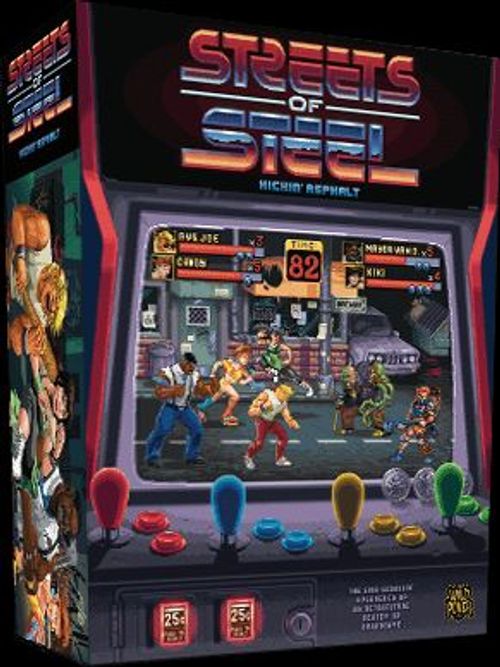
Streets Of Steel: Kickin' Asphalt
Streets Of Steel: Kickin' Asphalt Rulebook
Table of Contents
Table of Contents
Setup
- HERO SELECT: Each player chooses their heroes and base colors. The number of players determines the number of heroes:
- 1 PLAYER GAME: Player selects 3 Heroes.
- 2 PLAYER GAME: Each player selects 2 Heroes.
- 3 PLAYER GAME: Each player selects 1 Hero.
- 4 PLAYER GAME: Each player selects 1 Hero.
- DIFFICULTY SELECT: Make your pile of Quarters based on your desired game difficulty:
- WIMP: 5 Quarters
- BADASS: 3 Quarters
- TOTAL BADASS: 2 Quarters
- BEHAVIOR DECK: Shuffle the Threat I, II, and III Behavior cards together, but leave the Boss Behavior cards separate.
- SETUP STREET TILES:
- Make the Street Tile deck by placing 1 RED tile facedown. Then place 4 YELLOW tiles on top of it. Then place 3 GREEN tiles on top.
- Draw the top three tiles and place them.
- Add a Baddie to each appropriate Baddie symbol. For example, Firebugs are Threat II Baddies, so they would be placed on all Threat II spawn points.
- ADD ITEMS: Add one Item token to each space with an Item symbol.
- SPAWN HEROES: Place Heroes on any of the first column's spaces.
- ASSIGN 1st PLAYER: Assign the 1st Player Token to the last player who was outside.
Game Over
The game ends when the Boss is defeated, or all Heroes are dead and no Quarters remain.
The Game Round
Player Phase
The player with the 1st Player Token activates their Hero first.
- HERO ACTIVATION: A Hero activates by spending any 3 Actions. They may spend the same Action multiple times. The available Actions are:
- MOVE spaces equal to the Hero's Speed.
- ATTACK a Baddie in the Hero's space.
- TAUNT to gain one Wild Power token.
- SPECIAL ATTACK by paying the cost on a Hero card and following its instructions.
- BADDIE ACTIVATION: Each time a Hero completes their activation (3 actions), the Baddies get a chance to respond.
- A. RESET ACTIVATED BADDIES by shifting them back to the right Lane.
- B. DRAW A CARD from the Behavior deck and follow its instructions.
The player to the left activates their Hero next. Continue until each player has activated.
Street Phase
- DISCARD STREET TILE: The leftmost Street is discarded. Items, Baddies, Obstacles, and Hazards on the tile are also discarded. Heroes on the tile lose remaining Health points.
- DRAW NEW STREET TILE: A new Street is drawn and placed to the right of the rightmost Street. Add Baddies, Items and Hazards to the new Street Tile.
Round ends...
The Game Board
Before you can navigate the Steel City streets, it's important to become familiar with the game board. The board is composed of the following terms:
- BOARD: The entire play area, composed of 18 spaces.
- STREET TILE: A full card composed of 6 spaces.
- COLUMN: A vertical group of spaces.
- ROW: A horizontal group of spaces.
- SPACE: Figures navigate from space to space. Each space holds a maximum of 3 figures.
- LANE: Spaces are split into two Lanes. Lanes are used to track Baddie activations.
- ADJACENT: These spaces are each adjacent to the blue space.
Heroes
Move
As an action, a Hero may move one space for each of their Speed value. They MAY NOT move to diagonal spaces. Their Speed value may never be less than 1.
A Hero may not enter a space occupied by 3 figures.
OBSTACLES and ROUGH TERRAIN: If a Hero enters a space with an Obstacle, their movement action immediately ends.
HAZARDS: A Player rolls a Danger Die if their Hero enters OR ends their turn in a space with a Hazard. If the rolled die is not blank, the Hero suffers damage equal to the Hazard value on the top of the Threat deck. Hazards DO NOT stop movement actions.
Example: the top of the Behavior deck displays a "2". Average Joe moves onto a space with a Hazard. As soon as he enters the space, one Danger Die is rolled. The roll produces one hit. With no Wild Power tokens to reroll dice, Average Joe suffers 2 damage.
INVINCIBILITY: Each Hero is immune to Obstacles, Hazards, and Backstabs during their first Action in the game AND during their first Action after returning to play after spending a Quarter.
Attack
A Hero may spend one Action to attack a Baddie they share a space with. Each attack uses all of their punch and kick dice.
If a Hero's dice roll produces results that are equal to or greater than a Baddie's Defense, the Baddie is defeated or damaged.
- PUNCH DICE are accurate.
- KICK DICE deal the most damage.
- DANGER DICE are unpredictable.
Taunt and Rerolling
TAUNT: A Hero may spend one Action to Taunt, which awards them one Wild Power token.
A Wild Power token may be discarded to reroll one die to improve attacks, dodge Baddie attacks targeting the token's owner, or avoid Hazard damage.
Multiple Wild Power tokens can be spent in an attack.
Example: Kiki is targeted by a Killgaroo's Master Kick, which rolls two Kick dice against her. One die is blank. The other die has one hit. Kiki has two Wild Power tokens. She spends one token to reroll the die with a hit. The reroll produces two hits! Kiki spends her final Wild Power to reroll again.
Super Attack
Heroes are able to use powerful abilities called Super Attacks. To use a Super Attack, a Hero must use an action to pay its Wild Power cost.
Baddies
THREAT LEVEL: Not all Baddies are created equal! Low level baddies, like a common Punx, are Threat Level 1. In each SoS game, players will face off against 4 types of Baddies:
- Threat Level 1 (Core Game - Punx)
- Threat Level 2 (Core Game - Firebug)
- Threat Level 3 (Core Game - Killgaroo)
- Boss Baddie (Core Game - Supermutie)
BACKSTABS: When a Hero leaves a space occupied by a Baddie, each Baddie in that space rolls an attack die against the Hero. The type of attack die used is specified on the Baddie card.
DEFENSE (DEATH): If an attack roll against a Baddie exceeds this number, that Baddie is defeated.
DEFENSE (DAMAGE): If an attack roll against a Baddie exceeds this number, that Baddie loses one Health token.
HEALTH: Like Heroes, Boss Baddies have a pool of Health points. When they take damage, one Health token is removed from their Boss Baddie card.
BOUNTY: When a Hero exceeds a Baddie's defense, that Hero is awarded Wild Power tokens equal to number specified on the Baddie card.
Baddie Behavior
A Behavior card shows: Baddie Type, Title, Behavior Instructions, Redraw, and Tiebreaker.
REDRAW: Baddie actions are determined by the Behavior deck. After a Hero has completed its activation, draw a card from the Behavior deck. Draw cards from the Behavior Deck until you draw a card that matches a type of a Baddie that is on the board. Follow its instructions, then place it (and any unactivated Baddie cards) faceup in the Behavior Deck discard pile.
If there are multiple Baddies of the type activated, each Baddie is activated in this order.
Before a Behavior card is drawn, all Baddies are reset to the right lane. When a Baddie activates, move them to the left Lane. The Behavior card is fully resolved after every Baddie of that type has activated.
Baddies ignore the effects of Obstacles and Hazards. If a Baddie would enter a space occupied by 3 figures, it would end its movement before entering the full space. If a Baddie has two equidistant paths towards a target, they move vertically first, then horizontally.
TIEBREAKING: If a Baddie experiences a tie while resolving a Behavior card, they refer to the Tiebreaker located at the bottom of the card.
Baddies choose Hero targets in the order specified by the Tiebreaker (from left to right). In the above example, if a Baddie was instructed to "target the nearest Hero" but they were one space away from both the Hero in the blue base and the Hero in the red base, and two spaces from the Hero in the green base, they would target the Hero in the blue base.
If playing a game with less than 4 players, any missing base colors are ignored while determining ties.
In the rare event that this does not resolve a tie, the last active player chooses between the options.
The Boss Baddie
The Boss Baddie is the most powerful Baddie type who only appears when the red Street Tile is placed. Defeat him to win! When this occurs, gameplay changes in the following ways:
- The back of the red Street Tile has instructions to follow when the Boss Baddie appears.
- Street Tiles are no longer removed and the 1st Player token will no longer be used.
- The Boss Baddie Behavior Deck replaces the Baddie Behavior Deck. On the Baddies' turn resolve all instructions on the Behavior card.
- Like Heroes, Baddie Bosses have an HP value. When a Hero's attack exceeds the Boss Baddie's defense, reduce the Boss Baddie's health by 1 and assign 1 WP to the attacking Hero.
When the Baddie Boss reaches 0 HP, the GAME IS WON!
Death and Taxes
When a Hero loses all their Health, they must discard all Items, Effects, and Wild Power.
If there are any Quarters left on a dead Hero's next turn, they must spend one to return to play in one the starting spaces. Life is cheap.
The Hero starts his activation with full Health and one Wild Power.
INVINCIBILITY: During the Hero's first Action, they are immune to Hazards, Obstacles, and Backstabs.
Items
Hot shot Steel City truckers love to show off by not securely fastening their shipments of crates and toxic waste. Luckily, those shipments are usually packed with useful items!
When a new Street Tile is placed, an Item token is assigned to each Crate or Hazard icon.
When a Hero enters a space with an Item token, they may draw a card from the Item deck after they resolve any possible Hazards.
Some Item cards direct a Hero to DISCARD that card to gain its bonus. Example: a Hero would discard the "Spikey Boots" Item to add one kick die to their next attack.
Some Item cards direct a Hero to IMMEDIATELY use that card for its bonus. Example: when a "Slurpo" Item card is drawn, the Hero immediately gains 2 HP, then the Item is discarded.
A Hero may only equip one Item at a time. When an equipped Hero enters a space with a new Item token, they may draw a new card from the Item deck, then discard back down to one Item.
Reshuffle if every card has been drawn from the Item deck.
FAQ
Can you dicard an item to add a dice to an attack you already rolled?
No, the Item is discarded at the time of the initial attack roll.
When determining Baddie movement, do Baddies ignore targets in fully occupied spaces when determining their movement?
No, they will still move towards targets in those spaces. They will stop movement before entering a full space.