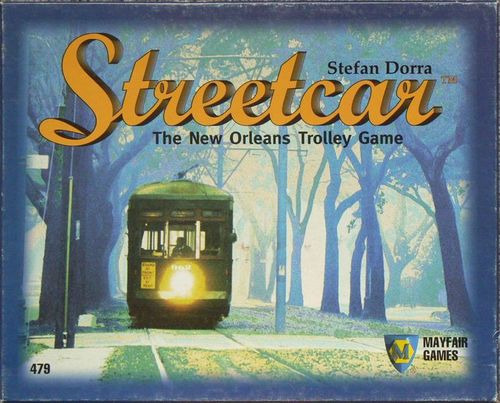
Streetcar
Streetcar Rulebook
Table of Contents
Table of Contents
Set Up
Place the board in the middle of the table. The board contains the spaces on which the players will lay tracks. It also has twelve locations (labelled A through M) which represent places in New Orleans where streetcars can stop. Around the central white grid, there are twelve terminals (two each for each line) where the streetcar routes begin and end.
There are six line cars, one for each streetcar line, and twelve route cards, six with two stops and six with three stops. The two-stop route cards are recommended for normal games; the three-stop route cards provide longer, more challenging games.
Before each game, shuffle the line cards and deal one face down to each player. Shuffle the six route cards being used this game and deal one face-down to each player. Set the unused line and route cards aside, face down. Players may not look at the unused line or route cards. The six streetcars and the thirteen stop signs are set next to the board for use during the game.
From the stack of track tiles, give each player three straight and two curved track tiles. These are the player's starting tiles. This "hand" of tiles is kept face up at all times. All remaining tiles are placed in the canvas bag for players to draw during the game.
Players' Routes
Each player receives a line card to show which two terminals begin and end that player's route.
Each player also receives a route card which shows the locations that he must connect in his route. To determine which locations must be connected, find the line number on the route card. The locations listed next to that line number are the locations that must be included in that player's route. These locations can be connected in any order.
The line card shows a line number, from 1 to 6, and each line number corresponds to a set of three locations on the route reference:
| Line | Locations |
|---|---|
| 1 | C - D - I |
| 2 | B - D - M |
| 3 | G - K - L |
| 4 | E - F - K |
| 5 | E - H - K |
| 6 | A - L - M |
Example One (for 2 or 3 players): Your line card tells you that you are playing line 2. Your route card tells you that you must stop at stop B, D, and M. You could start at one terminal and run your track to M, B, and D before entering your other terminal. Or you could start at the opposite terminal and run to D, then M and B (or any other combination of these three locations) before entering your other terminal.
The information on each player's line and route cards is kept secret until that player is ready to begin running his streetcar later in the game.
Playing the Game
Play goes clockwise around the table. On each turn a player either:
- lays two track tiles on the board and draws track tiles to bring his total back to five (if his route is incomplete), OR
- moves his streetcar (if his route is complete).
Laying Track Tiles
On his turn, a player must lay two track tiles. Tiles can be placed on empty white squares, or they can replace existing tiles.
Either way, every tile must adhere to the following rules:
A. the track on the tile may not lead off the board unless it leads into a terminal; B. the track on the tile may not lead into a location square (i.e., into a stop); C. the track on the tile must connect to all existing track that leads into the square on which it is placed; D. the track on the tile may not lead into an existing tile unless it connects to track on that tile.
For example, a tile that leads to the edge of the board where there is no terminal is illegal; a tile that doesn't connect to the track already entering a terminal is illegal; and a tile whose track leads into a location square is illegal.
Once both tiles are placed, the player who placed them randomly draws two tiles from the bag to replace the two that he used.
Instead of drawing from the bag, a player can select from the leftover tiles of any player who has begun his inaugural run, if any player has done so. Once a player has drawn his two tiles, the player to his left begins his turn.
Exchanging Track Tiles
Under certain circumstances, previously placed track tiles can be exchanged with new tiles. To do so, ALL track on the tile being replaced must be maintained exactly as it was. In effect, the exchanges are upgrades that can only add new connections; old connections are never removed. All new connections must follow the track laying rules (A-E) described above.
When a player exchanges a tile, he takes the old tile off the board and exchanges it with one of his tiles. The old tile becomes one of the five tiles in that player's "hand" as if he had drawn it. This counts as one draw for this turn, so the player draws one less tile at the end of his turn for each exchange. The tile that was exchanged can immediately be played if that player has not already played both of his tiles for that turn.
For example, when replacing the central tile of a configuration of three tiles laid in a row, some replacements are valid upgrades that add a new branch of track while keeping the original connections intact, and other replacements are not valid because they remove a connection that was already there instead of only adding to it — one illegal replacement removes the possibility of travelling horizontally, while another removes the connection directed downward.
Track tiles marked with trees MAY NOT be replaced once they are played, but they may be used to replace other tiles.
Track tiles that have streetcars or stop signs on them may be exchanged. Simply pick up the streetcars and/or stop signs while exchanging and replace them after making the exchange.
Two side-by-side tiles may be exchanged simultaneously as long as all track laying rules are obeyed for both tiles after the double exchange has been completed. Each one of the two replacements may be illegal on its own, but together they can result in a valid configuration.
Stop Signs
There are 12 locations (labelled A - M) on the board. As indicated above, no track can be built on these spaces. However, when the first track tile is placed adjacent (horizontally or vertically, but not diagonally) to one of these locations, a stop sign (i.e., a black chip) is placed on that tile. Only the first adjacent tile gets a stop sign; each location can have only one stop sign next to it. All players who have that location on their route card must include the tile with that location's stop sign as part of their route.
Spaces that are diagonal to a location could not have a stop sign placed on them. Once a stop sign has been placed on the tile adjacent to a location, no other tile adjacent to that location can have a stop sign, because there can only be a single stop sign beside each location. A player with that location on his route card will have to stop at the tile bearing its stop sign when he runs his route, even if he would prefer to use another adjacent tile to drive past the location without stopping. Passing by a location does not count toward completing a route unless the streetcar stops at the stop sign.
Inaugural Run
Once a player completes his route, he can begin his inaugural run at the beginning of his next turn. A player does not have to start as soon as his route is ready; he may want to improve his route before starting. Once a player has begun to move his streetcar, he cannot lay any more track tiles. His unused track tiles remain face up in front of him. Other players may select from these tiles when they draw new tiles.
When a player begins his inaugural run, he must display his line card and his route card. He must trace the route he will follow with his finger to show the other players that he can connect both of his terminals and the stop signs of all the locations listed on his route card. If it turns out that the route is not complete, then he must continue laying track tiles on his turns until his route is truly complete, at which time he may begin moving his streetcar. If there are no mistakes, he may begin moving. If a player begins moving and a better route appears due to other players' subsequent tile placements, he may change his route accordingly.
To begin his trip, a player places his streetcar in either of his terminals. Then, on each turn he moves his streetcar. The number of spaces he can move is equal to the number of places moved by the last player to move, plus one. Use the extra stop sign and the numbers on the small additional board to show how far each player has gone.
For example, if Janet is the first player to move, she can move one space on her first move. If no other player has moved before her next turn, she moves two spaces. If Brad starts moving after Janet's first move, Brad moves two spaces and Janet moves three.
A player does not have to move his streetcar the maximum number of spaces allowed. If he moves less than the maximum, the number of spaces he does move determines the number of spaces the next player may move. In this way, a player may intentionally slow himself down to slow down another player.
For example, Victor moves 3 spaces on his turn. Jenny is next, so she can move up to 4 spaces, and Jack (who is after Jenny) can move 5. If Jenny chooses to move only 1 space, then Jack can move only 2 spaces.
All streetcars must stop at all stop signs posted on their route, even if that location is not listed on that player's route card. If stopping at the stop sign requires a player to use less movement than he is allowed, he cannot use his full movement. The next player moves based on how many spaces were actually moved.
All streetcars must move forward, never backwards. Streetcars from different lines can stop in the same space and may pass each other on the same track. Streetcars may also move through any terminal (their own or another player's) as if they were normal track. The entire terminal counts as one space.
Streetcars cannot turn through any intersection that makes a right angle or sharper turn. Track that makes a gentle curve from one side of a tile to an adjacent side over the space of an entire tile is not considered a right angle.
If a player takes a wrong turn and discovers that he cannot complete his route from his current location, he removes his streetcar from the board. Next turn, he must start over from one of his terminals. If a player discovers that his route really wasn't completed and thus he will never be able to complete it, he removes his streetcar from the board. He can then begin playing track again on his next turn. Once his track is reconnected, he can place his streetcar in one of his terminals and start again.
The rulebook illustrates a worked example of an inaugural run: Bob is playing line 2, with his announced route indicated by a series of arrows across the board. On Bob's first move, his streetcar moves one space. No other player is moving yet, so the number of spaces Bob can move increases by one on his next turn, moving him two spaces. Next, the streetcar moves three spaces; he could have moved one more space, but he had to stop at a stop sign along the way. Bob's streetcar could not have turned toward his terminal at the second stop of his run, since that turn was sharper than a right angle — if the streetcar had come from the other direction, the turn would have been possible. Similarly, at a later point on the route the streetcar would not be allowed to turn, since the turn would not have been smooth.
Ending the Game
Once a player completes his inaugural run, the game ends and the player is the winner. To complete his inaugural run, a player must move his streetcar from one terminal to the other, stopping at all the stop signs and including all locations on his route card. A player does not have to arrive at the final terminal by an exact count.
Variants
-
Instead of the normal movement rules, a player rolls a 6-sided die to determine how far he moves. Any roll of "5" or "6" takes the player to the next stop immediately (no matter how far away it is). A player must still stop at all stops on his route.
-
Use the dice rule of #1, but a player can choose to roll the dice or use the same roll as the player before him. Thus, one good roll could be used repeatedly by all players. A player may choose to reroll just to prevent the next player from moving too far.
-
When playing with three stops, players must connect the three stops in the order printed on the card.
Contents
1 game board; 126 track tiles; 13 stop signs; 1 small board; 6 streetcars; 6 line cards; and 12 route cards.
Tiles
The 126 track tiles are made up of the following pieces, shown by quantity:
- 36 straight tiles (one straight length of track from edge to edge)
- 30 curved tiles (a quarter-circle curve connecting two adjacent edges)
- 10 tiles combining a straight track with a curved branch splitting off one end, forming a three-way fork
- 10 tiles combining a curved track with a straight branch (the mirror of the tile above), also forming a three-way fork
- 10 tiles with two curves meeting at a point, forming a V-shaped three-way fork
- 6 tiles with two curves crossing each other, forming an hourglass-shaped four-way crossing
- 6 straight-plus-curve fork tiles (as above) marked with one tree
- 6 straight-plus-curve fork tiles (mirrored) marked with two trees
- 4 four-way crossing tiles combining curves and straight track, marked with two trees
- 4 four-way straight crossing tiles (track running straight in all four directions) marked with one tree
- 2 four-way crossing tiles (curved variant) marked with two trees
- 2 four-way crossing tiles (curved variant, mirrored) marked with two trees