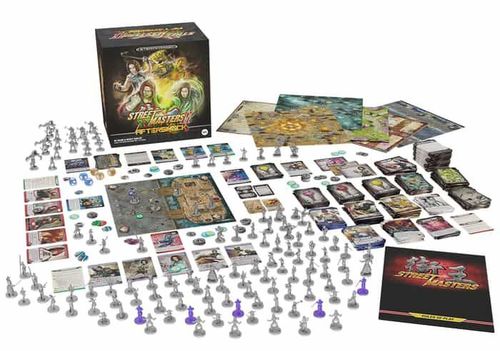
Street Masters II: Aftershock
Street Masters II: Aftershock Rulebook
Table of Contents
Table of Contents
Overview
Aftershock is a deluxe expansion for Street Masters that introduces new fighters, enemies, and stages, while also introducing new mechanics such as mission cards and showdown decks. A base game of Street Masters is required to use this expansion.
Components
- 33 Miniatures
- 5 Fighter miniatures
- 2 Boss miniatures
- 26 Minion miniatures
- 75 Tokens
- 39 Five-value defense tokens
- 20 Mission tokens (5 tokens in each of 4 different colors)
- 12 Act phase tokens (3 tokens in each of 4 different colors)
- 4 Rival/ally tokens
- 426 Standard Cards
- 100 Fighter cards
- 42 Enemy cards
- 84 Stage cards
- 94 Story cards
- 4 Rival/ally cards
- 4 Mission reference cards
- 40 Mini Cards
- 20 Loot cards
- 20 Mission cards
- 12 Card Dividers (4 fighters, 2 enemies, 4 stages, missions, and showdown stories)
- 92 Plastic Dividers
- 2 Double-Sided Map Tiles
New Rules
The following sections cover each new rule and component this expansion adds to Street Masters.
Act Phase Tokens
These tokens are included for players that prefer to track each step of their act phase. When using these tokens, players may choose a set of 3 tokens in a single color to put near their play area during setup, faceup (the lower opacity side is facedown). During a fighter's act phase, they can track which steps they have performed that turn by flipping over the appropriate act phase token after completing the corresponding step; at the end of their turn, they flip each of their act phase tokens faceup in preparation for their next turn.
The act phase tokens are marked Move Step, Card Step, and Action Step.
Overview Cards and Random Arcade Mode
Overview cards serve several purposes: introducing new players to decks, randomly creating Arcade Mode match-ups, and easy fighter selection. These cards are divided into decks for fighters, enemies, and stages. Players are free to use these cards however they wish, including handing a new player all the fighter overview cards to create an easy and fun "Choose Your Fighter" experience!
Overview Card Breakdown
- Deck Name and Type: The deck that corresponds with a particular overview card is represented here. The type of deck (fighter, enemy, or stage) is indicated below the deck name.
- Overview: Each overview card has a brief summary of what players can expect from that deck. This text helps new players understand general strategies and deck concepts.
- Complexity Rating: This rating represents both how complex the deck is for newer players, as well as the level of difficulty and challenges the deck provides. Ratings go from 1 to 5, with 1 being the lowest and least complex to 5 being the highest and most complex.
Missions
To add another layer of player interaction during any their games, players may choose to include mission cards. Missions are a completely modular addition to the game and provide specific, thematic tasks for fighters to accomplish during a given stage. Completing mission cards earns fighters mission tokens, which in turn can be spent to aid yourself and your fellow fighters.
Missions can be added to any game session and any game mode. In order to include missions in your game, perform the following setup steps after performing all normal setup:
- Choose Mission Token Color: Each fighter chooses 1 mission reference card in a color of their choice, also gathering each of the 5 mission tokens of the matching color. Each fighter places their mission reference card near their fighter turn card.
- Create Mission Deck: The players shuffle all the mission cards together to create the mission deck, placing it near the play area. Each fighter draws 1 mission card and places it near their mission reference card.
- Create Mission Token Supply: Each fighter adds their 5 mission tokens to a common mission token supply near the mission deck.
Each mission card provides flavor text detailing the mission's task, as well as an effect that indicates how the fighter can complete the mission. Each fighter may only have one mission card at a time, and each fighter may only gain mission tokens of their color.
Completing a Mission
When a fighter completes a mission, that fighter discards their active mission card, gains one of their mission tokens from the supply (if able), and draws one mission card. If a fighter is unable to gain one of their mission tokens when completing a mission, they may instead draw one loot card. Fighters may complete multiple missions during their turn.
Abandoning a Mission
During their threat phase, a fighter may abandon their mission once per turn by discarding their active mission card and drawing a new one.
Mission Token Effects
Fighters spend the mission tokens they earn to gain various benefits. Spent mission tokens are returned to the shared mission token supply. Fighters can spend their earned mission tokens on the following effects:
- Find an Opening (at least 1 mission token, maximum of 5): Before any attack (on any fighter's turn), a fighter may spend 1 or more mission tokens to add 1 additional red die (fighter die) to that attack for each mission token spent. Only 1 fighter may spend mission tokens for this effect for each individual attack.
- Prepare (2 mission tokens): At any time during a fighter's turn, choose 1 fighter to draw 1 card from their fighter deck or play 1 Tactic card from their hand.
- Equip (3 mission tokens): During a fighter's turn, they may spend 3 mission tokens to allow each fighter to draw 1 loot card.
- Motivate (4 mission tokens): During any fighter's turn, a fighter may spend 4 mission tokens to allow that fighter to perform 1 additional action during their turn. A fighter may choose themselves for this effect.
- Mobilize (5 mission tokens): During a fighter's turn, they may spend 5 mission tokens to allow each fighter to perform an action. This must be triggered before or after a game effect is fully resolved, and each action must be fully resolved before another action is resolved. The fighter whose turn it is gains this action in addition to their normal action step.
Story Rules
Story Conditions
These are a special type of card that enter play through story deck effects. When setting up a story stage, each Story Condition card in the story pool are added to play. Unless otherwise specified, Story Condition cards are added to the stage play area in an order chosen by the players.
Additional Story Pool Rules
Between play sessions of a story, it is recommended that players add each active story card to the story pool as a reminder of where they left off. For example, if the fighters just completed Part 1 of the "Aftershock Story" and both Gabriel and Leeta completed both of their Part 1 cards of their respective hero stories during that same stage, then they would add all three appropriate Part 2 cards to the story pool to remind them where to pick up next game.
When loot cards from the story pool are added to a stage during setup, players may distribute these loot cards however they wish. Unless otherwise specified, loot cards in the story pool are always permanently removed from the story pool after stage setup.
During some stories, rivals can disrupt which allies are in the story pool, and vice versa. If a rival would ever be added to a stage while that rival's ally version is already in the story pool, the ally version is temporarily turned to its rival side during the stage. If that rival is not added to the story pool, then its ally version remains in the story pool; otherwise, that ally is removed from the story pool and is replaced by its rival version.
Showdowns
Showdown stories extend any given story by one stage, adding in a final confrontation with an upgraded enemy deck. Each showdown deck is tied specifically to a particular enemy deck, providing narrative and new challenges for fighters to overcome.
Similar to hero stories, showdown stories can be added to any story deck. Fighters may use showdown stories in conjunction with their hero stories. While it is recommended that fighters only choose one showdown story to add to a regular story, players may agree to extend their overarching story, letting each fighter choose one showdown deck to undertake. This can be a very challenging and complicated endeavor, though.
When beginning a new story deck with a showdown story, players add Part 1 of each of their chosen showdown decks to the active story's first stage. When playing showdown stories with a regular story deck, players add Part 2 of their showdown deck to Part 3 of their chosen regular story; otherwise, Part 2 is resolved during the next stage. Part 3 of a showdown is always played after the regular story is completed, i.e. Showdown stages are always played last after all other story stages are complete.
Showdown (NAME OF STAGE): This keyword appears on the final part of all showdown stories. A story card with the Showdown (NAME OF STAGE) keyword indicates a showdown stage that is always the culmination of any combination of stories. The stage listed in the parentheses indicates which particular stage the showdown takes place in. Only 1 showdown stage may be played at a time, and no other story cards may be active during a showdown stage. Players may not attempt a showdown stage until all other active non-showdown stories are complete. After all showdown stages are complete, the outcomes of the individual showdowns will indicate the results.
Enemy Upgrade Cards
The rules for enemy upgrade cards are included in the core Street Masters rulebook.
Additionally, players are encouraged to customize their Arcade Mode games by including enemy upgrade cards at their discretion. For a slightly more challenging enemy deck, add 1-3 upgrade cards to the respective enemy deck (replacing the standard cards of the same name). For an even greater challenge, add each enemy upgrade card to its respective enemy deck (replacing the standard cards of the same name).
Rule Clarifications
Cancelling Attacks
- Attacks that are cancelled are still considered to have happened; the effects after the attack begins are just cancelled.
- Attacks that target multiple fighters can be cancelled, meaning none of the intended fighters are affected.
- "Attack each fighter" is multiple attacks, while "attack, targeting each fighter" is a single attack.
"Treated as a Fighter Figure" and Non-Player Controlled Fighters
A general rule for any figure that is "treated as a fighter" is that typically only enemy attacks will target these figures. In almost every other case, players will use their own discretion on any other effects that affect these figures. For example, a fighter card effect that lets each fighter move and gain a defense token of their choice can affect non-player controlled figures that are treated as fighters if the players wish. While this list is not comprehensive, it should serve as a good guideline for what types of effects affect non-player controlled fighters.
- Fighters have turns, but figures treated as fighters do not. So an effect that specifies "Once during their turn..." would only affect a player-controlled fighter.
- An effect that instructs a fighter to perform an activity that a player typically does (such as searching a deck or shuffling a deck) does not affect non-player figures.
- Effects that cause fighters to choose, such as discarding a defense token or suffering a consequence, would not affect a non-player controlled figure.
Enemy Movement
Blocked & Occupied Spaces
If an enemy would end its movement in an occupied space, it will end its movement in the space that is both nearest the occupied space and the target space they are moving toward. In case of a tie, players may choose which space the enemy ends its movement in.
When a blocked space prevents an enemy from reaching its destination, the enemy will move so that it will eventually reach its destination (even if it takes several turns). For example, if one or more blocked spaces prevents an enemy from reaching its target, it will move around the blocked spaces so that it will eventually reach its target; this will sometimes benefit the fighters, so using positioning as an advantage is a good strategy against certain enemies.
Treating All Damage As...
Some figures have passive effects that allow them to treat damage as a certain type. For example, a figure might have an ability like: "This figure treats all damage as general damage."
This type of effect specifically only affects damage that would be dealt to the figure. It does not affect the type of damage that figure deals when it attacks.
Simultaneous Turn Variant
Note: This is a variant specifically designed for multiplayer games (3-4 fighters) that was co-developed with MVP Boardgames. This variant is intended to speed up games for players who are experienced with the core game rules. This variant utilizes the act phase tokens included in this expansion.
Setup Changes
Follow normal setup rules for your chosen mode of play (Arcade or Story). Additionally, read the "Act Phase Tokens" section earlier in this rulebook to incorporate these into your setup.
Gameplay Changes
The main change in this variant is that each fighter will perform their turn at the same time, following these standard guidelines:
- During the collective fighter turns, each fighter must resolve a single phase (in order) before the fighters collectively begin the next phase of the fighter turn.
- Any effects that specifically affect a "fighter's turn" can affect any fighter during the fighter's shared turn.
- During the act phase of the fighter's turn, each fighter individually resolves a step of their choice in sequence, and must completely resolve the chosen step before another fighter resolves a chosen step. Fighters can collaborate and resolve these steps in any order, as they normally do during their individual turns in a normal game.
- During the react phase, the fighters choose 1 threat area to fully resolve before resolving another threat area. Repeat this until each fighter's threat area has been resolved.