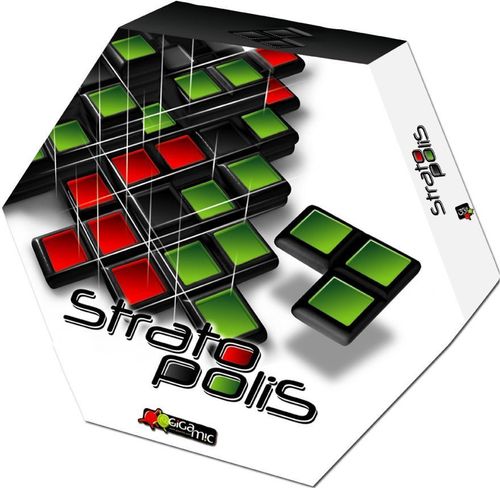
Stratopolis
Stratopolis Rulebook
Table of Contents
Table of Contents
Components
- 40 L-shaped tiles, each made of three squares (red, green or neutral);
- 1 rectangular tile made of a red and a green square.
Object of the Game
Players take turns placing their tiles on the table. Their goal is to create a zone of their own color that is larger than the opponent's biggest zone. When all tiles have been placed on the table, the winner is the player who has scored more points. The points of each zone are its area multiplied by its height (see the illustration in the "End of the Game" section).
Setup
Divide all tiles into two sets of 20 tiles each (numbered "1" or "2" on the back).
- The set marked "1" consists of: fully red tiles, red-neutral tiles, and tiles with two red squares and one green square.
- The set marked "2" consists of: fully green tiles, green-neutral tiles, and tiles with two green squares and one red square.
Each player takes one set of tiles, shuffles it, and places it in a face-up stack. During the game, each time players take the top tile of their own stack. The rectangular tile is the starting tile; it is placed on the table between the two players.
Gameplay
Choose the first player at random. Then players act in turn. On their turn a player takes the top tile of their stack and places it on the table. With this action they can pursue one of the following aims:
-
Increase the area: the player places the tile on the table. This tile must touch at least one side of any other tile already on the table; colors are not taken into account here (it does not matter which color square the new tile is adjacent to).
-
Increase the height: the player places the tile on top of other tiles, following these rules:
- the tile must cover at least two tiles already on the table;
- the color of each square of the new tile is subject to the following restrictions:
- a red square may not be placed on a green square and vice versa;
- all other combinations are allowed: green square on neutral square, red on neutral, neutral on neutral, green on green, red on red.
No square of the new tile may be located over an empty space; each tile must be placed on three squares that are at the same level. There is no limit to the height of a construction.
End of the Game
The game continues until all tiles have been placed on the table. Then each player counts points for each zone of their color:
- The points of each zone are the area of that zone multiplied by its height.
- The height of a zone is determined by the highest square of the zone (level 1, 2, 3, etc.).
- The area of a zone is the number of squares of the same color touching each other; squares of the same color must touch by at least one side; only visible squares are counted when calculating area, regardless of the level they are on.
The winner is the player whose largest zone is larger than the other player's largest zone (in the illustration, the red player won).
Alternative Variants
- At the start of the game, players stack their tiles in an order convenient to them, preparing a particular strategy.
- At the start of the game the tiles are not stacked, but laid face down in front of the players. On each turn each player picks a random tile.
- At the start of the game players shuffle their tiles and stack them. Then each player takes three tiles from the top of their stack and lays them on the table in front of them. Each turn they choose one of these tiles. At the end of each turn, players take one tile from the top of the stack to replace the tile just used.