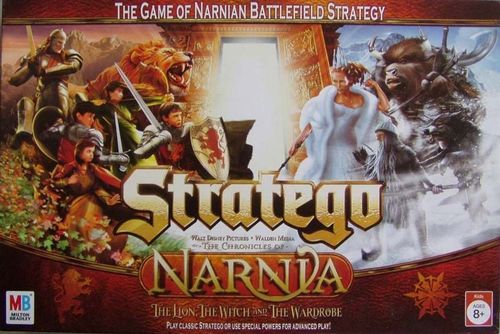
Stratego: The Chronicles of Narnia – The Lion, The Witch, and The Wardrobe
Stratego: The Chronicles of Narnia – The Lion, The Witch, and The Wardrobe Rulebook
Table of Contents
Table of Contents
Object
Capture your opponent's Flag before he/she captures yours.
Contents
- Gameboard
- 40 Red Pieces
- 40 Blue Pieces
- Display Tray
- Label Sheet
- Special Powers Reference Sheet
The First Time You Play
Remove the game parts from their wrapping and discard the waste. Then, following the directions on the label sheet, apply the appropriate label to each playing piece (see Figure 1).
How To Play
There are two ways to play this Special Edition Stratego Game. In Game 1, play by classic Stratego rules and race to capture your opponent's Flag. In Game 2, Special Powers come into play and some of your army pieces gain additional abilities above and beyond their traditional powers. Plus, the Red army will have the chance to add Reinforcements to help them in battle, while the Blue army also has an additional way to win & defeat the Red army!
Game 1: Classic Stratego – The Lion, The Witch & The Wardrobe Edition
Setup
-
The red pieces represent the good army – (Peter & Aslan's army) and the blue pieces represent the evil White Witch's army. Hide a red piece in one hand and a blue piece in the other. Your opponent chooses a hand and takes the color army of the piece in that hand. The other army is yours.
-
Place the gameboard on a level surface between you and your opponent, with the STRATEGO logo facing each of you. Make sure the pictures on the end of the gameboard match the pieces in your army. Note: Ignore the "Special Powers" references to the characters on the gameboard; Special Powers are used only in game 2.
-
Place each of your pieces on a gameboard square in the first four rows in front of you (see Figure 2). Make sure the labeled side faces you, and is hidden from your opponent. Your opponent sets up his/her pieces the same way.
Placing your pieces strategically is an important part of the game. After you've played a few times you will start to develop your own strategy. For now, take a look at the rules for moving and attacking, and read the Strategy Hints on page 5. They'll help guide your decisions.
On Your Turn
You and your opponent alternate turns. The player controlling the Blue army goes first.
On each of your turns, you must do one of the following:
- Move one of your pieces; or
- Attack one of your opponent's pieces.
In a case where you cannot move or attack, the game is over and your opponent wins.
Rules For Movement
The only pieces that cannot move are your Flag and Spring Magic (Red army) or Winter Magic (Blue army) pieces. Move your other pieces according to the rules below.
- Move only one piece on a turn.
- Move your pieces one square at a time to an open adjacent square (a square next to it). Pieces may move forward, backward or sideways, but not diagonally. Exception: See Special Scout Movement Privilege, below.
- You cannot jump over other pieces, or move a piece onto an occupied square (unless attacking; see Rules for Attack, below.)
- You cannot jump over or move onto the Boulder spaces (see Figure 2).
- You cannot move a piece back and forth, between the same two squares, on three consecutive turns.
Special Scout Movement Privilege
Wolves and Leopards (pieces ranked 2) have special movement rules. They may move any number of open squares forward, backward, or sideways in one direction. They cannot move diagonally, nor can they pass over or move onto the Boulder spaces. Before moving Wolves or Leopards more than one square, you must first reveal your piece to your opponent. (You may wish to move them only one square at a time, to confuse your opponent.)
Rules For Attack
The only pieces that cannot stage an attack are your Spring Magic or Winter Magic pieces and your Flag. Attack rules are as follows:
-
ATTACK POSITION: When a red and a blue piece occupy adjacent spaces (back-to-back, side-to-side, or face-to-face), they are in Attack Position (see Figure 3).
-
HOW TO ATTACK: Take your attacking piece and lightly tap your opponent's piece. Reveal your attacking piece; your opponent then reveals his/her defending piece. The piece with the lower rank is captured and removed from the gameboard. If the pieces are of equal rank, both are captured and removed from the gameboard. (See Captured Pieces, below.) Note: Pieces not ranked by number have special rules; see Spies and Spring/Winter Magic, on page 5.
-
If the attacking piece wins, it moves onto the square formerly occupied by the defending piece.
-
If the defending piece wins, it stays on its square.
-
Attacking is always optional.
(Figure 3 in the printed rules shows the "Not in range" and "In range" squares around an attacking piece.)
Spies
The pieces ranked S are the Spies. A Spy has no defensive power, so it is captured by any piece that attacks it. Likewise, it is captured by any piece that it attacks, with a few exceptions:
- A Spy may capture a 10-ranked piece.
- A Spy may capture another Spy.
- A Spy may capture your opponent's Flag.
Keep in mind if you attack your opponent's Spy with your Spy, both pieces are still removed from play.
Spring/Winter Magic
If Spring Magic or Winter Magic pieces are attacked, the attacking piece is captured. Exception: see Special Dryad/Minoboar Privilege, below.
Special Dryad/Minoboar Attack Privilege
Dryads and Minoboars (pieces ranked 3) are the only pieces that can capture a Spring Magic or Winter Magic piece. When a Dryad or Minoboar attacks an opposing Spring Magic or Winter Magic piece, it is disarmed and the piece is captured. The attacking piece then moves onto the square that was occupied by the Spring Magic or Winter Magic piece.
Special Scout Attack Privilege
This privilege applies only to Wolves and Leopards (pieces ranked 2). They can move any number of open squares forward, backward, or sideways. A Scout using this special movement may end its move on a square occupied by an opponent's piece, then immediately attack it.
Captured Pieces
Any piece that is captured is immediately removed from the gameboard. Players can either place captured pieces near the gameboard, or they can fit them into the notches provided in the cardboard platform (shown in the STORING YOUR GAME section on page 8).
Before the game begins, both players should agree on how captured pieces will be treated. The options are as follows:
- Open Play: New players may want to place all captured pieces where both players can see them. This will help you keep track of which pieces are still in play.
- Prisoner Play: The player who captures a piece, takes it and keeps it secret from the other player.
- Secret Play: The player whose piece was captured, takes it and keeps it secret from the capturing player.
- Stealth Play: ALL captured pieces are kept facedown, hidden from BOTH players. This forces both players to try to keep track of all captured pieces.
Special Attack/Defense Rules
Some pieces have special attack or defense rules. Using these pieces strategically can mean the difference between victory and defeat!
Strategy Hints
- Spring Magic, Winter Magic and Flag placement: When setting up your pieces, place your Flag somewhere in the back row, and place your Spring Magic or Winter Magic pieces around it for protection. Another strategy is to place Spring Magic or Winter Magic pieces in the back corners as decoys, and hide your Flag in the middle of the back row with a high-ranking piece near it, for protection. Important: It's not usually a good idea to place Flag and Spring Magic or Winter Magic pieces in the front row, or in any other place where they can block your pieces.
- Protect your Dryads/Minoboars: If your opponent's Flag is surrounded by Spring Magic or Winter Magic pieces, you'll need a Dryad/Minoboar to open a pathway to the Flag.
- Scouts: Place some of your Scouts (pieces ranked 2) in the first two rows, and use them to reveal enemy pieces that are moving towards you. Keep some Scouts safe, then use them later in the game to capture your opponent's Flag.
- High-ranking Pieces: Place some high-ranking pieces in the front row, to capture Scouts and other low-ranking pieces.
- Do not move your highest-ranking pieces into unknown enemy territory. You don't want to lose them to a Spring Magic or Winter Magic piece.
- If you know that you own the highest-ranking piece on the board, you also know that you can capture any piece that moves! Try to keep track of which pieces move during the game, and be wary of those that don't; those pieces are probably the Spring Magic or Winter Magic pieces and the Flag.
- Spy strategy: Try to keep your Spy near your 9-ranked piece. If the enemy 10-ranked piece is nearby, you might be able to lure it over to capture your 9-ranked piece, then attack with your Spy to capture it!
How To Win
The first player to capture his/her opponent's Flag wins the game. If all of your moveable pieces have been captured and you cannot move or attack on your turn, you must surrender and declare your opponent the winner.
Game 2: Stratego® - The Lion, The Witch & The Wardrobe Edition with Special Powers
The Special Powers version of the game begins by placing all characters with a green background out of play (Aslan, Susan, Lucy, Mr. Tumnus, Rumblebuffin and the 5 Dryads). These pieces are "reinforcements" and will come into play later on in the game.
Special Game 2 Setup
The blue player sets up the Blue army pieces according to the usual Classic Stratego rules. However, the red player should place the Red army pieces in the first three rows (meaning the rows closest to the Stratego logo) of the gameboard.
This version of the game plays similar to classic Stratego with a few added twists. Some pieces now have Special Powers, which adds a new level of strategy to the game. The characters and their Special Powers are shown on each end of the gameboard, near the logo, and are explained on the separate Special Powers Reference Sheet. To help you remember what your army's Special Powers are, cut the Reference Sheet in half, along the dotted lines. Each player takes the appropriate side for their army, and refers to the sheet during gameplay.
Follow These Guidelines For Using Special Powers
- Pieces with Special Powers may either make a standard move, or use ONE of their Special Powers.
- Always reveal a piece to your opponent before using its Special Power.
Reinforcements
Reinforcements (pieces with a green background) are only allowed into play after the Red player has captured 7 Blue army pieces. After 7 Blue army pieces have been captured by the Red army, on the Red player's next turn, he or she may add the reinforcements into the game. All of the reinforcements must be added in at once and placed on any unoccupied space in the first four rows (meaning the rows closest to the Stratego logo) on the Red player's side of the gameboard (see Figure 2). Then continue your turn as usual.
Note: You may want to place the captured Blue army pieces into the notches numbered 1 through 7 in the display tray. Reinforcements may enter the game on the Red player's next turn once all 7 notches are full.
How to Win
In the Special Powers version of the game the Red army wins by capturing the Blue army's Flag. And, there are two ways the Blue army may win. They are:
-
The first player to capture his/her opponent's Flag wins the game. If all of your movable pieces have been captured and you cannot move or attack on your turn, you must surrender and declare your opponent the winner.
-
If all four of the children pieces (Peter, Susan, Lucy and Edmund) are either captured or enchanted by Turkish Delight, or "turned to stone," then the Blue army wins.
For example: Let's say Peter is Turned to Stone, while Susan and Edmund are captured, and on his next turn, the Blue army Enchants Lucy; the game is now over and the Blue army wins!
Storing Your Game
Done playing for now? Be sure to keep these rules and the Special Powers Reference Sheets together with the game. For easy storage, fold the gameboard and place it under the cardboard platform. Then fit each piece into a notch in the platform, as shown in Figure 4.
Blue Army Special Powers Reference Sheet
Turn to Stone
The White Witch's wand gives her the power to turn her enemies to stone. The White Witch may use this ability instead of taking her normal turn or attacking. To turn an enemy piece to stone, first reveal the location of the White Witch, then declare, "Turn to Stone." Then choose one enemy piece, up to 2 spaces away (vertically, horizontally, or diagonally) to attack. Reveal the piece to your opponent, and if it is not Spring Magic, the Flag, or Aslan, turn it sideways, and leave it on the board. This piece cannot be moved again or captured from play until the spell is broken.
Note: The wand's magical powers work by line of sight, so she may not cast this spell over or around another game piece or through a Boulder space. Additionally, Spring Magic, the Flag, and Aslan are all immune to this Special Power.
Turkish Delight (Enchant)
The White Witch's arcane magic gives her the power to enchant good characters and turn them to her side. The White Witch may use this ability instead of taking her normal turn or attacking. To enchant an enemy piece, first reveal the location of the White Witch, then declare "Enchant." Choose one enemy piece, which is adjacent to the White Witch, vertically, horizontally, or diagonally. Reveal that piece to your opponent. If it is not Spring Magic, the Flag, Aslan, Peter, Susan, or Lucy, (since these pieces are "immune" to the enchanting powers of Turkish Delight) then it immediately comes under the control of the Blue army. Turn the piece completely around, and for the rest of the game it will remain a member of the Blue army. It retains any special powers it had as a Red piece. It may not be "Turned to Stone" and may only be removed from play after it has been captured by a Red piece.
Note: Enchanted pieces may not be attacked with Arrows.
Quickness
Otmin and The Giant have the added power of "Quickness" and may move 2 spaces vertically, horizontally, or any combination except diagonally. If the first space is occupied by an opponent's piece (causing an attack), the second move is automatically forfeited. A piece using Quickness may not jump over pieces or Boulder spaces. A piece may end its move on an opponent's space and immediately attack.
Advanced Flight (Blue)
"Advanced Flight" gives the Harpy the ability to glide over any number of adjacent friendly or enemy playing pieces (and Boulder spaces) and land on the first empty space. Flying must be done in a straight line, horizontally or vertically (not diagonally) in one direction. Once the piece has landed on the first empty space, you may immediately attack an adjacent enemy piece.
Tunneling
"Tunneling" gives the Boggle the ability to tunnel under any number of adjacent friendly or enemy playing pieces and/or the Boulders in a straight line and land on the first empty space. Tunneling must be done horizontally or vertically (not diagonally) in one direction. Once the Boggle has "come up" in the first empty space, it may then go on to make a conventional attack against an enemy piece in an adjacent space.
Rampage (Blue)
A Cyclops using "Rampage" may attack several enemy forces at once. To use the Rampage power, move a piece one space into an unoccupied spot and reveal its identity. The charging piece simultaneously attacks all adjacent enemy pieces, including pieces that are diagonally adjacent! To resolve a Rampage, the ranks of all adjacent pieces are revealed. Any attacked pieces that are ranked the same or lower than 7 are defeated and removed from the gameboard. However, the Cyclops who led the Rampage is always captured and removed from the board after using this special power.
Note: Rampage WILL destroy enemy Spring Magic pieces but the Flag is NOT vulnerable to a Rampage.
Red Army Special Powers Reference Sheet
Detect Enemy
Using Deeper Magic, Aslan has the ability to sense the presence of nearby enemy forces. Using "Detect Enemy" you may reveal the Aslan piece and force an opposing piece up to 2 squares away (horizontally, vertically, diagonally, or any combination) to reveal itself.
Restore
Only Aslan has the ability to reverse the "Turn to Stone" spell for one or more pieces, instead of taking his normal turn. To break the "Turned to Stone" spell, the Red player must reveal Aslan's location and declare "Restore" and any and all "Turned to Stone" pieces that are adjacent (horizontally, vertically, diagonally) to Aslan are immediately returned to their normal playing state. On subsequent turns, they may move and play as usual.
Quickness
Aslan, Peter and Rumblebuffin have the "Quickness" Special Ability may move 2 spaces vertically, horizontally, or any combination except diagonally. If the first space is occupied by an opponent's piece (causing an attack), the second move is automatically forfeited. A piece using Quickness may not jump over pieces or pass over the Boulder spaces. A piece may end its move on an opponent's space and immediately attack.
Advanced Flight
"Advanced Flight" gives the Gryphon and Hawks the ability to glide over any number of adjacent friendly or enemy playing pieces (and Boulder spaces) and land on the first empty space. Flying must be done in a straight line, horizontally or vertically (not diagonally) in one direction. Once the piece has landed on the first empty space, you may immediately attack an adjacent enemy piece.
Rampage
A Gorilla using "Rampage" may attack several enemy forces at once. To use the Rampage ability, move a piece one space into an unoccupied spot and reveal its identity. The charging piece simultaneously attacks all adjacent enemy pieces, including pieces that are diagonally adjacent! To resolve a Rampage, the ranks of all adjacent pieces are revealed. Any attacked pieces that are ranked the same or lower than 7 are defeated and removed from the gameboard. However, the Gorilla who led the Rampage is always captured and removed from the board after using this Special Ability.
Note: Rampage WILL destroy enemy Winter Magic pieces but the Flag is NOT vulnerable to a Rampage.
Arrows
Susan may attack an enemy piece up to 2 spaces away with her special Bow and Arrows. To use this power, pick which enemy piece is under attack and then reveal Susan's location and declare, "Arrows." By doing so, this forces one opposing piece up to 2 spaces away (vertically, horizontally, or diagonally) to reveal its rank. If it is ranked lower than Susan, it is immediately removed from the battlefield. If the piece is ranked the same or higher than Susan, (or is a Flag or Winter Magic) it survives the attack and play continues as usual.
Note: Arrow attacks may be made over friendly or enemy forces. Arrows may also shoot over the Boulder spaces, as long as the targeted piece is within proper range.
Summon Help
Susan's Ivory Horn gives her the additional ability to call for help instead of taking a turn. To use this ability, the Red player must first reveal Susan's location. Then move any one Red piece from wherever it is on the gameboard and place it on a square that is unoccupied and adjacent (vertically, horizontally, or diagonally) to Susan. The identity of the summoned piece must then be revealed to the opposing player.
Note: If there are no unoccupied spaces adjacent to Susan's piece, she may NOT use this special power. Additionally, Susan may NOT summon pieces that are "Turned to Stone," Spring Magic or the Flag.
Healing
Lucy's Healing Cordial gives her the ability to return a captured piece (ranked S, 2, 3, 5, 6, or 7) to the board, instead of taking her turn. To heal a piece that has been captured, reveal Lucy's location and then place the captured piece back into play on an empty space in the back four rows of your side of the board. This ability may only be used once per game.
Note: Healing does not work on pieces that are "Turned to Stone."