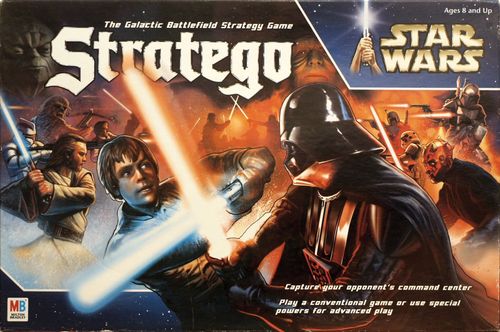
Stratego: Star Wars
Stratego: Star Wars Rulebook
Table of Contents
Table of Contents
- Contents
- Object
- Assembly
- A Look at the Games
- Star Wars Saga - Classic Stratego Set Up
- Gameplay
- Rules for Movement
- Rules for Attack
- Captured Pieces
- Strategy Hints
- Winning the Game
- Advanced Gameplay: The Star Wars Saga - With Special Powers
- Rise of the Empire (Episodes I and II)
- Rebellion (Episodes IV, V, and VI)
Contents
Gameboard, 40 Blue Pieces, 40 Gray Pieces, Label Sheet.
Object
To capture your opponent's Command Center, represented by the Lightsaber.
Assembly
- Remove the blue and gray pieces from the plastic bags. Discard the bags.
- Following the instructions on the label sheet, apply the labels to the pieces.
A Look at the Games
Stratego - The Star Wars Edition features 4 versions of play:
- The Star Wars Saga - Classic Stratego - This version uses all 80 pieces, and features characters from the 5 episodes of the Star Wars Saga, fighting side-by-side, in a classic battle of good against evil. The gameplay is the same as the classic game of Stratego.
- The Star Wars Saga - With Special Powers - The gameplay is the same as The Star Wars Saga, but certain pieces have been given additional special powers.
- Rise of the Empire (Episodes I and II) - This version gives players the opportunity to re-create the action and excitement featured in the most recent Star Wars films. The additional special powers are used in this game.
- Rebellion (Episodes IV, V, and VI) - This game re-creates the characters and scenarios featured in the original classic Star Wars Trilogy. The additional special powers are used in this game.
Star Wars Saga - Classic Stratego Set Up
- Hide "The Force" piece (gray) in one hand and the "Dark Side" piece (blue) in the other. Your opponent chooses a hand and plays with the color army the selected piece designates. The other color army is yours.
- Place the gameboard on a level surface between you and your opponent with the Stratego - Star Wars logo facing each of you. Make sure the pictures on the edge of the gameboard match those in your army.
- Set up your armies using the rules for movement and attacking as well as the strategy hints (see Strategy Hints below). These rules and hints will help guide your decisions.
- Place your pieces on the gameboard. The labeled side faces you, so your opponent cannot see the rank of your pieces. Your opponent does the same.
- Only one piece can occupy a square. Place them anywhere in the first four rows on your side of the gameboard. The two middle rows are left unoccupied at the start of the game.
Gameplay
You and your opponent alternate turns. The Dark Side (blue pieces) moves first.
On your turn, you must do one of the following:
- Move one of your playing pieces to an open adjacent space, or
- Attack one of your opponent's playing pieces.
NOTE: If you cannot do either, the game is over and you lose.
Rules for Movement
IMPORTANT NOTE: Thermal Detonator pieces (ranked B) and the Lightsaber cannot be moved. Once placed, these pieces remain on their original squares for the duration of the game.
- Only one piece can be moved on a turn.
- Pieces move one square at a time, forward, backward, or sideways. (Exception: see Special Trooper Movement Privilege.)
- Pieces cannot move diagonally. They cannot jump over another piece, and they cannot move onto a square already occupied by another piece (unless attacking; see Rules for Attack).
- Pieces cannot jump over or move onto the two asteroid fields in the center of the board.
- A piece cannot move back and forth between the same two squares in three consecutive turns.
Special Trooper Movement Privilege
This privilege applies only to pieces with a rank of 2 (Storm Troopers, Battle Droids, Rebel Troopers, and Clone Troopers). Due to their elite training and programming in lightning-fast attacks, these pieces can move any number of open squares, forward, backward, or sideways. Before moving a Special Trooper piece more than one space, you must first reveal that piece to the other player.
At times, you may wish to move your Special Trooper piece one square at a time to confuse your opponent. REMEMBER: Pieces cannot move diagonally, nor can they move over or onto the asteroid fields.
Rules for Attack
IMPORTANT NOTE: The Thermal Detonator and Lightsaber pieces cannot attack.
- Attack Position: When a blue and gray piece occupy adjacent spaces, either back-to-back, side-to-side, or face-to-face, they are in an Attack Position. (Pieces that are only diagonally adjacent are not in range.)
- How to Attack: To attack, take your attacking piece and, on your turn, lightly tap your opponent's piece. Then declare the number rank of your attacking piece. Your opponent then declares the number rank of his/her defending piece. The piece with the lower rank is captured and removed from the board. NOTE: Before the start of the game, players may agree to reveal attacking and defending pieces. See Captured Pieces.
- If the attacking piece wins, immediately move it onto the space formerly occupied by the defending piece.
- If the defending piece wins, it stays on the square that it was on when it was attacked.
- If pieces of the same rank battle, both pieces are removed from the game.
- Attacking is always optional.
Special Trooper Attack Privilege
This privilege applies only to pieces with a rank of 2 (Storm Troopers, Battle Droids, Rebel Troopers, and Clone Troopers). These pieces are the only ones that can move and attack on the same turn. REMEMBER: A Special Trooper may move any number of spaces vertically or horizontally (not diagonally) in one direction. It cannot jump over pieces or pass over asteroid fields. It may end its move on a space occupied by an opponent's piece, thereby attacking it immediately.
Special R2 and Sith Droid Attack Privilege
When any piece (except an R2 unit or a Sith Droid, ranked 3) strikes a Thermal Detonator, that piece is destroyed and removed from the board. However, due to their advanced programming and special on-board equipment, R2 units and Sith Droids are capable of diffusing Thermal Detonators. When an R2 unit or a Sith Droid strikes a Thermal Detonator, the Thermal Detonator is diffused, and removed from the gameboard. The R2 unit or Sith Droid then moves immediately onto the Thermal Detonator's space. REMEMBER: Thermal Detonators remain on the same space throughout the game unless they are diffused. Thermal Detonators cannot move or attack.
"Use The Force..."
"The Force" and "Dark Side" (marked with a rank of "S") are special pieces with a unique attack privilege. "The Force" is the only piece that can capture Emperor Palpatine (the blue piece ranked 10), and the "Dark Side" is the only piece that can capture Yoda (the gray piece ranked 10). To do this, "The Force" must be used to attack Emperor Palpatine first, and likewise with the "Dark Side" and Yoda.
If Emperor Palpatine (or Yoda) attacks first, then "The Force" (or the "Dark Side") is removed from the board. This attack privilege only pertains to Emperor Palpatine and Yoda. If "The Force" or the "Dark Side" attacks any other piece, the defending piece, regardless of rank, wins! NOTE: "The Force" and the "Dark Side" have no defense power and if attacked by any opposing piece, are removed immediately from the board.
Captured Pieces
Once a piece is captured, it is immediately removed from the gameboard. There are several ways to handle captured pieces and both players should agree on the method before the game begins. Below are the suggested methods of handling captured pieces.
- Open Play: New players may want to place captured pieces in a location where BOTH players can see them. This will help players keep track of which pieces are still in play.
- Prisoner Play: The player who captures a piece takes it and keeps it secret from the other player.
- Secret Play: Captured pieces are taken back by the player who lost them, and kept secret from the other player.
- Stealth Play: ALL captured pieces are kept facedown, hidden from BOTH players. This forces BOTH players to try to keep track of all captured pieces.
Strategy Hints
- When setting up your pieces, place your Lightsaber somewhere in the back row. Place Thermal Detonators around it for protection. Another strategy is to use Thermal Detonators as corner decoys and hide your Lightsaber in the middle of the back row. Then place a high-ranking piece near it for protection. IMPORTANT: It is usually not a good idea to place Thermal Detonators in the front row. They can block you in.
- Protect your R2 units and Sith Droids! If your opponent has surrounded his/her Lightsaber with Thermal Detonators, you will need one of these later in the game to open up a pathway.
- Place some of your Troopers (Storm Troopers, Battle Droids, Rebel Troopers, Clone Troopers) in the first two rows. Use them to reveal the rank of enemy pieces moving towards you. Keep some Troopers safe and use them later in the game to capture the Lightsaber!
- Place some of your high-ranking pieces in the front line to capture Troopers and other low-ranking pieces.
- Do not move your highest-ranking pieces into unknown enemy territory. You don't want to lose them to a Thermal Detonator.
- Keep "The Force" or the "Dark Side" near your #9 piece. If the enemy #10 piece is nearby, you might be able to lure him over to capture your #9, then you can strike back with "The Force" or the "Dark Side"!
- Once you know you own the highest piece on the board, you can capture anything that moves! Try to remember what pieces have moved during the game.
- Be wary of pieces that have not moved. If you detect a cluster of pieces that have remained stationary throughout the game, they are more than likely the Thermal Detonators and Lightsaber.
Winning the Game
The first player to attack an opponent's Lightsaber captures it and wins the game. If all of your movable pieces have been captured and you cannot move or attack on a turn, you must surrender and declare your opponent the winner.
Advanced Gameplay: The Star Wars Saga - With Special Powers
Due to their advanced equipment and Jedi or Sith training, some of the characters in this game have additional "Special Powers." The guidelines for using Special Powers are:
- Pieces with special powers may either (1) make an ordinary move, or (2) use one of their special powers.
- You must always reveal a piece to an opponent before using its Special Power.
- You may use a Special Power once on your turn, instead of making a standard move.
- Pieces with TWO special powers may use EITHER power on a turn, but they cannot use BOTH powers on the same turn.
The characters with Special Powers are shown on your gameboard near the Stratego - Star Wars logo. The definitions of the powers are:
- Vision - Only the most powerful of the Jedi and Sith can employ Vision to sense the presence of others nearby. A playing piece with Vision, after revealing itself, may force an opposing piece up to 2 squares away, horizontally, vertically, diagonally, or any combination, to reveal itself.
- Charging - A playing piece with Charging may move any number of spaces vertically or horizontally (not diagonally) in one direction. It cannot jump over pieces or pass over asteroid fields. It may end its move on a space occupied by an opponent's piece, thereby attacking it immediately. This is the same as the Special Trooper movement privilege.
- Quickness - Quickness allows a piece to move 2 spaces vertically, horizontally, or any combination. Quickness cannot be used to move diagonally. If the first space on which it lands is occupied by an opponent's piece (causing an attack), it forfeits its second move. It may not jump over pieces or pass over asteroid fields. It may end its move on a space occupied by an opponent's piece, thereby attacking it immediately.
- Leaping - A playing piece with Leaping may jump over any number of adjacent playing pieces and/or asteroid field spaces in a straight line and land on the first empty space. Leaping must be done horizontally or vertically (not diagonally) in one direction. A piece may NOT use Leaping to attack.
- Slashing - A playing piece with Slashing may move any number of spaces diagonally in one direction. It may not jump over pieces or pass over asteroid fields. It may end its turn on a space occupied by an opponent's piece, thereby attacking it immediately.
- Advanced Blaster - A playing piece with an Advanced Blaster is able to destroy an opposing piece without moving onto that piece's space. The Advanced Blaster piece may force any one opposing piece up to two spaces away (vertically, horizontally, or diagonally) to reveal itself. If the revealed piece's rank is lower than that of the Advanced Blaster piece, then the revealed piece is captured. If it is equal to or greater than the Advanced Blaster piece, then it has blocked the attack and nothing happens. NOTE: Pieces with the Advanced Blaster special power CANNOT shoot THROUGH or AROUND other pieces. The shot must be fired in a straight line without any obstacle between the attacking and opposing piece.
Rise of the Empire (Episodes I and II)
This version features only the characters in Episodes I and II. Using only the RED and GREEN labeled pieces as well as "The Force" and "Dark Side" pieces, place your army on your side of the board, anywhere in the 3 rows indicated by the STEEL colored bars. The game is played with special powers in effect. Note: During this version of the game, the back row of each side of the gameboard remains out of play.
Rebellion (Episodes IV, V, and VI)
This version features only the characters in Episodes IV, V, and VI. Using only the BLUE and GREEN labeled pieces, place your army on your side of the board, anywhere in the 3 rows indicated by the STEEL colored bars. The game is played with special powers in effect. Note: During this version of the game, the back row of each side of the gameboard remains out of play.