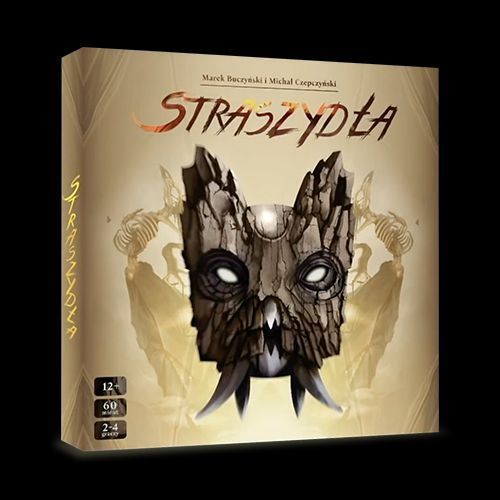
Straszydła
Straszydła Rulebook
Table of Contents
Table of Contents
Setup
Laying out the board
Place the board in the middle of the table. Arrange the tiles so that the Centre district is surrounded on all sides by other districts. The remaining tiles may be arranged freely, taking care that the Suburb tiles are placed on the edges of the board. These will be the starting tiles. Districts are divided into day districts (white stripe) and night districts (black stripe).
Preparing the creature cards
Set aside the creature cards marked with the numbers 3/3 (printed in the source as "3\3"). Divide the remaining creature cards by element (the element symbols are in the bottom right corner of each card), shuffle them, and form 4 stacks of creatures. On top of each stack place one 3/3 creature, which has all 4 elements.
Preparing the imp cards
In the same way, form four stacks of imp cards (face up, divided by element).
Legend
The rulebook's legend identifies the following symbols:
- fear cubes, water element
- fear cubes, air element
- fear cubes, fire element
- fear cubes, earth element
- district where scaring is possible
- imp
Time of day
The player who is most afraid of the coming game becomes the starting player. He places his player card (the day/night card) in front of him. The starting player also chooses the time of day in which the game begins. The starting player places 4 horror cubes on the time-of-day card.
Resource bank
Place next to the board all the fear cubes (green, orange, purple, blue), the horror cubes (black) and the white cubes. (The source setup text lists the white cubes as "action (white)"; the rest of the rulebook refers to them consistently as the white energy cubes, so they are treated as energy cubes here.)
Player resources
Shuffle the pact cards and deal one to each player. Do not show your pact card to the other players. The pact cards show your victory conditions: the game ends when, at the end of one of the times of day, one of you has gathered and fed 5 creatures (of elements matching the symbols on your pact card).
Keep at hand 3 movement tokens and the help card in the matching colour. Then, starting with the starting player, each player takes one 3/3 creature. Each creature that arrives with you brings 3 white energy cubes. Take one black horror cube from the bank. All these resources are open and visible to the other players.
You are now ready to begin the game.
Overview of Play
The goal of the game is to acquire (summon or buy) and feed the creatures you need as quickly as possible. Each of you must gather a different set of creatures. Which creatures you need you read, in secret, from your drawn pact card.
The game lasts several days and nights. Each time of day consists of 4 rounds (turns). In each round you move around the board and perform actions in the district where your movement ends. First everyone moves, and then you perform the remaining actions.
Each district produces fear cubes (in one of four colours), which are food for the creatures and which you collect. In some districts you can scare (thanks to which you have a chance to collect extra cubes), and in others you can summon an imp, which will help you.
If you end your movement in a district where another player is, you will have to duel, because only one player can use the resources there.
At the end of each day you must feed your creatures, or they will flee.
Game Notes
- Ending each of your actions in the chosen district, always place a STOP marker there.
- Horror cubes can be a great help, especially at the end of the game, when you have to feed many creatures.
- You may exchange each imp for one fear cube.
- Summoning a creature takes place at the beginning of the day. This means you have 4 full moves to feed it.
- When buying or summoning a creature, remember to take white energy cubes from the bank.
Round Structure
Time control
Each time of day consists of 4 rounds (turns).
At the beginning of each round the starting player removes one cube from the day/night card and returns it to the bank.
Taking the last cube means that this is the last round of that time of day. If the next cube cannot be removed because the card is empty, the starting player turns the card over, places 4 horror cubes on it, and passes the card to the next player, who becomes the starting player. The time of day has changed.
After the time of day changes, the starting player removes all blockade markers from the board.
Replenishing resources
The starting player replenishes the resources on the board. New resources (fear cubes in the matching colours) appear on all spaces that need replenishing, that is, on those matching the current time of day. The starting player places cubes in the appropriate number on all districts, regardless of whether cubes are already on them or not (for example, if they were not collected earlier).
Planning moves
Plan your move in secret, covering it with your help card. Place the tokens from left to right, directing your pawns. Note that each player plans from their own perspective. You may move in a straight line and diagonally.
When you are ready, reveal your tokens. From that moment you may not change your plan.
Moving
Each player moves their pawn across the board, starting with the starting player. You must complete the whole set of moves.
If a blockade marker lies on a district, you may not enter that district or pass through it.
If during your move you reach a suburb, you may automatically move to any other suburb and continue your move.
You may pass through districts occupied by other players.
If for some reason you cannot move (for example because of blockades), you may move to any suburb, at the cost of one arrow.
Example. The first round of the day begins. Przemo, as the starting player, returns a horror cube to the bank. 1 As the starting player, he collects the STOP markers from all districts 2 and replenishes the fear cubes on the day districts. 3 Unfortunately Przemo does not keep track and collects the markers carelessly: one marker is left on one of the spaces. 4 Przemo wants to reach "Niespokojny lasek" (Restless Grove). He plans a route around a blocked district (Przemo doesn't keep track!), laying out the tokens that show his path, 5 and then makes that move. 6 After all players have finished their movement, because he is the only player in "Niespokojny lasek", he takes the fear cubes available there. 7
Actions
Each player may perform any number of the actions listed below, in the district where their pawn stands.
Actions allowed only on marked districts:
- Summoning an imp
- Scaring
Actions allowed on all districts:
- Collecting resources
- Trade / exchange
- Buying a creature
After performing all actions (at the end of each round), players place blockade markers on the districts.
Scaring
Scaring is a way to gain extra fear cubes. To scare successfully you must pass a scaring test. To do so:
- Take as many dice as you have creatures and sum their strength (day or night strength, depending on the time of day).
- Roll the dice and add the results together.
- Compare the total of the rolled pips with the combined strength of your creatures.
- Check the effect of the scaring on your help card and take the correct number of fear cubes (in the colour of the district you are in).
You may modify the results of your roll. For each energy cube you discard, change the result on a chosen die by 1 (for example, you may change a 5 to a 4 or a 6). There is no limit to the number of energy cubes you may spend. You may change a chosen die several times, paying the full cost each time.
Regardless of the result of the scaring test, take one horror cube for every 6 rolled, and return one horror cube to the bank for every 1 rolled. It does not matter whether a 1 or a 6 came up on the die or whether the value was modified; only the final number of sixes and ones counts.
Example. Syla sums the night strength of her 4 creatures and gets 14. 1 From the table she reads that if she hits the exact number she gets 3 cubes. 2 She rolls 4 dice and gets 6, 1, 5, 4. 3 From the table it follows that with a difference of 2 points she gets only one cube. 4 Syla decides to keep the 6 (she gets a horror cube for it). She discards 1 energy cube and changes a 1 to a 2, avoiding the loss of a horror cube. 5 She now has 17 points, so she needs 3 more to reach 14. She pays 2 energy cubes and changes a 5 to a 3. 6 Paying the next cube, she changes a 4 to a 3 7 and has exactly 14 points. Syla takes 3 purple cubes 8 and one horror cube. 9
Collecting resources
If you are the only player in a district, take all the resources available there. If there are more of you, you must fight a duel.
Duels
To use the benefits of a district, only one person may be in it. If it happens that more than one player ended their movement there, you must fight a duel. The winner stays in the district and the losers must withdraw.
Regardless of how many players are in the district, a duel is always a fight between two players. The loser is forced to withdraw, and the winner will fight the next challenger.
If a duel is needed, take 2 dice each.
Then add together the strength of all your creatures (taking into account the time of day). The player whose total is higher receives a third die in addition. If the strength totals are equal, both players roll only two dice.
Each player rolls their dice and arranges them from highest to lowest. Then you compare them in pairs (starting from the highest results). For each pair of dice, the player whose die has the higher value succeeds. The winner of the whole fight is the player who had more successes.
The winner stays in the district. The loser must withdraw to one of the adjacent spaces (of course, one onto which movement is allowed). Which space the loser withdraws to depends on the winner: the winner may indicate such a space, or may allow the loser to choose. If the loser uses the second option, they receive a horror cube from the bank.
If the loser withdraws into a district where another player is, they will have to fight a further duel. This means that the resources of that space may only be taken after all duels are finished.
After the dice are set, each player decides in secret how many energy cubes they want to spend on changing the result. The players then simultaneously reveal the energy cubes. In this phase of the duel only the absolute difference in the number of cubes counts. If both participants declared the same number, the result of the duel does not change. The player who declared more may change the value of the rolled dice by the difference in advantage.
All cubes used in the duel are discarded to the bank.
Example. Przemo, Syla and Witek end their movement in the same district. To decide the winner they must fight two duels. The first to enter the district was Przemo, 1 then Syla, 2 and last Witek. 3 First Przemo will fight Syla, and the winner of that duel will fight Witek. 4 Each of them takes 2 dice. It is day, so the strength of the creatures on the white spaces counts. Syla's total is 5 5 and Przemo's is 7, so Przemo gets an extra die. 6 Przemo rolls 3, 5, 3, and Syla rolls 6 and 5. They then arrange their dice from highest to lowest and resolve the duel. In the first column Syla wins (6:5), 7 in the second column she also wins (5:3). 8 In the third Syla has no die, so Przemo wins automatically (3:0). 9 The whole duel is won by Syla (2:1), and she stays in the district. Roll decently, don't be like Przemo!
Example. Przemo and Syla plan modifications to the result in secret. Once the numbers of energy cubes are revealed, Syla has declared 2 cubes and Przemo 3. Because only the difference counts, Przemo can change the result by only 1. 10 He therefore cannot reverse the outcome of the duel. Przemo and Syla discard all the cubes used. 11 Be generous, don't be like Przemo!
Syla sees that a neighbouring district holds an orange fear cube. She can either let Przemo choose the space he retreats to, or decide for him. Since Syla cares about horror cubes, she gives Przemo the choice, and in return receives a horror cube from the bank. 12
Now it is Witek's turn. The duel with him is fought under the same rules as the duel with Przemo.
Summoning and Feeding
Summoning imps
In some districts (marked with the icon) you may summon imps. Summoning an imp consists of taking an imp from one of the stacks. Take an imp from the stack matching the element of the fear cubes produced in the district.
There is no limit to the number of imps you may hold.
All imps are open: keep them face up beside your creatures.
You may use the help offered by imps at any moment of the game. After using an imp, place it at the bottom of the appropriate stack.
Important to remember: even at night you may summon an imp in a day district, and vice versa.
Summoning creatures
At the end of the fourth round of each time of day (when there are no cubes left on the day/night card), you must summon creatures from the districts where you finished.
The starting player goes first. They take the first creature card from the stack with the matching element. The other players do the same in turn.
Then draw energy cubes equal to the strength of the creature in the current time of day.
Time for feeding and summoning
If the starting player took the last cube from the time-of-day card, this means the time of day is nearing its end. The time for feeding and summoning creatures has come.
Feeding creatures
Each player must feed their creatures (unless they are willing to lose them). A creature feeds on fear cubes of its matching colour. How many fear cubes you must provide depends on its strength. This means that some creatures will eat more at night and some during the day.
Starting creatures may feed on different cubes. It does not matter which cubes you give them, as long as they are of the same colour (during the first feeding they may be, for example, orange, and during the second, purple).
If you do not have enough cubes to feed a creature, discard that creature from the game. Remember, however, that you can always try to obtain the right cubes through trade.
Example. Syla needs 14 cubes for feeding: 4 purple for Wroniec and 4 green for Borowy. 10 Strzyga and Latarnik each require 3 cubes: any cubes, but all of the same colour. Syla discards the cubes for Borowy, Strzyga (purple) and Latarnik (orange). 11 For Wroniec she has only 2 purple cubes. She exchanges 2 blue cubes and 1 white cube for 1 purple cube, 12 but still lacks 1 cube. Syla must give up Wroniec. Suddenly Przemo points out to Syla that for 4 horror cubes she can feed one creature for free. 13 Syla pays 4 horror cubes and Wroniec is saved. 14 (4+3+3+4=14). Do not help others! Don't be like Przemo!
Horror Cubes
During the game you gather horror cubes. You may use them at any moment of the game.
Discard horror cubes to the resource bank and perform an action.
Trade and Exchange
You may exchange all cubes except horror cubes.
At any moment of the game you may exchange your cubes at the bank for other resources.
You may discard 3 cubes of your choice to the bank and take one cube of a colour of your choice. You may repeat this action any number of times.
You may discard 3 cubes of your choice to the bank and take an imp from the top of any stack.
You may discard to the bank a number of cubes equal to the sum of the day and night strength of the creature on top of any stack, and take that creature.
Buying a Creature
At any moment of your turn (including during feeding) you may buy one of the creatures.
Pay the bank the sum of its day and night strength using any cubes except horror cubes.
The new creature brings with it a number of energy cubes equal to its strength in the current time of day.
Who Wins
The game ends with the victory of the player who first fulfils the condition they drew, namely feeding, at the end of a time of day or night, the creatures needed to complete their mission.
Variant: Two Players
The starting player removes the district blockade markers after 2 rounds have passed (a full day and night).
Note on the source: the two-player variant paragraph appears twice in the printed rulebook (on the first page of the rules). It is transcribed once here. The printed text also contains the typo "pov" for "po" in the second copy, which is not reproduced.