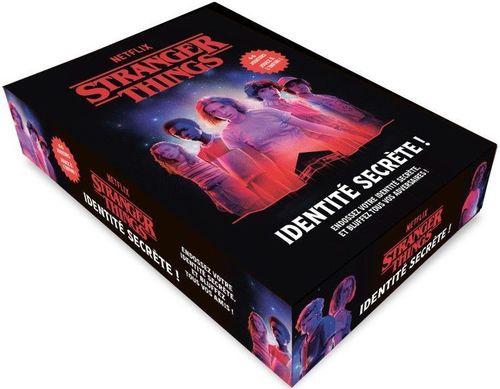
Stranger Things: Identité secrète
Stranger Things: Identité secrète Rulebook
Table of Contents
Table of Contents
But du jeu (Goal of the Game)
To win, you must do all of the following at once:
- Complete your objective before the others.
- Prevent the Heroes from reaching the darkness of the Upside Down.
- Prevent the Demogorgon from reaching Hawkins School.
Contenu de la boîte (Contents of the Box)
- 1 game board
- 1 HÉROS (Hero) pawn
- 1 DEMOGORGON pawn
- 50 "action" cards
- 12 "objective / corruption scale" cards
- 1 rulebook
- 6 "character" cards
Mise en place du jeu (Setup)
1 - Deal 1 "character" card to each player, who looks at it and places it face up in front of them. Unused cards are returned to the box.
2 - Deal 2 "objective / corruption scale" cards to each player. Each player chooses one, which they must keep secret; the others are returned to the box without anyone looking at them. Once a player has read their objective, they turn the card face down and slide it UNDER their "character" card: the player tracks their corruption level by covering/uncovering the rungs as the game goes on. The highest corruption level is the "possessed" level.
3 - Deal 2 "action" cards to each player, and form a face-down draw pile with all the other "action" cards.
4 - The youngest player starts.
Game option
To determine objectives, you may instead shuffle all the "objective" cards, then discard 6 of them face down into the box. The oldest player selects one of them and passes the remaining cards to their neighbour, who selects one on their turn, and so on. When everyone has an objective, discard any remaining face-down cards into the box. Continue setup at step 3.
Tour de jeu (Turn Structure)
Each turn has 3 phases, after which play passes to the next player (to the right).
1 - Resources: all players take 1 "action" card from the draw pile, starting with the active player and going clockwise. In addition, the active player stands up their character card to gain access to its personality action.
2 - Mystery: A. Each player other than the active player places one "action" card from their hand face down in the centre of the table and explains why the active player should (or should not) select it, without saying what it is. B. The active player then selects 2 of the proposed cards without looking at them, shuffles them, and reveals them to everyone so that their effects are applied one at a time, in the order the active player chooses. Unselected cards are discarded face down next to the draw pile.
3 - Exhaustion: the active player discards 1 "action" card from their hand, keeping it face down.
Note: When the draw pile is empty, shuffle the discard pile to reform it.
Attention au bluff ! (Beware of Bluffing!)
During the Mystery phase, players must persuade the active player to select or not select their card. This discussion phase is important and evolves as the game goes on.
Indeed, if at first a player persuaded the active player to take their card when it had negative effects, and the other players noticed, it will be complicated for them to convince the active player again. But was that card really negative, or did it simply not advance a pawn in the direction of its objective, without acting on behalf of the Mind Flayer? So, should the active player take their next card? Or, when a player says not to select their next card, should it be believed? Is this card positive or not? Or, a player may offer positive cards to win the trust of the others, in order to betray everyone later.
By watching the cards revealed over the course of the game, you may be able to guess the players' objectives, but nothing is ever certain.
Personnalité (Personality)
Each player may use the action described on their "character" card 1 time per round of the table (1 fois par tour de table), whenever they wish. They then tilt their "character" card a quarter turn (as well as the "corruption scale" card beneath it) so that everyone can see their personality has been used. Bonuses on "character" cards apply to the text in bold.
Example: Just before another player's Mystery phase, the player playing Dustin decides to use his personality action. He tilts his "character" and "objective / corruption scale" cards a quarter turn so that everyone sees he has used it. Then, since the HÉROS pawn is on a Home space (Maison), he draws 3 cards from the discard pile (2 base +1 because he is on a Home space). He discovers that one of the players discarded a card that removes corruption from everyone: is that player a traitor? He decides to select a card that quickly brings the HÉROS pawn closer to the laboratory to reach his objective, and discards the two other cards he looked at, plus one more from his hand. He cannot use his personality action again until he has completed the Resource phase as active player.
Mouvement des pions (Movement of Pawns)
The HÉROS pawn starts on the École (School) space and the DEMOGORGON pawn starts on the Ténèbres (Darkness) space.
The active player moves the pawns across the board following the instructions of the "action" cards revealed during phase 2.
Note: it is possible to go from the Mirkwood Forest to Château Byers, but not the reverse.
Example: The player playing Eleven has just selected two cards from the other players during her Mystery phase. She shuffles them without looking at them. One of them moves the HÉROS pawn 2 spaces toward the Ténèbres, and the other moves it 1 space toward the École. Her "objective" card first requires her to go into the Upside Down and then return to a Home space, so this is perfect: she plays the first card with a movement of 2 spaces and then the second card with the 1-space movement, which lets her return to the Laboratoire d'Hawkins. Her objective is fulfilled, and she has won the game!
Corruption
When a character receives corruption effects, the player slides their "character" card over the "corruption scale" on the back of their "objective" card to reveal the corruption level where they stand. A player is POSSESSED (POSSÉDÉ) by the Mind Flayer when the red line on this card appears. A POSSESSED player remains so at least until the end of their turn.
- When the revealed cards show corruption points gained or lost, all characters are affected.
- An active player whose character is POSSESSED when "action" cards are revealed in phase 2 no longer counts the movements of the HÉROS pawn toward the École.
- If the HÉROS and DEMOGORGON pawns are on the same space at the start of the active player's turn, the active player gains +1 corruption level.
- If the HÉROS pawn is on a Monde à l'Envers (Upside Down) space at the start of the active player's turn, the active player gains +1 corruption level.
Example: The active player playing Lucas starts his turn in the Upside Down. Unlucky, he gains +1 corruption level and becomes POSSESSED at the same time. He takes his turn normally. He reveals the cards during the Mystery phase, and one of them lets him lower his corruption by 1: he goes back down to level 4 and is no longer POSSESSED, but this only takes effect at the end of his turn. He therefore still cannot move the HÉROS pawn toward the École. Too bad, because it would have let him reach the Chez Will space and fulfill his objective.
Fin de partie (End of the Game)
To win the game, a player must reach their objective. The objective can only be completed starting from the active player's 2nd turn (that is, after 1 full round of the table).
- The game ends if a player fulfils their objective during their turn: they and any other players who have the same objective win.
- The game ends if the HÉROS pawn reaches the Ténèbres (Darkness) space: the character with the "possessed" objective wins. If nobody had this objective, everyone loses.
- The game ends if the DEMOGORGON pawn arrives on the École (School) space: everyone loses.
Example: Max's player is the youngest, so they start the game. After a Resource phase, they begin the Mystery phase. Their right-hand neighbour states that their card will move the HÉROS pawn in a direction that pleases "Max la fonceuse" (Max the Go-Getter). The next player says it is better to ignore the card, because it is really not "cool", and the last player says: "Frankly, it's not the best card, but you have to make some sacrifices for everyone's good."
The active player decides to take the other players at their word, at least to assess their honesty: they take the cards underlined by "Max la fonceuse" and "quelques sacrifices". They set the "bad card" face down next to the draw pile, shuffle the 2 remaining cards and reveal them. One sends the HÉROS directly to the Forêt de Mirkwood (Mirkwood Forest) space, and the other moves the HÉROS 2 spaces toward the Ténèbres, moves the DEMOGORGON 2 spaces toward the École, and gives +2 corruption levels to everyone. The active player's objective is to be on the Mirkwood Forest space while no character has more than 3 corruption (objective "Se cacher", "Hide"). But it is the first turn, so they cannot fulfil their objective yet; they will have to wait for their next turn to return to the Mirkwood Forest space. They play the cards in the order in which they were revealed and prefer to keep their personality action for later, in case they need it. That ends their turn.
FAQ
Can a POSSESSED character become unpossessed? No. A character remains possessed at least until the end of their turn as active player. However, if a card lowers the corruption level before the end of their turn, they are no longer possessed.
Can I use my personality action just before taking my turn? Yes. You tilt your card, then straighten it during your Resource phase at the start of your turn as active player.
Can I use my personality action during another active player's turn? Yes. You tilt your card, then straighten it during your Resource phase as active player. Your action may take place between two phases of the active player's turn, between the revealing of two cards in the Mystery phase, or between two turns of other players.
Can Eleven's personality action select two different pawns? Yes. Depending on the number of times Eleven can cancel a pawn movement during her personality action, she can cancel the movement of the HÉROS and DEMOGORGON pawns on the same card or on different cards, or even cancel only the DEMOGORGON's movement on both cards. If she could use an additional movement cancellation, she is not obliged to use it.
Can Will's personality action affect several players? Yes. Depending on the number of cards to exchange, the player of Will may take one card from one player's hand, another from a different player's hand, or several from the same hand of another player. They must then give back as many cards from their own hand.
Can Mike's personality action affect several players? No. Mike can only "heal" one character at a time.