Strands
Strands Rulebook
Table of Contents
Table of Contents
Overview
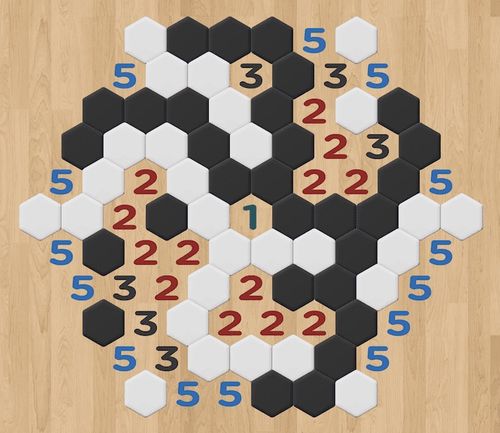
Strands is a two-player abstract strategy game played on a hexagonal board whose spaces are printed with numbers. There are no dice, cards, or hidden information — the entire contest is about how you divide your stones between the board's numbered regions as the game unfolds.
One player plays white stones, the other black.
The Board
The board starts empty. Its spaces are printed with numbers from 1 up to 6 (the exact set of numbers depends on the board), arranged in rings running from the center out to the edge. The numbers tell you how many stones you are allowed to place there in a single turn — see How to Play below.
Strands can be played on several different boards:
- A small board, sized for kids and players new to the game.
- A larger board, sized for game enthusiasts, with more rings of numbered spaces.
Board Game Arena additionally offers several other pre-designed boards, plus randomly generated boards, for players who want more variety.
The board's center spaces are numbered lower and are the most powerful places to hold stones, because central spaces touch more of the board's other spaces. Spaces further from the center are numbered higher, letting you place more stones there per turn to compensate for their lower individual value. See The Main Strategic Dilemma.
Setup
- Set out the empty board.
- Decide who plays white stones and who plays black stones.
- Black covers any one space marked "2" with a black stone. This is the only move of the game with a fixed, forced shape — every later turn is a free choice.
How to Play
From then on, starting with White, the players take turns.
On your turn, cover up to X empty spaces marked "X". For example, you could cover any 3 empty spaces marked "3" with your stones.
- You choose which number X you want to play, then choose which of the empty spaces bearing that number you cover.
- You may cover any number of empty spaces marked "X" up to and including X, but there is never a reason to play fewer than the maximum available, so in practice you always cover as many as you can.
- If there are fewer than X empty spaces marked "X" left on the board, and you choose to play that number, you must cover all of the empty spaces that still carry it.
The game ends when the board is full.
Winning the Game
The winner is the player with the largest group of stones when the game ends. A group of stones is a set of same-colored stones that all touch each other.
Resolve ties in this order:
- If the players' largest groups are the same size, whoever has more groups of that size wins.
- If that is also tied, compare the players' second-largest groups, and so on, until you reach a pair of groups that are not the same size. Whoever owns the larger of that pair wins.
The Main Strategic Dilemma
Placing stones near the center of the board gives you the strongest position, because central spaces touch more of the board and help you build a large connected group. Placing stones near the edges lets you cover more spaces per turn, because edge spaces carry higher numbers. Winning Strands means navigating this tradeoff between a few powerful stones and many weaker ones.
Playing an Even Match
To give each player a 50% chance of winning across a session of games, record the score difference after each game. To win the next game, the previous game's winner must finish with a score difference (that is, the gap between the winner's largest-group size and the loser's) that is the same size or larger than the previous game's margin. Otherwise, she loses the match.