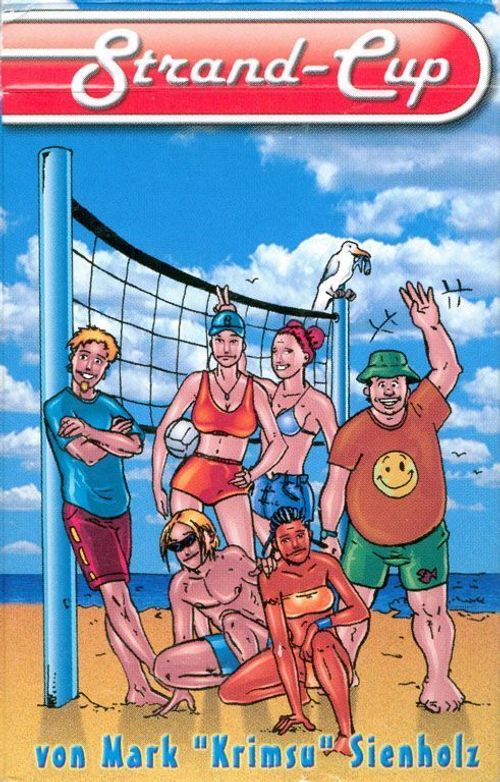
Strand-Cup
Strand-Cup Rulebook
Table of Contents
Table of Contents
Introduction
Strand Cup / Beach Cup
A card game for four, six or eight players in two teams.
Contents: 1 Aufschlag [Serve] card, two scoring cards, 39 action cards (14x Baggern [Forearm Pass], 14x Pritschen [Overhead Pass], 11x Schmettern [Spike]), 8 Block cards, 5 Rettungssprung [Save] cards, 5 special cards.
In addition you need a normal six-sided die.
The game in reality
The game of beach volleyball pits two teams of two players against each other on a sand court. This playground is divided by a net streching over the middle at approximately head level of the players. The objective of the game is to pass the ball over the net so that the opponents are not able to reach it before it hits the ground inside the lines. If the team that won the point in question was serving it scores one point - if it didn't serve, it receives the right to serve and can score from now on until it loses service again.
On your own side the ball may be touched up to three times before being sent back over the net again. The first team to score 15 points (with a lead of two points) wins the set and maybe even the whole match. And of course, everything takes place on the beach.
So much for reality. In this card game, however, there are some small changes:
- We don't play 15 points to win a set, but 10 (that's the way that it is; you just have to face it).
- You can freely decide if you want to play one, two or three sets to win the match. However, the teams should decide upon the victory conditions before the game.
- Mixed teams (you know, men and women together) are allowed.
- Teams can consist not only of two, but also of three or even four persons.
Game preparation
- The teams take their seats on opposite sides of the table.
- Every team receives a scoring card on which the point score will be marked. At the beginning of the match a marker is placed on the 0 (grab whatever is handy: die, coin, cheeseburger, CD player, washing machine).
- One player from each team rolls the die. The team with the higher results receives the Aufschlag [Serve] card which is placed next to one of its players.
- The remaining 57 cards are shuffled and placed face-down in a stack between the two teams. Then every player draws 7 (when playing with 4 players) or 6 (when playing with 6 or 8 players) cards which he takes concealed in his hand.
- And now, let the game begin.
The Action cards
Most of the cards in this game are action cards (Baggern [Forearm Pass], Pritschen [Overhead Pass] and Schmettern [Spike]). On these cards, in the upper left area, you will find the so-called Annahme [Receive] score and beside it (from left to right) the following scores:
- Aufbau [Build-Up] (yellow ball)
- Stellen [Setting] (orange ball) and
- Abschluss [Finish] (red ball)
The play
Using these action cards one team must now play the ball until they pass it over the net into "enemy territory". This finishing move should possibly put the ball in a position where it is unreachable for the opposing team. That is to say that you have to achieve a so-called net score which should be as high as possible (more about this score later on). Every card type has its special advantages:
- Baggern [Forearm pass] cards are especially useful during a build-up.
- Pritschen [Overhead pass] has the advantage when setting a ball for the big finish.
- Schmettern [Spike] is used best to play the ball over the net with as much power as possible. In contrast to the other action cards you can use Schmettern only for the Finish.
The advantages of the different action cards are shown in the relevant scores on the cards. Depending on when the cards are played the different scores are calculated for the net score:
- The card which brings the ball back over the net adds its Abschluss [Finish] score to the net score.
- The card which was used to set the ball for the finish adds its Stellen [Setting] score to the net score.
- And if there was a build-up before the setting the Aufbau [Build-up] score of that card is added to the net score as well.
These scores are added to yield the net score which is used to determine how fast or hard the ball clears the net. And one thing should be noted: the higher the net score, the better.
Receiving the ball
Why is a high net score better? Quite simple: an opposing player trying to reach the ball must play an action card whose Annahme [Receive] score is equal to or greater than the net score.
If the player can manage that, he has successfully reached the ball. He may freely decide whether he passes the ball to his partner or bounces it right back over the net; however, he should listen to his partner's calls. If no one posesses an action card that is good enough to reach the ball it will drop to the ground and the other team scores a point or receives the right to serve. Too complicated? No problem, here is an...
Example
We are playing a two-on-two game (i.e. 4 players): Player A plays a Baggern card (Aufbau 2, Stellen 2, Abschluss 1) and passes the ball to Player B. He plays a Pritschen card (Aufbau 1, Stellen 3, Abschluss 1) and sets the ball for Player A who makes the finish with a Schmettern card (Abschluss 5). That takes the net score up to 5 (Abschluss) + 3 (Stellen) + 2 (Aufbau) = 10.
The opposing team must now try to reach the ball by beating the net score of 10. Player C uses a Baggern card with an Annahme score of 11 (Aufbau 2, Stellen 2, Abschluss 1). He has reached the ball and passes it to Player D who plays the ball back over the net after just two touches with a Pritschen card (Aufbau 1, Stellen 3, Abschluss 1). That gives the ball a net score of 2 (Stellen score by Player C) + 1 (Abschluss score by Player D) = 3 which means that it can be reached quite easily by the other team.
And so on...
Some things to note
- The active team can touch the ball no more than three times (including receiving the ball) before it clears the net again. This means you cannot play more than three cards per team on any given play. No player may touch the ball two times in a row (i.e. play two action cards one after the other).
- Always place the cards from left to right onto the table so that you can without a doubt determine the sequence of cards at the end of the play.
- If a card is placed onto the table, it remains there; no removing or exchanging cards, please!
- Any cards used during the play are thrown onto the discard stack at the end of the point.
Scoring a point / Receiving the serve
You score a point or receive the serve when the opposing team can't reach the ball (i.e. no player has a card with a high enough Annahme score). This might happen if the net score is high enough or if the opposing team runs out of cards. After a score or change of serve new cards are drawn to refill your hands (up to 6 or 7 cards). If the drawing stack is used up, just shuffle the discard stack and use it as the new drawing stack.
The serve
Of course, a normal point doesn't simply start with the ball up in the air, like in our example, but with a serve.
To make a serve that travels all the way from the back of the court over the net and onto the opposing team's side the serving player chooses an action card from his hand. The ball clears the net with a net score equal to the Abschluss score of this action card and must be received as described above. If a player has no card he wants to use for his serve he can discard any one card and roll a die to determine his net score (1-6). The serve must always be performed by the same player until his team loses the right to serve. If they win it back the next player can test his luck; i.e. the right to serve always passes on after a change of service.
The Aufschlag [Serve] card: This card determines which team is serving. It always lies with the serving team, and the arrow points to the player in the opposing team who will next make his serve.
Communication at the table
Some words about communication at the table:
- If you want to talk to your team fellow you may shout whatever you might shout in a real game of beach volleyball: "Take it!", "Over here!", "Giv'em the spike!", "I can't get it!", "I'll get it!" and so on.
- Any calls should be short (this is a fast game, after all).
- You may not make any direct or indirect reference to your own cards (like shouting "Hey! Give it to me! I have a Schmettern card!").
- When you yell at the opposing team you may shout whatever you want: "Take that!", "You sorry loser!", "You'll never get this one!", Hey, sandkisser!" and so on.
Spike, Block, Save
Schmettern [Spike] card: As already noted this card can only be used for a finish or a serve, but is much more effective than any Pritschen or Baggern card then. Spiking a ball is not without risk, however. Every player who uses a Schmettern card must roll a die: if you roll a 1 the ball touches the net and drops to your own half of the court without any chance of saving it. If you roll any other number the ball clears the net and must be received by the opposing team.
Killer-Schmetterball [Killer spike] card: A Schmettern card with an exceptionally high Abschluss score. However, if you roll a 2 on the die, you hit the ball too hard and it will touch the ground behind the base line (giving a point or the right to serve to your opponents!). In such a case the receiving player must roll a die as well: When he rolls 1-3 he misjudges the situation and tries to receive the ball - he plays a card and the play continues. On a 4-6 he realizes just in time that the ball will be flying out of bounds, lets it pass and wins a point or the right to serve for his team.
Block card: Spiked balls (those that have been played over the net with a Schmettern card) can be blocked directly at the net. Any player taking part in the attempt to block the incoming ball may play one of his Block cards and then rolls two dice. The pips of all dice rolls are added. If the total is equal to or greater than the net score the blocking attempt was successful; if it is less than the net score the block has failed: the ball touches the net and drops to your own half of the court without any chance of saving it. A ball that has been successfully blocked can be received by the opposing team by using any action card with an Annahme score equal to/greater than the total of the block. A serve can not be blocked!
Rettungssprung [Save] card: A player can reach any ball regardless of its net or block score by playing a Rettungssprung card. However, such an action is extremely inaccurate and the following player must roll a die to see whether he reaches the ball at all (before using any of his action cards): when rolling 1 or 2 he doesn't reach the ball but can also play a Rettungssprung card to keep the ball in the air. A 3-6 means he reached the ball.
Please note that you can't play a ball back over the net with a Rettungssprung card. Also, a player who has used a Rettungssprung card may not play any other card for the remainder of the play because he needs the time to get back on his feet.
Special cards
Kraftriegel [Power bar]: Is played along with a Schmettern card. Gives a bonus of +2 to any spike or serve that uses a Schmettern card.
Energydrink: The player may draw two cards from the stack at any time he wishes.
Killeraufschlag [Killer serve]: The player who makes the serve may add the pips from a single die roll to his net score.
Blenden [Blinding]: Blinds an opposing player when he tries to receive the ball. He must roll a die before playing a card: when rolling a 1-3 he misses the ball which drops to the ground without any chance of saving it. When he rolls a 4-6 the blinding has no effect and the play continues normally.
Angeschnittener Ball [Curve ball]: The player gives the ball a spin (also possible while serving). This card is played together with an action card. The receiving player must roll a die before playing a card: when rolling a 1-3 he misses the ball which drops to the ground without any chance of saving it. When he rolls a 4-6 the curve ball has no effect and the play continues normally.
The end of the game
The first team to win a previously determined number of sets wins the match. This team can now place the Beach Cup on their mantlepiece at home. But never forget that the opponents will be longing for a rematch as soon as possible.
Alternative: more than two teams
Alternatively: Beach volleyball with more than two teams at the same time!!!
In spite of reality Strand-Cup can be played by more than two teams at the same time. You just have to download another scoring card from our web site or draw one yourself. The right to serve is passed from team to team all taking turns. At the end of any play you have to announce which team's court you were aiming at. Try it; there don't have to be just two teams all the time.
Designer's note
What makes you create a game like this one? Good question. Well, the basic idea was to develop a card game which pits teams against each other and not just single players. In addition to that, winning should be a team effort, without the members knowing about their partners' cards.
I've been looking for a subject for the game and finally found beach volleyball which also allowed for some really nice illustrations. And the best thing about it is that this game transcends reality and enables you (to my knowledge, for the first time ever) to play beach volleyball with three or more teams at the same time. Maybe that doesn't interest anyone at all but I liked that touch very much. So, have fun in the sand...