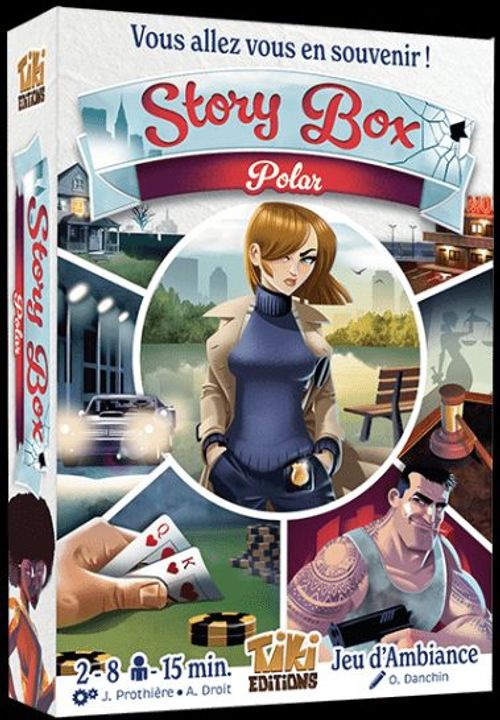
Story Box: Polar
Story Box: Polar Rulebook
Table of Contents
Table of Contents
Components
- 1 rulebook
- 110 illustrated cards
- 1 double-sided illustrated board (Story side / Score side)
- A 2-minute timer (not included; a phone timer works)
Some cards have an icon on their back to help you remember what the illustration shows: Animal, Object, Place, or Character. These icons are only a memory aid. They do not stop you from interpreting the illustrations however you like during the story.
Setup
- Place the board in the centre of the table, with the Story side face up.
- Shuffle the cards. Cut the deck in two. Place the two piles face down on either side of the table so that everyone can easily draw cards.
- Each player takes 3 cards from one of the piles and looks at them secretly.
- Prepare a 2-minute timer.
Overview
The game has two phases: Story and Memory.
- During the Story phase, players stack cards face up while telling a story together.
- During the Memory phase, the stack is turned face down and players try to recall the story in order so they can place the cards correctly.
Step 1: Story
The player who wishes to start the game begins.
- That player plays one of their 3 cards face up onto the board and tells the beginning of a story. This is the first card of the Story pile.
- Start the 2-minute timer.
There are no turns during the Story phase. Anyone around the table may play a card at any time to continue the story. Do not hesitate to interrupt!
When you play a card:
- Place your card face up on the Story pile.
- Tell what you like, as long as it is "linked" to the thread of the story.
- Immediately draw a new card to bring your hand back to 3 cards.
The Story phase ends as soon as the 2 minutes have run out.
The story told will very likely be funny, sometimes serious, sometimes absurd, and often far-fetched, depending on the game.
Step 2: Memory
Return all unplayed cards and the draw pile to the box. They are no longer needed.
The player who played the last card takes the Story pile, turns it face down, and keeps this pile in hand.
Be careful not to mix up the cards of your story!
Turn the board over to its Score side.
Starting with the player holding the pile, and sometimes helped by the back of the card (see "What are these card backs?"), you will try to remember the story.
The player holding the Story pile may:
Try to remember the card alone:
Try to recall the card on top of the pile, or the part of the story that corresponds to it. Then check by turning the card over and place it face up on the matching side of the Score board.
- If your memory is correct, place the card next to +2.
- If your memory is incorrect, place the card next to -1.
Or ask for help:
Are you lost in the story? Ask your teammates for help!
Designate a teammate who thinks (or seems to think) they have the right answer. That teammate must then try to remember the card on top of the pile.
- If their memory is correct, place the card next to +1.
- If their memory is incorrect, place the card next to -1.
Then, this player passes the Story pile to the next player clockwise. It is now that player's turn to try to remember the next card of the Story.
Tip: shift the cards on each side of the Score board so you can see what has already passed.
Example: Débora has just placed the last card of the story. She turns the pile and the board over and tries to remember the first card of the story.
Débora: "Well, I think it was Joe who disappeared." Correct! She places the card in front of +2 and passes the pile to the next player, Alexandre.
Alexandre: "... Wasn't it the card with the morgue?!..." Wrong, it was the cork board. He places the card in front of -1 and passes the pile to the next player, Julien.
Julien: "I'm not sure... I need help!" Débora says she knows, and Julien trusts her: "Go on, tell me!" So Débora says "I had lots of missed calls!" Correct! Julien places the card in front of +1 and passes the pile to the next player, Débora.
Warning: From this point on, players who do not hold the Story pile may only say whether they remember the card or the person who played it. If a teammate gives an answer without having been invited to (see "Ask for help"), immediately turn the card over and check what they said. Then place the card as if you had asked them for help.
Starting with the player holding the pile, continue until the Story pile is empty.
End of the Game and Scoring
When the Story pile is empty, go on to count your points!
Score.
The important thing is to have fun and try to improve your score from game to game. But if you wish, you can refer to this scale:
- 10 or less: If your game were a film title, it would be "The Fatal Tear!"...
- 11 to 20: Not bad for a rookie, but you can do better!
- 21 to 30: You have the eye and the touch!
- 31 to 40: You have well earned your promotion, Inspector!
- 41 to 50: Nothing better than your team to put the criminals behind bars!
- 51 and up: Congratulations, with you, investigations are solved in no time!
What Are These Card Backs?
Most cards have a neutral back. They can be of any kind and give no clue at all.
Some cards have an icon on the back to help you remember the nature of the illustration: Animal, Object, Place, or Character. These icons are only a help and do not prevent you from interpreting the illustrations as you wish during the story.
Expert Variant: "Find the Culprit!"
During setup, set aside the 12 cards bearing the Character icon.
- Shuffle them and place one card face down on the Story board.
- Then place 4 cards face down on one side of the table. These are the Suspects.
- Shuffle the 7 remaining cards together with the rest of the cards to form the Story pile.
- To start the game, designate one person to be the Inspector for this game.
The Inspector turns over the Character card placed on the Story board and tells what they wish happened to that character.
Example: "Bill was murdered!", "Johanna's jewels have disappeared!", etc.
Then continue as in the standard game until the end of the Memory phase.
When the Memory phase is finished:
- Turn the 4 Suspect cards that were set aside face up and look at them.
- The Inspector takes these 4 cards in hand.
- The Inspector places face down on the table the Character card they judge to be guilty, and keeps the 3 "innocent" cards in hand.
The Blues (the other players) must agree on innocence for the characters one by one. They announce their choice to the Inspector:
- If the character is innocent: place the card above +2.
- If the character is guilty: place this card, along with all remaining cards, next to -1.
When only 2 suspects remain:
- If the character is innocent: place this card, and the guilty card, above +2.
- If the character is guilty: place this card and the guilty card next to -1.
THE END!
Count your points and check your level of expertise.