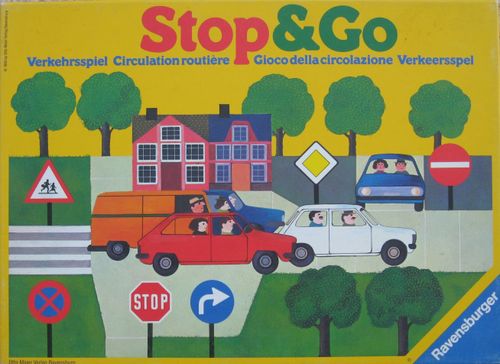
Stop & Go
Stop & Go Rulebook
Table of Contents
Table of Contents
Destination
The players have to collect destination-cards at the city's main buildings. The cards have the names of these buildings on them and are numbered from 1-25, as are their locations on the city map.
To Begin
Each player chooses a motor-car and places it in the market-place in the middle of the old part of the city, from which point the race begins. A caller is chosen, who is in charge of the destination-cards.
To Move
The players dice in turn. After each throw the car can move forward as many spaces as shown on the die. One can, however, either because of a hindrance or because it seems more advantageous, move fewer spaces, or can remain standing. Thus a player who throws a three can move 1-3 spaces, or, can stay in the same place. The destination-card may only be collected once the player's car has actually been driven onto the numbered space. Extra points are lost. Only after the next throw the car is permitted to continue its journey in any direction desired.
Crossroads
At the crossroads one may turn in any direction desired. U-turns are only allowed on the market-place.
Passing One Another
Each space, other than the market-place, may be occupied by only one car at a time. If one has enough points, however, one can pass another car going in either direction.
New Destination
As soon as the destination-card has been taken by the first driver to reach that destination, the caller turns over another one, lays it in its proper place — and the chase begins anew. Each car has to continue from where it stands at that moment. Dicing continues in turn.
Winner
The game ends when all the destination-cards have been collected. The player who has collected most of them is the winner. The players can also agree beforehand that the numbers on the destination-cards should be added together and that the player with the highest score is the winner.
If a shorter game is desired it can be agreed upon in advance to leave out some of the destination-cards.
Observation of Traffic Regulations
The road-signs and the changing traffic-lights at the crossroads have to be duly observed. Only those signs apply which, from the driver's point of view, are placed on the right-hand-side of the road. At each road-sign the direction for which it is valid is indicated by a small arrow. If a player violates a traffic regulation he must return to his last stopping-place and receives a fine-ticket. Anyone who has received three tickets must forego three turns in order to study the traffic regulations.
Traffic-Lights
Each time a 1 or a 6 is thrown, the dial which changes the traffic-lights is given one turn in the direction indicated by the arrow, before the player makes his move.
Explanation of Road-Signs
You will find the explanation of the road-signs on the last two pages. The alternative signs still in use in some countries are also shown.
Traffic Signs — Dial Signs
Each row lists the sign, its real meaning (English column of the printed table) and its meaning in the game. Where the game column reads "Ebenso / identique / identico / the same / hetzelfde", the meaning in the game is the same as the real meaning.
- Red disc. Real meaning: "Halt!" / "Stop!" (printed in five languages). Meaning in the game: the same.
- Green disc. Real meaning: "Freie Fahrt!" / "Voie libre!" / "Via libera!" / "Go!" / "Doorrijden!". Meaning in the game: the same.
- Red ring (empty circle). Real meaning: "Closed for all vehicles" (the Dutch line adds "except pedestrians"). Meaning in the game: the same.
- Red disc with white horizontal bar. Real meaning: "No entry (on one-way streets)". Meaning in the game: the same.
- Red-bordered inverted triangle. Real meaning: "Major road ahead" (priority sign). Meaning in the game: "You may not cross if there is any car waiting to cross from left or right."
Traffic Signs — Further Signs
- Blue disc with red border and red diagonal slash. Real meaning: "No waiting" (restricted parking). Meaning in the game: "You may drive through the spaces with these signs, but you may not stop on them."
- Red ring with a car. Real meaning: "All motor cars prohibited." Meaning in the game: the same.
- Blue rectangle with a white arrow ("Einbahnstraße"). Real meaning: "One-way street." Meaning in the game: the same.
- Blue square with a white arrow pointing up. Real meaning: "One-way street" (second form of the one-way sign). Meaning in the game: the same.
- Red octagon "STOP" (with the note "im Ausland z. T. noch gültig", i.e. still valid in some countries abroad). Real meaning: "Stop and Give Way." Meaning in the game: "Stop at crossing. Proceed only after the next throw."
- Red-bordered triangle "STOP" (alternative sign). Real meaning: "Stop and Give Way." Meaning in the game: "Stop at crossing. Proceed only after the next throw."
- Blue circle with straight-and-right arrows. Real meaning: "Straight on or turn right (compulsory)." Meaning in the game: the same.
- Red ring with a black turning arrow. Real meaning: the printed table lists this sign beside the blue compulsory-direction sign, with no separate English label for it. Meaning in the game: the same as the compulsory-direction row above. (Judgment call: the transcriber could not read a separate label for this icon on the scan.)