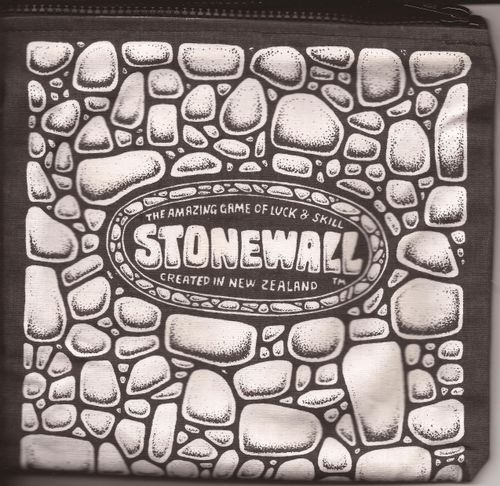
Stonewall (1996)
Stonewall (1996) Rulebook
Table of Contents
Table of Contents
Welcome to Stonewall
Your Stonewall game should include one cloth board, four playing pieces, one dice and 60 walls (24 single, 24 double and 12 triple).
The Object
Move your playing piece from your Start/Finish square through the diagonally opposite Change a Wall corner and back to your Start/Finish square. Place walls as you go in order to STONEWALL your opponent(s) by lengthening their path(s) or protecting your own. The first one back to their Start/Finish square is the WINNER. The exact number does not have to be rolled to get home.
To Set Up Stonewall
Place your chosen playing piece on the matching Start/Finish square. When two people are playing it is best to choose adjacent corners. Divide the single, double and triple walls equally between all players. (Take care that this is done fairly to avoid any pre-game tension.)
To Play Stonewall
Each player rolls the dice - highest dice takes first turn. Play then follows in a clockwise direction. A turn consists of: a roll, a move and a wall placement option.
Roll the dice and move your playing piece the number of squares indicated. (When starting count the Change a Wall square as one). If you roll a four you have another turn. There is no limit to how many fours you can roll.
Move your playing piece in any collection of straight lines - not diagonally and not through or on to the same square twice within one dice roll. There are eight corner walls marked on the board which are permanent walls (#1 on diagram) these, or any other walls placed on the board, may not be moved through.
Squares marked with arrows must be moved on to and off from in the direction indicated (#2). Your playing piece may move over an opponent but if your move ends on the same square as their playing piece your opponent must start again. This is called STOMPING!
Count the Roll Again Square as one if you choose or are forced to move through it. If your move ends on the Roll Again Square you have another Turn. If you land on the Roll Again Square with a four you have another two Turns! You may exit by any other doorway unless they are blocked by a placed wall. You may only exit through the same doorway you entered by if your move ended on the Roll Again Square.
Placing a Wall
At the end of each Turn you have the option of placing one wall of any length on the board's black guide lines to restrict access to one or more squares (#3). You should state your intention of doing this before the next player rolls the dice. A placed wall can not lie partially off the board (#4), or on top of permanent walls (#5). A wall can never be placed in a position which completely denies access of any playing piece to any square on the board (#6). It is important when placing or changing a wall that you are not closing off any players path from start to finish (#7-8).
(Board diagram not reproduced.)
KEY
- Permanent walls (#1)
- One-way corners (#2)
- Placed walls (#3)
- Illegal walls (#4-8)
Changing a Wall
Once your playing piece passes through or lands on the diagonally opposite Change a Wall corner square you must move or remove any one wall from the board. This replaces the wall placement option for that turn. This can be done only once in a game unless you have been stomped and started again.
In this illustration, player piece A, having reached the diagonally opposite corner from its start, must change a wall. If wall #8 is changed to position #9 not only would playing piece B (who was four steps from winning) have a considerably longer path home but playing piece A's path (through playing piece B's starting corner) would be far shorter.
(Illustration not reproduced. It shows the board with B's START and A's START corners and the wall positions #8 and #9.)
You do not have to move through the Roll Again square or any corner square except your diagonal opposite. You may move through the other corners but you can only change a wall when passing the corner diagonally opposite to your starting point.
May the Fours Be With You!
Stonewall Travellers Edition boards and bags are made from pre-shrunk cotton and printed with heat-set dyes. If they require washing a cold-machine wash is recommended.