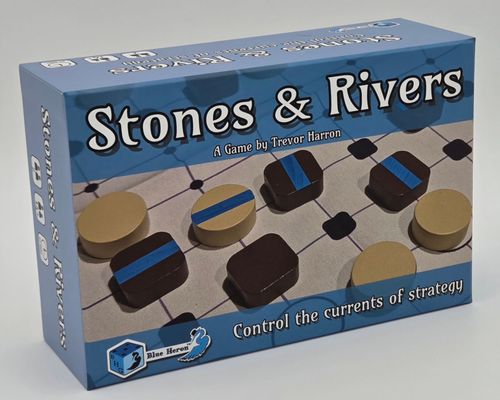
Stones & Rivers
Stones & Rivers Rulebook
Table of Contents
Table of Contents
Components and Goal
Goal: Be the first player to put 5 Stones into your Score Area on the other side of the board.
The Pieces: Each player is either the Square player or Circle Player and has 14 Pieces. A piece has two sides to it, a Stone Side and a River Side.
The Stone Side: A piece with the blank side up is called a Stone. Stones are needed to win and can block.
The River Side: A piece with a blue line side up is called a River. Use Rivers for sweeping movement.
The Board: The game board is a 13x14 grid with 28 starting areas and 2 score areas. Each player has 14 pieces and each score area has 5 spaces.
Setup
- Place the board on the table and decide who is the Circle Player and which is the Square player.
- The Circle player sits with the Square Score Area in front of them and the Square player sits on the opposite side.
- Each player places their pieces stone side up in the starting areas closest to them.
- Decide which player will go first by taking one of the pieces and flip it with the other player calling if the stone or river side will be up. If correct, the caller chooses to go first or second; otherwise the flipper chooses.
The rulebook's example diagram shows a fully set up board ready for play, with the Circle player seated at the top and the Square player at the bottom, each player's pieces in the starting areas nearest them, and each player's Score Area at the far end.
How to Play
On your turn do one of the following to one of your pieces: Move a Piece, Push a Piece, Flip a Piece and Rotate, Rotate a River.
Move a Piece
Move along the grid 1 space in any direction following these rules:
- Both Stones and Rivers can be moved.
- Pieces must be placed on the intersections of the grid.
- Only one piece can be at an intersection.
- Pieces can only move up, down, left, or right.
- You cannot move your piece in or through the other player's Score Area.
The rulebook shows examples of movement.
River Movement
If a piece moves onto a River, it can move any number of spaces in the River's indicated directions until it encounters another piece.
- You can use both player's Rivers for movement.
- The Player whose turn it is chooses how far the piece moves.
- If you would land on another River, repeat this in the new River's direction.
The rulebook shows movement using Rivers.
Push a Piece
Pushing with a Stone
If one of your Stone Pieces would land on a piece you can push that piece one space in the direction of the move to an empty intersection.
The rulebook shows pushing with Stones, and a second diagram titled "Ways stones cannot push," in which the pushes shown are marked as not allowed.
Pushing with a River
If one of your River Pieces would land on a piece you can choose to push it in any number of spaces in one of the River's directions.
- You choose the movement of the pushed piece.
- The pushed piece follows the same rules for River Movement.
- The pushed piece cannot push during this movement.
- After the push movement is complete, flip the pushing River to its Stone side.
The rulebook shows pushing with Rivers.
Notes: You can push an opponent's piece into and through your score area.
You cannot push a piece such that the board is returned to the same state it was the previous turn.
Flip a Piece and Rotate
You can flip both Stones and Rivers.
If you flip to a River, you can choose the direction Vertical or Horizontal.
The rulebook shows examples of flipping a piece, marking correct and incorrect results.
Rotate a River
Rotate a River 90 degrees:
- Vertical to horizontal, or
- Horizontal to vertical.
The rulebook shows examples of rotating a River, marking correct and incorrect results.
Score Area
Pieces in Score Areas must all be Stones for a player to win.
The game continues until a player has 5 of their pieces stone side up in their score area.
Pieces in a Score Area are still in play and can be moved, flipped, rotated, or pushed.
Ending the Game
A player immediately wins when 5 of their Stone pieces are in their scoring area, ending the game.