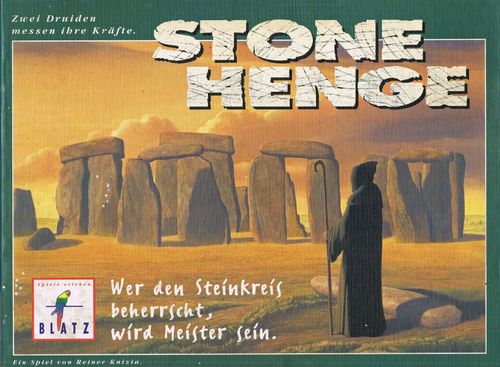
Stonehenge
Stonehenge Rulebook
Table of Contents
Table of Contents
Game Idea
Imagine you are at the mystic site of Stonehenge. It is a dark midsummer's night, 395 B.C. You have come here to become the Master Druid.
The contest begins. With the first rays of the sun, mysterious ley-lines appear on the ground. The intersections of the lines sustain the power of the druids. The most magically powerful druid becomes the Master - therefore place your druid-pieces wisely at the intersections. The total value of your pieces on a line should be higher than your opponent's. In this way you dominate a line, and can mark it with one of your megaliths. The first player to place all of his megaliths becomes the victorious Master Druid.
Game Materials
If you want to enter into the struggle for the Mastery of Stonehenge you will need:
- these rules,
- the game board,
- 18 druid-pieces, 9 black and 9 brown (each set with the following values: 2x One, Two and Three; 1x Four, Five and Six),
- 16 megaliths, 8 black and 8 brown.
Game Set-Up
- Lay out the board.
- Each player receives the druid-pieces and megaliths of one colour, and places them face-up in front of him.
- Decide who starts. Play continues alternately.
Game Play
On his turn a player places one of his druid-pieces onto an empty grey intersection space. The number must be face-up, to indicate the druid-piece's value. Play tactically, so that you dominate the yellow ley-lines on the board. Each line is between two and five spaces in length, thereby varying the difficulty in dominating them.
When is a line dominated?
a) When all the spaces on the line are occupied and the total value of your druid-pieces is higher than your opponent's total. If both totals are equal, the player who last placed a druid-piece on that line loses.
b) Very often, you will dominate a line even before it is completely filled with druid-pieces. This will be the case when your opponent, even if he plays the best of his remaining druid-pieces in the spaces still unoccupied, cannot beat your current total.
Example: The player with the brown pieces has a current line total of 6; his opponent's total is 1; and there are two empty spaces remaining on this line. Brown's opponent only has a Three, a Two and a One druid-pieces left. Even if he places his Three and Two on the two free spaces, he can only reach a total of 6. This is not enough to beat brown. Therefore brown can claim his domination of the line immediately.
As soon as a player dominates a line he may place one of his megaliths onto the small green space at the end of that ley-line. If a player overlooks such an opportunity, or if an opportunity arises during his opponent's turn, he must wait for his turn to place his megaliths. Sometimes, more than one megalith can be placed in a turn.
Game End
The power struggle is decided when one of the players succeeds in placing all eight of his megaliths. The game is now over. The successful player is honoured as the Master Druid.
By the way, this does not have to be the end of it. Play STONEHENGE several times and record the number of megaliths the loser has left. After several games, the player with the fewer total of remaining megaliths is the true Master Druid.
Furthermore, you can also play STONEHENGE with druid-pieces face-down. All the rules are unchanged. However, you keep your druid-pieces secret and place them face-down on the board. Only when a line has been completely filled with druid-pieces are the pieces on that line finally revealed.
Let's see who, like a real druid, is capable of foretelling the future, and making his moves most wisely.
The contest may begin! Prove your true Mastery!