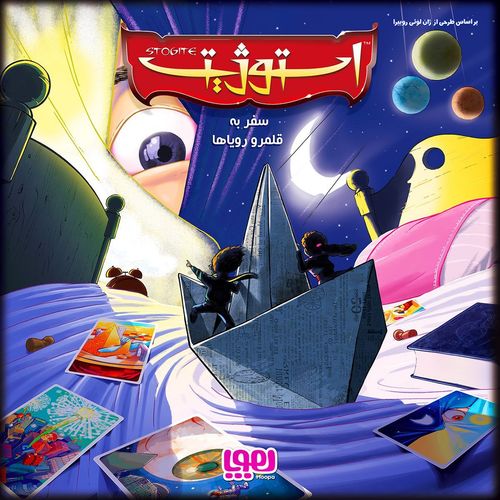
Stogite
Stogite Rulebook
Table of Contents
Table of Contents
Components
- 1 game board (scoring board)
- 96 picture cards
- 8 wooden scoring markers
- 8 sets of voting cards, 8 cards per set, numbered 1 to 8 (one set per colour)
Game Overview
Stogite is played in 4 to 8 players with the main method. There are also 2-player methods (a basic mind-reading game and an advanced game) and a 3-player method. For the 2-player methods see pages 9 and 16 of the rulebook, and for the 3-player method see page 19.
Four to Eight Player Game
Setup
- Place the scoring board on the table.
- Each player chooses one scoring marker and takes the voting cards that match the colour of that marker.
- Shuffle the picture cards and deal 6 picture cards to each player. Set the remaining picture cards aside as the storage cards (Figure 1).
- Never show your picture cards to other players during the game.
- Choose one player by lot or by agreement as the first storyteller. After each round, the storyteller role passes to the player on the storyteller's right.
Object of the Game
In each round of the game, the goal is to find the picture card chosen by the storyteller. The storyteller must describe the card in a way that others cannot easily identify.
How to Play
Storytelling
- The storyteller looks at their picture cards and chooses one of them in their mind. The storyteller then tries to describe that card to the others with a clue. The clue may be a word, a sentence, a poem, part of a song, a sound, a proverb, a gesture, or anything else.
- The storyteller places that card on the table face down, so that its picture is not visible.
- Now the other players choose, from their 6 picture cards, the card that is most similar in appearance or concept to the storyteller's clue. Each player gives their chosen card to the storyteller, in a way that no one sees its picture.
- After all players have handed their chosen cards to the storyteller, the storyteller shuffles these cards together with their own card and places them at random along the margin of the scoring board, next to the numbers 1 to 8. In this way each picture card is assigned a number from 1 to 8 (Figure 2).
Voting
- Now the players must find the storyteller's picture card among the cards laid out. To do this, each player must carefully look at all of the laid-out picture cards and finally choose one card in their mind.
- Each player secretly gives the voting card with the number matching the picture card they think belongs to the storyteller to the storyteller. Players must arrange their voting cards so that no one else can see which number they voted for.
- No player may vote for their own picture card.
- After all players have made their choices and handed in their voting cards, the storyteller reveals them and places each voting card under the picture card it voted for (Figure 3).
- Finally, the storyteller announces the number of their own picture card so that everyone can see who guessed the storyteller's card correctly.
- Be careful: the storyteller cannot vote.
Scoring
- If all players guessed the storyteller's card correctly, the storyteller scores 0 points and each of the other players scores 2 points. (That is, the storyteller described their card so clearly that every player found it easily, so the description was simplistic and of little value.)
- If no player guessed the storyteller's card correctly, the storyteller still scores no points and each of the other players scores 2 points. (That is, the storyteller described their card so vaguely and intricately that no other player could find it, so again the description was of little value.)
- In every other case (even if only one player voted for the storyteller's card), the storyteller scores 3 points and the player or players who found the storyteller's picture card correctly each score 3 points. (That is, this time the storyteller described their card in a skilful, layered and ambiguous way, so that only a few players could find it, and the description was creative and valuable.)
- In addition, each player other than the storyteller scores 1 extra point for each player who voted for their picture card. (That is, this player chose their card skilfully in line with the concept expressed by the storyteller, diverting the others from the original card so that they voted for theirs. The choice was clever and valuable (Figure 4).)
- Finally, the storyteller calculates each player's score and moves each player's marker forward on the scoring board by the number of points scored in that round (Figure 5). Then the storyteller role passes to the player on their right.
Continuing the Game
The new storyteller places the played cards into the box and gives each player one new picture card from the storage pile, so that every player again has 6 picture cards. Play then continues as in the first round.
When the storage pile runs out, shuffle the cards placed in the box and use them as the new storage pile.
Ending the Game
- The first player to reach 30 points wins the game, and the game ends.
- Other ways of ending the game may also be agreed. For example, the game may end, and the points be counted, once every player has been the storyteller at least once. Or the first player to reach 60 points may be the winner (for this, after reaching 30 on the scoring board, start again from 1).
Two-Player Mind-Reading Game (Basic)
Components
- 1 scoring marker
- 2 sets of voting cards, numbered 1 to 8
- 1 game board (scoring board)
- 96 picture cards
Setup
Place the scoring board on the table. Each player chooses a set of voting cards (numbered 1 to 8) and places the scoring marker at the bottom of the scoring board. Each player takes 8 picture cards from the deck and arranges them in two rows of four in front of themselves, so that the pictures are visible to both players (Figure 5). The cards are numbered from 1 to 8 by agreement between the two players.
Winner
Each player tries to guess correctly the opponent's response to each of their cards. This game has no winner: in every round, points are counted for both players.
Starting the Game
In each turn, the storyteller looks at their picture cards, chooses one of them, and places it on the game board (Figure 6).
Voting
- After placing their card on the game board, the storyteller must guess which of the opponent's cards the opponent will play in response. The storyteller then places the number of that card, face down, in the empty space beside their own card (Figure 7).
- After this, the opponent plays one of their cards in response to the storyteller's card (Figure 8).
Scoring
After both players have played their cards, the storyteller's voting card is turned over (Figure 9). If the storyteller correctly guessed the number of the opponent's card, both players score 5 points. If the storyteller guessed incorrectly, both players receive 3 negative points.
Continuing the Game
At the end of each turn, after scoring, the storyteller role changes. Both players remove the cards played in the previous hand from the game and replace them with new cards.
Ending the Game
The game lasts six turns. At the end of the six turns, the players determine their rank:
- "Stogitak": if you reached 30 points, you are the greatest seer of the land of Stogite, and everyone will remember you for years.
- "Dream Interpreter": if you have 15 to 25 points, you are good dream interpreters, but you still need practice and training.
- "Apprentice": if you have 5 to 15 points, you are novice dream interpreters and must try much harder!
- "Soldier": if you have 1 to 5 points, you do not have much talent for reading the minds of others.
- "Jester": if you have no points, you had better think about a different game!
Two-Player Advanced Game
Components
- 2 scoring markers
- 2 sets of voting cards, numbered 1 to 8 (see the note below on numbering)
- 1 game board (scoring board)
- 96 picture cards
Note: the components list in the source gives the voting cards as two sets numbered 1 to 8, while the setup text below uses voting cards numbered 1 to 5. The setup and play text is transcribed as printed; the advanced game uses the cards numbered 1 to 5.
Setup
Place the scoring board on the table. Each player chooses a set of voting cards (numbered 1 to 5) and takes a scoring marker matching its colour. One player is chosen by lot as the storyteller and takes five picture cards from the deck. Be careful never to show your cards to your opponent during the game.
Winner
Each player tries to correctly identify the storyteller's card in every round.
Starting the Game
In each turn, the storyteller looks at their picture cards and chooses one of them in their mind. The storyteller then tries to describe it to the opponent with a clue. The storyteller then places their five cards in a random order along the margin of the scoring board, numbered from 1 to 5. After the cards are placed, the storyteller chooses, from their voting cards, the number of their own picture card and places it face down beside the game board, so that the opponent cannot see it (Figure 10).
Voting
It is now the opponent's turn to identify the storyteller's card among the laid-out cards. To do this, the opponent uses their numbers 1 to 5 to award points to the picture cards: 1 is given to the card farthest from the storyteller's card, and 5 to the card closest to the storyteller's card. Once all points have been given, the storyteller turns over their voting card (Figure 11).
Scoring
In each turn, only the storyteller scores points. The storyteller's score is calculated as follows:
- If the opponent gave the storyteller's card 5 points, the storyteller scores nothing.
- If the opponent gave the storyteller's card 2 or 4 points, the storyteller scores 2 points.
- If the opponent gave the storyteller's card 3 points, the storyteller scores 5 points.
- If the opponent gave the storyteller's card 1 point, the storyteller scores nothing.
Continuing the Game
At the end of each turn, after scoring, the storyteller role changes. The new storyteller removes the cards from the previous turn from the game and takes five new picture cards from the deck. The game continues in the same way.
Ending the Game
The first player to reach 30 points wins the game.
Three-Player Game
The three-player method is the same as the basic four-to-eight player method above, with the following differences:
- Each player has 7 picture cards instead of 6.
- After the storyteller has stated the concept of their picture card, each of the other two players chooses two picture cards from their hand instead of one, and hands them to the storyteller. In total the storyteller shuffles five cards and lays them beside the numbers 1 to 5 on the scoring board.
- At the end of each round, the new storyteller gives each player 1 or 2 picture cards from the storage pile, so that every player again has exactly 7 picture cards.
Game Summary
Setup: Place the scoring board with the players' markers in the middle of the table. Give each player 6 picture cards and the voting cards in their marker's colour.
Each turn is played as follows:
- Storytelling: The storyteller chooses one of their picture cards and says a phrase about it (a word, a sentence, a poem, a proverb, etc.). The storyteller places that card face down on the table. The other players choose from their hand the card most similar to the storyteller's phrase and secretly hand it to the storyteller. The storyteller shuffles all the cards, including their own, and lays them face up beside the numbers on the scoring board.
- Voting: The players examine the cards and secretly hand the storyteller the voting card whose number matches their guess. The storyteller reveals the voting cards and places each one under the picture card it voted for. The storyteller announces the number of their own card, and the scoring phase begins.
- Scoring: If all players guessed the storyteller's card correctly, the storyteller scores 0 points and each other player scores 2 points. If no player guessed correctly, the storyteller scores 0 points and each other player scores 2 points. If some players guessed correctly and some did not, the storyteller scores 3 points and each player who guessed correctly scores 3 points. Each player whose picture card received votes scores 1 point per vote.
- Start of the next turn: The player on the storyteller's right becomes the storyteller. The cards played are removed from the game, and each player adds one new card to their hand.
The game ends when the first player reaches 30 points.