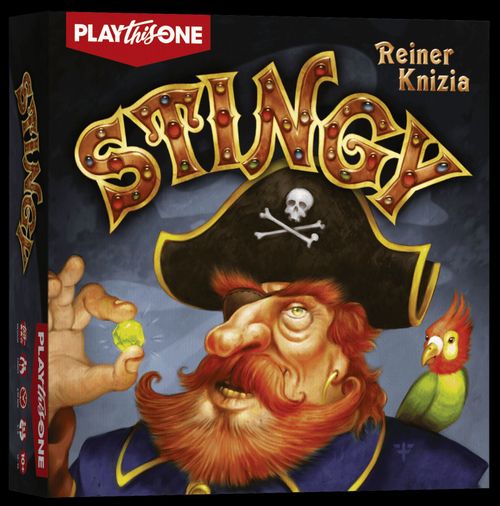
Stingy
Stingy Rulebook
Table of Contents
Table of Contents
Preparation
Shuffle the tiles and place them face down in the middle. This is the booty! The tiles show different images in six different colours. There are 3 tiles of each bottle, 4 tiles of each parrot, 5 tiles of each pile of coins and 6 tiles of each diamond. The pirate flag only occurs in one colour and there are 7 corresponding tiles.
Each player draws 6 tiles from the middle and displays them face up in front of him. Equal tiles, with the same image and colour, are placed together in groups. The number of tiles in each group must be visible to all the players. Each player also receives one information card.
Play
One player starts, then play progresses clockwise. In your turn you may first do a swap and then you conclude your turn by taking new tiles from the middle.
1. Swap
Choose any one group (of one or more tiles) from any one of your opponents and demand this group. The opponent must give you all the tiles of the demanded group and you place these tiles in front of you. Now the opponent may take one or more groups from your display with a total value not higher than the value of the group he had to give you.
Note: The opponent may not take back any tiles of the group you just demanded.
Values: During the game the value of a group is determined by its number of tiles as shown on the information card:
| Line 1: Number of tiles | 1 | 2 | 3 | 4 | 5 | 6 | 7 |
| Line 2: Swap points during game | 1 | 3 | 6 | 10 | 15 | 20 | 25 |
| Line 3: Points for complete groups | - | - | (illustrated) | (illustrated) | (illustrated) | (illustrated) |
Note: Line 3 is printed as a row of tile illustrations; the text layer shows only "- -" for the first two columns, and the remaining cells are pictures of the complete-group tiles. Their values are not legible in the text and are not reproduced here.
Picture 1: You demand the two red piles of coins (value 3) from your opponent. The opponent takes 3 single tiles (3 x value 1) in return. A good swap! Your group of 4 red piles of coins has now got a value of 10. Your opponent's 3 purple parrots have a value of 6 and his 2 red bottles have a value of 3.
Picture 2 and Picture 3: Instead of demanding the two red piles of coins you could for example demand the two purple parrots or the red bottle from your opponent. Each of the two pictures shows a corresponding example.
Special Case: If it is impossible for your opponent to take tiles of an equal value from you in return, he can either take tiles of a smaller total value or he can tell you to pay. In this case you must give your opponent one or more groups with a total value higher than the value of the group you received. However, you decide which group(s) you give. An example is shown in the picture (the illustration is not reproduced here). If you do not possess enough tiles to make up the required value, you may not undertake the swap.
Complete Groups: When you succeed in collecting a complete group of the same colour of 3 bottles, 4 parrots, 5 piles of coins, 6 diamonds or 7 flags, then you immediately remove the tiles of this group from your display and place them face down in a stack in front of you. These complete groups may not be swapped.
2. New Tiles
Conclude your turn by taking new tiles from the middle: with 3 or 4 players, take 2 new tiles; with 5 or 6 players, take 1 new tile. If you do not do a swap on your turn and you have no more than 2 single-tile groups in front of you, then you may take one additional tile from the middle when you conclude your turn.
Game End
When the last tile is taken from the middle, play one more round. The player who has taken the last tile also has the last turn. Then the game ends.
Now each player counts the values of his complete groups as indicated on the information card. The player with the highest total value wins.
Note: At the game end only completed groups count. Incomplete groups do not score. However, if there is a tie, the number of the tiles in your incomplete groups is used as a tiebreaker.
Game Variant: 2 Player Rules "Stingy Ghost"
All of the rules apply also for a 2 player game, but now you play with a virtual third player, a Stingy Ghost. The set-up is the same as a 3 player game. The Ghost player also gets 6 treasures. Every time the Ghost player gets a turn, two new tiles from the middle are added to the Ghost's display.
In your turn you can take treasure tiles from your opponent or the Ghost. But when you take tiles from the Ghost, your opponent will act as the Ghost player and takes tiles which are added to the Ghost's display.
Game Variant: Captain Sly 2-6 players
All of the rules apply for this variant, but in the "Special Case" your opponent will get nothing in return if it is impossible to take tiles of an equal or lower value. So he can not tell you to pay and therefore it does not matter if you do not possess enough tiles to make up the required value.
Advanced Rules: Colour Scoring
Advanced players can agree to score bonus points at the end of the game for the number of different colours each player has collected within his complete groups. The pirate flags count as a separate colour.
| Line 1: Number of different colours | 1 | 2 | 3 | 4 | 5 | 6 | 7 |
| Line 2: Bonus points | 1 | 3 | 6 | 10 | 15 | 20 | 25 |
| Line 3: (illustrated row) | - | - | (illustrated) | (illustrated) | (illustrated) | (illustrated) |
Note: Line 3 of the colour scoring table is a row of illustrations; only the dashes under the first two columns are legible in the text layer. The illustrations are not reproduced here.