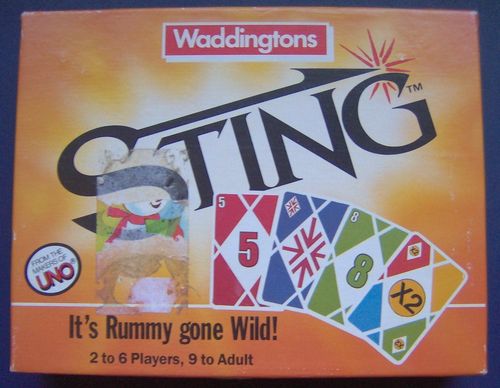
Sting
Sting Rulebook
Table of Contents
Table of Contents
Object of the Game
Be the first player to rid your hand of all cards by giving them to your opponents.
Equipment
106 cards consisting of:
- 2 sets of red cards numbered 1-10
- 2 sets of blue cards numbered 1-10
- 2 sets of green cards numbered 1-10
- 2 sets of yellow cards numbered 1-10
Wild cards:
- 4 Wild Sting cards
- 4 Double Wild Sting cards
- 2 Triple Wild Sting cards
- 2 Super Wild Sting cards
Word cards:
- 8 Pass-a-Pile cards
- 4 Take-it-Back cards
- 2 Quick Reference Information cards
First Time Players
We suggest playing at least the first game FACE UP on the table so that all players can read the instructions together.
Summary of Play
Deal 10 cards to each player. Then each player in turn tries to get rid of their cards by grouping the cards in their hand into runs and sets and them placing the cards in front of any opponents. [Sic: "and them placing" as printed.] The round is over when a player gets rid of their cards. Player with the lowest point total at the end of 5 rounds is the winner.
Terms Used in the Game
A ROUND is a hand of play. A round ends when a player gets rid of their cards. A game consists of several rounds. (See WINNER.)
A SET is at least 3 cards of the same number but all different colors (as in Rummy). For example, a 2 red, a 2 blue and a 2 yellow.
A RUN is at least 3 cards of the same color but different numbers in sequence (as in Rummy). For example, a green 2, a green 3 and a green 4.
A WILD CARD is a card that can represent another card of ANY COLOR and ANY NUMBER.
How to Play
Before playing remove the 2 Quick Reference Cards and 2 Promotion Cards. [Sic: the printed instructions refer to "2 Promotion Cards"; the equipment list prints no promotion cards. Transcribed as printed.]
- Each player picks a card, high card is dealer.
- Deal 10 cards to each player.
- Remaining cards are stacked in a pile face down to form the Draw Pile.
- Turn over top card of Draw Pile and place it next to it face up to form the Discard Pile. If the card is a word card, turn over the first numerical card.
- Player to the left of the dealer goes first. This player must first draw 1 or 2 cards from the Draw Pile. However, before drawing, the player must announce to all players how many they will draw. (Strategy Hint: At the beginning of a turn the 1 or 2 card draw is a strategic option. Draw only 1 card if you have many cards in your hand. Draw 2 cards if you are "stuck" with only a few cards in your hand.)
- The first player then tries to make as many sets or runs as possible by laying them on the table in front of any of the opponents. The player may lay down sets and runs in front of several opponents if they so wish. The player can continue to make plays as long as they can.
- When the player cannot make any more plays, they must discard 1 card FACE UP on the Discard Pile. The turn ends and passes to the next player on the left.
Special Cards
STING is made exciting and unusual by using SPECIAL WORD CARDS. The following may be referred to as quick reference during the play of the game (Quick Reference cards are included in the deck with this information for use during play):
- WILD STING CARD – This is a Wild Card.
- DOUBLE STING CARD – A Wild Card that doubles the score.
- TRIPLE STING CARD – A Wild Card that triples the score.
- SUPER STING CARD – A Wild Card that cannot be passed.
- PASS-A-PILE CARD – Allows a player to pass one of their runs or sets.
- TAKE-IT-BACK CARD – Allows a player to return a run or set immediately after it is passed.
The following explains each card in detail:
WILD STING CARD – This is a WILD card. One WILD STING may be used in any 3 card set or a 3 card run. Two WILD STING cards may be used in any sets or runs of 4 or more. [The printed text reads "sets or tuns"; "runs" is the evident intent.] Three WILD STING cards may be used in any runs of 7 or more. However, in any run 2 WILD cards can never be placed consecutively. A numerical card must always separate them.
DOUBLE WILD STING CARD – Same as WILD STING but when a run or set is scored then the score for the run or set is DOUBLED.
TRIPLE WILD STING CARD – Same as above but when a run or set is scored then the score for the run or set is TRIPLED.
SUPER STING CARD – Same as WILD STING except when given to a player in a run or set, the player receiving it MUST KEEP IT until the end of the round. It cannot be passed by using a PASS-A-PILE card. However, other players can continue to add to it.
PASS-A-PILE CARD – When it is your turn, you may play this card on the Discard Pile and then take one run or set on the table in front of you and place it immediately in front of any other player.
TAKE-IT-BACK CARD – When an opponent uses a PASS-A-PILE card during their turn and passes one of their runs or sets to you, you may play a TAKE-IT-BACK card IMMEDIATELY on the Discard Pile, even though it is not your turn, and return the run or set back to the player who tried to give it to you. (The player could return the run or set back to you again only if they had a TAKE-IT-BACK card.) The TAKE-IT-BACK card CANNOT be used to return runs or sets ORIGINALLY GIVEN FROM A PLAYER'S HAND. The TAKE-IT-BACK card can only be used after a PASS-A-PILE card has been played.
A player's turn always begins by drawing 1 or 2 cards. A player's turn always ends by discarding 1 card on the Discard Pile. This card is in addition to any PASS-A-PILE or TAKE-IT-BACK cards played on the Discard Pile during the player's turn.
Note: If the Draw Pile is used up before a player gets rid of their cards, reshuffle the Discard Pile and stack it face down to form a new Draw Pile. Turn over the top card to start a new Discard Pile.
Scoring
Play continues until a player gets rid of the cards in their hand. The round then ends and points are scored. All cards in front of each player at the end of a round are scored AGAINST them (except the winner of the round). Also, all cards left in each player's hand are scored against them. The player who gets rid of their cards ALWAYS scores "0" points even if there are runs or sets left in front of them.
- All runs or sets count 1 point for each card including ANY type of WILD CARDS.
- A more challenging game can be played by scoring all numerical cards by their actual numerical value.
- Any runs or sets that include a DOUBLE STING CARD – double the score. A TRIPLE STING CARD triples the score. If a DOUBLE and TRIPLE STING are included in the same run or set, then the score is DOUBLED then TRIPLED!
- All cards left in your hand at the end of a round are also counted as follows:
- Numerical cards: Score 1 point
- Wild Sting: Score 5 points
- Double Sting: Score 10 points
- Triple Sting: Score 15 points
- Super Sting: Score 5 points
- Pass-a-Pile: Score 1 point
- Take-it-Back: Score 1 point
Winner
After points are totaled at the end of each round, the next round is dealt. The player with the LOWEST score at the end of a determined number of rounds is the WINNER. (Suggestion: 5 rounds for beginners.)
Another option is to stop the game when a player reaches a certain number of points. (Suggestion: 100 points for beginners.) The player with the lowest score at that point is the winner.
Additional Rules, Suggestions and Game Variations
- During a player's turn, they may add to any sets or runs already on the table. Runs can actually become as long as ten (10) cards with #1 as the lowest card and #10 as the highest. Wild cards cannot be used to extend a run beyond 10 cards. Sets are limited to four (4) cards.
- During a player's turn a player may use the card face up on the Discard Pile providing it is played immediately to form a set or run or to add on sets or runs already on the table. The player can then use the next card showing face up on the Discard Pile in the same way. Note: PASS-A-PILE and TAKE-IT-BACK cards CANNOT be picked and played from the Discard Pile.
- Anytime during a player's turn, a player may substitute actual numerical cards for any WILD cards used in sets or runs already on the table, providing the player substitutes the ACTUAL numerical card that the WILD card represented and plays it immediately. For example: a run consists of #1 red, #2 red, Wild Sting. A player holding the actual #3 red can substitute it for the WILD card and then use the WILD card to make additional runs or sets. REMEMBER: A SUPER STING can never be substituted. A more challenging game will result by not allowing any substitutions.
- Runs and Sets cannot be made of only WILD CARDS. A 3 card run or set can only include 1 Wild Card, a 4 card run or set can only include 2 Wild Cards and a 7 card run or set can only include 3 Wild Cards.
- Beginners who never played STING may prefer to play this game without any Special Word Cards at first. Word Cards may be added after the players become more familiar with making runs and sets.
- All Wild Cards are played as cards of any color or number. They are different only when scoring at the end of a round.
- Note that all #6 cards are underlined to contrast them with #9 cards.
- Strategy suggestion: At the beginning of a turn, after drawing 1 or 2 cards, a player should first look for any available Wild Cards in runs or sets on the table that can be substituted. Then look at the discard pile to see if the face up card can also be used. Finally put together as many runs or sets as possible and divide them among several opponents. Also, try to add to any runs or sets already on the table. This procedure allows players to get more out of their turns.
- Younger player version: We suggest dealing 7 cards to each player for each round.