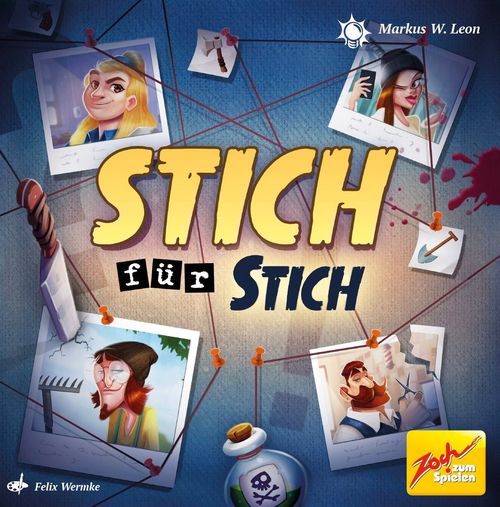
Stich für Stich
Stich für Stich Rulebook
Table of Contents
Table of Contents
- The material for your investigations
- How to prepare your investigations
- How to conduct your investigations
- The objective of your investigations
- The course of a trick
- The criminal case ends
- The next criminal case follows ...
- The end of all investigations ... and who wins
- Smart tips for good investigators (overview sheet)
The material for your investigations
- 16 tiles show the 4 suspects: influencer, hairdresser, gardener, mechanic.
- 28 tiles show the 7 weapons: revolver, statue, spade, knife, pillow, poison, ax.
- 1 investigation pad.
- 52 trick-taking cards, each showing one of the characters, a weapon and a number (1-13).
- 3 trick-taking cards show phantoms: no weapon, the number "0", a phantom.
- 4 racks.
How to prepare your investigations
The player who last had a knife in his or her hand becomes the confidant in the first criminal case. All the other players act as sleuths. Everybody gets 1 rack and 11 tiles with the same color on the back: 7 weapons and 4 suspects. Shuffle all 55 cards.
The confidant ...
- ... shuffles his 11 tiles, face down, and secretly draws 1 weapon and 1 culprit. He looks at these tiles and puts them down in front of him, face down. He may look at them anytime, but may not show them to anybody else.
- ... gets 10 cards. Hold your cards in your hand, so that the others can't see them. Put any surplus cards aside, unseen.
The sleuths ...
- ... set up 11 tiles on their own rack so that they are hidden from the others.
- ... get 7 cards each.
In the upper left-hand space on the investigation pad, write the name of the confidant in the first criminal case. In the spaces to the right of this, write the other players' names, in clockwise order according to their seating positions.
How to conduct your investigations
You play several criminal cases in a row. Each individual case is a trick-taking game and ...
- consists of 7 tricks.
- has 1 weapon and 1 culprit.
In each case, a different player becomes the confidant. Only he knows the weapon and the culprit, both of which are always trumps. The other players are the sleuths, trying to deduce the weapon and the culprit.
The objective of your investigations
Collect as many investigation points and trick-taking points as possible in order to win STICH FÜR STICH!
Investigation points
- The longer the confidant keeps the sleuths from figuring out the culprit and the weapon, the more investigation points he gets.
- The earlier a sleuth finds out the culprit and the weapon, the more investigation points he gets.
Trick-taking points
- The confidant and the sleuths get one trick-taking point for every trick they win.
The course of a trick
Each trick you play consists of these 4 steps:
I. Play a card II. Determine the winner of the trick III. Search for the culprit and the weapon IV. The winner of the trick piles up the cards of the trick in front of him
I. Play a card
The 1st trick of each criminal case is led by the player seated left of the confidant. In this game, there is no compulsion to play a specific color or follow suit.
- The player who leads a trick plays any one card from his hand and puts it face up in front of him.
- After that, all the others, in turn, play any one card and put it face up in front of them.
- The player who takes the trick leads the next one.
On the "overview" sheet, you can find clever tips for how to play the cards.
II. Determine the winner of the trick
Once everybody has played a card, the confidant announces who has the most valuable card in front of him and thus wins the trick. However, the confidant never discloses why the winner gets this trick. The following 5 trump rules and trick-taking rules apply:
1. The weapon and the culprit are trumps!
- Every card showing the culprit and the weapon is a full trump.
- Every card with the weapon is a weapon trump.
- Every card with the culprit is a culprit trump.
Example: Fiona, as the confidant, draws the influencer as the culprit and the pillow as the weapon. Consequently, in this criminal case, every card with an influencer AND a pillow is a FULL TRUMP; every card with a pillow is a WEAPON TRUMP; every card with an influencer is a CULPRIT TRUMP; every card without an influencer and without a pillow is a NON-TRUMP.
2. Full trump beats weapon trump beats culprit trump beats non-trump
- Any full trump card beats any other weapon trump or culprit trump.
- All the weapon trumps are more valuable than all the culprit trumps.
- Non-trumps take the trick only if no trump card was played.
Example: This trick is taken by Nicolas. His influencer with a pillow is a full trump and thus beats Joshua's pillow (weapon trump) as well as Linda's and Fiona's influencers (culprit trump).
Example: Linda's culprit trump beats the other cards, none of which is a trump card, since they show neither the weapon nor the culprit.
3. With the same kind of trump, the card with the higher number prevails.
- Higher numbers on a card beat lower numbers on the same kind of trump.
- If the trick does not contain any trump at all, the card with the highest number prevails.
Example: This trick goes to Nicolas. With the higher number, his weapon (pillow) beats Fiona's weapon trump. Despite the higher numbers, Joshua's and Linda's culprit trumps don't take the trick - since the weapon trump beats the culprit trump.
4. Every phantom card is a culprit trump - and never a weapon trump.
- Every phantom stands for the culprit and beats any non-trump card.
- Any phantom card (number "0") is beaten by any other culprit trumps.
- Any phantom card is beaten by any weapon trump and any full trump.
Example: This trick goes to Linda, since her culprit trump (influencer) shows a higher number than Joshua's culprit trump (phantom). Nicolas' and Fiona's cards are non-trumps and are also beaten by Linda's culprit trump.
5. With completely equivalent cards, the one that has been played first trumps.
- There are no trump cards (except for the phantom cards) with the same number.
- Only non-trumps can show the same number.
Example: One after another, Nicolas, then Joshua, Linda and finally Fiona have played cards, but neither culprits nor weapons. Since only non-trumps have been laid out, the highest number trumps. This is the "10" - a number that is shown on two cards (Linda and Nicolas). Nicolas wins the trick, since he played his "10" before Linda did.
Example: Two phantom cards - and no other trumps - are lying in this trick. Since Nicolas played his phantom before Linda did, he takes the trick.
III. Search for the culprit and the weapon
After the winner of the current trick has been determined, a search takes place:
- Leave the cards of the trick still in place! This allows all sleuths to draw "deductive conclusions" regarding the weapon and the culprit.
- All sleuths hand the confidant the two tiles that they consider the weapon and the culprit, face down; the confidant looks at these clues - top secret (!).
- Players who have already figured out the weapon and the culprit of the current case don't participate in the search.
The confidant announces who has solved the case:
- Only those who have given him the correct culprit tile and weapon tile ... obtain the information: "Case solved," and immediately get investigation points for that (as described below).
- Whoever has not given him the two correct tiles (culprit and weapon) ... obtains the information: "False suspicion." The confidant does not disclose whether only the culprit, only the weapon or both were guessed incorrectly.
Investigation points ... are noted down at the magnifier symbol!
The confidant gets investigation points only when all sleuths have figured out the weapon and the culprit. The number of points corresponds to the number of tricks you have already played. (The current trick is included in the count.)
Example: In the search during the 5th trick, the last sleuth manages to figure out the weapon and the culprit. The confidant gets 5 points.
If not all sleuths have managed to deduce the culprit and the weapon by the end of the last (7th) trick, the confidant gets 8 investigation points.
A sleuth gets investigation points as soon as he himself has figured out the weapon and the culprit. The number of points corresponds to the number of his own hand cards +1.
Example: If a player solves the case after the 2nd trick, he still has 5 cards left in his hand. He gets 5+1=6 investigation points. So, with the last (7th) trick, a player still gets 1 investigation point for solving the case. Only those sleuths who have not even been able to find out the culprit and the weapon with the last trick get ZERO points.
The confidant gives all tiles face down back to their owners, and they place them anew in their racks. This completes the search in this trick.
IV. The winner of the trick piles up the cards of the trick in front of him
Once the search has been completed, the winner of the trick piles up the cards of that trick in front of him. In doing so, he has to place his own card - the one that made him win this trick - on top, visible to everybody. Until the end of the current criminal case, nobody - not even the winner of the trick - may look at the cards underneath it any more.
A player who takes several tricks during the course of a criminal case piles up the cards of each trick next to one another in front of him, so that the top card of each trick remains visible. This way, all players can see anytime which card allowed somebody to win the individual tricks.
This ends the trick. Now the winner of this trick leads the next trick (in the current criminal case).
The criminal case ends
Each criminal case ends after the 7th trick - even if all sleuths have already solved the case before that. The confidant still has 3 cards in his hand.
Trick-taking points ... are noted down at the cards symbol! Now the confidant and the sleuths get one trick-taking point for each trick they have won.
The next criminal case follows ...
The player to the left of the current confidant becomes the confidant in the next criminal case. Reshuffle all 55 cards and prepare your investigations again (as described under "How to prepare your investigations").
The end of all investigations ... and who wins
Once each of you has been the confidant in one criminal case, STICH FÜR STICH ends. The player who has accumulated the most investigation points and trick-taking points wins the game. There can be more than one winner.
Smart tips for good investigators (overview sheet)
- As the confidant, it is best to play cards into the trick that make it difficult for the sleuths to figure out what is trump.
- As a sleuth, it is best to play cards into the trick that make it easy for yourself to figure out what is trump.
Once you have deduced the culprit and the weapon in the current criminal case, you can act in different ways while you continue playing cards. You have the following three possibilities:
- Make it harder for the other sleuths to also solve the case. If possible, play cards that don't clearly reveal the trump. Your goal is: To keep the other sleuths from gaining as many investigation points as you!
- Make it difficult for the confidant to hide the weapon and the culprit from the (other) sleuths. If possible, play cards that make it easier for the other sleuths to find out the trumps. Your goal is: To keep the confidant from gaining as many investigation points as he would like to get.
- Simply try to win as many tricks as possible - no matter whether this disguises trumps or rather discloses them. Your goal is: To gain trick-taking points.
Of course, it is particularly smart to combine these three possibilities so that you gain more investigation points and trick-taking points than any other player!