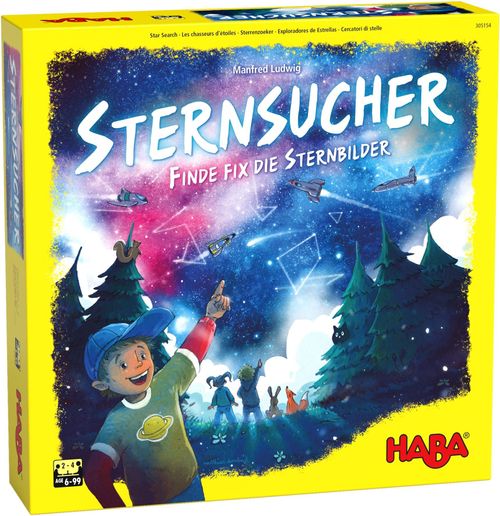
Sternsucher
Sternsucher Rulebook
Table of Contents
Table of Contents
Contents
- 1 box base with 4 partitions
- 2 game boards
- 6 star charts
- 1 die
- 1 orange fixed star
- 1 sand timer
- 4 rockets
- 29 yellow stars
- 4 lap tiles
Before the First Game
Carefully separate the cardboard pieces from the two tableaus and the game board. The small circles and both large white frames can be discarded. Take the four partitions and put them together as illustrated. Place the created grid in the box base.
Tip: At the end of the game you can leave the dividers together in the box base. Simply distribute the rest of the game material into the compartments, and then place the game boards and rulebook on top.
Game Variation "Eagle-eyed Astronaut" for Space Explorers
Game Setup
Place the box base in the center of the table. Place the game board without holes on the grid in the box base. Then place the game board with holes over the top. This shows the starry sky and the surrounding flight path.
Distribute the stars relatively evenly in the holes of the starry sky. For the first game, we recommend placing the orange fixed star in the center.
One side of the stars is a little more difficult to stick into the holes. Place the stars into the game board with this side down, so that they don't fall over so easily.
The red starting field of the flight path is marked with arrows. Each player selects a rocket and places it on this starting field. The lap tiles are only needed for the second game variation. Set the lap tiles and any spare rockets aside.
Shuffle the star charts and stack them. It doesn't matter which side is facing up. Keep the hourglass and the die handy.
Example: Game setup for 4 players.
How to Play
Play in a clockwise direction. The player who has most recently seen a shooting star begins.
Which field is your rocket on at the start of your move?
- On a field with red or blue planets: Great! Time for you go on a Star Search! The rules about this can be found in the next section. The starting field shows red planets!
- On a field without a planet: Take the die and roll it! What does the die show?
- Dice pips: The dice pips show how many fields you can move your rocket forward in a clockwise direction (the source prints "canmove"; read as "can move"). Is your rocket the last one, and all alone on a field? Then all the dice pips count. If not, then only the black (filled) dice pips count.
- The red or blue planet: Fantastic! Time for you go on a Star Search!
Then the next player takes their turn.
Star Search
A Star Search consists of three phases: Star Chart Placement, Rocket Flight, and Twinkling Stars.
1. Star Chart Placement
Take the bottom star chart from the stack. Turn it over so that it shows the same color as the planet field that you are on, or the planet that you rolled. Then the player to your left turns the sand timer over and starts timing.
Before the game starts, agree on the degree of difficulty. Use the sand timer according to the image, letting the hourglass run once, twice or three times before the time is up. If children and adults are playing together they can play with different levels of difficulty to give children a better chance. The adults play at the difficult level, the children at the easy level.
While the sand timer times, you try to place your star chart on the starry sky as cleverly as possible; the more constellation markings are filled with a star the better!
Example: It's Max's turn. His rocket is on a red planet field. He takes the bottom star chart from the stack and turns it over to the red side. Anna turns the hourglass over. After a short time, Max places his card.
Important: You may ...
- ... hold the star chart over the starry sky to find the best position.
- ... turn the star chart left and right, but not turn it over.
- ... only place the star chart within the starry sky. The star chart may not cover any of the surrounding flight path.
- ... not move any stars in the starry sky.
Warning: No corrections are allowed after placement.
The player to your left must watch the sand timer (and depending on the degree of difficulty turn it over and let it run again), then call "Stop!" when the time is up. If you haven't already, you'll need to place your star chart on the starry sky at this point.
2. Rocket Flight
Now see how many of the star markings on your star chart have a star in them. For each of these stars you can move your rocket forward one field in a clockwise direction. Is there a star in every marking? Wow, you're an excellent Star Searcher!
The orange fixed star: Are all the markings filled with stars, and one of them is even the fixed star? Intergalactic congratulations! You can move your rocket forward an extra field. If not all markings are filled, then the fixed orange star counts like a normal yellow star.
Example: There is one yellow star and the fixed star in the markings. The third marking is empty. Max can move his rocket forward by two fields. If he had also been able to fill the third marking, then he could have moved his rocket forward by 4 fields (3 for the stars + 1 extra for the fixed star).
3. Twinkling Stars
After the Rocket Flight, the player to the left takes the stars out of the white markings. They then put them in other empty holes in the starry sky or the star chart.
Warning: The fixed orange star cannot be moved!
Now take the star chart off the game board and place it on top of the star chart stack.
End of the Game
The game ends as soon as the first player has circled the starry sky once with their rocket, by reaching or flying past the starting field. This player is the winner and may call themselves an Eagle-eyed Astronaut!
Game Variation "Astronaut Rudi Rocket" for Intergalactic Pros
Game Setup
Set up the game as described in "Eagle-eyed Astronaut". Now each player also takes the lap tile that matches the color of their rocket, and places it in front of them with the number "1" facing up.
How to Play
The rules from "Eagle-eyed Astronaut" apply, but with the following changes:
As soon as a player rolls the red or blue planet, a Super Star Search takes place.
Super Star Search
The Super Star Search also consists of the phases: Star Chart Placement, Rocket Flight and Twinkling Stars. But now all players play at the same time, and you need to be quick.
1. Star Chart Placement
All players take turns drawing a star chart from the bottom of the stack. Everyone turns their star chart so that the color rolled faces up. The sand timer is not needed. On "Let the star search begin", all players start searching at the same time (astronaut's honor):
- Everyone searches for where they can place their star chart so that all the white markings are filled with a star.
- Warning! You are not allowed to hold the star chart directly above the starry sky.
If a player thinks that they have found the right spot for their star chart, they quickly place it there.
- Did they manage to fill all the markings with a star? Excellent! Then the Star Chart Placement phase is over.
- Did they not manage to fill all the markings with a star? Too bad, the player goes away empty handed! For the other players, the search continues. Placed star charts can overlap partially or completely.
Example: Marie rolls a blue planet. Players take turns drawing a star chart, and turn them so that the blue side faces up. On "Let the star search begin" they start searching. First Tom places his star chart, but he accidentally only fills three of the four markings with a star. So the other players can keep searching. Soon after, Anna places her star chart. She's managed to fill all the markings! Placement of the star charts is now over, and Anna can move forward 4 fields with her rocket.
Important: In the following two cases, the Super Star Search may end early:
- Have all players placed their star chart without any of them filling all the markings? Too bad – maybe it'll work out better next time!
- Is placement of the star charts taking too long, without a player finding the right spot? Then the search can be called off by mutual agreement.
In both above cases, the phases of Rocket Flight and Twinkling Stars are skipped. Everyone places their star charts back on the stack.
2. Rocket Flight
Only the player who was first to place their star chart so that all the markings were filled with a star can move their rocket forward. The rules about the fixed star apply here too.
3. Twinkling Stars
The same rules apply as in Eagle-eyed Astronaut. Afterwards, everyone places their star chart back on the stack.
Star Search
The standard star search (which happens when it's your turn and your rocket is on a field with a planet) is also a little more challenging in this version:
- Before the hourglass time is up, you must place your star chart in such a way that all the markings are filled with a star! Are any markings on your star chart empty after placement? Then your rocket stays where it is.
- As well as this, you may not hold the star chart directly over the starry sky during the search!
The following actions can help you keep track of whose turn it is in this game variant. Always place the die in front of the player whose turn it is. Even after the Super Star Search, the die will remind you whose turn it is next.
End of the Game
Once a player has circled the starry sky once in their rocket, they turn their lap tile over. Now it shows a "2". The game ends as soon as the first player has circled the starry sky twice with their rocket, by reaching or flying past the starting field again with their rocket. This player is the winner, and is entered into the hall of fame of space travel as Astronaut Rudi Rocket.