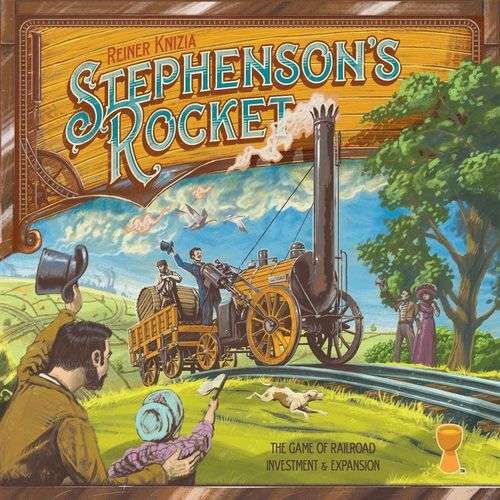
Stephenson's Rocket
Stephenson's Rocket Rulebook
Table of Contents
Table of Contents
Game Contents
- game board
- 4 player boards
- 60 double-sided regular track tiles
- 12 double-sided connector tiles (2 lines)
- 4 double-sided connector tiles (3 lines)
- 9 passenger pawns
- 12 city indicator cubes
- 6 "X" signs
- 7 wooden locomotives
- 7 plastic locomotives (to replace the wooden locomotives)
In four player colours:
- 32 player markers
- 72 industry cubes
- 28 stations
Game Setup
-
Place the game board in the middle of the table.
On the right side, it shows parts of England at the dawn to the rail age. You see hexagonal areas where track tiles will be placed during the game. Also note the 7 starting towns where the various rail lines began (in bright colours), 12 cities (London, Sheffield, Brighton, etc), and 9 other railway towns (Leeds, Oxford, Swindon, etc.)
On the left side, the board depicts a city investment chart for the 12 cities (top) and share tracks for the 7 rail lines (bottom).
-
Place the locomotives on their starting towns, by matching their colours to their spaces. The direction the locomotives face does not matter at this point.
Each player now selects a colour to play with, and collects all the pieces matching that colour: 1 player board, 8 player markers, 7 stations, and 18 industry cubes.
- Each player places one player marker (with the "+10" side face-down) on the "0" step of each of the share tracks for the 7 rail lines.
- Each player places the final player marker (with the "+100" side face-down) on the "0/100" step of the Prestige track that surrounds the left side of the board.
- Each player places their stations and industry cubes on the places allocated for them on their player boards.
- Place the 12 city indicator cubes beside the board, near the city investment chart.
- Place the 9 passenger pawns, and 6 "X" signs near the board, in easy reach of all players.
- Place the 60 track tiles near the board, in easy reach of all players.
- Place the 16 connector tiles near the board, in easy reach of all players, but separate from the 60 regular track tiles.
Randomly select a starting player.
On Board Icons
| On Board | Icon | Type |
|---|---|---|
| The rail line's home space (e.g. L&Y) | Filled hexagon | Starting Town |
| A numbered city space (e.g. Manchester 1) | Open hexagon with flat top | City |
| A round town illustration | Circular outline | Railway Town |
Overview
The aim of Stephenson's Rocket is to score Prestige (Prestige points). The player with the most Prestige points at the end of the game will be considered the greatest of the investors vying for influence over the early days of the rail age.
During the game, players will receive shares in the different rail lines after "paying" to extend them. These shares can then be used as bids to influence the future directions of the lines. Stephenson's Rocket is a building game, but it is also a bidding game.
Players will attempt to gain prestige by gaining shares in the rail lines, and, by investing in the infrastructure of the rail lines. They will do this by erecting stations, carrying passenger pawns, and building up the local industries that depend on the young rail lines for future success.
Build and prosper – but be wary of the all-powerful veto that may remove your influence in a puff of smoke!
Playing the Game
Beginning with the starting player and proceeding clockwise around the table, each player must take two actions on their turn, taken from the following list of actions.
Players may take two separate actions, or the same action twice, with the following exception: a player may not choose to extend the same line twice on their turn.
The three possible player actions are:
A) Extend a rail line, thereby increasing its reach and affluence, as well as the player's influence upon it.
B) Invest in industries of the various cities that the rail lines may be connected to, thereby increasing a line's (and therefore, the player's) wealth.
C) Build a station in an attempt to make a rail line more popular and lucrative.
Once again, please note that players may choose to do the same action twice on their turn, but if the "extend a rail line" action is taken twice, the player must choose two different rail lines to extend.
The actions in more detail:
A) Extending a Rail Line
This action is arguably the most common one taken by players during the game. There are four steps that must be followed for the action to be completed. These steps are: 1) Move a locomotive on the board, 2) Possible veto by other players, 3) Place a track tile on the board, and possibly, 4) Receive a passenger pawn.
The steps in more detail:
1) Move a locomotive
The first step for a player choosing to extend a line, is to move one of the locomotives on the board into an adjacent hex. From its starting town, a locomotive may be moved into any adjacent hex (following the placement rules below), but on all future turns, a locomotive may only be moved into one of the three hexes in front of the locomotive (either straight ahead, or in a slight curve to the left or right). The locomotive must be placed in its new hex with its rear facing the hex from which it came.
When moving a locomotive, it can never be moved into a hex that contains: a city, any town, a track tile, or another locomotive. A locomotive can be moved into a space containing a player's station. Moving a locomotive into a hex with a station will link that station to the rail line.
Once the locomotive has been moved, the player receives one share of the corresponding rail line. To denote this, the player must move their player marker on the corresponding share track one space forward. (If a player ever reaches the end of a Share track, simply flip their player marker to the "+10" side and return it to the beginning of the share track, remembering that they have ten more Shares than the number shown on the space that the player marker sits on.)
2) Possible veto
After the active player has decided where they are moving the selected locomotive, and they have received their share in that rail line, any other player who has at least one share in the corresponding rail line may call a veto round. The veto round may change the direction in which the selected locomotive is moving, but it cannot stop the selected locomotive from moving at all.
When called, a veto round begins with the player to the left of the active player (the player who moved the locomotive) and goes once around the table. Each player may, in turn, bid any number of their Shares in the corresponding rail line, and, at the same time, reposition the locomotive to any of the allowed hexes (including the hex the locomotive currently sits on). Each subsequent bid made by the players must be higher than the previous bid.
No player is required to bid, not even the player who called the veto round! The active player will always bid last, and unlike the other players' bids, the active player need only equal the previous highest bid to reposition the locomotive and win the veto bid.
Whichever player wins the bid must then pay the Shares they bid by moving their player marker down on the corresponding Share track. (All other players keep the Shares they bid.)
3) Place a track tile
Finally, the active player places a track tile on the hex that the locomotive has just left, unless it was the locomotive's starting town. (Like cities and railway towns, the starting towns do not count as part of the lines and cannot have tracks placed upon them.) The tile should be placed straight or curved side up, so that the extended line is now connected with the locomotive. (There should never be a track tile in the same hex as the locomotive itself.) If the vacated space contained a station, the track tile is placed under the station.
Depending on where the locomotive moved to, players may be rewarded with Prestige (see Scoring Prestige During the Game, below.)
4) Receive a passenger pawn
If the active player moves the locomotive into a hex that contains another player's station, they receive a passenger pawn, which is placed in the corresponding space on their player board. If there is a veto round, the active player only takes the passenger pawn if they won the veto. Players are only ever awarded passenger pawns on their own turn. The number of passenger pawns in the game are limited. Once all 9 passenger pawns have been collected, no more are awarded. (More on the importance of stations and passenger pawns later.)
B) Investing in Industries
To invest in the industries of the various cities around the board, the active player simply places one of their Industry cubes on any available place on the city investment chart, located on the left-hand side of the board. The various industries are ordered by city and industry type.
Placed industry cubes can never be moved during the game, nor can two industry cubes sit on a single space. If a player runs out of industry cubes they may use a substitute cube. (The supply is not intended to be limited.)
C) Building a Station
When taking this action, the active player places one of their stations on the board. The player may use any of their stations yet to be placed, or, they may move one of their stations already placed on the board to a new location.
Stations may not be placed on: towns, cities, or hexes containing track tiles, locomotives or other stations. Also, stations may not be placed on hexes adjacent to Locomotives or other stations.
In other words, when placing a station, the hex it is placed on must be empty, and it must be at least one hex away from a locomotive or another station.
The icons on your player board will remind you of these restrictions.
Scoring Prestige During the Game
To win the game, a player needs to score the most Prestige points. Scoring Prestige points occurs during the game, and at the end of the game. During the game, scoring can occur in three different ways: After a rail line is connected to a city, after a rail line is connected to a railway town, or, when two rail lines merge. When scoring, players advance their player markers along the Prestige track accordingly.
A) Connecting to a City
If, at the end of a player's action, a locomotive has been moved into a space adjacent to a city, players who have invested in that city's industries will score Prestige points.
The player who has invested the most in that city's industries – the player with the most industry cubes against that city on the city investment chart – at the time the locomotive is connected to the city, scores 2 Prestige points.
The player with the second most industry cubes against that city receives 1 Prestige point.
The icons on your player board will remind you of this: most investment = 2 Prestige points (second most = 1 Prestige point).
Note: If the same rail line connects again to the same city, a second scoring does not take place. If no players have invested in the city's industries at the time of scoring, no scoring occurs. For the resolution of any ties, see below.
The first time that a rail line connects to a city, a city indicator cube should be placed on the space next to the city's name on the city investment chart. (This will aid players when Prestige points are scored at the end of the game – see below.)
B) Connecting to a Town
If, at the end of a player's action, a locomotive has been moved into a space adjacent to a railway town, players who have the most stations on that line will score Prestige points.
The player who has the most stations on the line at the time it connects to a railway town scores 1 Prestige point for every city and every starting and railway town connected to (directly adjacent to) the entire line.
The player with the second most stations on the line scores half this amount of Prestige points.
The icons on your player board will remind you of this: most stations = 1 Prestige point per connected feature (second most = one half).
Note: If the same rail line connects again to the same railway town, a second scoring does not take place. If no players have placed stations on the line at the time of scoring, no scoring occurs. For the resolution of ties, see below.
C) Merging two Rail Lines
If, at the end of a player's action, a locomotive has been placed into a space adjacent to another line (either one of its track tiles or its locomotive), the two rail lines merge. Note: A locomotive may never be moved into a space adjacent to two or more rail lines.
The rail line of the locomotive that has just been moved and caused the merger is dissolved.
The player with the most Shares in the dissolved rail line scores 1 Prestige point for every city and every starting and railway town connected to (directly adjacent to) the entire line.
The player with the second most Shares in the dissolved rail line scores half this amount of Prestige points.
After scoring, the active player removes the locomotive from the board and replaces it with a track tile, thereby connecting both lines. (Both lines are now considered part of the same line.) A connector tile may be used to visually join the merged rail lines together. Whenever a connector tile is used to replace a tile during a merger, the replaced tile must be removed from the game (this will ensure that no more than 60 track tiles will ever be placed on the board).
Every player who has Shares in the dissolved rail line must then trade them for Shares in the surviving rail line at a rate of two for one. For every two Shares in the dissolved rail line that the players have, the players receive one share in the surviving rail line, and move their player markers on the corresponding share tracks to denote this. Single Shares in the dissolved rail line are lost. The player markers on the dissolved rail line's share track should now be removed from the board. An "X" sign is placed on this rail line's share track to signify its dissolution.
Note: When a locomotive's movement triggers more than one type of scoring, proceed in the order listed above (first cities, then railway towns, then mergers).
The icons on your player board will remind you of the steps involved in merging two rail lines: most Shares = 1 Prestige point per connected feature (second most = one half); then 2 Shares in the dissolved line become 1 Share in the surviving line.
Ties
In the case of a tie for any of the above scoring opportunities:
- If there is a tie for first place, add the rewards for first and second place together, and then share the Prestige points evenly among the tied players, rounded down.
- If there is a single player in first place, but a tie for second place, share the Prestige points reward for second place evenly among the tied players, rounded down.
Connector Tiles
Connector tiles are used to join two rail lines during a merger:
Two Lines — These tiles are used when two rail lines merge.
Three Lines — These tiles are used on the rare occasions when a future merger occurs on the same hex as a previous merger.
NOTE! When using connector tiles to replace regular tiles during a merge, the tile being replaced is discarded from the game, and NOT returned to the supply.
Isolated Rail Lines
During the game, if a locomotive cannot be linked to any further starting towns, railway towns or cities, and if it also cannot be merged with another rail line, then the rail line is to be considered isolated. Players keep their Shares in isolated rail lines, and they may still choose to extend an isolated line, but no new Shares are ever awarded for extending an isolated line – even if the line can be legally extended. To show that a rail line is isolated, place an "X" sign on the rail line's share track as a reminder that Shares are not awarded.
Game End
The game will immediately end after the active player's turn, if either of the following criteria are met:
- Only one rail line is still able to award Shares (meaning 6 of the 7 rail lines are either dissolved or isolated),
OR
- There are no more track tiles left in the supply (meaning all 60 track tiles have been placed on the board. NOTE: connector tiles are NOT counted.)
Players then proceed to the final scoring and determine the winner. Any ties are resolved as described above.
Scoring Prestige at the End of the Game
A) Passenger pawns
Players will be awarded Prestige points for moving the most passenger pawns around England.
Just as with scoring industries (above), the player who has collected the most passenger pawns during the game, scores 6 Prestige points. The player with the second most scores 3 Prestige points.
The icons on your player board will remind you of this.
B) Industries
Players will be awarded Prestige points for investing in the different industries across England.
First, any industry cubes against cities that were never connected to any rail line during the game are removed from the city investment chart. (These cities will be the ones without a city indicator next to their name on the city investment chart.)
Then, each type of industry is scored in turn (steel, textiles, brewing and leather). The player with the most industry cubes placed under each industry (by looking down each column on the city investment chart), scores 6 Prestige points. The player with the second most scores 3 Prestige points.
The icons on the main game board, and on your player board will remind you of this.
Then, Prestige points are awarded for the Shares and stations of each rail line that has not been dissolved. Players should score one rail line at a time.
C) Stations
The player who has the most stations on a rail line scores 1 Prestige point for every city and every starting and railway town connected to (on or directly adjacent to) the entire line. The player with the second most stations on the line scores half this amount of Prestige points.
The icons on your player board will remind you of this.
D) Shares
Also, the player who has the most Shares in a rail line scores 1 Prestige point for every city, railway town and starting town connected to (directly adjacent to) the entire line. The player with the second most Shares in the rail line scores half this amount of Prestige points.
The icons on the main game board, and on your player board will remind you of this.
Winning the Game
The winner of the game is the player with the most Prestige points. In the case of a tie for first place, the tied players are joint winners.
Expansion Content
The following rules are for playing on the eastern USA and China maps which are available for purchase as a double-sided expansion board. Once you have played Stephenson's Rocket on the England map, try these other maps for a different experience!
Playing on the USA Map
Earning prestige and wielding power in the early days of the railroad in the United States was a totally different proposition! The population distribution, industrial needs, and terrain, brought its own challenges to those who decided where the rails would be laid. Do you have what it takes to be a rail baron on the east coast of the USA?
Set up and Play
Set up and play is identical to the England map.
Take note of the following hints:
- There are more industries to invest in (cattle, coal, cotton, grain, manufacturing goods, and steel), but note that there are only 6 opportunities to invest in each industry (instead of 9 in England), so the competition to claim these investments may be fiercer.
- The orientation of the hexes on the map is different, thereby changing the speed at which the locomotives will travel long distances.
Playing on the China Map
Do you have what it takes to be a rail baron in the world's most populous nation?
Set up and Play
On the reverse of the eastern USA map you will find a map of eastern China. Set up and play is identical to the England map.
Take note of the following hint:
- There are more industries to invest in (coal, cotton, livestock, manufacturing goods, petrochemicals and steel), but note that there are only 6 opportunities to invest in each industry (instead of 9 in England), so the competition to claim these investments may be fiercer.
Summary: Scoring During the Game
Connecting to a City — Player with most investment in that city scores 2 Prestige points. Second scores 1 Prestige point.
Connecting to a Railway Town — Player with most stations on the line scores 1 Prestige point for every city and every starting and railway town connected to that line. Second scores half this number of Prestige points.
Merging with another Rail Line — Rail line of the moving locomotive is dissolved. Player with most Shares in that rail line scores 1 Prestige point for every city and every starting and railway town connected to that line. Second scores half this number of Prestige points. All shareholders of dissolved rail line change 2 old Shares for 1 in the surviving rail line. Single Shares are lost.
Summary: Scoring at the End of the Game
Passenger pawns — Player with the most scores 6 Prestige points. Second scores 3 Prestige points.
Investment — All Industry cubes for cities not connected to any rail line are lost. Player with the most in each industry scores 6 Prestige points. Second scores 3 Prestige points.
Stations — For each rail line that has not been dissolved: The player with the most stations scores 1 Prestige point for every city, railway town and starting town connected (adjacent) to that line. Second scores half this number of Prestige points.
Shares — For each rail line that has not been dissolved: The player with the most Shares in a rail line scores 1 Prestige point for every city, railway town and starting town connected (adjacent) to that line. Second scores half this number of Prestige points.
Ties — When players tie for first, add the scores for first and second and divide equally among tied players. When players tie for second, divide the score for second equally among the tied players. Always round down when required.