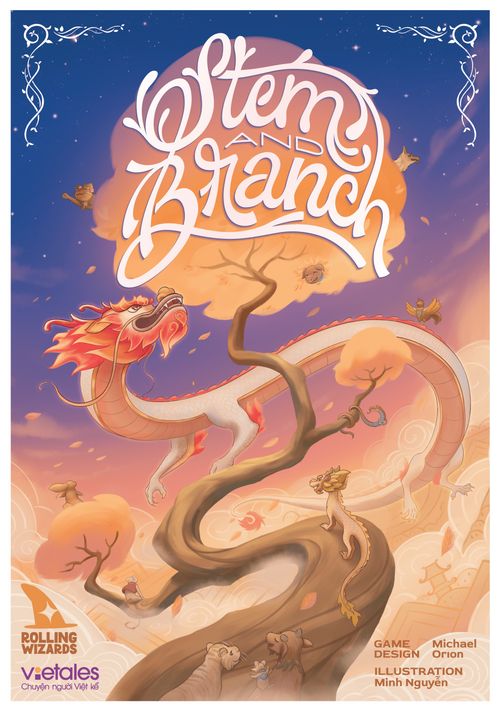
Stem & Branch
Stem & Branch Rulebook
Table of Contents
Table of Contents
Goal
Control the Five Elements and ascend the twelve Spirit Animals to nurture the Tree of Time and complete a Stem and Branch cycle. The player who devotes the most years to the Tree before the deck runs out is the winner.
Game Overview
The Stem and Branch cycle is represented in the 60-card deck, with each card symbolizing a year guided by a Spirit Animal and one of the Five Elements. As an Immortal, your sacred task is to nurture the Tree of Time by summoning and ascending the Spirit Animals from the Stream of Time and recording their progress in the Scroll of Time.
The cost to summon a Spirit Animal depends on its rank and Element Type, paid by expending matching Animals and Elements you control. Once summoned, Animals already on the Scroll can share their Element Type, making it easier to summon and ascend more Animals.
In cooperative play, you work together to help all the Spirit Animals complete their journeys before the Stream of Time runs out. In competitive play, you compete for control of the Animals and Elements to devote the most years to the Tree of Time.
The game ends when the Stream of Time runs out. You then add the years you gained, and the one who has the most years will be the winner.
About the Vietnamese Zodiac
Thiên Can Địa Chi is a time-keeping system that comprises two components: the 10 Heavenly Stems and the 12 Earthly Branches. Combining a Heavenly Stem and an Earthly Branch in sequence creates sixty Can Chi pairs. As this system begins with the character "Giáp," these 60 pairs are often referred to as the Lục Thập Hoa Giáp (Sixty-Year Cycle).
Included in the Box
- Vietnamese & English Rulebooks
- Scroll of Time Game Board
- 60 Unique Spirit Animal Cards
- 12 Animal Tokens (mouse, buffalo, tiger, cat, dragon, snake, horse, goat, monkey, rooster, dog, pig)
- 10 Element Tokens (two each of fire, earth, metal, water, and wood)
- 4 Spirit Flower Player Tokens
Game Setup
- Put the Scroll of Time Game Board in the middle of the playing area and randomly place the 10 Element Tokens around the 10 outer spaces as shown.
- Pick a unique Spirit Flower to use for your Player Token. Place each token near the "60" space of the Year Track around the outside of the Game Board. Pick a starting player randomly (or the youngest player). Play goes in a clockwise direction.
- Shuffle all cards into a single Deck and deal each player 4 cards. Then, put 8 cards face-up next to the Game Board to create the Stream of Time.
- Place the Deck & Animal Tokens near the Game Board.
You're ready to play!
Actions
On your turn, you must take 2 actions. You can choose to either Draw one Spirit Animal card or Summon one card as a single action. You may take the same action twice or take two different actions.
Draw Action: Taking Cards
Take one card from the 8 revealed cards in the Stream of Time OR from the top of the card deck. If you take a card from the Stream, immediately replace it with a new card from the top of the deck.
You may hold up to 7 cards in your hand between turns. You can draw more than 7, but at the end of your turn, you must discard down to 7. When you discard cards, make one faceup discard pile for all the discarded cards. You may view the discard pile at any time.
Summon Action: Placing Cards
Place one card from your hand onto any of the 12 spaces of the Game Board. Each Spirit Animal card can only occupy 1 space and may not be moved once placed. When you place a card on top of an Element Token during a Summon action, you will gain the token after paying the cost to place the card.
Placing Cards
Animal Card Cost
The cost to Summon and place a card on the Game Board is equal to that Animal's rank. You pay this cost by discarding cards or Element Tokens you control that match the placed card's Animal or Element Icon.
A card's rank is shown by the number of circles on the left side and the top of the card. Ranks range from 1 to 5. For example, a card with 5 circles showing Fire Snake is a rank 5 Fire Snake.
Highest Rank Only
You can never place a lower rank Animal if the higher rank version of the matching animal type is already on the game board.
Animal Card Placement
If the card is the first of its Animal Type to be placed, put it on any empty space on the Game Board. If there's already a lower-ranked Animal of the same type on the board, place the new card on top of it.
For example: you want to place the Fire Mouse, but can only place it on the same space as the Wood Mouse and may not place on another empty space or over a different Animal Type.
Gaining Animal Tokens
After placing a card, gain control of the matching Animal Token and put it in front of you. If another player controls the token, you must take it from them.
(See Ascending on Pg. 7.)
Gaining Years
The years you gain are moved along the Year Track on the Game Board. There are two primary ways to gain years in the game:
-
Gain 1 year for each Animal Token you now control after taking a new Animal Token.
For example: You already control 2 tokens (Pig & Monkey) and you just gained your 3rd token (Mouse), gaining you 3 years on the Year Track.
-
When you place a card and already control its matching Animal Token, gain 1 year for each Element Token you now control.
For example: You place the rank 5 Water Mouse on top of the Fire Mouse and collect 1 Fire Token. Since you already had the Mouse Animal Token & now control 3 Element Tokens, you gain 3 years.
(See Gaining Elemental Tokens on Pg. 7.)
Sharing Elements
Cards already on the Game Board will share their Element Type, reducing the cost for a Summon Action. Each adjacent card with a matching Element Type connected by a vine will contribute one Element Icon towards the cost to Summon and place new cards.
For example: You place a rank 4 Water Cat adjacent to the Water Goat & Water Mouse. You need only to discard 2 matching Icons since each Animal provides 1 Water Icon to the space. You choose to discard 1 Cat Icon and 1 Water Icon from your hand to place the Water Cat.
Ascending Animals
When you place a higher-rank card of an Animal that is already on the Game Board, the lower-rank one Ascends into the higher-rank one. Place the higher-rank card overtop of the lower-rank one, replacing it. You may skip ranks when Ascending.
Ascending Discount
The cost to play the higher-rank card is reduced by the difference in the ranks.
For example: If a rank 2 Water Horse is on the board, and you place a rank 5 Earth Horse, you only need to pay the cost difference of 3 Icons. You put the Earth Horse on top of the Water Horse and gain 1 Water Element Token. Now, only the Earth Horse is visible on the game board. You then take the Horse Token and gain years for each Animal Token you currently have.
The Ascension Discount can also be combined with sharing adjacent Element Icons.
Gaining Element Tokens
When you cover an animal with a higher-rank version, you gain one Element Token that matches the Element Icon of the lower-rank card. This is the main way to gain Element Tokens during the game. The only other way is to place cards onto spaces of the Game Board that start with Element Tokens.
Sometimes there will not be a matching Element Token available on or near the Game Board since the players have them both. When this happens, you must take the matching token from a player of your choice. If you already have both tokens of that element, you don't get another one.
Element Tokens
There are 10 Element Tokens, two of each type: Fire, Earth, Metal, Water, & Wood. You may spend these tokens to help pay the cost of a Summon Action. Each token counts as one matching Element Icon when you spend it to pay for placing a card. Put all spent Element Tokens next to the game board.
In the previous example, you placed the Earth Horse by spending 2 Earth Tokens and 1 Earth Snake card to pay the cost of 3 matching Icons. This gained you 1 Water Token from Ascending the Water Horse. There are no Water Tokens available since both opponents have a Water Token. You choose the player with the most years and take their token. By placing the Earth Horse in this example, you have taken both the Horse Token and an Element Token from the other player, making it harder for them to earn years on their future turns.
The elements of the Animals follows a pattern: Fire follows Wood, Wood follows Water, Water follows Metal, Metal follows Earth and Earth follows Fire. This can help you to plan ahead for placing future cards.
Game End
The game ends when the draw deck is empty or if a player achieves 60+ years on the Year Track. When this happens, the current player finishes their turn, then all other players get one last turn. The player who caused the game to end does not get another turn.
Final Scoring
Gain 1 year for each Element Token you control and then gain 1 year for each Spirit Animal Card in your hand that matches an Animal Token you control. Add these to any years gained during the game. The player with the most years wins.
Tiebreaker
If there is a tie, the player who controls the Animal Token of the current year wins. If no one has the current year's Animal Token, go to the animal of the year before.
For example: If it is the year of the snake, the player who has the Snake Token wins the tie. If no one has the current year's Animal Token, then go to the previous year's animal (dragon). Reference the guide on the back of the rules to see the current years animal.
Solitaire & Cooperative Mode
Play alone or with friends to Ascend all the animals before time runs out.
Card Moving Rule
When placing a card, you may now move all Animal Cards from one space to an adjacent empty space along a connecting vine. This will open the space for the new card to be placed. Gain any Element Token covered from moving the Animal Card(s). (This is a free action.)
For example: you place the Water Horse onto the space where the Water Cat is. This moves the Water Cat one space over and gives you two Water Element Icons from both the Water Goat and the Water Cat next to it. This lets you play the Water Horse for free without discarding any matching Icons.
Animal Token Rule
When you play a rank 5 Animal Card, put the matching Animal Token on top of the card to show that it has fully Ascended. Cards with an Animal Token on them cannot be moved and become obstacles for moving cards.
No Sharing Rule
You cannot freely share or trade Element Tokens or Animal Cards. The standard rules for gaining Element Tokens apply. You may play openhanded, but for a harder challenge do not discuss or show the cards in your hand.
End Game & Scoring
The game ends when there are no longer any cards available to draw from the Stream of Time or if all 12 Animals have fully Ascended to rank 5. Score each card that has an Animal Token covering them, counting each card under each Animal Token, adding them up for your score.
BONUS: When successfully Ascending all 12 animals to rank 5, you also count all cards remaining in the deck and Stream of Time.
When ready for an even harder challenge, remove all Element Tokens from the game.
When playing with younger kids, only score the number of Animal Tokens placed on top of the Animal Cards. This way you will 'win' immediately if you are able to Ascend all 12 animals to rank 5!
Score Rankings
1-11: Beginner, 12-20: Apprentice, 21-28: Average, 29-37: Good, 38-45: Strong, 46-54: Expert, 55-59: Master!
History of the Can Chi
The Can Chi system was likely introduced to Vietnam during the periods of Chinese domination, which began over 2,000 years ago and spanned more than a millennium. Evidence for its early adoption can be found in Han dynasty brick tombs within Vietnam, where records based on this calendrical system have been discovered. Linguistic research by scholars like Michel Ferlus further supports this, concluding that the Vietnamese people borrowed the system directly from China.
This cultural adaptation is most evident in the modification of some of the spirit animals associated with the 12 Earthly Branches. For instance, the Chinese equate Sửu (丑) with Ngưu (牛), representing the Ox or cow. However, in Vietnam, Sửu is represented by Thủy Ngưu (水牛), the Water Buffalo, an animal far more common and central to Vietnamese agriculture than cows. Another notable difference is Mão (卯): while the Chinese associate it with the Rabbit, in Vietnam, it is equated with the Cat. These changes highlight how the system was localized to resonate with the indigenous culture and common animals of the region.
Your Stem & Branch
We created a chart on the next two pages for you to discover your own personal Stem and Branch combination based on your birth year in the Lunar Calendar. Look through the years and find which you fall in the middle of to find your match. For example, if you were born on February 15, 1984, you would fall between February 2, 1984, and February 19, 1985, indicating you were born in the year of the Wood Mouse. We have this shown as "1984.2.2 - 1985.2.19".
Note: The fate calculation in the table below is based on the Element of the Heavenly Stem. In Vietnam, another common method for calculating fate is based on the Tử Vi Đẩu Số (Purple Star Astrology) system developed by Chen Tuan (Trần Đoàn) during the Northern Song Dynasty. Here, we will use the first method. Let's explore your Can Chi based on the Element of the Heavenly Stem.
Source: Vietnamese Calendar of the 20th - 21st Centuries (1901 - 2100) & Vietnamese Historical Timeline / Trần Tiến Bình. Publisher: Natural Science and Technology, 2013.
Discover Your Stem & Branch (Birth Year Chart)
Each row below lists an Element/Animal combination, its Vietnamese Can Chi name, and the Lunar New Year date ranges in which someone born falls under that combination.
| Element & Animal | Can Chi Name | Date Ranges |
|---|---|---|
| Wood Mouse | Giáp Tý | 1924.2.5 - 1925.1.23 · 1984.2.2 - 1985.1.20 |
| Wood Buffalo | Ất Sửu | 1925.1.24 - 1926.2.12 · 1985.1.21 - 1986.2.8 |
| Fire Tiger | Bính Dần | 1926.2.13 - 1927.2.1 · 1986.2.9 - 1987.1.28 |
| Fire Cat | Đinh Mão | 1927.2.2 - 1928.1.22 · 1987.1.29 - 1988.2.16 |
| Earth Dragon | Mậu Thìn | 1928.1.23 - 1929.2.9 · 1988.2.17 - 1989.2.5 |
| Earth Snake | Kỷ Tỵ | 1929.2.10 - 1930.1.29 · 1989.2.6 - 1990.1.26 |
| Fire Mouse | Bính Tý | 1936.1.24 - 1937.2.10 · 1996.2.19 - 1997.2.6 |
| Fire Buffalo |
Note: two of the source dates in the box's own chart (Water Snake and Water Tiger) appear to contain typesetting errors in the original printed rulebook — reproduced above exactly as printed.
Player Aid
Take two actions each turn: Draw and/or Summon
Draw: Take new Animal Cards into your hand
- Draw 1 card from the eight face-up cards (replacing cards immediately) or from the top of the deck. (Discard down to 7 cards at the end of your turn.)
Summon: Play Animal Cards from your hand
- The cost to summon animals is equal to the card rank, reduced by each adjacent Shared Element and the difference in rank when Ascending the same animal.
- The cost is paid by discarding cards or tokens matching the Element OR Animal icon of the card played.
- When placing cards, you must place them into an empty space or on top of a lower-rank version of the same animal.
- After summoning the animal, gain the matching Animal Token (take from another player if needed).
Element Tokens
You acquire Element Tokens by playing Animals on top of lower-rank matching Animals (Ascending) OR by covering an existing token on the game board space. If an Element Token is not available, take one from another player.
Scoring years (Points)
- When gaining an Animal Token, you gain 1 year per Animal Token you control.
- When Ascending an animal you already control, you gain 1 year per Element Token you control.
Ending the game ~ Most years wins
When the deck is empty or a player reaches 60 years, it triggers the last round. Each remaining Element Token you control counts as 1 year, and each card in your hand matching an Animal Token you control counts as 1 year.