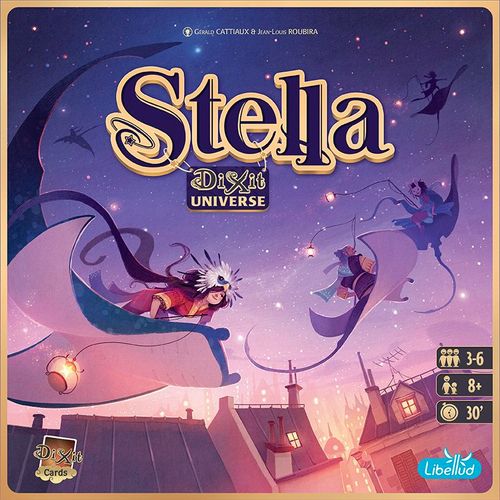
Stella: Dixit Universe
Stella: Dixit Universe Rulebook
Table of Contents
Table of Contents
Designers' Notes
Gérald Cattiaux
Creating this game was a wonderful adventure. To see the players getting to grips with it reminds me how much "playing together" is sharing. Sharing a good time together, a pleasant activity, and above all, sharing emotions. I wish you wonderful emotions. Enjoy!
Jean-Louis Roubira
I profusely thank Gérald for his enthusiasm and creativity, which bring new harmonics to the Dixit universe, a universe that is magnificently highlighted by Jérôme's illustrations; and I also warmly thank the Libellud Team for their incredible work in the players' service.
Goal of the Game
Stella is a game of associations of ideas and image interpretation.
Each round, players secretly associate several Dixit Cards with one random Word Card. If you manage to associate the same cards as the other players, you'll form a Spark that scores points. Multiplying associations gives you more chances to create Sparks. But don't be too greedy, as the player with the most associations runs the risk of scoring fewer points!
At the end of the fourth round, you need to have more points (stars) than other players to win the game.
Components
- 1 Board
- 84 Dixit Cards
- 96 Word Cards (2 unique words on each card)
- 4 Discovery Word Cards (recommended for your first game)
- 10 Customizable Word Cards (blank cards)
- 6 Lantern Tokens (double-sided: Light/Dark)
- 4 Round Tokens (numbered I to IV)
- 1 First Scout Pawn
- 6 Erasable Personal Slates
- 1 Erasable Scoring Slate
- 6 felt-tips and 6 cloths
Setting Up the Game
-
Assemble the two parts of the board and place it on the table.
-
Shuffle all the Dixit Cards and place 3 lines of 5 cards next to the board, as shown above. Make a draw pile with the remaining cards.
-
Randomly select 4 word cards without looking at them and place face down next to the board as a draw pile. The rest of the word cards are not needed and can be placed back in the box.
-
Place the Round Tokens on the appropriate spots, numbered side visible, in the proper order (from bottom to top).
-
Each player takes a Personal Slate and the felt-tip of the matching color, as well as a cloth.
-
Form a pile with the Lantern Tokens, face up (Light side). There must be one Lantern Token per player of the matching color. Place this pile on the starting spot, in the lower part of the board.
-
Give the Scoring Slate to the player of your choice (to keep track of the players' points during the game). This player writes down the name of each player at the top of the column of their color.
-
Randomly determine the first player. Give this player the First Scout Pawn.
If this is your first game, use the 4 Discovery Word Cards. These cards are numbered #1 to #4. Sort them in ascending order to form a pile that you place next to the board (#1 on the top).
The Game Round
Stella plays in 4 successive rounds, each being divided in the following steps:
1. Associate
During this step, each player secretly associates Dixit Cards with a Clue Word. Selecting the same Dixit Cards as the other players allows you to score more points. Conversely, selecting a card that no one else chooses may cost you dearly.
The player who owns the First Scout Pawn reveals the first Word Card from the draw pile. They read aloud the word printed at the top of that card. That word becomes the Clue Word of the round. Slide the Word Card under the board in the designated location so that only the Clue Word is visible.
Note: If some players do not understand the Clue Word or do not wish to play with it, all players may collectively decide to use the word printed upside down instead.
Take your Personal Slate (hiding what you'll write from other players) and make sure that it is properly positioned (see below: How to properly position your Personal Slate).
Observe the Dixit Cards to associate some of these cards with the Clue Word. What does the Clue Word remind you of? What does it evoke for you? Do some Dixit Cards present some similarities? It can be a concept, an atmosphere, colors, characters, details, and so on. Associations of ideas depend on your perception and your interpretation, so be creative!
You must secretly indicate the Dixit Cards that you choose on your Personal Slate. To do that, mark with a cross each box that matches the card that you've chosen. You must select at least one card, and up to 10 cards.
When you're done selecting your Dixit Cards, pass your felt-tip to your left neighbor to indicate that you completed your selection. Once all players have passed their felt-tip, the selection is over and you can no longer change it.
Note: You have as much time as you want to select your cards. Play at your own rhythm.
Example: The Clue Word is "Captain". To Orange, this word evokes the captain of a ship, or of a team... It also evokes a leader, a military officer...
Orange sees 7 cards that, to them, have a link with the Clue Word, and could possibly be chosen by other players. For instance:
- A features a treasure chest and a pirate ship;
- B features a star holding a stellar map;
- C features a character that could be an alpine guide, leading a team.
Orange checks the 7 boxes matching the cards that they have chosen on their Personal Slate.
How to properly position your Personal Slate
Personal Slates reproduce the position of Dixit Cards on the table. Each Dixit Card has its own box on your Personal Slate. To make sure that your Slate is properly positioned, pay attention to the position of the miniature board that appears on it.
2. Announce
During this step, each player announces the number of Dixit Cards that they associated with the Clue Word. If a player has made more associations than the others, they must flip their Lantern Token to its Dark side (a risky situation when scoring points).
All players announce the number of boxes that they checked on their Personal Slate this round.
Reminder: Your Personal Slate must constantly remain hidden from other players' eyes.
Each player then places their Lantern Token on the matching numbered spot on the Board, Light side up.
Once all Lantern Tokens have been placed, two situations may occur:
-
A player is alone in the lead (having checked more boxes than any other player). That player is in the Dark. They must now turn their Lantern Token to its Dark side.
Example: Orange checked more boxes than any other player (7 crosses). They must flip their token to display its Dark side.
-
At least 2 players are in the lead with the same number of crosses. In that case, no one is in the Dark. All tokens remain on their Light side.
Example: Orange and Pink checked more boxes than any other player (8 crosses). Since no one is alone in the lead, their tokens remain on their Light side.
Note: Being in the Dark does not affect the remainder of the round, but it will affect scoring (see 4. Scoring).
3. Reveal
During this step, each player will progressively reveal the Dixit Cards that they have chosen during Step 1 to try and score as many points as possible.
The first Scout of the round is the player who owns the First Scout Pawn.
The "Scout" is the name given to the player who shows one of the cards that they selected. This role passes clockwise from one player to another, until no player can show any card (see This Step Ends).
Note: The player with the First Scout Pawn does not give their pawn to the other players when these players become the Scout. That pawn will only move at the end of the round (see 4. Scoring).
When the Scout shows a card, they simply choose one cross from their Personal Slate and points at the matching Dixit Card to the other players with their finger. The Scout cannot choose a card that has already been chosen during this round.
The other players check their Personal Slate to see whether they also selected this card or not.
Three situations may occur:
The Spark
If several players have selected the card shown by the Scout, then they all get a Spark. All involved players, including the Scout, fill the two stars of the matching box.
Note: Players that have fallen during this round may be part of the Spark, but won't fill any stars (see The Fall).
The Super-Spark
If one other player (and only one!) has selected the card shown by the Scout, then that player and the Scout get a Super-Spark. They fill the two stars of the Spark, and the bonus star of that box.
Note: Players that have fallen during this round may be part of a Super-Spark but won't fill any stars (see The Fall).
The Fall
If no other player has selected the card shown by the Scout, the Scout falls:
- They fill no stars for this card;
- They can no longer fill stars nor bonus stars for this round;
- They can no longer be a Scout for this round;
- They must keep their Personal Slate in their hand, because the crosses that they made may count for other players who didn't fall (to get a Spark or a Super-Spark).
Hint: To avoid falling, as a Scout, always try to choose the most obvious Dixit Card first.
Example: This round's Clue Word is "Captain". Several cards have been revealed and Orange is now the Scout.
- Orange decides to show the card A, but no one has chosen this card! Orange falls. They already filled 4 stars in this round, and won't fill any more stars until the next round. (Fall!)
- It is now Pink's turn to be the Scout. They show the card B, which has been selected by Orange and Blue – that's a Spark! Pink and Blue each fill the 2 stars of the matching box on their Personal Slate. Orange does not fill any stars because they already fell. (Spark!)
- Purple now becomes the Scout. They show the card C, which has been selected by Orange only – a Super-Spark! Purple fills the 2 stars of the matching box, +1 bonus star. Orange, again, does not fill any stars. (Super-Spark!)
Normally, Green should now become the Scout, but since they have fallen, they cannot do so. The following player is Blue who still has crosses to reveal. Blue becomes the Scout and the 3. Reveal step continues.
Once the situation has been resolved, the player that sits on the left of the current Scout becomes the new Scout. They must now show a card that they have selected on their Personal Slate, and so on.
The new Scout cannot be a player who has already fallen or who has no crosses left to confirm. In this case, the next player becomes the new Scout, and so on.
This Step Ends:
- either when all players have fallen (no one can become the Scout),
- or when players that did not fall have no crosses left to confirm.
4. Scoring
During this step, players tally their score, counting the points that they scored for the round. Then, they prepare the next round.
Each player scores as many points as the number of stars that they filled on their Personal Slate (bonus stars included). The player who was given the Scoring Slate notes down each player's score in the matching column.
Example: Orange has a total of 9 stars – they score 9 points for this round.
Player in the Dark
If you're in the Dark, you do not score your points like the other players. Two situations may occur:
No mistake — You didn't fall, congratulations! You managed to create Sparks (and/or Super-Sparks) with all of the crosses that you made during step 1. In that case, calculate your score normally.
Example: Orange is in the Dark, yet they managed to form Sparks and/or Super-Sparks with all of their crosses. As a consequence, Orange scores their points regularly (6 Sparks + 1 Super-Spark = 15 points).
One or several mistakes — If you fell, it means that at least one of your crosses did not create a Spark or a Super-Spark. In that case you score one point less for each Spark and Super-Spark. To reflect this, you must delete one star of each matching box before tallying your score.
Example: Orange is in the Dark. Some of their crosses did not create a Spark. Maybe they were too greedy… As a result, Orange scores only 1 point for each Spark instead of 2, for a total of 8 points (6 Sparks + 1 Super-Spark = 8).
Note: The bonus point of a Super-Spark still counts, even in the Dark.
Preparing the next round
Once you've noted the scores, prepare the next round. Follow these steps:
- Put the Word Card that you used for this round back in the box.
- Pass the First Scout Pawn to the next player (clockwise).
- Flip the Round Token of the current round (I for round 1, II for round 2, etc.) This token indicates the line of Dixit Cards that you must replace. Replace the 5 Dixit Cards of the corresponding line with 5 new cards from the draw pile. Put the Round Token and the 5 discarded cards back in the box.
- Reset the Lantern Tokens (Light side) and place them back on their starting spot.
- Each player erases their Personal Slate.
End of the Game
At the end of the fourth round, each player calculates their total score, adding up the points that they scored in each round.
The player(s) with the most points win(s)!
Example scoring column: 9 + 12 + 6 + 15 = 42.
Customizable Word Cards
You have 10 blank Word Cards at your disposal. Give free rein to your imagination (characters, movies, books…) and create your own Word Cards! Write the words of your choice on the cards and add these cards to the others for customized games.
Summary of a Game Round
Stella plays in 4 successive rounds, each being divided in the following steps:
1. Associate — Each player must secretly indicate on their Personal Slate the Dixit Cards (from 1 to 10 cards) that they associate with the Clue Word.
2. Announce — Each player places their Lantern Token on the numbered spot of the Board matching the number of boxes that they checked on their Personal Slate. If one player has checked more boxes than any other player, that player turns their Lantern Token on its Dark side.
3. Reveal — Starting with the First Scout and going clockwise, each player shows a Dixit Card they have checked on their Personal Slate.
- The Spark (At least 2 other players have selected this card): The Scout and all involved players fill 2 stars.
- The Super-Spark (Only 1 other player has selected this card): The Scout and the involved player fill 2 stars and 1 bonus star.
- The Fall (No one else has chosen this card): The Scout fills 0 stars. They can no longer fill stars nor be a Scout for this round.
This Step Ends: either when all players have fallen (no one can become the Scout), or when players that did not fall have no crosses left to confirm.
4. Scoring — Each player scores as many points as the number of stars that they filled on their Personal Slate and notes it down on the Scoring Slate.
- Player In the Dark: They must make no mistake to score normally. Otherwise, they delete one star for each Spark and Super-Spark before tallying their score.
Discover the Dixit Universe
Discover the Dixit universe, with the multi-awarded base game and all the expansions!
Dixit is a unique and simple game favouring communication and imagination, that makes you travel in fantastic and dreamlike worlds.