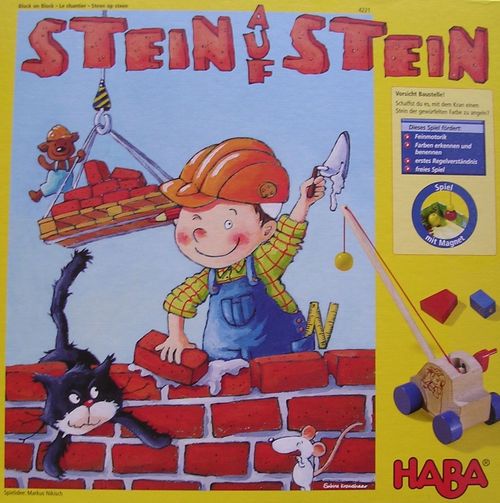
Stein auf Stein
Stein auf Stein Rulebook
Table of Contents
Table of Contents
Basic Game
Translated from the French basic rules printed in the manual ("Règle du jeu"). The German and English basic-game text is not in the source file.
Contents
- 1 wooden crane
- 18 building blocks in different colours
- 1 building site (chantier)
- 1 folding yardstick
- 4 coloured pegs
- 1 multicoloured die
- 1 rules sheet
Object of the Game
Translated from the French ("But du jeu").
Which crane operator will manage to hook the most blocks and so become the head of the crane operators?
Setup
- Place the building site in the middle of the table or on the floor.
- Put the 18 building blocks on the building site. Make sure the metal buttons on the blocks are turned upward.
- Prepare the crane and the die.
- The yardstick and the pegs are used only for the variants. Leave them in the box.
Course of Play
- Players take turns in clockwise order. The player who last saw a crane goes first. If you cannot agree, the youngest player starts and rolls the die once.
- The player takes the wooden crane and moves it to the building site.
- The player must lift a block of the same colour as the die.
- The player decides which side of the building site to stand on.
- The player may stand up and walk around the building site.
- Did you hook a block? Lift it by turning the crank.
- Did the block match the colour? Well done, you are a good crane operator! Take the block and place it in front of you.
- Is the block a different colour? Too bad! You may not keep the block. Put it back on the building site.
- Did you lift several blocks?
- If one or more of them are the right colour, you may keep them. Place them in front of you. Good work!
- If none of them is the right colour, put all of them back on the building site.
- Then inspect the building site. Check that all the metal buttons are turned upward. If any are not, turn the blocks concerned the right way round.
- Then it is the next player's turn to roll the die.
Translation note: the steps above translate the printed French sidebar entries ("mettre les blocs sur le chantier", "lancer le dé 1x", "repêcher le bloc de la couleur correspondante", "Réussi ? Prendre le bloc", "Pas réussi ? Reposer le bloc", "Plusieurs blocs ?", "Mauvaise couleur ? Reposer les blocs"). The printed headings are kept as their English gloss above.
End of Game
- The game ends as soon as there are no blocks left on the building site in the colour matching the die.
- The player who can lay out the longest row with their building blocks wins the game. That player becomes the head of the crane operators.
Free Play Without the Rules
Translated from the French ("Jouer sans suivre la règle").
- Playing according to their imagination, children practise the coordination of eyes and hands and develop fine motor skills.
- They operate the crane, turn the crank and try to hook blocks onto the hook.
- They play with the building blocks.
- Play with your child and imitate the typical noises of a building site. This will also awaken language, hearing and a passion for games.
Variants
The English variants below are reproduced verbatim from the manual's English column ("Variants"). The variant headings are the printed sidebar labels of that column, rendered in title case. The French column of the manual prints the same four variants in French; it is not repeated here.
Determine Length by Yardstick
- The variant with the yardstick: Whoever wants can determine the longest row by using the yardstick. It's true that younger kids are not yet able to read numbers, but if the length of the row of the first player is marked on the yardstick by the red peg, the row of the second player by the yellow and the third by a green one for example, the different lengths can be compared.
Pile Up Blocks
- The variant with the tower:
- Skillful players don't put the blocks next to each other, but on top of each other. Then the player with the tallest tower wins the game. Again the winner can be determined using the yardstick.
Pile Up Blocks in Order of Fishing Out
- Variant of the master tower builder, for far-sighted players!
- Aim of the game again is to build as tall a tower as possible. The blocks, however, have to be piled up immediately after being fished out: so at the beginning you have to fish for the bigger and then for the smaller ones in order to build a tower successfully.
- The game ends either as described for the basic game or as soon as the tower of a player falls over. This player loses. The player with the highest tower left wins.
- Important: Whoever, when piling up the blocks, notices that the next block can't be placed, may stop building of the tower. Then it's the tallest tower built up to this point which counts.
Compare Blocks Fished Out with Remaining Blocks
- The variant for solo constructors
- Rolling the dice, fishing and collecting of blocks is done in exactly the same way as in the basic game.
- Then the player tries to lay out a row or build a tower as long and high as possible. The length/height is marked by the yardstick.
- Then the remaining pieces are taken out of the box and piled up to a tower, measured and marked by another peg.
- Only if the player's own tower is higher, do they win.
- Hint: This variant gets more difficult if you can not change the order of the blocks in which you build the tower.