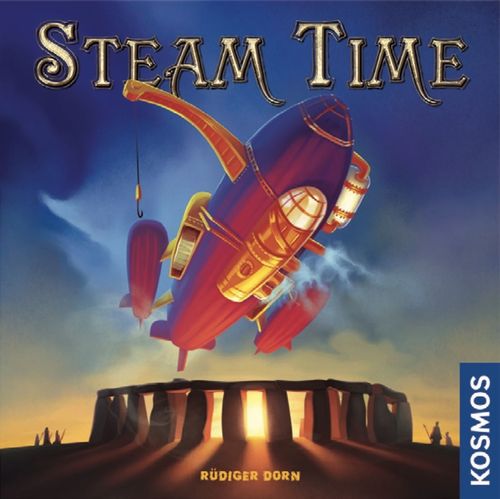
Steam Time
Steam Time Rulebook
Table of Contents
Table of Contents
Components
Note: Before the first game, carefully separate the gold sovereigns, esteem tiles, saboteurs, and upgrades, as well as monument boards, first player tile, and airship boards from their die-cut cardboard frames. Then carefully punch the die-cut holes out of the monument boards and airship boards.
- 1 First player tile
- 3 Game board tiles
- 36 Gold sovereigns, referred to as "gold" (20 x 1-unit pieces, 16 x 5-unit pieces)
- 4 Esteem tiles (1 per player color)
- 30 Upgrade tiles, referred to as "Upgrades" (6 per round)
- 9 Monument boards (double-sided; 6 panels each for 2, 3, and 4 players)
- 4 Airship boards (1 per player color)
- 24 Encounter cards, referred to as "Encounters"
- 30 Expedition cards, referred to as "Expeditions" (6 per round)
- 32 Mission cards, referred to as "Missions"
- 12 Effort cards (6 each α and Ω)
- 1 Fabric bag
- 12 Control discs (3 per player color)
- 12 Airships (3 per player color)
- 120 Crystals
- Mr. T.I.M.E. (a small figure)
Prospector: T.I.M.E. has a monopoly on the rare and universally usable T.I.M.E.-crystals (the clear crystals). They cannot be found in the regular deposits.
Modules (not required for base game)
Sabotage module: 4 Saboteur tokens (1 per player color)
Specialist module: 36 Specialist cards (9 per player color)
Preparation
Each player receives the following in his or her color:
- 1 Airship board. Place it in front of you.
- 3 Airships. Place them in the hangar of your airship board.
- 3 Control discs. Place 1 each on:
- the start space of the esteem track on the game board,
- the space marked "1" on your steam track,
- and the start space of your time portal track.
- 8 Gold. Place it in your vault.
The least punctual person is the starting player.
-
The players also receive crystals in the following quantities, according to the order in which they will play. Each player places his or her crystals in the correspondingly colored generators on his or her airship board. There are generators located in six places on the airship: bridge (green), engine room (blue), laboratory (black), time portal (pink), Midas-machine (gray), and analytic engine (orange).
All players each receive 5 crystals: 1 each in green, blue, black, pink, and gray.
The second, third, and fourth players additionally receive 1 orange crystal each, which are placed in the analytic engines.
The third and fourth players additionally receive 1 steam each. They advance the control discs on their steam tracks accordingly.
The fourth player additionally receives 2 gold, which are placed in the vault.
Placement rule 1: When placed, a crystal must be placed into the generator of the same color as the crystal.
Placement rule 2: When placed, a crystal must be placed into the slot in the generator that is farthest left and empty.
-
Put all of the remaining crystals except the clear T.I.M.E.-crystals in the fabric bag.
Now connect the 3 game board tiles and prepare the game board.
- Place the 30 clear T.I.M.E.-crystals in the secret mine.
- Place the remaining gold in the bank.
- Place the esteem tiles on the corresponding spaces of the game board.
- Place Mr. T.I.M.E. on the time compass.
- Shuffle the 24 encounters face down and place them face down on the encounters box. This is the encounter deck.
- Shuffle the 32 missions face down and place them face down on the missions box. This is the mission deck.
- Sort the expeditions into 5 decks by the Roman numerals on their back sides. Shuffle each deck separately face down. Stack the 5 decks face down and sorted by Roman numeral on top of each other on the expeditions box, with "V" at the bottom, then "IV", "III", "II", and "I" on top. This is the expedition deck.
- Sort the upgrades in the same manner as the expeditions and place them face down on the upgrades box. This is the upgrade deck.
- Sort the effort cards by the Greek symbols on their back sides (α "alpha" and Ω "omega"). Shuffle each stack separately face down. Then draw 2 effort cards from the α-deck and 3 from the Ω-deck. Place the 2 α effort cards on top of the 3 Ω effort cards. Place this stack face down on the effort box. This is the effort deck. Reveal the topmost effort card and place it face up on top of the effort deck. The other 7 effort cards are removed from the game.
- Place the first player tile next to the game board.
- Take the monument boards marked with the number (2, 3, or 4) in the corners equal to the number of players in the current game. Place them in any order next to the game board. Choose any desired sequence of the monument boards. The other 3 monument boards are removed from the game.
On each monument board, there are several different action spaces (see "Action phase" below). Prepare the action spaces of the monument boards as follows:
- Crystal deposit action space: Place 1 crystal in each available slot. Randomly draw the crystals from the bag.
- Mission action space: Draw 1 mission per action space from the mission deck and place them to the left of the corresponding monument boards on the corresponding mission spaces of the game board.
- Expedition action space: Draw 1 round-I-expedition per action space and place them to the right of the expedition images on the corresponding monument boards. The remaining round-I-expeditions are removed from the game.
- Upgrade action space: Draw 1 round-I-upgrade per action space and place them on top of the upgrade action spaces on the monument boards. The remaining round-I-upgrades are removed from the game.
You do not place anything on the Encounters or Gold action spaces.
Game Objective
T.I.M.E. has entrusted you to examine the temporal phenomena around the monuments. Gain knowledge about the past, gather crystals, build up steam, and return. The more successful you are, the higher you will rise in T.I.M.E.'s esteem!
The player who has the highest esteem score after 5 rounds is the winner.
Game Sequence
The game is played over 5 rounds. Each round consists of the following phases:
- Income phase (this does not happen in the first round!)
- Action phase
- Supply phase
1. Income phase
(Please note: this does not happen in the first round because players have not acquired upgrades yet.)
For each upgrade which improves a player's airship board, he or she receives rewards in each subsequent round. Starting with the first player, players receive the rewards (in clockwise order) for each of their upgrades. The possible income rewards are:
- The Midas-machine generator is working more efficiently! Take X gold from the bank.
- You rise in T.I.M.E.'s esteem! Advance your control disc X spaces on the esteem track.
- T.I.M.E. sends you 1 T.I.M.E.-crystal! Take 1 T.I.M.E.-crystal from the secret mine and place it immediately in a free generator slot on your airship. Please note the placement rules! Note: T.I.M.E.-crystals are universally usable. They can represent any color.
- T.I.M.E. sends you a crystal! Take 1 crystal of the depicted color from the bag and place it in the corresponding generator on your airship board. Please note the placement rules! Please note: if there is no open slot of the matching color, you cannot take the crystal!
- Your steam generator is running more efficiently! Advance the control disc on your steam track by 1 space. Please note: if you already have 10 steam, your steam generator has reached its capacity and you do not get the additional steam.
- Your lookout reports that there is a crystal deposit ahead! Take 1 crystal free of costs from any crystal deposit on a monument board and place it in an open slot on the corresponding generator on your airship board. Please note the placement rules! Please note: do not draw a replacement for this crystal from the bag for the current round!
Possible costs for placing crystals
Placement rule 3: Running some generators at full capacity will cost you additional gold. If you want to place a crystal in a slot that is marked with "-2", you immediately have to pay 2 gold to the bank. These additional costs apply regardless of how you received the crystal, be it from a crystal deposit, encounter, expedition, upgrade, or the first player tile. If you cannot (or do not want to) do so, you can neither place the crystal on that slot nor take or buy it. The costs apply every time you place a crystal in one of these slots, even if one had been placed there before and then removed.
Placement rule 4: When you receive a T.I.M.E.-crystal, you immediately have to place it in any open slot in a generator on your airship. Please note the other placement rules!
Placement rule 5: T.I.M.E.-crystals are always placed to the right of colored crystals. If you receive a new colored crystal, the T.I.M.E.-crystal shifts to the right.
Example: Leo already has 2 orange crystals and 1 T.I.M.E.-crystal in the generator of his analytic machine. Now he receives another orange crystal. The T.I.M.E.-crystal shifts one slot to the right and the orange crystal takes its old slot. And he pays 2 gold because a crystal is placed into a slot marked with a "-2".
2. Action phase
Starting with the first player, in a clockwise order, players execute 1 of the following possibilities:
a) Either take the first player tile, or … b) Place 1 airship and execute the action.
a) Take the first player tile
The first player tile can be taken only once per round! If you take the first player tile, you may execute one of the two depicted special actions. After this, the turn passes immediately to the next player. You do not place an airship in this turn!
Please note: You do not lose an airship action for taking the first player tile! After all the other players have placed all of their airships, you will get one turn to place your third airship.
- Special action 1: Convert 1 steam into 1 esteem (up to 10 times).
- Special action 2: Convert 1 steam into 1 T.I.M.E.-crystal, which you must place in any of your generators. Please note the placement rules!
Please note: The current round's first player cannot take the first player tile in his or her first turn. (In other words, the first player in the current round must give all the other players one chance to take the first player tile before taking it.)
Please note: If all players have placed all their airships, but no one has taken the first player tile, the previous first player gets the first player tile. He or she stays first player for another round and may execute one of the special actions before the end of this round.
b) Place 1 airship and execute the action
Place 1 of your airships from your hangar on any unoccupied action space on a monument board (following Placement rule 6). Execute the corresponding action. After executing the action, you may receive a reward and/or a bonus. If you cannot or do not want to do so (e.g., you don't have enough gold, or you don't have any open slots in generators for available crystals), you cannot choose this action.
Bonuses generated by the airship: Each crystal color and each action space color correspond to one of the six generators on the airships, with the exception of the clear, universally usable T.I.M.E.-crystals. The more crystals there are in a generator, the higher the bonus you get when the generator is activated by the correspondingly colored action on the monument board.
Please note: Only the active player receives a bonus! And you only get a potential bonus after completely executing the action. Refer to the generator of the same frame color as the action space of the executed action. If you have 1 or more crystals in this generator, you receive the bonus(es) depicted below the filled crystal slot(s)!
Placement rule 6: If you have already placed an airship in a previous turn, and it is your turn again, you must place your next airship at least 1 monument board further up in the stream of time.
Example: In his first turn, Finn (Red) places his airship on the gold action space on the second monument board (from the bottom). In his second turn, he can place his airship on a free action space. The action spaces on which Dani (Yellow), Leo (Blue), and Sabrina (Green) have placed their airships are not available for him anymore. And he has to follow the stream of time. Therefore, he cannot place his second airship on the bottom monument board or on the monument board second from the bottom.
Actions
There are 6 different action spaces, but some of them are not available on some monument boards: Mission, Encounter, Crystal Deposit, Upgrade, Gold, and Expedition.
1. Mission
Take one of the missions and place it face down left of your airship board. You may check your mission at any time. Missions allow you to convert resources into esteem at the end of the game.
Please note: Some mission action spaces additionally give you 1 steam or you can advance the control disc of your time portal by 1.
Missions are revealed and checked at the end of the game. A mission only increases your esteem if you deliver the resources that are depicted in the top half of the mission. You can see the amount of esteem points you can earn at the bottom of the mission card. Some missions even allow meeting the requirements multiple times (e.g., 1x, 2x, 4x, 10x) as long as you have enough resources.
Bonus: Advance the control disc on the esteem track by 1 per green crystal in your bridge.
Examples of missions: Move 1 step back on the time portal track (only until the starting space); hand in 1 upgrade; hand in 1 expedition; hand in 10 gold plus any 3 crystals; hand in any 3 crystals of the same color.
2. Encounter
Draw as many encounters as depicted (2 or 3). Choose 1 and execute it.
Please note: Some encounter action spaces additionally give you 2 esteem or you can advance the control disc of your time portal by 1.
There are 2 different kinds of encounters:
a) Both possible card actions are blue. The active player either executes the top or the bottom action.
b) The bottom action is purple. The active player executes the blue action first. After this, each of the other players may in turn decide whether they can and want to execute the purple action.
Please note the placement rules!
Then place all drawn encounters on the encounter discard pile. When the encounter deck has run out, shuffle the encounter discard and place it again face down on the encounter box.
Bonus: Get 1 steam for each blue crystal in the generator of your engine room. If you already have 10 steam, you do not get the bonus.
The top action always gives the active player resources. This is also true for the bottom actions of Crassus, Rockefeller, and ad-Din. For all other encounters' bottom actions, you need to spend something (left of the hand) to receive the reward (right of the hand).
Example: Dani places her airship on the encounter action space. She immediately receives 2 esteem. Then she draws 2 encounters: Alfred Nobel and Bi Sheng. She chooses Alfred and executes the top action (to get 2 crystals of the same color) and takes 2 blue crystals from the bag and places them in the blue engine room generator on her airship, which was previously empty. Then she checks for the bonuses generated by the engine room, because the encounter activated the blue engine room generator: since she now has 2 blue crystals in her engine room generator, she receives a bonus of 2 steam.
3. Crystal deposit
Buy 1 or more crystals for 2 gold each.
Please note: Some deposit action spaces additionally give you 2 esteem.
Bonus: Get 1 T.I.M.E.-crystal from the secret mine for each black crystal in your laboratory generator. You have to place it immediately! Please note the placement rules! If the secret mine is empty, you do not get the bonus.
4. Upgrade
Pay for the upgrade and incorporate it into your airship board.
Please note: Although there are only 4 upgrade spaces on the right side of your airship board, you can have more than 4 upgrades.
- The letters (A to F) on the left of the upgrade tell you how many crystals the upgrade costs.
- The effort card tells you which color of crystal is required for each letter on the upgrade.
After paying for the upgrade, you immediately receive the depicted income on the upgrade (see the Income phase section).
Bonus: Advance the control disc on your time portal by 1 space in a clockwise direction for each pink crystal in your time portal. If the control disc reaches or crosses the top pink space, you immediately gain 1 bonus action on any of the monument boards. Please note the placement rules.
Do not use one of your airships, but instead Mr. T.I.M.E.! Take Mr. T.I.M.E. from the time compass space and place it on almost any action space: Mr. T.I.M.E. allows you to land on action spaces without following the stream of time and/or that are already occupied by another airship! Return Mr. T.I.M.E. to its place on the time compass after you have executed the bonus action.
Please note: If there are no more crystals on a crystal deposit, or if the expedition, upgrade, or mission of an action space have already been taken, those spaces are not available, even to Mr. T.I.M.E.!
Example: Finn wants to buy the upgrade to the right. It costs 3 crystals: A, B, and C. The current effort card shows that he has to pay 1 black, 1 pink, and 1 gray crystal. However, he wants to keep the pink crystal so that it activates his time portal when the time portal generator is activated. He therefore uses 1 steam to convert any other crystal (he chooses a gray crystal in this case) into pink to satisfy cost B. This, together with 1 black crystal to satisfy A and 1 gray crystal to satisfy C, covers the cost of the upgrade.
Steam
If you do not have a required crystal or do not want to spend it, you have another option when paying for upgrades or expeditions: For each 1 steam you spend, you can transform 1 crystal into any other colored crystal. When you do so, slide the control disc of your steam generator 1 space to the left.
Please note: If you neither have the required crystals nor the steam, you cannot change the crystal color and may not execute this action.
5. Gold
Take X gold.
Please note: Some gold action spaces additionally give you 1 steam and/or you can advance the control disc of your time portal by 1.
Bonus: Receive 2 additional gold per gray crystal in your Midas-machine generator. If the bank is empty, you do not get the bonus.
6. Expedition
Pay the expedition cost and place the card face up on the left side of your airship. The number of crystals required is indicated by the letters on the left of the expedition, and the required crystal colors are indicated on the active effort card.
Bonus: After paying for the expedition, you get 1 or more of the depicted rewards. For each orange crystal in your analytic engine generator, you could achieve 1 additional discovery on your expedition and thus get 1 reward. (For this action, the bonus and reward are one and the same.)
Example: The expedition at the top of the page costs 4 crystals: 1 each in green (A), blue (B), orange (C), and black (D) as indicated by the current effort card. Sabrina has 4 orange crystals. She spends 1 crystal each in blue, green, and black. But instead of spending the required orange crystal, she spends 1 steam and converts any other crystal (in this case, gray) into orange. By doing so, she keeps 4 orange crystals and thus also receives the first 4 rewards: 8 esteem points and 2 spaces on the time portal. If she had a fifth orange crystal, Sabrina would also get 1 T.I.M.E.-crystal.
Spending crystals and T.I.M.E.-crystals
Spending rule 1: When you spend crystals or T.I.M.E.-crystals, you must start with the rightmost slot in the corresponding generator of your airship board! This means that crystals in slots that have additional placement costs are used first.
Spending rule 2: If you must or can spend crystals during the game (for encounters, expeditions, or upgrades) and you have a T.I.M.E.-crystal in the corresponding generator, you must spend it first! Only when there are no more T.I.M.E.-crystals in a generator may you spend the colored crystals in that generator.
Spending rule 3: When spending a T.I.M.E.-crystal, it is spent as if it were a crystal of the color of the generator it is installed in. (For example, a T.I.M.E.-crystal placed in the analytic engine must be spent as an orange crystal.) However, by using 1 steam, you can convert a T.I.M.E.-crystal from one color to another during spending only, as if it were a colored crystal.
Spending rule 4: If you spend a T.I.M.E.-crystal during the game, place it on the secret mine and not in the bag!
The action phase ends when no one can or wants to place any airships anymore and the first player tile has been taken.
3. Supply phase
Execute the following preparations for the next round:
- Take back your airships and place them in your hangars.
- Move the monument board in the top position to the position at the bottom of the stream of time.
- Return all crystals remaining on crystal deposit action spaces to the bag. Remove all expeditions, missions, and upgrades for the round that just ended from the game.
Now prepare the monument boards:
- Place new crystals in the crystal deposit action spaces. Place new missions from the mission deck. Place the expeditions and upgrades for the new round. (The Roman numeral on the card matches the number of the round.)
- Remove the previous round's effort card from the game and flip the top effort card from the effort deck face up.
- Finally, the new first player places the first player tile next to the game board and starts his or her turn.
If a player crosses the start space of the esteem track with his or her control disc for the first time, he or she takes the esteem tile and places it next to his or her airship board, 60-side up. If he or she crosses the start space for the second time, he or she flips the esteem tile to the 120-side.
End of the Game
The game ends after 5 rounds. All that counts now is how high you have risen in T.I.M.E.'s esteem!
If you have accepted missions from T.I.M.E., you now check whether you can fulfill them. Starting with the first player, reveal your missions and spend the required resources to build esteem. Advance your control disc on the esteem track accordingly.
Please note: Missions for which you did not meet the requirements do not provide you any esteem.
Any remaining resources you may still own at this point (gold, crystals, upgrades, expeditions, steam, or steps on your time portal) are of no value!
The player who is in the highest esteem wins and is the celebrated captain of Steam Time!
In case of a tie, the player with more remaining crystals on his or her airship board wins. If there is still a tie, you have to share the title of most esteemed airship captain!
Modules
(Not required for the base game.)
Sabotage module
The game is played as described with the following changes:
- Preparation: Each player receives the saboteur of his or her color and places the saboteur in his or her hangar with the airships.
- At the end of the supply phase, starting with the first player, place your saboteur on any action space on the monument boards. The other players follow in clockwise order and place their saboteurs as well.
Please note: It is possible that at the end of the supply phase, there are several saboteurs on the same action space!
If a player wants to place his or her airship on an action space with a saboteur, he or she has to pay 1 T.I.M.E.-crystal per saboteur on the action space and return it to the secret mine! The color of the saboteur is of no importance. Only after "bribing" the saboteur may you execute the corresponding action. If a player cannot or does not want to bribe the saboteur, he or she cannot place his or her airship on this action space.
At the beginning of the next supply phase, players return their saboteurs together with their airships. So each player gets to place his or her saboteur four times in the entire game.
Specialist module
The game is played as described with the following changes:
- Preparation: Each player receives the 9 specialists of his or her color.
- Before you start the game, each player picks 2 specialists and takes them in his or her hand. Then each player shuffles his or her remaining specialists and places them face down as a draw pile next to his or her airship board.
- The specialists come into play during the action phase. In a player's turn and before executing any action (either taking first player tile or placing an airship), the player may play (face up) 1 or 2 specialists. Place the first specialist left of the corresponding symbol of your airship board. Each subsequently played specialist is placed face up on top of already played specialists, thus creating the specialist deck.
Please note: Only the special skills of the topmost face-up specialist are active!
Please note: Special skills of already covered specialists cannot be used for the rest of the game! So if a player plays 2 specialists at the same time in his or her turn (i.e., to draw new specialists which might suit his or her purposes better), he or she has to choose which specialist to place on top. Only the special skill of the top specialist is active.
- Refresh your specialist hand to 2 specialists at the end of your turn. Please note: If the draw pile is exhausted, you cannot draw any more specialists.
Example: In her first turn, Sabrina plays the navigator. She may now place airships on any action spaces and may ignore the stream of time! At the end of her turn, she draws 1 specialist from the draw pile.
In her fourth turn, Sabrina plays the psychic. Now, she can no longer use the special skills of the navigator, which she played in the first turn. She takes the still available first player tile and chooses special action 1: convert steam to esteem. With the psychic's special skills, she can convert 1 steam into 2 esteem instead of the usual exchange rate of 1:1. At the end of her turn, she draws 2 specialists. So due to the second special skill of the psychic, she now has 3 specialists to choose from.
In her fifth turn, Sabrina plays the adventurer. Now the skills of the psychic are lost. She chooses the expedition action. After paying the costs of the expedition, she now checks how many rewards she gets. Sabrina has 4 orange crystals. Thanks to the special skills of the adventurer, she receives one more reward, so she gets all 5 rewards! At the end of her turn, she does not draw another specialist, since she still has 2 specialists in her hand.
Later, Sabrina simultaneously plays banker and scientist. She places the banker on top. Now all special skills of the adventurer and the just-played scientist are lost. At the end of her turn, she draws 2 specialists from the draw pile.
Steam Time Almanac
Background on the historical figures who appear as Encounters, and the real-world monuments and legendary sites that appear as Expeditions.
Encounters
- Alfred Nobel (1833-1896), Swedish chemist and inventor of dynamite. Founder and eponym of the Nobel prize.
- Archimedes of Syracuse (287-212 BCE), Greek mathematician, physicist, and mechanic. Considered inventor of burning mirror, pulley, and irrigation system.
- Bi Sheng (died around 1052), Chinese inventor. Conceived print with movable type long before Gutenberg.
- Marcus Licinius Crassus (ca. 115-53 BCE), Roman statesman. Supported the first Roman triumvirate with Caesar and Pompeius with his great wealth.
- Jakob Fugger (1459-1525), German merchant prince. The most significant banker of his time; he rated high aristocracy and royal dynasties among his customers.
- Galileo Galilei (1564-1642), Tuscan scientist, mathematician, and philosopher. Proved that Earth circles around the sun.
- Hero of Alexandria (ca. 20-62), Greek mechanic and engineer. Invented the aeolipile, the first thermal engine in history.
- Christiaan Huygens (1629-1695), Dutch physicist and mathematician. Founder of wave theory and inventor of the pendulum clock, among other things.
- Johannes Kepler (1571-1630), German polymath and theologian. Discovered the laws of planetary motion.
- Leif Erikson (ca. 975-1020), Norwegian seafarer. Considered to be the first European discoverer of America, described in the Vinland sagas.
- (1646-1716), German polymath. Discovered differential calculus and invented calculating machines.
Expeditions
- Alhambra – Built in the 13th and 14th century by the emirate of Granada in Spain. Residence and fortress with extensive gardens.
- Andersons Creek – A gold discovery in 1851 at this creek started the Australian gold rush, which lured hundreds of thousands to Australia.
- Atlantis – Mythical island, first mentioned by Plato in the 4th century BCE. Existence is disputed.
- Amber Room – Created around 1700 in the Berlin city palace. Room with countless amber elements. Current whereabouts unknown.
- Library of Alexandria – Built in the early 3rd century BCE. Most important library of ancient times. Location and fate unknown.
- Big Ben – Built in London in 1859, renamed in 2012 to Elizabeth Tower. Its chime is known as "The Voice of Britain."
- Himeji Castle – Construction started in 1346; extensively expanded in 1580 and 1601. Japanese castle complex with advanced fortifications.
- Eiffel Tower – Constructed for the 1889 world exhibition in Paris. For about 40 years it was the world's tallest building.
- Eldorado – 16th century Colombian legend. Legendary country of gold somewhere in South America.
- New York Harbor – Location of the first paddle steamer line, which traveled between New York and Albany in 1807. Site of the Statue of Liberty since 1886.
- Hagia Sophia – Opened in 537. Last major building of late antiquity. In the beginning it was a Byzantine church, then a mosque. Today it is a museum.