Stax
Stax Rulebook
Table of Contents
Table of Contents
Equipment
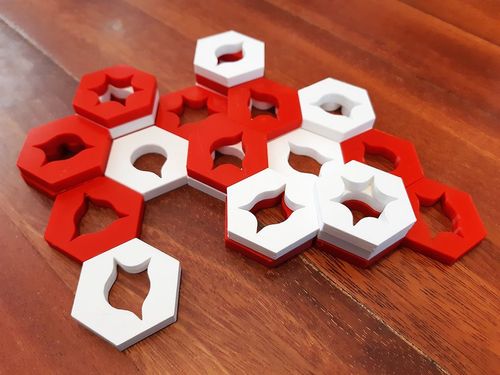
Each player has thirteen tiles, each with a unique arrangement of pointers to various edges. The blank tiles without pointers are the players' kings, and the tiles with six pointers are the players' queens.
The rulesheet shows the full set of tile pointer arrangements as diagrams.
Notice that the 8th tile is asymmetrical and can be placed either side up.
Rules
Aim: The aim is to capture the enemy king.
Start: Light starts by placing any tile (except their queen) on the playing surface. Dark then places any tile (except their queen) adjacent to it, to share an edge.
Play: Players then take turns placing a tile of their colour. Once a player has placed their king, they may then choose between placing or moving a tile of their colour each turn. Players must leave their unplayed tiles visible so that others can see what has and what hasn't been played yet.
Placement: Tiles may be placed on the table adjacent to any two or more existing tiles, provided that the tile placed does not point at the enemy king, either directly or through intervening pieces pointing the same way.
Movement: Tiles may move in a straight line in the direction of any of their pointers. Tiles cannot change direction during a move and must land adjacent to at least one other tile or stack. If the move passes over any other tile or stack (of any height and belonging to either player) then the move ends there unless that tile or stack also points in the direction of travel, in which case the move may continue in that direction. Players can never move onto their own king.
The king is a special case. It has no pointers, but can move one step in any direction.
For example, tile m has five available moves in the following example, one of which would cover the enemy queen.
Tiles can move in a line over empty space, provided each empty cell passed over along the way has an adjacent tile.
Tiles cannot be moved unless they have at least one free side. A tile cannot make any move that would split the board into two or more separate subgroups after the move.
After moving, the tile may be rotated. Tiles cannot rotate in-place without first moving.
Stacking: Tiles may land on pieces of either colour to stack upon them. Any tile stacked upon is immobile until everything moves off it; only the top tile of a stack can move.
Step Rule: At the end of the turn there must be a path of adjacent steps from every stack to the table level. Steps can only be flat, up a level or down a level. In other words, a miniature person placed on any tile or stack must be able to step down to the table without dropping down a cliff of two or more levels.
For example, tile m only has three available moves in the example shown below, as stacking on top of either of the height 2 or height 3 Dark pieces would violate the Step Rule. In this case, m can step past the enemy queen but not land on it.
End: A player wins by landing on the enemy king to capture it (the enemy king is removed) or if the opponent has no legal moves.
Three-Player Stax
Stax may be played with a third player using a third set of differently coloured pieces. The aim of each player is to capture the king of the player on their left (i.e. next in the turn order) to win the game. Players cannot land on or capture their own or the previous player's king.
Variants
For variants and tips, see the designer's site at http://www.cameronius.com/games/stax.