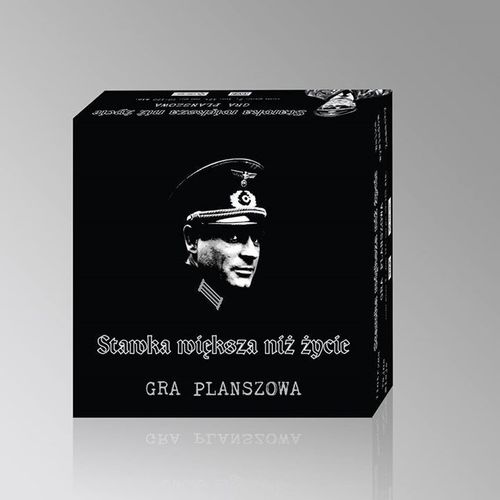
Stawka większa niż życie
Stawka większa niż życie Rulebook
Table of Contents
Table of Contents
- Introduction
- Game Components
- Agents
- Mission Cards (EXTENDED)
- Sectors
- Planning Cards and Stages
- Activating an Agent
- Movement of Agents
- Conversation
- Search Action
- Item Tiles
- Investigation Track
- Arrest Action
- Assassination Action
- Threat Tokens (EXTENDED)
- Location Cards (ADVANCED)
- Reaction Cards (ADVANCED)
- Scenarios
- Training Campaign - Scenario 1: Meeting (Spotkanie)
- Training Campaign - Scenario 2: First Clash (Pierwsze starcie)
- Training Campaign - Scenario 3: The Best Chestnuts Are on Place Pigalle (Najlepsze kasztany są na placu Pigalle)
- Film Scenario: I Know Who You Are (Wiem kim jesteś)
- Film Scenario: Hotel Excelsior
- Film Scenario: Top Secret (Ściśle tajne)
Introduction
Paths to Victory
The aim of the game is to defeat the opponent according to the assumptions of the scenarios or to break up his network of agents. Each scenario at the end of the rulebook describes in detail the victory conditions for both sides. Sometimes it may be sending a report, other times handing over a top-secret document or breaking the password of an enemy network. Hans Kloss must be careful not to be exposed, and the German SD officers must take care not to be compromised. Ordinary Polish agents must additionally be careful not to be arrested as a result of suspicion.
Learning the Rules
The game is based on complex rules whose mastery requires at least several plays. Therefore we suggest starting the adventure with the game with the training campaign (see the Scenarios section). When starting the training campaign, it is enough to learn the BASIC rules, and learn the EXTENDED and ADVANCED rules while playing the subsequent scenarios.
Rule Difficulty Levels
- Basic: Include a description of agent activation, movement, boards, rules of conversation between agents, acquiring items and collecting evidence.
- Extended: Include additional rule elements such as: use of mission cards, threat tokens and other actions, e.g. arrests and assassinations. EXTENDED rules are marked on a dark background with a parachute.
- Advanced: Include the use of location cards, reaction cards and adding detailed solutions such as creating your own scenarios. These rules enable playing the film scenarios and full use of all the possibilities the game offers. ADVANCED rules are marked in colour on a dark background with a parachute.
Game Components
Board
Play takes place on sector tiles which, joined together, form the board.
- Sector tiles. On seven large tiles (including three double-sided) are printed the street spaces and locations along which the agent figures move.
- ITEM tiles. Each location has 5 item tiles assigned. At the start of every game they should be shuffled and placed on their respective locations. They show items which, when used by agents, can strengthen their abilities or burden them with evidence from enemy agents.
Agents
Players lead their intelligence networks made up of a group of agents marked with the appropriate emblem on the Agent Documents and the colour of the base.
- Agent figures. Using the figures, Players move their agents along street spaces and to locations in the individual sectors.
- Agent Documents. Each agent has a Document with information on his special traits and ratings.
Preparing the figures for play: before the first game, Players should prepare bases for the characters chosen in the scenario and insert the agent figures into them. NOTE: Polish agents should be placed in red bases, German in black.
Tokens
- Victory Point (VP) tokens: used to mark VP won during the game.
- INVESTIGATION TRACK: a field for marking game results: victory points and evidence.
- INVESTIGATION tokens: markers used to mark on the investigation track the evidence acquired against enemy agents. These tokens come in four colours assigned to individual agents.
- "I WAS HERE" tokens: markers used to mark visited locations, in four colours assigned to individual agents.
- THREAT tokens: Polish and German markers that Players place in sectors to hinder enemy agents' actions. Preparing threat tokens: like agent figures, threat tokens should be carefully inserted into their (transparent) bases. They remain permanently joined to the tokens and need not be removed between games.
- STAGE TRACK: an element used to mark the successive stages of the game with a time token.
- Cheat sheets: hint cards. Sheets of threat token effects; on the reverse, a hint of how much evidence the items in given locations hide.
Cards
- PLANNING cards: a set of five Polish and German cards played at the beginning of each stage. They contain information about the Action Point pool, priority, and the possibility of drawing reaction cards.
- Mission cards: alternative goals for individual agents. Each agent has a unique set of three mission cards.
- LOCATION cards: two decks (German and Polish). Each card corresponds to one location. Only those cards whose locations are on the board are used in the game.
- REACTION cards: cards played by Players during the activation of enemy agents. This is the only deck common to both Players.
Special Items
TOP SECRET cards: if an agent "cracks" a chest with documents, the Player receives this card instead of an item tile.
Agents
General Information
Players will lead two competing agent networks. By performing actions with their agents, they will pursue individual goals, described each time in the scenario.
Attributes of an agent. Each agent has: an agent document, an agent figure, and 3 mission cards.
Agent Document
- Special trait: expresses the character's influence on the game. When it conflicts with the general rules, it takes precedence in interpretation.
- Unique traits: all the unique traits of individual characters are placed here. They are expressed through descriptions and ratings.
- Name, surname.
- Rank: expressed by a value from 1 to 9; it matters when attempting conversations between enemy agents.
- Military function: private, officer, SS officer. (Image: each agent in civilian clothes is treated as a civilian. Note: all women are treated as civilians, even if they put on a uniform.)
- Action Point (AP) limit: determines how many AP in the course of a stage a given agent may use from the general AP pool available to each Player's network.
- DEFENCE: taken into account during an assassination or kidnapping (see Assassination action).
- ALERTNESS: expressed in values from 4 to 9. This rating is taken into account in tests, e.g. during an arrest or when discarding a threat token.
- Polish or German emblem.
- COLOURS: four colours assigned to individual agents determine their significance for the network. Item tiles hiding evidence most often burden agents in yellow, then purple and blue, and least often black.
- Success in CONVERSATION:
Each agent has one agent document. The exception is Hans Kloss, who has three such cards. Before every game the Polish Player must choose which Hans Kloss document will be used during the game (the other Hans Kloss documents are put back in the box).
Figure
Each agent has his own figure, which is moved around the sectors along the paths marked with a red line, street spaces and locations. For convenience the character images repeat the information from the document so that Players do not have to look at each other's documents when attempting conversations between agents or assigning evidence: single, double success in conversation, position in the network (colour), rank, secret.
NOTE: Hans Kloss (for the Polish Player) and the black SS officers (for the German Player) are so-called network chiefs. This matters in several elements of the game, explained later in the rulebook.
Mission Cards (EXTENDED)
During play Players can acquire mission cards for their agents, thanks to which they gain the possibility of alternatively obtaining secrets (not only through conversation) and winning Victory Points (VP) or evidence.
- Preparing the cards for play. Each agent (except Hans Kloss, Hermann Brunner and Stedtke) has three unique mission cards, the face of which shows the agent's silhouette. At the start of the game, from among all mission cards find the sets of 3 mission cards for each agent taking part in the game and place them face up with the character images upward, so that neither Player knows what they hide.
- Detailed information. The face of the cards shows: the agent's image, the basic mission (usually easier to complete), and the special mission.
- Receiving a MISSION. At the start of the game agents have no mission card assigned. During the game an agent cannot have more than one mission card assigned! It can be obtained in several ways:
- A. In a sector without enemy agents, when the network chief meets another agent of his own network, one of them may perform the take-over-mission action (point 4).
- B. Some items (e.g. a typewriter) make it possible to acquire a mission card.
- C. From a hideout, by alternatively using a location card (see Location Cards, point 5).
- MISSION from Kloss or the SS officer. When a network chief passes a mission, the Player himself chooses from the mission cards available for the given agent the one he will assign to the agent. This card should be kept near the agent's document; from now on the agent may complete either the basic or the special mission (see point 6). (Action of passing a mission: example: A. Hans Kloss, on entering the street space occupied by agent Jack, stops and performs the mission passing action. B. From the three available mission cards the Polish Player chooses one. C. He places it next to agent Jack's card.)
- MISSION from an item or HIDEOUT. When a mission card is acquired this way, the Player does not choose from the available mission cards (for the given agent) but draws one at random and assigns it to the agent. From now on the agent may strive to complete the basic or the special mission. NOTE: Fritz Kopf, as the only black SS officer, can receive a mission, but only from an item or a hideout.
Note: Players should try not to reveal the mission cards they hold, because the opponent's learning of them can make completing them much harder.
Sectors
They constitute the space in which the game takes place. Each sector is a tile measuring 22x22 cm. Each has its name, visible at the bottom of the board on a coloured plate.
- STREETS: agents can move only along the paths marked by the red line. Places marked with empty circles are street spaces. Sectors are connected by streets, which agents may cross without any additional restrictions and costs in action points. NOTE: In the police sector a broken line (blue) runs through the building. This path may be used only by the German Player's agents. In the city sector a broken line (red) is drawn; this path may be used only by the Polish Player's agents.
- LOCATIONS: places marked with an X. Each location has a name and a field for placing item tiles at the start of the game (see Item Tiles).
- Edge of the board: the outer edges of sectors that do not touch other sectors mark the end of the board. No agent may leave the board, either voluntarily or forced by the opponent's actions.
- NOTE: In the military sector all agents except Kloss and black SS officers must pass a document check before they enter the fort, which works like the threat token document check (see cheat sheet).
- Choice of SECTORS. The scenarios at the end of the rulebook indicate the sectors and their placement relative to each other. Before play, arrange them carefully according to the guidelines of the chosen scenario.
- Telephone connections. At selected locations — Gestapo, jail, police station, employment office, courts, SS officer's villa, Abwehr, Rail office, telephone booth, hotel — a telephone symbol is marked. It means the possibility of a telephone connection between locations (this matters when using selected location cards and may have additional significance indicated in the scenario description).
Planning Cards and Stages
In the game, play is divided into stages. Most scenarios have a strictly defined duration measured in stages. Each stage begins with the Players choosing planning cards.
Planning Card
- Priority: the Player who chose the card with the lower rating will be able to activate his agent first.
- Action Point (AP) pool: defines the pool of AP the Player will have for his whole network of agents during the given stage. While performing actions with agents, such as movement and actions, the Player will use AP from his pool.
- Number of reaction cards the Player draws at the start of the stage.
Stage
During a stage the Players, in the appropriate order, may and sometimes must perform strictly defined activities:
- A. Choose and reveal a planning card.
- B. Determine priority by comparing the ratings from the planning cards. If in the first stage the Players choose identical cards, a die roll decides who first activates an agent: the one who rolls lower goes first. In subsequent stages, with equal priority values, the Player who goes first activating an agent will be the same Player who was first in the previous stage.
- C. Draw threat tokens (see Threat Tokens). The Player who, as a result of comparing the priority ratings from the planning cards, will activate his agent second receives 2 threat tokens (chosen randomly by the opponent), and his opponent only 1. Before agent activations the Players must set up these tokens on the board.
- D. Draw reaction cards (see Reaction Cards).
- E. Draw location cards (see Location Cards). Players top up the number of location cards to the limit indicated in the scenario.
- F. Agent activations. Players alternately activate their agents according to the activation rules (see Activating an Agent). Agent activations last as long as Players have action points (set by the AP limit on their planning cards). NOTE: If only one of the Players still has AP, he may continue to activate his agents.
- G. End of the stage. After activities A-F the stage ends. Players discard the used planning card and put it aside next to the play area. In the next stage they will not be able to choose that card. Only after both Players have used the fourth planning card (of five available) do all planning cards return to their disposal. NOTE: After reading all the information the planning card should be put in a visible place so that the Player remembers his AP pool.
- H. Moving the time marker. On the stage track the Players move the marker to the next space to measure game time.
Activating an Agent
Players activate their agents alternately. When the agent of one Player finishes his activation, the activation of the opponent's agent begins. This continues until the Players use up their AP limit or when none of the agents can be activated. If only one Player has AP left, he may activate his agents to the end of the stage, without giving the opponent the right to activate.
The AP pool (obtained from the planning card) will not suffice to move all the agents, especially by the maximum number of AP. The Player will have to wisely and gradually distribute the pool of AP among the characters he controls.
-
Activities during an activation. An activation is the choice of an agent with whom the Player may perform the following:
- only movement for at least 2 AP, or
- only an action, or
- an action and movement, or
- movement and an action.
At any moment the Player may give up playing his activations in this stage (without having to use all AP). In that case he will no longer be able to activate any of his agents (passing is therefore not allowed).
-
Limitations. When activating an agent, remember that only one of your own agents can be activated at a time, but each agent may be activated in a stage even several times (provided there are Action Points in the general pool and up to the limit [AP limit] from the agent's document). When during an activation an agent only wants to move (does not want to perform any action), he must use at least 2 AP. NOTE: If an agent has only 1 AP left in his AP limit, he can be activated only if he is able to use this point on an action whose cost in AP is 1 (see below).
-
AP costs of activities and actions:
- movement by 1 space (1 AP) — see Movement,
- action: search of a location (2 AP),
- action: initiating a conversation (1 AP),
- action: arrest or kidnapping (2 AP),
- action: passing a mission card or taking a mission card when meeting the network chief (1 AP),
- action: discarding a threat token (1 AP),
- action: assassination (1 AP).
Movement of Agents
The Player may move only with the activated agent, using AP from the pool indicated on the planning card, but not more than up to the AP limit shown on the agent's document.
- Rules and restrictions. When moving an agent the Player moves the agent's figure around the board only along the paths marked on the sector tiles. Not allowed:
- jumping over and bypassing spaces,
- leaving sectors through edges not touching other sectors,
- using for movement more AP than the agent's AP limit.
- Influence of other characters. Any number of agents may occupy one space. The presence of enemy agents, and of agents of one's own network, has no influence on the movement of characters (except for the agents' special traits, which take precedence over this rule, e.g. Marta Becher).
- Movement and action or action and movement. If an agent begins an activation with movement, to perform an action he must interrupt the character's movement. During this activation the agent can no longer move. If an agent begins his activation with an action and still has AP in his pool, he may also move.
- Influence of items. Some items (e.g. officer's boots) increase agents' AP limits, giving them greater possibilities of moving around the board. The city map item allows moving the agent's figure to any location within one sector — remember, however, that this action is also movement.
- Influence of threat tokens. If an agent enters a space with an enemy threat token, and has the possibility to perform an action of discarding that token, he must stop to perform that action. If an agent enters a space with an enemy threat token and wants to continue moving without checking the threat token, the opponent may activate the token and bring its effect into the game immediately.
- Influence of REACTION cards. Some reaction cards, played during the opponent's activation, refer directly to the enemy agent who is moving. If such a card is played and is not blocked (see Reaction Cards), its effects are immediately brought into the game.
Conversation
One of the available actions, as a result of which the Player may acquire evidence or extract a secret from an enemy agent.
-
Conditions for holding a conversation. A conversation between agents of enemy networks may occur in several situations:
- when an activated agent meets an enemy agent on one space and initiates a conversation,
- as a result of playing a selected reaction card,
- as a result of playing a selected location card.
-
Initiating a conversation on meeting. The activated agent trying to talk to an enemy agent is the initiator of the conversation. The initiating agent must compare the value of his own Rank and the Rank of the enemy agent. If the initiator has a Rank higher than or equal to the enemy agent's Rank, a conversation takes place. If the initiator has a lower Rank than the enemy agent, he must immediately roll a die. If he rolls more than the difference between the two Ranks, a conversation also takes place. In every other case no conversation takes place.
- Example 1. Polish agent Jacek (Rank 3) meets German agent Bruno Dreher (Rank 3). Since both have the same Rank value, the conversation takes place without the need to roll a die to compare Ranks.
- Example 2. Polish agent Ingrid Heizer (Rank 4) meets Hermann Brunner (Rank 8). Since Ingrid has a lower Rank than Brunner, to talk she must roll a die. A roll of 3 means that no conversation takes place (4 < 8: difference 4; roll must exceed it).
- Example 3. Polish agent Ingrid Heizer (Rank 4) meets Hermann Brunner (Rank 8). Since Ingrid has a lower Rank than Brunner, to talk she must roll a die. A roll of 5 means the conversation takes place (5 > 4).
-
Effectiveness of the CONVERSATION. In the case of a successfully initiated conversation, the Player rolls two dice and adds the result, which may be modified by:
- traits described on the Agent Documents,
Example 3 continued (reciprocity rule, special trait and items): Ingrid Heizer decides to use her special trait. The Polish Player rolls two dice for the effectiveness of the conversation. The total on the dice (9) means the Polish Player achieved a single. Ingrid's special trait allows her to add two points to the result. So the total roll is 11, which gives her not a single but a double in the conversation with Brunner (4 + 5 + 2 = double). The German Player decides to play a reaction card — the reciprocity rule. Before rolling the dice for the effectiveness of the conversation he reveals the item he holds, flowers. He also uses the bonus from the investigation track (+1). He rolls two dice for the effectiveness of the conversation. The result on the dice and the modification for the flowers give a total of 11 (3 + 5 + 2 flowers + 1 = secret), and thus he gains 1 secret.
Search Action
Allows agents to acquire items found in locations.
-
Detailed information. For an agent to perform the search action, he must be on a location space where there are still some items. This action costs 2 AP.
-
BLOCKED location. If on a location there is an "I was here" token in the colour of the agent who wants to search, he cannot do so (see point 4).
-
Drawing an item. If the conditions in point 1 are met and there is no "I was here" token in the colour of the searching agent on the location, the Player draws the top item tile and must immediately decide whether to:
- keep the item (see Item Tiles),
- use the item as evidence in the investigation (see Investigation Track).
If the Player keeps the item, he puts it next to the Agent Document so that he has easy access to it. Such an item is assigned to the character, and only that agent may bring the effects described on the item into the game. If the Player discards the item as evidence in the investigation, he obtains it against the enemy agent of the colour indicated by the item (see Item Tiles).
NOTE: If an item tile shows several colours of evidence, the Player may burden with evidence only one agent.
-
"I WAS HERE" markers. Each time an agent performs the search action, he must leave behind an "I was here" token in the colour of his own character (e.g. after a search Hans Kloss must leave a black marker). The marker should be placed next to the location so that it is visible to both Players. Remember that on one location there can be at most two different markers, but never of the same colour! To search a location with two "I was here" markers, the Player must do so with an agent whose colour is not yet placed at that location. He then discards the markers there and leaves only the marker of the agent who has just searched the location.
NOTE: Placing an "I was here" marker on a location blocks the possibility of searching it for agents (of the given colour) of both sides.
Item Tiles
Each location has 5 item tiles assigned. At the start of the game shuffle them carefully and put them on the assigned location, with the side showing the location name visible. Neither Player may know the order of the item tiles.
-
Reverse. The reverse of an item tile shows an illustration of the location to which it is assigned.
-
Obverse. Contains several important pieces of information:
- name and image of the item,
- description of effect — explains in detail what possibilities the item gives the agent who has it,
- incriminating evidence — each item has an evidence value from 1 to 3 in the colours assigned to the agents. By discarding an item as a result of the search action (see Search Action), the Player burdens the enemy agent (of the same colour) with evidence of the value shown on that item and marks this on the investigation track. Note: if there is more than one colour of evidence on the item, the Player must choose one of the colours to use as evidence against an enemy agent.
- durability of the item — the symbol * means that the item may be used many times by the agent who has it. The absence of this symbol on the item tile means that after the first use (using the effect description or obtaining evidence) it must be discarded from the game.
- (Also shown: the location, the name, the description of effect, and the incriminating evidence.)
-
Using items. As a result of the search action agents will acquire items. Those they keep they will be able to use later in the game. To use the effect description of an item, remember that:
- the Player puts the acquired item next to the document of his agent who acquired it. If it is an item with the * symbol, he reveals it; if not, he places it face down so that the opponent does not know what item it is,
- an item may be used only by an activated agent (see Activating an Agent),
- using an item does not require using Action Points (unless the item description says otherwise),
Investigation Track
Used to mark the fact of having evidence incriminating enemy agents. Gathering evidence is one of the most effective methods of supporting a conversation; it also determines the possibilities of influencing enemy agents, depending on the evidence gathered.
-
Gaining evidence. The Player can obtain evidence incriminating an enemy agent:
- as a result of a successful conversation action (see Conversation),
- as a result of finding and discarding an item as incriminating evidence (see Search Action),
- as a result of the effect of threat tokens (see Threat Tokens),
- as a result of playing particular location cards (see Location Cards),
- as a result of playing reaction cards (see Reaction Cards).
-
Investigation progress markers. Each time the Player obtains new evidence he must immediately update the state of holding it on the investigation track. For this purpose the markers included in the game are used.
-
Marking the investigation. Each investigation track consists of progress paths in colours corresponding to the network membership of individual agents. If the Player obtains e.g. 2 pieces of evidence against an agent of black colour, he marks this by moving its token two spaces to the right on the black track. If the Player must subtract e.g. 2 pieces of evidence against a purple agent, he marks this by moving its token two spaces to the left on the track.
-
Effects of investigation progress. As evidence accumulates, the Player gains benefits and possibilities of influencing the enemy agent. On each progress path 5 ranges of effects are marked. All modifications refer to a conversation with the agent burdened with evidence:
- 0-2 under observation — no additional effects.
- 3-5 located — a +1 modifier to the die roll for the effectiveness of a conversation with this agent. Additionally, from this moment an agent burdened with at least three pieces of evidence may reveal a secret during a conversation.
Arrest Action
Only the German Player, meeting specified conditions, can arrest enemy agents (except Hans Kloss). Arrests are one of the ways to break up the Polish intelligence network.
-
SS officers. Hermann Brunner, Stedtke, Fritz Kopf and Erik Kopf are SS officers. As the only German agents they can arrest Polish agents burdened with at least 6 pieces of evidence on the investigation track.
-
Arrest from mission cards. The German agent Glaubel, although not an SS officer, may make an arrest when he obtains the appropriate mission card. Erik Kopf and Fritz Kopf may also draw a mission card ordering them to arrest an enemy agent (although even without this task they can make arrests because they are SS officers). This way, besides the benefit from the arrest itself, they will receive the reward for completing a special mission. Remember that also in the case of mission cards the arrest must take place on the basis of at least 6 pieces of evidence gathered.
-
Attempted arrest. If during an activation a German agent (able to arrest) is on a space with an enemy agent against whom he has gathered at least 6 pieces of evidence on the investigation track, he may perform the arrest action. In that case the Polish Player must immediately roll two dice and add the results. If:
- the total on the dice is less than or equal to the Alertness value of the Polish agent — he is immediately arrested,
- the total on the dice is greater than the Alertness value of the Polish agent — he avoids arrest (see point 6).
NOTE: The arrest action is treated as a conversation; therefore if the German agent has already talked to the Polish agent in this stage, he cannot arrest him. The arrest action costs the German agent 1 AP (see also the AP cost list: 2 AP for arrest or kidnapping).
-
Effects of arrest. The figure of the arrested Polish agent is immediately moved to the location jail and laid on its side to remember the fact of his arrest. Effects of arrest:
- the agent cannot be activated,
- the agent loses all items he held at the moment of arrest,
Example: The German Player activates SS officer Stedtke. He may approach two Polish agents. On entering the space with Jacek he decides to arrest him (Hans Kloss he cannot arrest, despite the evidence gathered). The Polish Player immediately rolls two dice. A result of 7 is however lower than the Alertness of 8, and Jacek is arrested. The German Player moves his figure to the location jail. The German Player decides to perform an interrogation immediately. He rolls two dice (as for a conversation). A result of 6 (modified by +2 from the investigation track) does not bring any effect (6 + 2 = 8, below Jacek's 9). Jacek will remain in jail until released or until, as a result of an interrogation, he reveals a secret.
Release of the Arrested
Arrest of agents is a great burden for the Polish side. The arrested lose items, cannot complete missions, and arrest of all agents threatens defeat. The Polish Player has several ways of freeing prisoners:
-
Kidnapping for exchange. A Polish agent holding a weapon who shares a space with a lone enemy agent (not an SS officer) against whom he has gathered at least 6 pieces of evidence on the investigation track can perform the kidnapping-for-exchange action. Its procedure is analogous to an attempted arrest. The threatened German agent rolls two dice and adds the result. If he rolls less than or equal to the value of his Alertness, he is kidnapped. If he rolls more, he avoids the kidnapping and immediately gains 3 pieces of evidence against the agent who tried to carry out the kidnapping.
The Polish Player does not hold the kidnapped enemy agent but immediately forces the German Player to a prisoner exchange (the kidnapped and the arrested). The Polish Player first moves the figure of the kidnapped agent to any street space in a sector of his choice. Then the German Player takes the figure of the Polish agent held in jail and places him in a location in a sector of his choice (except the sector where an SS officer is).
NOTE: The Polish Player can initiate a kidnapping only when some Polish agent is in jail.
-
Release of an agent. An arrested agent can also be released by playing the location cards: Gestapo and jail (see Location Cards).
Assassination Action
During play agents, in strictly specified circumstances, can perform the assassination action (cost 1 AP). Its effect may be the elimination of an enemy agent from the game.
-
Conditions for carrying out assassinations. To be able to perform the assassination action, an agent must:
- hold a mission card whose goal includes, among other things, an assassination or liquidation of an enemy agent,
- hold a weapon item,
and in most cases must be on the space with the attacked enemy agent (the exception is the use of a grenade, dynamite or a rifle).
-
Manner of carrying out assassinations. The Player carrying out the assassination, using a weapon, rolls two dice (taking into account the modification of only one chosen weapon). If the weapon does not specify its use, he rolls the dice and adds the result. If:
- it is lower than or equal to the value of the Defence rating, the assassination failed,
- if the result is higher than the value of the Defence rating, the assassination succeeded and the attacked agent is liquidated, and his figure and the items he held are removed from the game.
NOTE: Selected items, e.g. the first-aid kit, influence the effectiveness of an assassination.
NOTE: If an unsuccessfully attacked agent occupied the same space as the attacker, he immediately receives 3 pieces of evidence against the assassin.
-
Combat of agents. If the attacked agent has a weapon, he must attack the assailant with it. His fight takes place simultaneously with the attack of the one carrying out the assassination. He performs the same actions as the opponent (see point 2). A situation may therefore arise in which the assailant is liquidated.
Note: the attacked agent need not hold a mission card with an assassination goal to take up the fight.
Note: All weapon-type items are single-use!
Example: A. Jacek moves and enters the space with Marta Becher. B. He reveals a mission card. C. He reveals the weapon, a bayonet, which gives no modifications in combat. D. He rolls two dice and gets a result of 7, and compares it with Marta's Defence rating. Unfortunately the result turns out to be lower and the assassination fails (7 < 8). E. Marta Becher attacks Jacek. She rolls two dice. A result of 8 and the revealed pistol (+2 to an assassination) means a successful attack and Jacek dies (8 + 2 > 8). F. His figure, agent document, mission cards and the items he held are removed from the game. As a result of the failed assassination the German Player should gain 3 more pieces of evidence against Jacek, but because he died in combat, all evidence against him is removed from the investigation track.
Threat Tokens (EXTENDED)
Each Player has a pool of 18 threat tokens. They are obstacles and hindrances for enemy agents, introducing confusion and uncertainty into their activities. NOTE: Only one threat token may be on one space. NOTE: The full description of how the tokens work is on the cheat sheet cards.
- Preparing the token pool for play. All threat tokens should be carefully inserted into plastic (colourless) bases. Before play each Player places his tokens beside the play area, description side towards himself, so that the opponent does not know their traits but at the same time has access to them. Each time a Player must set out threat tokens, he does not choose them himself but the opponent randomly points them out to him (without knowing, of course, what he has chosen).
- Acquiring threat tokens. At the start of each stage Players acquire new tokens from the pool, which they will be able to place on the board. Each time the planning cards are revealed, the Player who will be forced to activate his agents second receives 2 threat tokens, and his opponent only 1. The Polish Player randomly draws German tokens for the German Player, and the German Player randomly chooses tokens for the Polish Player. Because the tokens face them with symbols, they do not know their content.
- Setting out. Players set out tokens alternately, starting with the Player who acquired two threat tokens. The German Player may set out his tokens only in locations (even if agents of his own or an enemy network are already there). The Polish Player may set out his tokens only on street spaces (but may not set them on spaces with enemy agents).
- Discard-threat action. When during an activation an agent enters a space with an enemy threat token, or begins an activation on a space with an enemy threat token, he may declare the discard-threat action. To do so he rolls two dice. If the total on the dice is higher than his Alertness, he immediately removes the enemy token from the board and puts it in the discarded pool. If the total on the dice is equal to or lower, nothing happens and the token remains on the board. The opponent may then activate it (see point 5).
- Bringing the effects of a threat token into play. The moment of bringing their effects into play depends on the type of token and the Player's decision. Most of them can be triggered only during the activation of an enemy agent (alarm, document check, cauldron, suspect, thief, confusion, dangerous terrain). In the listed cases this happens when the enemy agent has entered the space or declares a wish to perform any action (except discarding the threat). The Player who owns the token then reveals it and brings the effects written on it into play (see Threat Token cheat sheet).
Example (Threat Tokens)
Phase 1. Christianson begins the activation. Because he is on the space next to the hotel, the German Player had to reveal the threat token, revealing a document check. Even so, the Polish Player decides to enter the hotel space with Christianson. To enter a location with a document check he must roll two dice, hoping to bypass it. To increase his chances, before the roll he decides to reveal and discard one of the support tokens lying on the street. The German Player does not decide to make his test harder, so the Polish Player rolls the dice and gets a result of 10. From the result he subtracts two points (difficulty from the document check token). The result is equal to Christianson's Alertness, so it would have been a failed test; however, thanks to using the support-type threat token the modified result was 10 - 2 + 1, i.e. 9, and the test ends in success. Christianson thus enters the hotel location, discards the German document check token and performs a search action in the hotel, after which his activation ends.
Phase 2. The German Player activates Lemner, who is also heading for the hotel. When he meets a Polish threat token on his way, he decides to try to discard it. He reveals one of his support-type threat tokens; the Polish Player does the same. The German Player rolls two dice. He gets a result of 6, which means the test fails (the German and Polish modifications from the support tokens cancelled out: 6 - 1 + 1 = 6). The Polish Player decides to bring the effects of the thief token into play. Because Lemner had only one item (a pistol), he must discard it. The activation of the German agent ends (because he performed movement and action). All used threat tokens are removed from the game.
Location Cards (ADVANCED)
Both the German and the Polish Player have a set of unique cards assigned to particular locations. Before the game starts, the Players must discard from them those cards (they will not take part in the game) whose location is missing from the game. The remaining cards should be carefully shuffled and put face down beside the play area. This produces two decks of location cards.
- Decks. Each Player is assigned an independent group of cards (26 cards — corresponding to 26 locations). Whenever the Players are to draw location cards, they do so from their own decks. At no moment of the game may either of them peek at or change the order of cards in the deck. Each time the Players draw a location card they take the top card from the deck.
- Information on the card. A card contains four important pieces of information:
- A. Special action — described in detail it may have a large influence on the game. The interpretation of the card text takes precedence over the rules in the rulebook. Location cards may change the rules of, among others, search, movement, conversation and arrest.
- B. Location — shows in which place the activated agent must be so that the Player can bring the card's effects into play.
- C. Conversion to AP — this symbol reminds that the Player during the activation of any of his agents may discard this card to increase the AP pool by 2 for that stage.
- D. Hideout — this symbol reminds that the Player whose activated agent is in the location to which this card relates may, instead of performing a special action, take a mission card from the hideout (see Mission Cards).
- Special action. To use the action described on the card, the activated agent must be in the location assigned to that card. NOTE: Using a card as a special action is not an action!
- Use as 2 AP. At any moment of the activation of any of his own agents (not necessarily one in the location assigned to the card) the Player may decide to discard this card to increase the general AP pool for the whole network by 2 AP. Remember that this way only 1 location card per stage can be discarded.
- Hideout. An agent in the location to which the card is assigned may, instead of using its action, receive a mission card. He then discards this location card and randomly draws one card from the mission cards available for that agent.
Example: In the scenario "I Know Who You Are" the game takes place in the sectors: police, administrative, railway, city, military. Therefore before starting the game the Players must leave in their location card decks only the cards assigned to locations from the sectors that take part in the game — their decks will therefore have 14 cards each. The chosen and shuffled cards form the current decks from which the Players will draw cards during the game. According to the scenario guidelines the card limit is 3. This means that both Players, already in the first stage, after choosing the planning card, will draw 3 location cards from their decks. If one of them uses e.g. two cards during that stage, in the second stage he will draw two cards (up to the limit of 3).
Reaction Cards (ADVANCED)
Before the game starts the Players place a common deck of reaction cards beside the play area. NOTE: Reaction cards serve only to hinder the actions of enemy agents and can be played only during their activation. No card may be played during one's own activation other than as a block (see point 4).
- Information on the card. Each card contains three important pieces of information:
- A. Division into a card of the Polish Player and the German Player.
- B. Circumstances of playing the card in response to the action of an enemy agent.
- C. Description of the event and a detailed condition.
- Shared card. Each reaction card is divided into two parts. If the card is held by the Polish Player he may use the action assigned to the Polish symbol, and if it is held by the German Player he may use the action assigned to the German symbol.
- Circumstances of playing a card. For convenience the cards are divided by colours corresponding to reactions to particular actions: movement — red cards; search — purple cards; conversation — yellow cards. NOTE: In reaction to one action of an agent only one card may be played, e.g. if an agent is performing movement, only one movement-type card can be played on him. If he then takes a conversation action, one conversation-type card can be played on him.
- Blocking cards. A Player who has become the target of a reaction card has only one possibility of avoiding the consequences of its play. If he himself holds a card of the same colour as the one played by the opponent, and it has the block symbol, he may use it to cancel the effect of the opponent's card. After this play both cards are discarded from the game without any additional effects.
- Acquiring new cards and the limit. The limit of cards that a Player may hold is 3. Players can acquire reaction cards by using the planning card at the start of each stage. NOTE: At no moment of the game may a Player hold more than 3 reaction cards. If the planning card allows the Player to draw reaction cards, and he still holds some cards, the Player draws them, may look at them, and only then must discard (without bringing their effects into play) as many cards as to leave himself only 3 cards.
- Used or discarded cards are put beside the play area. Only when the Players have used all cards from the deck may they reshuffle all used cards and recreate the reaction card deck.
(Example card: this card may be played by the Player only when an enemy activated agent initiates a conversation. If used by: A. the Polish Player — he reads the card description with the red seal; B. the German Player — he reads the card description with the black seal.)
Scenarios
The rulebook includes scenarios which contain a description of the elements taking part in the game, detailed rules and victory conditions.
Training Scenarios
When sitting down to Stawka większa niż życie for the first time, we suggest choosing the training campaign. Through simplified play you can gradually learn the rules from the basic to the more complex. The training campaign is divided into three scenarios which gradually use more and more extensive rules. Each time a reminder of the basic rules is included to ease the initial recognition of the game.
- For the first scenario knowledge of the basic rules is enough.
- Before playing the second scenario you should already know the part of the rulebook covering the extended rules.
- The last, third scenario uses the full rules, so besides the extended rules you must be familiar with the advanced rules.
Even Players who already know the game perfectly may find in the training campaign a challenge to carry out a long-term strategy, and final success in the last scenario will probably be the result of hard planning and a bit of luck.
Film Scenarios
3 film scenarios are included with the game. During play the Players may use the full rules described in the rulebook. Before starting the game the Players must:
- A. Prepare and arrange according to the given description the specific sectors, and then lay the item tiles on them.
- B. Prepare their agent networks composed of the specific characters named in the description. If the scenario requires it, each Player must place his agents in specific places on the board.
- C. Familiarise themselves with the detailed rules enriching play.
- D. Familiarise themselves with the victory conditions — each film scenario defines differently the goals the Players must fulfil to achieve success.
- E. Familiarise themselves with the game time — some scenarios (e.g. I Know Who You Are) have a strictly defined game time measured in stages; others end only when one of the Players fulfils specific Victory Conditions (e.g. Hotel Excelsior).
- F. Prepare all necessary game elements, such as: investigation track, location and reaction card decks, mission cards, agents present in the scenario, auxiliary tokens ("I was here", VP, investigation, threat) and HINT cards.
Free Scenarios
This form of play gives the Players full freedom in creating the play area, choosing characters, setting the number of stages and Victory Conditions. To create their own scenario the Players must follow the scheme below:
- A. Choose a side: Polish or German.
- B. Decide how many sectors the board will consist of (min. 4, max. 7).
- C. Players put on the table the police sector (it must be chosen for every game).
- D. The German Player first sets the sector of his choice and places it beside the police sector (so that it touches it by an edge).
- E. The Polish Player sets the sector of his choice and places it so that it touches by at least one edge any already placed sector. After him the German Player sets his sector, and so on alternately, until as many sectors are laid out as the Players decided before choosing them. In this way the board will be created, which will be the play area.
- F. On the location spaces in all chosen sectors lay 5 item tiles assigned to each (shuffling them carefully beforehand so neither Player knows their order).
- G. Each Player draws four of his agents, remembering that each network must have one agent in each of the colours: yellow, purple, blue, black. Then the Players take the corresponding figures and agent documents.
- H. The Players alternately place agent figures on the board, on any space, starting with the Polish Player (not necessarily his own AGENT). NOTE: When mutually placing the character figures, no more than one agent from each network can be placed in one sector.
- I. The Players decide the level of advancement of the rules: whether they will use the basic, extended or advanced rules.
- J. If at least the extended version is chosen the Players must prepare: mission cards (for the characters in the game), threat tokens, their own location card decks (only for the locations represented on the chosen sectors), and the common deck of reaction cards.
- K. Beside the board the Players place the investigation tracks and auxiliary tokens ("I was here", investigation) and hint cards.
- L. The Players settle the level of difficulty and game time:
- Basic (approx. 45 min.). Game time — 8 stages. Victory Conditions — the first Player to gain two secrets wins the game (the alternative ending related to the exposure of Kloss or the compromise of an SS officer also applies). Also having three Polish agents arrested by the German Player in jail ends in automatic victory for the German Player.
NOTE: Depending on the number of SECTORS, the Players are entitled to the following limit of location cards: 4 sectors — card limit 2; 5-6 sectors — card limit 3; 7 sectors — card limit 4.
Training Campaign - Scenario 1: Meeting (Spotkanie)
NOTE: In this scenario the Polish Player chooses the indicated Hans Kloss document.
Step 1. In a place easily accessible to the Players set two sectors: Hitlerplatz and administrative, and on all locations lay the item tiles assigned to them.
Step 2. Arrange all elements according to the drawing (not reproduced here).
- A. The Polish Player receives the agent documents, and places their figures on the board: Hans Kloss — officers' apartments; Ingrid Heizer — hotel.
- B. The German Player receives the agent documents, and places their figures on the board: Glaubel — employment office; Marta Becher — theatre.
- C. Each Player places beside himself the investigation track and investigation markers and the hint sheets.
- D. Each Player takes small dice for marking action points.
- E. Prepare the "I was here" markers.
- F. Each Player receives a set of five planning cards.
Additional rules. Although in the game each Player has only two agents (instead of four), it is worth gathering evidence also against the colours of agents who are not on the board. Part of the evidence can be used in the next scenario of the training campaign, when new agents appear.
Victory conditions. When one of the Players gains two secrets (as a result of conversations with enemy agents), he immediately wins the game. If by the end of the 8th stage neither Player manages to win, the game ends in a draw.
NOTE: After the scenario ends the Players keep half of the evidence gained against all enemy agents (rounding up). The winner may choose not to reduce one of the tracks (except Kloss). All acquired and used items return to the board.
Training Campaign - Scenario 2: First Clash (Pierwsze starcie)
Step 1. Sectors: Hitlerplatz, administrative, police.
Step 2. The Players take all game elements indicated in the first scenario and additionally:
- A. The Polish Player receives the document and figure of Jacek.
- B. The German Player receives the document and figure of Hermann Brunner.
- C. Agents begin the game in locations: Hans Kloss and Hermann Brunner — Gestapo. The remaining agents are placed by the Players in any locations, doing so alternately. However, no other agents may be placed in the police sector. The first agent (not necessarily his own) must be placed by the German Player.
- D. Additionally the Players prepare: threat tokens, Victory Point (VP) tokens and mission cards.
Game time: 8 stages.
Victory conditions. During play, besides gaining secrets from conversations, the Players will for the first time encounter missions (see Mission Cards). This brings a chance of gaining Victory Points (VP) and alternative gaining of secrets from special missions. Each Player receives:
- 2 VP each time his agent completes a basic mission,
- 4 VP each time his agent completes a special mission,
- 3 VP each time his agent obtains a secret in a conversation.
If before the end of the 8th stage one of the Players gains 11 VP, the game ends with his automatic victory. If neither Player gains 11 VP before the end of the 8th stage, the game ends in a draw.
Alternative ending. If before the end of the 8th stage the German Player exposes Hans Kloss, the game ends with the automatic victory of the German Player. If before the end of the 8th stage the Polish Player compromises Hermann Brunner, the game ends with the automatic victory of the Polish Player.
Bonus for the winner. The Player who won by gaining 11 VP may keep 1 acquired item for the next game and does not halve the evidence gained against an enemy agent of his choice. If the Polish Player compromised Brunner, the German Player in addition cannot choose Brunner in the next game, only Fritz Kopf. If the German Player exposed Hans Kloss, in addition in the next game the Hans Kloss document must be changed to another.
Training Campaign - Scenario 3: The Best Chestnuts Are on Place Pigalle (Najlepsze kasztany są na placu Pigalle)
Step 1. Sectors: Hitlerplatz, administrative, Gestapo (police), and additionally the city sector.
Step 2. The Players take all game elements indicated in the first and second scenarios and additionally:
- A. The Polish Player receives the document and figure of Georg.
- B. The German Player receives the document and figure of Bruno Dreher.
- C. The Players place agents in any chosen locations, doing so alternately. The German Player must place the first agent (not necessarily his own). NOTE: No more than one agent of each Player may begin the game in one sector.
- D. The Players prepare: threat tokens, Victory Point tokens and mission cards.
- E. Beside the play area each Player places the location card deck he has built.
- F. Beside the play area the Players place the reaction card deck.
Game time: 10 stages. Location card limit: 2.
(Starting positions of the agents are shown on the scenario map: Polish — Hans Kloss, Ingrid Heizer, Jacek, Georg; German — Hermann Brunner, Marta Becher, Glaubel, Bruno Dreher. The map is not reproduced.)
Victory conditions. The first Player to reach 11 VP (gained as in the training scenario First Clash) or to gain 3 secrets wins the last scenario and becomes the winner of the training campaign. If play went smoothly, you are ready to begin the adventure with the film scenarios or with creating your own scenarios.
Film Scenario: I Know Who You Are (Wiem kim jesteś)
NOTE: During the film scenarios the Players use all game elements, applying the ADVANCED rules (using THREAT tokens, MISSION cards, LOCATION cards, REACTION cards).
Game time: 8 stages. Location card limit: 3. The sectors used are: police, administrative, railway, city and military (shown on the scenario map).
Starting positions:
- Polish Player: Irena — railway station; Jacek — tenement; Marta Becher — hospital; Hans Kloss — Abwehr (military sector).
- German Player: Stedtke — Gestapo; Heinrich Vogel — employment office; Starsza pani (the Old Lady) — courts; Bruno Dreher — market.
(The map also shows, for each agent figure, the agent's rating symbols; those are on the agent documents.)
Radio Station
Before the game the Polish Player writes on a piece of paper (and does not reveal this information) the hiding place of the radio station. It must be a location in any sector except the police and military sectors.
The Polish Player will have to reveal the location of the radio station in two cases:
- A. when he begins transmitting the report,
- B. when the radio station is "located" by the German Player.
Transmitting the report. When the Polish Player has gathered two secrets (through conversation or as a reward for completing a special mission), he may go with Kloss to the location where the radio station is hidden and perform the transmit-report action (cost 1 AP). He then places the radio station token in the location and from that moment its position is public. From this moment until the end of the next stage, at least one Polish agent must be present on the space with the radio station so as not to break the connection. If the connection is broken, Kloss must initiate transmitting the report again, and the transmission time is counted anew.
If by the end of the second stage, counted from the start of transmitting the report, the German Player fails to interrupt the transmission (e.g. through a successful assassination or arrest), the game ends with the automatic victory of the Polish Player.
Radio station LOCATED. The German Player, gaining secrets (through conversation or as a reward for completing a special mission), gets closer to locating the radio station (provided the Polish Player has not yet begun transmitting the report).
- A. When the German Player gains the first secret, the Polish Player must give him the names of two sectors, one of which certainly hides the radio station.
- B. When the German Player gains the second secret, the Polish Player must reveal the name of the sector with the radio station.
- C. When the German Player gains the 3rd secret, the Polish Player reveals the radio station.
From the moment the radio station is located, or a situation in which the Polish Player himself reveals its position, the German agents may perform assassinations (they must hold a weapon), and Stedtke may try to arrest every Polish agent in the location with the radio station (he need not have evidence, but every arrest requires performing the action).
Victory Conditions
- If before the end of the 8th stage the Polish Player manages to transmit the report — he wins the game.
- If by the end of the 8th stage the Polish Player fails to transmit the report, and the German Player himself located the radio station (3 secrets) — the German Player wins.
- If by the end of the 8th stage the Polish Player fails to transmit the report, and the German Player did not manage to locate the radio station himself — the Player who has gathered more VP wins.
The Players in the game receive: 1 VP for completing a basic mission; VP from location cards. NOTE: If as a result of a CONVERSATION or discarding an item the Player would obtain more than the tenth piece of EVIDENCE, he instead receives 1 Victory Point for each evidence above 10. With an equal number of VP gained the game ends in a draw.
Film Scenario: Hotel Excelsior
Game time: until victory. Location card limit: 3.
Starting positions (see scenario map; sectors include police, railway, Hitlerplatz, villa, waterfront and others):
- Polish Player: Georg — police station; Hans Kloss — railway station; Emma Schmidt — park; Ingrid Heizer — café.
- German Player: Fritz Kopf — Gestapo; Erik Kopf — employment office; Sergeant of the gendarmerie — waterfront; Johannes Lemner — hotel.
Room 217
Before the game begins, both Players, preparing their location decks, take out of them the hotel card and put it as the last card at the bottom of the deck. They will therefore be able to receive it only after using all the other cards. The hotel card will be needed in the final phase of the game, when the Players manage to find the key to room 217 in the Hotel Excelsior. Until the moment a given Player gathers 15 VP, nobody may either search the hotel or play the hotel card.
Victory Conditions
During the game the Players try to obtain 15 VP as quickly as possible. The Player who gains 15 VP (or more) may perform the search action in the hotel. Moreover, if during the activation of his agent he manages to meet the conditions on the hotel location card, he automatically wins the game.
Victory Points (VP) are awarded for:
- A. a basic mission — 1 VP,
- B. a special mission — 3 VP,
- C. a secret from a conversation — 3 VP.
NOTE: In certain situations the Players can gain VP by playing selected location cards (e.g. the Germans from the SS officer's villa). NOTE: If as a result of a CONVERSATION or discarding an item the Player would obtain more than the tenth piece of EVIDENCE, he instead receives 1 Victory Point for each evidence above 10.
For convenience, a list of places where the Players can find:
- A. Top Secret cards in caskets (needed for the Polish Player's victory): SS officer's villa, hotel, theatre, employment office, officers' apartments. Additionally the Polish Player can "create" a Top Secret Document using two items: stamp and document.
- B. Valuable Items (needed for the German Player's victory): Gestapo, hotel, telephone booth, employment office, market, SS officer's villa.
Film Scenario: Top Secret (Ściśle tajne)
Game time: until victory. Location card limit: 3.
Starting positions (see scenario map; sectors include military, police, railway, administrative, factory and others):
- Hans Kloss (Polish) — Abwehr (military sector); Hermann Brunner (German) — Gestapo; Glaubel (German) — market.
- Other agents: Kazik — railway station; Puschke — bunker; Barbara Reczko — design office; Erwin Reil — design office; Edward Kania — tenement. (Which network each belongs to is shown by the base colour on the scenario map, not stated in the text.)
- The Black Audi figure (German) starts in the barracks.
Will Pulkowski Cooperate?
In the factory location Dr Pulkowski, an outstanding Polish engineer and specialist in jet engines, is held. The Germans try to persuade him to cooperate. Pulkowski is not represented by any token. No tokens or special traits of agents affect him.
At the end of each stage the German Player interrogates the doctor. He then rolls two dice. At first "breaking" the Polish scientist is not easy, but his resistance weakens with each stage. To "break" the doctor the German Player must roll at least 12 on two dice. If in the first stage he fails, in the second he gains a +1 modifier to the roll, in the third +2, in the fourth +3, etc. When the German Player "breaks" the doctor, from that moment he may take him to the Black Audi from the factory space and drive him to the barracks, in order to win the game.
Reinforced Factory Security
Before the game begins the German Player finds among the threat tokens the document check token (-3) and places it face up on the factory space. From the moment one of the Polish agents manages to get into the factory, the German Player, interrogating Pulkowski, will subtract 3 from the dice rolls to "break" him. Each Polish agent can introduce a maximum of one modification (-3), but their effect accumulates. Thus, if e.g. three Polish agents infiltrate the factory, the German Player when interrogating the doctor will subtract as many as 9 from the rolls! (Polish agents after infiltrating need not stay in the factory for the effect to continue to apply.)
The Black Audi
At the start of the game the German Player places the Black Audi figure in the barracks location. It is the car that is to pick up Dr Pulkowski from the factory and drive him to the proving ground to carry out tests with jet engines. During play the German Player will be able to activate this car, which has an AP limit of 5. It can move only along street spaces (except the factory space, where it must be in order to pick up the doctor) and its activation is at the cost of AP from the German Player's pool.
Until Pulkowski is in it, the Black Audi cannot be attacked by Polish agents and ignores threat tokens. At the moment Pulkowski is "broken" and the Black Audi is in the factory location, from the next stage it sets off on the return journey. It can then be the target of assassinations carried out by Polish agents (except Kloss), without the need to hold a mission. During the return the Black Audi is subject to the effects of threat tokens.
NOTE: At the start of the game it is assumed that the escort accompanying the Black Audi gives it a Defence rating of 6, and its Alertness rating is 7.
Top Secret Cards
When a Player discards a Top Secret card (during the activation of an agent holding that card) he may immediately move the Black Audi 2 spaces in a direction of his choice.
Basic and Special Missions
Each time the German Player completes a mission:
- A. basic: increases the Black Audi's Defence by 1,
- B. special: increases the Black Audi's Defence by 3.
Each time a Polish agent completes a mission:
- A. basic: this agent receives +2 to an assassination of the car transporting Pulkowski,
- B. special: this agent receives +4 to an assassination of the car transporting Pulkowski.
Each time a Polish or German agent obtains a secret from a conversation with an enemy agent, he may change the position of two of his own chosen threat tokens or draw a new one from the pool (his own choice) and put it on the board.
NOTE: Obtaining a secret from a conversation does not reset the evidence level on the investigation track. Obtaining more than the 10th piece of evidence does not result in VP, but: for the Polish Player it means +1 to all assassinations on the car transporting Pulkowski; for the German Player it means +1 to the Alertness rolls when trying to discard threat tokens.
Victory Conditions
If not later than the end of the 15th stage the German Player drives Pulkowski to the barracks, he automatically wins the game.
The Polish Player wins if: one of the Polish agents manages to carry out a successful assassination of the Black Audi with Pulkowski inside, or the car does not reach the barracks in time.
NOTE: The Black Audi is not subject to the document check in the military sector. NOTE: German threat tokens (protection of agents) also support the Black Audi's defence.