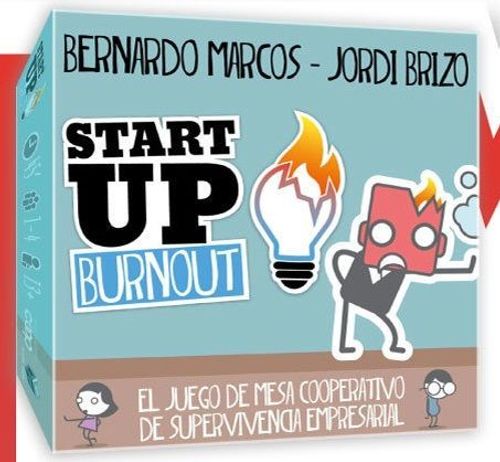
StartUp Burnout
StartUp Burnout Rulebook
Table of Contents
Table of Contents
Components
- Game board
- Burnout meter
- 1 six-sided die
- 49 agenda cards (cartas de orden del día)
- 4 cheat sheets (chuletas)
- 18 ravage cards (cartas de estrago)
- 29 extra cards (cartas de extra)
- 11 investor cards (cartas de inversor)
- Company pawn (peón de empresa)
- Entrepreneur tokens (tokens de emprendedor)
- Tokens:
- Emails (correos)
- Money (monedas)
- Action points (puntos de acción)
- Coffee tokens (tokens de café; printed as "Rokens de café" in the source, a typo)
- Investor tokens (tokens de inversor)
Objective
To win, the players must gather enough investors to escape the crisis (8 investor points), meet their goals by completing the required tasks, and use every kind of resource and trick available to do so without losing the little money they have left, or their heads.
Winning: The players win when investor cards worth 8 investor points have been obtained.
Losing: The players lose in any of these cases:
- When an entrepreneur dies (burnout level 7, or 3 permanent ravages at the end of the day) and three days pass, which is how long it takes for a corpse to start smelling in the office.
- When something must be paid and there is not enough money at the end of the day.
- When the last investor is discarded.
Setup
- Separate the cards by their backs, forming the investor deck, the agenda deck, the burnout deck and the extra deck.
- Each player chooses an entrepreneur card and its token, and takes 3 action point tokens.
- Place the company pawn on the Monday day space.
- Emails: Shuffle the email tokens and place one face down on each day space from Monday to Friday.
- Hatred of Mondays (initial): Determines the position on the burnout meter where the entrepreneur tokens start.
- 1 player: 2
- 2 players: 2
- 3 players: 2
- 4 players: 3
- Initial extra cards per player:
- 1 player: 4 cards
- 2 players: 3 cards
- 3 players: 3 cards
- 4 players: 2 cards
- Starting money in the treasury:
- 1 player: 3,000
- 2 players: 2,000
- 3 players: 3,000
- 4 players: 4,000
- Investor deck:
Layout
The numbers below refer to the setup diagram (Despliegue).
- Board
- Burnout meter
- Treasury
- Agenda deck
- Agenda deployment
- Investors
- Investor deployment
- Ravage deck
- Ravage discard
- Extra deck
- Extra discard
- Ravage area
- Character
- Player's hand
- Company report area
Board key:
- a. Resolution spaces (triangle markers marked with a "V")
- b. Day spaces (triangle markers marked in pink)
The Turn
Meeting Phase
- Place the company pawn on the day space.
- Open the email for that day and place it on that day's resolution space.
- Reveal the agenda: place 2 agenda cards per player face up on the table.
- All players decide how to invest their action points.
- Store the agenda cards obtained in the company report and discard the rest.
- If the requirements of an investor are met, it can be paid for and obtained.
Resolution Phase
- Place the company pawn on the day's resolution space.
- Resolve the effect of the emails.
- Each entrepreneur makes the corresponding burnout roll. If the roll fails (equal to or lower than the number specified on the meter space where the entrepreneur's token is), draw a ravage card.
- Remove one investor token from each investor.
- If there are fewer than 3 investors in play, reveal a new one.
Action Points
On each day, all entrepreneurs have 3 action points to distribute as they wish. Action points can be used for:
- Performing tasks. The tasks that are performed must be stored separately in what is called the "company report".
- Playing certain extra cards.
- Sleeping (costs 1 action point). Not sleeping means moving up 1 space on the burnout meter.
- Character abilities.
An entrepreneur can spend their points in any combination.
Sharing action points: Two entrepreneurs can spend action points on the same task. For example, to perform a communication task that costs two action points, each of them spends one.
Costs and Gains
Costs: The costs to buy or play a card are specified in the upper left corner of the card. They are marked with the action point symbol or the money symbol. If there are two symbols, it means the cost is two (whether money or action points).
If there are two different costs separated by a "/", it means you can pay either one of them.
For example, many task cards show two action point symbols / two money symbols. This means you can perform that task by spending two action points, or by paying €2,000.
Gains: Some cards specify in their upper right corner what you gain if you use them. For example, the coffee card shows an action point symbol with a "+", meaning you gain one action point.
Other Symbols
- Arrows (black arrows and flame): Move up or down on the burnout meter by the number of arrows.
- Die: Roll a six-sided die and abide by the result obtained.
- Group of people: Some cards show a symbol of two players or of several players. This indicates how many players the card affects.
- Crossed-out card: Non-permanent ravages have a crossed-out card symbol. This means the ravage takes effect as soon as you draw it, and then the card is discarded.
Investors
The only way to win in StartUp Burnout is to gather 8 investor points. Each investor gives a different number of points (the number between laurels in the upper right corner of the investor card).
To earn the points an investor gives, the investor must be "paid" with the tasks it requires. To do so, check the reference column for the number of players: 1 player (1P), 2 players (2P), 3 players (3P) or 4 players (4P).
Obtaining an investor gives, apart from the points, a reward specified on the card.
Rewards: Task rewards are permanent. From then on, it is as if the company had a task card of that type fixed in place, usable once per day. The multicolour task can be used like any other task. A money reward is received only once, when the investor is obtained.
Investor tokens: During the resolution of each day (including days when nobody works), remove one investor token from each investor card in play (or rotate the card clockwise if you are not using tokens). If an investor runs out of tokens, or completes a full turn, without having been obtained, it is discarded from the game.
Agenda Deck (Orden del día)
The agenda deck is made up mainly of task cards. These cards (Administration, Communication, Engineering and Creativity) are the different tasks that entrepreneurs can perform and that investors ask for. Each type of task is associated with a colour and a symbol.
When the cost of a task card is paid, with action points or money, it becomes part of your company report. It is with the tasks in your company report that you can pay investors.
When tasks are spent to obtain an investor, the discard pile and the agenda deck are shuffled together. Unspent tasks are kept.
Double tasks: Some tasks are of double colour. These tasks are paid like any other task, assuming the cost of one of the two options. To pay the requirements of an investor, a double card can count as either of its two options, but only for one of them.
Extra income: These grey cards, found in the agenda deck, are used to gain money. Money is needed to pay company expenses and fines, and it can be used to buy tasks instead of spending action points on them.
Extras
All Extra cards can be used at any time.
Once used, they are discarded. Each entrepreneur can use Extra cards ONLY on themselves, unless the card itself or its character ability says otherwise. Extra cards can be played on another character if the corresponding email appears: "play on others".
You can affect other players indirectly with an Extra card by playing Extra cards marked with the "two players" symbol or the "all players" symbol.
If the Extra deck runs out, shuffle the discard pile to form it again.
Ravages (Estragos)
When you fail a burnout roll during the resolution phase (rolling your space number on the die or lower), draw a card from the ravage deck and place it next to your character card. All ravages begin their effect, or are resolved, at the start of the next day, except for non-permanent ravages. While this card is on the table, you are affected by what is detailed on the card.
If, at the end of the resolution phase of a day, you have 3 or more permanent ravage cards next to your character, your character dies.
If the ravage deck runs out, shuffle the discard pile to form it again.
Special Days
Monday (from the second Monday onwards):
- Pay the company expenses (€1,000 per living entrepreneur).
- Each entrepreneur moves up on the burnout meter by the number corresponding to their Hatred of Mondays, according to the number of players (see Setup).
- Card draw: each entrepreneur draws the same number of Extra cards as the initial deal (see Setup).
Friday:
- Each entrepreneur draws X Extra cards:
- 1 player: 3 cards
- 2 players: 2 cards
- 3 players: 1 card
- 4 players: 1 card
Saturday:
- Entrepreneurs who so decide may not go to work. On that day they cannot do anything, but they go down one space on the burnout meter.
Sunday:
- Entrepreneurs who so decide may not go to work.
- Entrepreneurs who go to work move up one space automatically on the burnout meter.
- Shuffle all the emails. Deal 5 emails face down, Monday to Friday.
Emails
Emails are turned face up when the day on which they are placed is played. Once seen, they can be destroyed if someone has a "delete inbox" card, or they are moved to the resolution space of that day.
Burnout: Every entrepreneur moves up one space on the burnout meter.
Fine: The company pays €1,000 (discard them).
When you resolve the email, decide whether it acts as a burnout email or a tax email.
Play on others: During that day, entrepreneurs can play Extra cards on others.
Specialties
All characters are specialists in some field: Administration, Creativity, Communication or Engineering. This means that, when their specialty is activated, performing tasks in which they are specialists costs them only one action point (only on that day).
Quick Reference
1 player:
- Hatred of Mondays: 2
- Cards to draw: 4 on Mondays, 3 on Fridays
2 players:
- Hatred of Mondays: 2
- Cards to draw: 3 on Mondays, 2 on Fridays
3 players:
- Hatred of Mondays: 2
- Cards to draw: 2 on Mondays, 1 on Fridays
4 players:
- Hatred of Mondays: 3
- Cards to draw: 2 on Mondays, 1 on Fridays
1-Player Special Rules
- Before starting, remove the following burnout cards from the game: Coffee Addiction, Untidiness (Desaseo), Row (Bronca), Insomnia, Workaholic, Virus and Hangover (Resaca).
- The agenda deck is not shuffled when an investor is obtained.
- The entrepreneur you choose is alone, so they must be a specialist in every field. When their specialty is activated, all tasks cost only 1 action point that day.
- You have an intern assistant (use any other entrepreneur). The intern has only one action point per day, which you can use to:
- Share a task with them.
- Exchange a discarded agenda card for one in play.
- No card in the game affects the intern.
Frequently Asked Questions
Can you use character abilities on days when an entrepreneur does not go to work?
No.
When an Extra that affects more than one entrepreneur is played, must all the entrepreneurs involved pay its cost?
No. All cards played, collective or not, have a single cost, which is paid only by the entrepreneur who uses that card.
If a permanent ravage is removed by a card, does its effect continue until the end of that day?
No. Its effect disappears at the moment the ravage leaves the table. You will be able to sleep if you remove Insomnia, and you will recover your action point if you remove Exhaustion, and so on.
With the Untidiness ravage, can I invite others to collective Extras?
Yes.
What are the action point and coffee tokens for?
These tokens, like the investor tokens, were made as a thank-you to the backers of the Verkami campaign. They serve to keep track of the points spent each day. If they are face up, they represent one action point to spend. If they show a red cross, they have been spent.
How does coffee work?
Use the coffee token as an extra action point. You can only take advantage of the effect of one coffee per day.
How does the card "Supermotivated" work?
It is placed in the pile of tasks of its own type in the company report. When it is used to obtain an investor, it goes to the Extra discard pile.