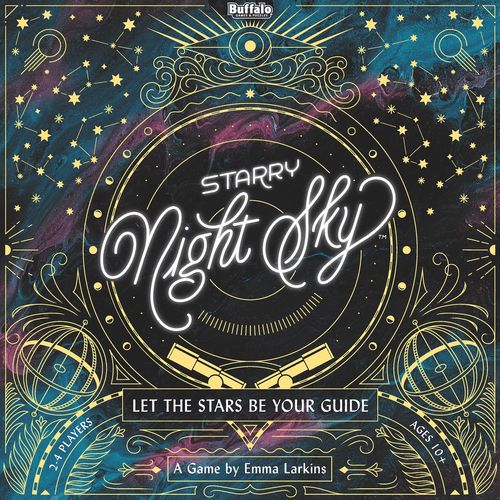
Starry Night Sky
Starry Night Sky Rulebook
Table of Contents
Table of Contents
Components
- 1 Game board
- 4 Telescope pawns
- 4 Player boards
- 4 Scoring markers
- 24 Discovery markers
- 1 Starting player marker
- 1 Bag
- 150 Star tokens (3 sets of colors: 50 red, 50 yellow, & 50 blue)
- 16 Myth cards
- 36 Exploration Goal cards
- 2 Turn Reference cards
- Game instructions
Setup
A. Place the Game board face-up in the center of the play area.
B. Fill the Night Track with Discovery markers (star side up). The number of Discovery markers on the Night Track depends on the number of players in the game:
- In a 2-player game, fill all spaces up to and including the 2 Player space.
- In a 3-player game, fill all spaces up to and including the 3 Player space.
- In a 4-player game, fill all spaces up to and including the 4 Player space.
For example, in a 4-player game, Discovery markers are placed on all 20 spaces across the Night Track. The Game board indicates where to stop placing Discovery markers based on the amount of players.
C. Fill all 4 spaces of Dawn Track with Discovery markers (star side up).
D. Shuffle the deck of Exploration Goal cards and place it face-down next to the Game board.
E. Remove the 2 Turn Reference cards from the deck of Myth Cards and place them out for players to refer to during the game.
F. Place all the Star tokens into the Bag. Give the bag a good shake to mix up the stars.
G. Each player chooses a Player board and places it in front of them.
H. Each player draws 3 random stars from the Bag and places 1 star into each of the 3 circles, or Star Pools, on their Player board. Set the Bag near the Game board within reach of all players.
I. Each player places their associated color Telescope in the center of the Game board on the START location. Shuffle the deck of Myth cards and place them face-down next to the Game board.
J. Each player places their Scoring marker next to the board near the first space of the Score Track.
K. Deal out 3 Myth cards face-down to each player. Myth cards are kept secret — each player may look at their own cards but may not share their Myth cards with the players. Return the remaining Myth cards to the box.
L. Give the Starting Player marker to the person who most recently looked up at the night sky.
Now you're ready to play!
How to Play
Beginning with the player who has the Starting Player marker and continuing clockwise, players will take turns until all of the Discovery markers are removed from the Night Track.
On Your Turn
Each turn has 2 parts: Gather & Explore
Gather
At the start of your turn, you need to gather new Star tokens for your Star Pools along with a new Exploration Goal card.
1. Draw a New Exploration Goal
- Draw a new Exploration Goal card from the deck and place it face-up in front of you by your player board.
- Exploration Goals are challenges that you complete during the game for extra points (listed at the bottom of each card).
- Each player may only have a maximum of 3 Exploration Goals at a time. If you have 3 Exploration Goals, do not draw a new Exploration Goal on your turn.
2. Draw New Stars
Draw new stars from the bag (without peeking). Most turns you'll draw 3 stars: one per Star Pool. A Star Pool can only hold 4 stars maximum. So, if any Star Pool is full at the beginning of your turn, draw one less star from the bag.
- Draw 3 new stars if no Star Pools are full
- Draw 2 new stars if 1 Star Pool is full
- Draw 1 new star if 2 Star Pools are full
3. Assign New Stars to Star Pools
After drawing all of your new stars, assign each star to a different Star Pool of your choice. Each Star Pool can only accept 1 new star per turn. If a Star Pool is full (has 4 stars), it cannot accept new stars.
For example, all 3 of Sue's Star Pools have room for more stars. Sue draws 3 random stars from the Bag. She draws a red, blue, and yellow star. Sue then decides to place the yellow star in the first Star Pool, the red in the second, and the blue in the third Star Pool.
Explore...and score!
Now that you've finished the Gather step, it's time to Explore the night sky and score points! Each time you Explore, you will first move your Telescope pawn to a constellation and then map it by placing stars onto its empty Star Spots.
4. Move Your Telescope to a Different Constellation
To move, pick up your Telescope from your current constellation and move it to an adjacent constellation along the Stellar Path (the white lines connecting constellations).
Discovering New Constellations
If you are the first player to move your Telescope to a constellation without any stars placed in it, then you have discovered a new constellation.
Take the leftmost Discovery marker from the Night Track and place it onto that constellation (making sure not to cover up any Star Spots). Discovery markers are placed onto new constellations with their star side up to show that the constellation is not fully mapped yet.
Score Points for discovering new constellations. Each Discovery marker is worth the number of points listed above it on the Night Track (1, 2, or 3 points). When you place a Discovery marker onto a constellation, remember to score your points by moving your Scoring marker along the Score Track.
Locations You Cannot Move To
Some locations on the map are skipped over when moving your Telescope (see Skipping Over Locations for more info and examples).
- START space: You may not end your movement on the START space.
- FULLY MAPPED CONSTELLATIONS: During the game, players may not end their movement on a constellation that has all its Star Spots filled. These constellations are fully mapped and must be skipped over when moving.
5. Map a Constellation by Placing Stars
When you move your Telescope to a constellation, you must map it by placing at least 1 star into that constellation. Every constellation consists of a number of Star Spots (2-4 spots). Each Star Spot requires a star of a specific color (red, blue, or yellow). When placing a star into a constellation, you must match the color of the star you are placing with the color of an empty Star Spot.
NOTE: If you cannot place a star onto a constellation because you don't have the right colors in your Star Pool to match that constellation's remaining empty Star Spot(s), you MAY NOT move to that constellation.
How to Map a Constellation with Stars:
- Choose a Star Pool on your Player board.
- Place as many stars as you wish from that Star Pool onto empty Star Spots in that constellation.
- Score 1 point for each star you place by moving your Scoring marker forward on the Scoring Track. The more stars you place, the more points you score!
NOTE: When placing stars in a constellation, you don't have to fill all the Star Spots in the constellation, even if you are able to do so.
Mark Fully Mapped Constellations
If you fill the final Star Spot in a constellation, flip the Discovery marker over to show that this constellation is completed, and now fully mapped!
6. Check for a Bonus Exploration
If you explored a partially mapped constellation (moved to a constellation that already had Star Tokens on it), then you will Explore for a 2nd time on your turn.
Bonus Exploration Rules:
- Follow the same steps as Explore: move your Telescope to an adjacent constellation and place at least 1 star in that constellation. Update your Score Marker one space on the Scoring Track for each star you place.
- When placing stars during a Bonus Exploration you may choose stars from ANY single Star Pool on your Player Board, including the Star Pool you used in your 1st Exploration.
- You may only do 1 Bonus Exploration per turn. Your turn immediately ends after a Bonus Exploration.
End of Turn
Your turn is over after you Gather, Explore, and update your Scoring marker. The player on your left then begins their turn.
Game Rules
Skipping Over Locations
You may not move your Telescope to the START space OR a fully mapped constellation. You can skip over those locations to continue moving your Telescope along the Stellar Path to a different constellation.
As the game progresses, more and more constellations will become fully mapped. Skipping over fully mapped constellations will make it easier to move your Telescope to more distant constellations during a turn.
NOTE: You may not end your movement on the same constellation where you began your move.
For example, let's follow this player's move:
A. The player started here.
B. Since the next constellation is fully mapped, they were able to skip it and move on to the next constellation.
C. This constellation is also fully mapped. It may be skipped as well.
D. The start space is always skipped.
E. The player successfully made a distant move, discovering a new constellation.
Exploration Goals
Exploration Goal cards are challenges that you can complete during the game for extra points. Each player may only have a maximum of 3 Exploration Goal cards at a time.
Fulfilling Exploration Goals
On your turn, if you complete the requirements on one of your Exploration Goals, score the reward (the points at the bottom of the card), then place that card into a discard pile. You may complete any number of Exploration Goals on your turn.
Trade In an Exploration Goal for a Star of Your Choice
Exploration Goals may also help you gain a star of your choice. During the Explore part of a turn, a player may trade in an Exploration Goal card to gain 1 Star Token of their choice from the bag.
There is no limit to the number of Exploration Goal cards you may trade in for stars. Players must take this action before or after placing stars.
Place that star in a Star Pool of your choice, as long as there are less than 4 stars in that pool. (Each star pool may only hold a maximum of 4 stars.)
Myth Cards
Myth cards are hidden player goals that are scored at the end of the game. You may look at your own Myth cards during the game but keep your Myth cards face-down and hidden from other players.
Each Myth card has 2 constellations on it. At the end of the game, all players reveal their Myth cards. If BOTH constellations on a Myth card are fully mapped (all Star Spots are filled), add the points at the bottom of your Myth card to your final score.
NOTE: It doesn't matter which player contributed to mapping the constellations in your Myth. As long as the constellations on the Myth are fully mapped at the end of the game, you score the Myth points!
Tracking Your Score
Every time you get points, make sure to track them by moving your Scoring marker along the Score Track at the bottom of the board. Multiple Score markers on the same space of the Score Track are stacked on top of each other. The order of Score markers in a stack doesn't matter.
If your score ever exceeds 40 points, flip over your Scoring marker to the "40" side and move your Scoring marker to the beginning of the Score Track to mark any additional points.
Game End
Play continues until the final Discovery marker is removed from the Night Track. This event means that Dawn has arrived to signal the end of the game. Complete the current round so that each player has played the same number of turns.
Discovering New Constellations at Dawn
During Dawn, if you discover a new constellation (you move to a constellation without any star tokens on it), take a Discovery marker from the Dawn Track and place it in this new constellation. Each Discovery marker from the Dawn Track scores 3 points when it is placed.
Winning the Game
After all players finish their final turns, reveal your Myth cards, then score the points on your completed Myth cards. The player with the most points wins the game and is crowned Best Astronomer!
In case of a tie, the player with the most points from Myth Cards wins the game. If the game is still tied, the tied players share the victory!
Example Player Turn
Our example player, Skyler, is playing a 3-player game of Starry Night Sky and has decided to be the orange player. Fortunately, we happened to catch Skyler right as they are about to take a big turn that will give you a sense of the sorts of things that may happen on a player's turn in Starry Night Sky.
-
Skyler starts their turn by drawing a new Exploration Goal from the deck and places it face-up near their player board.
Skyler then gathers new stars. Skyler has 2 Star Pools on their player board that are not yet full, so Skyler draws 2 random stars from the bag. Skyler chooses to place their new red star into their first Star Pool and their new yellow star into their second Star Pool.
-
Now Skyler is ready to Explore. Skyler's Telescope is currently in the Reliable Sailboat constellation. Skyler chooses to move their Telescope to the adjacent Lost Scarf constellation, which currently has 2 empty Star Spots — a blue spot and a red spot.
-
Skyler takes the blue star and red star from their third Star Pool and places them onto the respective Star Spots. Skyler scores 2 points, one for each star token they placed, and moves their Score marker on the Score Track 2 spaces forward.
-
The Lost Scarf constellation has no more empty Star Spots, so it is fully mapped. Skyler marks the fully mapped constellation by flipping the Discovery marker over to its magenta-colored side.
-
Since Skyler Explored a partially completed constellation on their initial Exploration, they must now conduct a Bonus Exploration. Skyler now moves their Telescope a second time to the adjacent Trusty Lantern constellation. This constellation is already completely mapped, so Skyler skips over this constellation and moves to the adjacent Deft Magpie constellation.
-
Because Skyler is the first player to move their Telescope to the Deft Magpie constellation, Skyler takes the leftmost Discovery marker from the Night Track and places it yellow side up into that constellation. Skyler scores 2 points for discovering this constellation since the Discovery marker came from the 2 Points section of the Night Track.
-
Skyler now needs to place at least 1 star into this constellation. Skyler chooses their first Star Pool on their Player Board and places 1 yellow star and 1 blue star from this Star Pool onto the respective Star Spots in the Deft Magpie constellation. Skyler now scores 2 points (1 point for each star token they just placed) and moves their Scoring marker forward 2 spaces on the Score Track. The constellation is not yet completely mapped, so Skyler doesn't flip the Discovery marker.
-
Also, the Exploration Goal that Skyler drew this turn challenged Skyler to "Place stars in 2 different constellations on a turn." Skyler placed stars into the Lost Scarf constellation and the Deft Magpie constellation, so they completed this goal. Skyler scores the 2 points listed on the Exploration Goal and moves their Scoring marker 2 spaces forward on the Scoring Track.
Skyler now discards this Exploration Goal because it is completed.
-
Skyler's turn is now over because Skyler Gathered, Explored, and also happened to get a Bonus Exploration. Skyler scored a total of 8 points on their turn — wow!
Exploration Goal Glossary
1 Point
- Complete a constellation
- End turn without completing a constellation
- Place a total of 4 stars on a turn
- Empty at least 1 Star Pool on a turn
- Move to, or skip over, a constellation that has another telescope on it
- End turn with 2 or more stars of the same color in 1 Star Pool
- End turn with only blue stars in a Star Pool
- End turn with only yellow stars in a Star Pool
- End turn with only red stars in a Star Pool
- Do not place any blue stars on a turn
- Do not place any yellow stars on a turn
- Do not place any red stars on a turn
- End turn adjacent to a completed constellation
- Place 2 red stars in 1 constellation on a turn
- Place 2 yellow stars in 1 constellation on a turn
- Place 2 blue stars in 1 constellation on a turn
- Place 1 yellow & 1 blue star in 1 constellation on a turn
- Place 1 yellow & 1 red star in 1 constellation on a turn
2 Points
- End turn with 2 stars in each Star Pool
- End turn with a Star Pool with 1 star, a Star Pool with 2 stars, and a Star Pool with 3 stars
- End turn adjacent to 2 completed constellations
- End turn with identical groups of stars in 2 Star Pools
- End turn on a constellation with an unfilled blue star spot
- End turn on a constellation with an unfilled red star spot
- End turn on a constellation with an unfilled yellow star spot
- End turn adjacent to a constellation with a telescope
- Complete an empty 4-star constellation
- Complete an empty 3-star constellation
- Complete an empty 2-star constellation
- End turn with only 1 star in each Star Pool
- End turn with 1 red, 1 blue and 1 yellow star in a Star Pool
- End turn with 3 or more stars of the same color in a Star Pool
- Empty at least 2 Star Pools on a turn
- Only place 3 stars on a turn
- Place stars in 2 different constellations on a turn