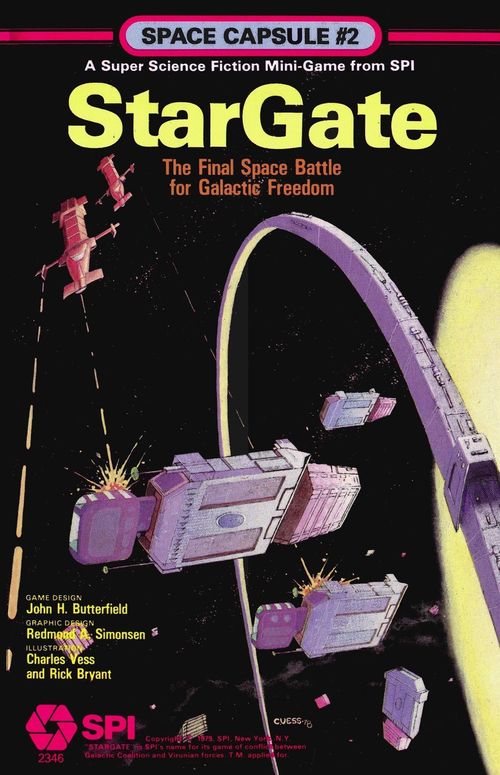
StarGate: The Final Space Battle for Galactic Freedom
StarGate: The Final Space Battle for Galactic Freedom Rulebook
Table of Contents
Table of Contents
[1.0] Introduction
Using their mysteriously controlled Stargates as an infallible method for surprise attack, the power-hungry Virunians have carried on a terrible War of Purification spanning the milky way for nearly 80 Earth years. Remnants of civilizations shattered by the might of the Virunian Tri-Ships have banded together into a coalition and assembled a ragtag battle fleet awaiting any opportunity to strike back at the Virunian enemy. In 2519 A.D. that opportunity arises when, in some distant part of the galaxy, the Virunians come up against an adversary so unexpectedly overpowering that it is all the Virunian fleet can do to flee pell-mell back through their stargates to arrive near their source of strength, the Nullgate. But their Tri-Ships are now randomly separated and their unified command non-existant. Coalition telepaths catch wind of the events transpiring and move their fleet toward the Nullgate, arriving there just as the first helpless Virunian elements tumble forth in disarray from the stargates. The wild battle that follows will decide whether the Virunians will ever again trouble the galaxy.
Stargate recreates this battle using a stylized, semi-abstract movement system. Most of the pieces in the game are primarily moved in straight lines along the hexgrid, which often means a Player must move his playing pieces into less advantageous hexes, unless he is willing to expose them to additional hazards. This may seem strange to Players who visualize the map as a representation of space. However, the technology of the distant future, with which this game is concerned in an abstract manner, enables spacecraft to "hide" from one another in the various planes and dimensions created by the Nullgate, a phenomenon central to Virunian power. Thus, when one ship is not in the same line of hexes as another, the two ships are considered not to be in the same type of space and may not make contact. If one of the ships were moved to a hex that was in line with the other ship's hex, the two would then be in the same plane of space and thus make contact. For most ships, shifting between these planes without proper preparation requires the suspension of all defensive mechanisms, exposing the ship to attacks, against which it is helpless to respond.
The Players attack each other's forces in one of two ways, attempting to destroy the opposing pieces and thus win the game. Approach takes place while a Player is moving his units and Combat takes place after all his units have been moved. Approach and combat are resolved by rolling a die and referring to one of the tables included with the game. If no die is available, Players may use the randomizer chits included in the countersheet. Place all the randomizer chits in a coffee mug or similar container. If a die roll is called for, draw one of these chits at random to give a number from 1 to 6. Return the chit to the mug after noting the result.
[2.0] Game Equipment
CASES:
[2.1] The Playing Pieces
The playing pieces consist of 100 die-cut cardboard counters which represent 19 various Coalition units (separated into four races: Humans; Meta-Mexish; Igugui; and Duonoips), 21 Virunian units, and 19 game markers. The pieces are placed on and moved across the map during play.
[2.11] Sample Units
(Diagram. Virunian unit: Ship Type; attack strength; defense strength; Tri-Ship designation; movement allowance. Coalition units: identification number; ship/unit symbol; attack-defense-movement values, e.g. "3-3-6". Teleportation ability is shown by an arrow to the unit's lower-left corner on the unit's counter.)
[2.12] Summary of Unit Types
(Diagram of unit counter types, with the following labels: Virunian control; Virunian transport; Virunian weapons; Virunian Monad; Maneuver option; Warp option; Charge option; Skim marker; Human; Igugui; Meta-Mexish; Duonoips; Randomizer chit.)
[2.2] The Map
The map represents a plane of space one light minute across. Two Stargates are located on the map in hexes 0914 and 0706. Each Stargate is surrounded by six hexes called orbit hexes. The Nullgate is located in hex 2109. The two Stargates and the Nullgate act as a focal point for positive and negative numbered hexes which affect the strength of some of the units in the game.
Transcriber's note: the printed map (a single graphic sheet) shows the energy hex values, the Stargate and orbit hexes, and the Coalition staging area as artwork. Its values are not transcribed hex by hex here; they are read from the map itself. Counter sheet and back-cover blurb are likewise not transcribed.
[3.0] Set-Up for Play
GENERAL RULE:
The Coalition and Virunian units are placed on the map during the first few Game-Turns.
CASES:
[3.1] How Coalition Units Enter the Game
During the Coalition Staging Segment of each Game-Turn, the Coalition Player may place one unit from each of the four Coalition races in any of four hexes of the Coalition staging area. No more than one unit may be placed in a single hex of the staging area. These units must then be moved into the playing area in the following Coalition Movement Phase. The staging area may not be entered by any units once they are in play, nor may staged units move within the staging area prior to entering the playing area.
[3.2] How Virunian Units Enter the Game
Before starting play, all 21 Virunian units should be turned face-down (blank side up) and randomly mixed. During the Deployment Phase of the first Virunian Player Turn, the Virunian Player rolls the die for each of the two Stargates on the map, starting with Stargate A (hex 0914). The number rolled represents the number of Virunian units which will be placed in that particular Stargate hex. Virunian units are drawn blind and placed upside-down in both Stargate hexes, starting with Stargate A. Neither Player should know which units these are.
For example, the Virunian Player rolls a 3 and a 4. In Stargate A, he would place three units face-down. Stargate B would receive four units.
For the next and all subsequent deployments, each die roll is halved, rounding fractions up (e.g., a 3 or 4 becomes a 2). This process is followed in each succeeding Virunian Deployment Phase until all Virunian units have been deployed.
There is no limit to the number of Virunian units which may occupy a single Stargate hex. However, no units may enter Stargates except by this process. Virunian units move from the Stargates into play during the Virunian Movement Phase.
[4.0] Sequence of Play
GENERAL RULE:
Stargate is played by two Players in Game-Turns, each composed of a Virunian Player Turn, a Coalition Player Turn, and two independent Segments. The Player whose Player Turn is in progress is called the Phasing Player. Each Player moves his units and resolves combat in his Player Turn, according to the following outline.
GAME-TURN SEQUENCE OUTLINE
COALITION STAGING SEGMENT
The Coalition Player places up to four units in the Coalition staging area.
VIRUNIAN PLAYER TURN
-
Deployment Phase: The Virunian Player randomly deploys his ship units in the two Stargates.
-
Movement Phase: The Virunian Player may move one unit from each Tri-Ship group by either moving units on the map or flipping over units within the Stargates. (Case 8.1). However, once a second unit of a Tri-Ship has been moved, The Virunian Movement Phase automatically ends.
-
Combat Phase: The Virunian Player must now attack all Coalition units with which he has Friendly units stacked or to which he has a Tri-Ship adjacent.
COALITION PLAYER TURN
-
Movement Phase: The Coalition Player may move any or all of his units, and must move those in the Coalition staging area.
-
Combat Phase: The Coalition Player must now attack all Virunian units with which he has Friendly units stacked.
[5.0] Movement
GENERAL RULE:
During his Movement Phase, the Coalition Player may move any or all of his units. The Virunian Player may move one unit or stack of units from each Tri-Ship group during his Movement Phase. Units move by linear movement, teleportation, wobbling, or gate skimming, depending on their specific movement abilities.
PROCEDURE:
Move each unit one at a time, tracing the path of its movement through the hexgrid. As each unit is moved into a hex, one Movement Point must be paid from the unit's total Movement Allowance, unless the unit is being teleported. Units may never be moved into Stargates or the Nullgate, or off the map.
CASES:
[5.1] Linear Movement
A Player uses linear movement to move Human, Igugui, Duonoip, and Virunian transport and weapon units during his Movement Phase. Linear movement represents standard propulsion movement through finite space. Units being moved by linear movement may only be moved along the grain of the hexgrid, in a straight line of hexes (however, see Case 5.2). Thus a unit may be moved in one of six directions from the hex in which it starts the Movement Phase.
(Diagram: "Linear Movement", "Three Turns", "One Turn" examples.)
A unit being moved by linear movement may be moved up to as many hexes as its Movement Allowance states. It may never be moved further than its Movement Allowance or save an unused portion of it. A unit may be moved into hexes occupied by Friendly or Enemy units. However, if a unit is moved into or through an Enemy occupied hex, the approach routine is triggered (see Case 7.0), which must be completed before the movement of that unit can continue. A unit may be moved into a Stargate exit hex, but the movement of that unit is then altered by gate skimming (5.3).
[5.2] Turning
The Phasing Player may attempt to turn a unit in the hexgrid when it is being moved by linear movement. Such a unit is referred to as a Turning Unit and is susceptible to Enemy fire when it shifts from moving in one direction to another. When a Player moves a unit, using linear movement, into the first hex that is not along the straight path determined by the unit's movement thus far in the Movement Phase, the unit must stop until all eligible Enemy units have fired at it. The die is rolled once by the non-Phasing Player for each Enemy unit that is within eight hexes of the Turning Unit. These eight hexes may be traced in a non-linear path and through any type of hex. If a 1 or 2 is rolled at any time during the process, the Turning Unit is eliminated. If a 1 or 2 is not rolled, the linear movement of the unit may continue. If the unit was Turned again, the process would be repeated. This process is not used for units that are moving by wobbling and for units that are Turning as a result of gate skimming. Units that are being teleported may never Turn in the hexgrid.
(Example diagram: hexes 1-6 around Stargate A; routes A, B, C are legal gate skimming; D is an illegal exit; E is an illegal exit that must pass through at least one more orbit hex; F is a prohibited turn from hex 1 to 2.)
[5.3] Gate Skimming
A unit that is moved by linear movement may be moved into a Stargate orbit hex and then in a circular direction through the other orbit hexes of that Stargate. The six orbit hexes around a Stargate are referred to as an Orbit Hex Circle. A unit employing linear movement may enter a Stargate orbit hex from any direction, unless, if linear movement continued, the next hex entered was a Stargate hex.
(Example diagram: hexes 1-6 around Stargate A. Hex 2 entry is "Prohibited" along one path and hex 4 entry is "Prohibited" along another, as marked on the diagram.)
[5.31] When a unit is moved into an orbit hex it must be moved through at least two more orbit hexes before leaving the Orbit Hex Circle. These hexes must be the next hexes along the Orbit Hex Circle in the direction the unit was heading when it was moved into the first orbit hex.
[5.32] The required movement of a unit around an Orbit Hex Circle does not have to be completed in one Movement Phase if there are not enough Movement Points remaining in the unit's Movement Allowance. A unit's required movement could be split between two Game-Turns. Counters have been provided to show such a unit's "Gate Skimming status" at the end of a turn. If a unit has entered only one hex of the Orbit Hex Circle, a 1 Skim marker should be placed on the unit with the arrow pointing in the direction that the unit must move. If the unit has entered a second hex of the Orbit Hex Circle, a 2 Skim marker should be placed on the unit. A unit without a Skim marker on it may exit the Orbit Hex Circle. A unit's movement cannot be stopped in an orbit hex if it has Movement Points remaining.
[5.33] A unit may only be moved out of an orbit hex to reenter the normal hexgrid in the direction that the unit was moved into the orbit hex.
[5.34] Upon leaving an Orbit Hex Circle, a unit's remaining Movement Points are doubled for the remainder of that Movement Phase. If such a unit is moved through another Orbit Hex Circle, its Movement Points would be doubled again, or quadrupled. However, a unit with an augmented Movement Allowance cannot be Turned (5.2).
[5.4] Teleportation
Igugui units and certain Virunian combined units (see Case 8.1) are moved by teleportation (signified by a T in the unit's Movement Allowance or on the Virunian Combined Unit's Capabilities Chart). Teleportation represents instantaneous travel from a point to a distant known point. Units that are teleported have no maximum Movement Allowance, but must trace a straight line of hexes when being teleported, like units being moved by linear movement. Units being teleported may be moved as far as the owning Player wishes and may be moved through any type of hex within the restrictions found in the following secondary cases.
[5.41] When a unit is teleported through a Stargate, the die is rolled; on a roll of one the unit is eliminated.
[5.42] A unit being teleported is not affected by Stargate orbit hexes nor may it use gate skimming.
[5.43] The approach routine (7.0) is triggered when a teleported unit ends its movement on an Enemy unit, but not when it is moved through one.
[5.44] Igugui units may be moved by linear movement with a Movement Allowance of six, or they may be teleported. They may do either, but not both in a single Movement Phase.
[5.45] If an Igugui unit (not Virunian) is teleported more than six hexes in a Movement Phase, the die is rolled after completing the move. On a roll of one, the unit is placed one hex further along its movement path; on a roll of six, the unit is placed one hex back. If the unit is unable to make this adjustment without breaking a movement rule, the unit is eliminated.
[5.5] Igugui-Human Teleportation
Igugui units that are not moved during the Coalition Movement Phase may "lend" their teleporting ability to Human units. To do so, an Igugui unit must start the Coalition Movement Phase within four hexes of the Human unit to be teleported. If the Igugui unit remains stationary for the entire Movement Phase, the Human unit may be teleported exactly as if it were an Igugui unit, subject to all the restrictions of Case 5.4.
[5.6] Wobbling
Meta-Mexish and Virunian control units are moved by wobbling (signified by a "W" in the unit's Movement Allowance). Wobbling represents multi-dimensional travel through known and unknown space. Units that are moved by wobbling are not subject to the one-direction restrictions of linear movement and do not trigger Enemy fire when they turn. They may be moved up to as many hexes as their Movement Allowance states, in any direction or combination of directions. If they are moved into or through an Enemy occupied hex, the approach routine is triggered (7.0). A unit being moved by wobbling may not execute gate skimming, but it may move into or through orbit hexes if desired.
[5.7] Mindless Transport Units
If a Virunian control unit is eliminated, the transport unit of the same Tri-Ship group is moved at random, if it is on the map or as soon as it is revealed to be on the map. At the beginning of each Virunian Movement Phase, each transport unit belonging to a Tri-Ship with an eliminated control unit is moved five hexes in a straight line. To determine the direction of this movement, look at any Stargate and its orbit circle and roll a die. A line traced from the Stargate through the orbit hex matching the number rolled on the die describes the direction that the Transport unit would be moved. If the transport unit is directed to be moved off the map or into a prohibited hex, it is eliminated. If it is directed to be moved onto or through any other unit or stack of units (Virunian or Coalition) all units in the hex, including the transport unit are eliminated. This process is repeated for all random transport units every Virunian Movement Phase. Transport units being moved randomly do not count as a Virunian move (see Case 5.8).
[5.8] Virunian Movement Restrictions
The Virunian Player may move one unit from each of his Tri-Ship groups per Virunian Movement Phase. A stack of units from the same Tri-Ship counts as one unit for this purpose (see Case 8.1). In addition, as the last unit moved in his Movement Phase, the Virunian Player may move a second unit of any one Tri-Ship group. This move is called the Virunian Bonus Move and signals the end of the Movement Phase. Until all Virunian units are revealed, the bonus move must be made by a unit in a Stargate, being revealed for the first time. To move an unrevealed unit in a Stargate, the Virunian Player flips it over and rolls a die, placing the unit in the Stargate orbit hex that matched the die roll. He repeats this process for any unrevealed unit he wishes to move. Just revealed units are subject to the following restrictions:
-
If a Stargate orbit hex is occupied by another unit, any unit to be placed there is placed in the next unoccupied orbit hex in a clockwise direction.
-
Once a unit has been revealed, it must be moved immediately.
-
The movement of a unit must begin by moving it out of the orbit hex and into a normal hex, according to the rules for that type of unit's movement. This is not considered gate skimming and the unit does not receive any benefits for gate skimming when it is so moved.
-
If a unit belongs to a Tri-Ship group containing units that have been moved in that Phase, it is moved as the Virunian bonus move, and the Movement Phase is finished for that turn, even if there are Tri-Ship groups remaining that have not been moved at all.
[5.9] Virunian Tri-Ship Movement
A Tri-Ship (three units of the same Tri-Ship group in one hex) is moved by teleportation. However, it may be Turned once at any point in its movement. This basically means that a Tri-Ship can be moved to any hex on the map in a single move. It is not subject to the conditions of Turning (Case 5.2).
[6.0] Virunian Monads
GENERAL RULE:
Three of the Virunian units, called Monads, do not belong to a Tri-Ship and are not subject to Virunian Movement restrictions. They may be moved every Virunian Movement Phase, once revealed, and do not count toward the limit of moves the Virunian Player may make per turn. The units each have a Combat Strength of 5 and a Linear Movement Allowance of 6. Monads may not be stacked with other Virunian units including Monads. The elimination of Monad units has no bearing on the victory conditions.
[7.0] Approach
GENERAL RULE:
Friendly units may move into and through Enemy occupied hexes during their movement. Every time a unit is so moved, both Players take part in the approach routine, a combination of mobile combat and defensive fire that is part of the Movement Phase.
CASES:
[7.1] The Approach Routine
The approach routine is executed according to the rules found in the following secondary cases.
[7.11] Each Player chooses an approach option tactic chit but keeps it concealed. He may choose warp (an indirect approach using matter displacement), charge (a head on approach), or manuever (a darting, acrobatic approach). In doing this, the Phasing Player is choosing his approach strategy and the non-Phasing Player (or defender) is attempting to guess that strategy.
[7.12] Both approach option tactic chits are revealed at the same time and the two options chosen are cross-referenced on the Approach Option Matrix to determine the approach number.
[7.13] The die is rolled. If the roll is equal to or less than the approach number, the unit being moved is eliminated. If a "d" follows the approach number, one defending unit in the hex would be eliminated instead (owner's choice).
[7.2] Approach Option Matrix
Phasing Player's (Attacker's) Approach Option across; Non-Phasing Player's (Defender's) Approach Option down.
| Defender's Approach Option | Warp (a) | Charge (b) | Maneuver (c) |
|---|---|---|---|
| Warp (a) | 2 | 1 | 1d |
| Charge (b) | 1d | 2 | 1(a)(b)(c) |
| Maneuver (c) | 1 | 1d | 2 |
Results are expressed as approach numbers. d = one defending unit in the hex is eliminated (see Section 7.0).
[7.3] Restrictions on the Approach Routine
The approach routine is used for each unit individually as the Phasing Player attempts to move it into an Enemy occupied hex. Some units have special restrictions on them concerning the approach routine, as follows.
[7.31] The approach routine is not used when a Tri-Ship is moved. Also, it is not used when a unit is being teleported through an Enemy occupied hex. It is used when a unit being teleported ends its movement in an Enemy occupied hex.
[7.32] The Coalition Player may only choose the charge option when moving a Duonoip unit. He may choose from all three when defending with Duonoip units.
[7.33] The Coalition Player may not choose the charge option when moving a Meta-Mexish unit.
[7.34] In any approach routine in which an Igugui unit is being moved or is defending but not when it is being used as a shielding unit (7.4), the Virunian Player must announce one option he is not choosing before the approach option displays are revealed.
[7.4] Shielded Approach
When a Player is moving a unit into an Enemy occupied hex, the Player with the greater number of units in the hex is shielded. To determine which side has more units in the hex, count the number of defending units that occupied the hex at the beginning of the current Movement Phase and compare it to the total number of units belonging to the Phasing Player in the hex. This includes units that have just been moved into or through the hex, units eliminated when the Phasing Player attempted to move them into the hex in the current Phase, and the unit presently being moved into the hex. For example, two Virunian units occupy a hex that a Coalition unit is entering. The Virunian Player is shielded since he has two units facing one Coalition unit. If the Coalition Player moved another unit into the hex, regardless of what happened to the first unit, neither side would be shielded, since both sides have two units.
If either Player's units are shielded in an approach routine, the approach number (as determined in Case 7.1) is cross-referenced with the appropriate row on the Shielded Approach Chart to see how the approach number is altered in the shielded units' favor. Numbers in the Shielded Approach Chart replace the appropriate approach number in the Approach Option Matrix.
[7.5] Shielded Approach Chart
Approach Option Matrix number across; shielded side down.
| 2 | 1 | 1d | |
|---|---|---|---|
| Defender Shielded | 3 | 2 | 0 |
| Attacker Shielded | 1 | 0 | 2d |
Results are expressed as approach numbers (replacing those determined on the Approach Option Matrix). See Case 7.4.
[8.0] Stacking
GENERAL RULE:
No more than three Friendly units may be in a hex at the end of the Friendly Movement Phase and throughout all other Phases. Thus, a maximum of six units (three Coalition and three Virunian) may be in a hex at one time. There is no limit to the number of units which may pass through a hex during a single Movement Phase. If Friendly units are stacked together in the Combat Phase, their Combat Strengths are added together when attacking or defending, unless the units are from the same Virunian Tri-Ship.
CASES:
[8.1] Virunian Tri-Ship Stacking
Each Virunian unit has a Tri-Ship designation that denotes which of six Tri-Ship groups it belongs to. There are three units in each Tri-Ship group. If two or three units from the same Tri-Ship group are in the same hex, regardless of the presence of other Friendly or Enemy units, the two or three units are treated as one unit for all combat and movement purposes. Units of the same Tri-Ship are treated as individual units for the purposes of stacking, determining shielded approach (7.4), and Nullgate elimination (11.3). Such a stack is called a combined unit and refers to the Virunian Combined Unit Capabilities Chart to determine its combat and movement values instead of using its printed strengths. The Virunian Player may join units of a Tri-Ship in an Enemy-occupied hex during his Movement Phase and engage in combat using their full combined strength.
[8.2] Virunian Combined Unit Capabilities Chart
| Units of same Tri-Ship in hex | Combat Strength | Movement Allowance |
|---|---|---|
| Control/Transport | (5) | 5, 5W or T |
| Control/Weapons | 6 | 5 or 5W |
| Transport/Weapons | 5 | 5 |
| Control/Transport/Weapons (Tri-Ship) | 10 | T (see Case 5.9) |
Parenthesized Combat Strength can be used for defense only. T = Teleportation. W = Wobbling. See Section 5.0.
[9.0] Combat
GENERAL RULE:
Combat occurs during the Combat Phase when opposing units are in the same hex. The Phasing Player must attack all Enemy units in a hex with all those Friendly units in that hex. Other Friendly units that are not in the hex may contribute to the attack if they are within range (Section 10.0). The Phasing Player is called the attacker, the other Player is the defender, regardless of the overall strategic situation.
PROCEDURE:
Total the Attack Strengths of all the units involved in an attack and the Defense Strengths of the units in the hex under attack. Subtract the total strength of the defending units from the attacker's total. The result is the combat differential, expressed in points. It may be either a positive or negative number. The attacker finds the appropriate combat differential column on the Combat Results Table (9.2) and rolls the die. The die roll cross-referenced with the combat differential yeilds a combat result. This should be applied immediately to the involved units before going on to resolve another combat. Separate combats may be resolved in any order that the attacker wishes, as long as all combats are resolved. All combat results are explained on the Combat Results Table.
CASES:
[9.1] Which Units Attack
In addition to Friendly units stacked with Enemy units, any other Friendly units that are within range, as explained in Section 10.0, may participate in an attack — but are not required to. No unit may attack (ranged or in-hex) more than once per Combat Phase, and no Enemy unit may be attacked more than once per Combat Phase. An attack in a single hex must involve all Enemy and Friendly units in that hex. If a Player finds he cannot meet the minimum differential on the Combat Results Table (- 2) when calculating the attack, all attacking units in the hex are automatically eliminated; no combat takes place.
[9.2] Combat Results Table
Combat Differential (Attacker minus Defender).
| Die | -2 | -1 | 0 | 1 | 2 | 3 or 4 | 5 thru 7 | 8 or more |
|---|---|---|---|---|---|---|---|---|
| 1 | Db | Dd | Dd | Ed | Ed | Ed | Ed | Ed |
| 2 | Da | Db | Dd | Dd | Ed | Ed | Ed | Ed |
| 3 | Da | Db | Db | Dd |
a = all attacking units; d = all defending units; D = all affected units are dispersed (the opposing Player may move dispersed units to any non-prohibited, unoccupied hex within five hexes of the units' position at the instant of combat; dispersed units may be placed in different hexes); E = all affected units eliminated from play; Db = all attacking and defending units dispersed (attacking Player disperses defending units first).
[9.3] Units That May Not Attack
All Virunian control and transport units have no Attack Strength. These units may not attack (either in-hex or ranged) unless they are part of a combined unit (see Case 8.1). If Coalition and Virunian units both occupy a given hex during the Virunian Combat Phase, and all the Virunian units in the hex are not eligible to attack, those Virunian units are automatically eliminated; no combat takes place.
[9.4] Tri-Ship Combat Capabilities
Virunian Tri-Ships must attack all Enemy units with which they are stacked and adjacent. Thus a Tri-Ship could be required to attack Enemy units in as many as seven different hexes at once — the one it occupies and the six surrounding it. When attacking adjacent Enemy units, Tri-Ships do not use ranged attack, they use their full Combat Strength of 10.
[9.5] Berserk Weapon Units
If a Virunian control unit is eliminated, the weapons unit of the same Tri-Ship group goes beserk, if it is in play. The weapons unit instantly attacks the nearest unit (Friendly or Enemy) regardless of what Phase is in progress, and at twice its normal strength, or 6. Range is not taken into account in this attack. If two units are the same distance from the weapons unit, it attacks the single unit of the Virunian Player's choice. Regardless of the outcome of the attack, the weapons unit is automatically eliminated after the combat is resolved. If such a weapons unit is just entering play, or subsequently enters play, it is placed in its designated Stargate orbit hex and then carries out its beserk attack.
[10.0] Ranged Attack
GENERAL RULE:
Most units may take part in an attack even if they are not stacked with Enemy units, by adding a portion of their Attack Strength to the strength of Friendly units attacking in-hex. This portion is called the Ranged Attack Strength and depends on the distance in hexes that the unit using ranged attack is from the hex under attack. All eligible Friendly units that are in linear range of an Enemy unit(s) being attacked may contribute their Ranged Attack Strength.
CASES:
[10.1] Which Units May Execute Ranged Attack
To be eligible for ranged attack, a unit must not be stacked with an Enemy unit or have taken part in another attack (ranged or in-hex) in that Combat Phase. It must be able to trace a linear range that is less in hexes than its own Attack Strength from itself to the Enemy units under attack by in-hex units. A linear range is a straight line of hexes (traced in the same manner as linear movement) counted by including the defender's hex but not the ranged attack unit's hex. Linear range may not be traced through Stargate, orbit, or Nullgate hexes or to hexes not occupied by both Friendly and Enemy units.
[10.2] Calculating Ranged Attack
After determining that a unit is eligible for ranged attack, its Ranged Attack Strength is calculated by subtracting its range in hexes from its printed Attack Strength. The resulting number is simply added to the Attack Strength of the Friendly units in the hex under attack when calculating the combat differential. Example: A Human unit with an Attack Strength of three is two hexes away from a Virunian unit being attacked by another Coalition unit. The Human unit could contribute a Ranged Attack Strength of one to the total Attack Strength (3 - 2 = 1).
[10.3] Ranged Attack Restrictions
[10.31] Regardless of the outcome, units using ranged attack are never affected by combat results.
[10.32] Duonoip units may never execute ranged attack.
[10.33] Defending units may never execute ranged attack.
[11.0] Stargate and Nullgate Energy Fields
GENERAL RULE:
A number of hexes on the map have numerical values that affect the Combat Strength of Virunian units. These hexes are called energy hexes and "eminate" from the two Stargates and the Nullgate, a strange planetary object from which the Virunians draw their dread power.
CASES:
[11.1] Effect of Energy Hexes on Virunian Units
If a Virunian unit, or stack of Virunian units, is in an energy hex during either Player's Combat Phase, the numerical value in the hex is added to the total Combat Strength of the Virunian unit(s). [For example, 5 + (- 2) = 3] If there is more than one Virunian unit in the hex, the number is added to the total Virunian Combat Strength in the hex. Energy hexes have no effect on Virunian movement or approach and no affect at all on Coalition units. The numbers in the Stargate orbit hexes do not effect Virunian Combat Strengths; they are used for an entirely different purpose.
[11.2] The Nullgate
The Nullgate (hex 2109) is prohibited to all movement, either into or through. However, a Player may attempt to move a unit through the Nullgate if that unit is being teleported. When doing so, a die must be rolled; on a roll of one or two the unit is eliminated. Units may not be moved by gate skimming around the Nullgate nor may Virunian units be deployed initially there.
[11.3] Nullgate Gravitational Force
If at the end of a Game-Turn there are any Virunian or Coalition units in any energy hexes with a value of four, there is a possibility that the erratic gravity of the Nullgate will capture a unit and send it plummeting to a fiery death. A die is rolled by the Virunian Player; on a roll of 1 or 2, one Virunian unit in a four value energy hex is eliminated; on a roll of 3 or 4, one Coalition unit in a four value energy hex is eliminated; on a roll of 5 or 6, no unit is eliminated. No more than one unit may be eliminated per Game-Turn by this process. If more than one unit is eligible to be eliminated, the owning Player must choose one. If no eligible unit falls into the catagory rolled, no units are eliminated.
[12.0] Victory Conditions
GENERAL RULE:
Victory in Stargate is achieved by either Player when he fulfills the conditions described below. Play continues until one Player meets the requirements of the victory conditions; there is no set number of Game-Turns.
CASES:
[12.1] Virunian Victory
If at any point the Coalition Player has lost eight units and in these eight there is at least one unit from each of his four races, the Virunian Player is immediately declared the winner.
[12.2] Coalition Victory
If at any point the Virunian Player has lost at least one unit from each of his six Tri-Ship groups, the Coalition Player is immediately declared the winner. If both this and condition 12.1 are fulfilled at the same time, the Coalition Player is declared the winner.