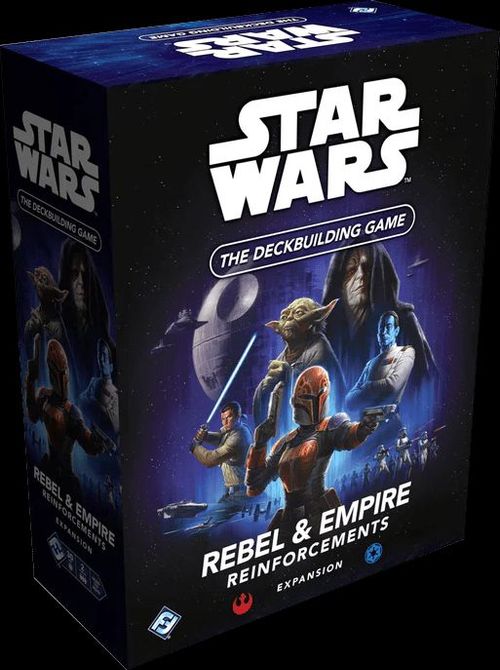
Star Wars: The Deckbuilding Game – Rebels & Empire Reinforcements Expansion
Star Wars: The Deckbuilding Game – Rebels & Empire Reinforcements Expansion Rulebook
Table of Contents
Table of Contents
Contents
The Rebels & Empire – Faction Support expansion contains 140 cards, divided equally between 2 factions (70 Rebel cards and 70 Imperial cards).
Each faction receives:
- 25 support cards (see p. 3),
- 25 mission cards (see pp. 4–5),
- 10 new base cards (see p. 6),
- 10 upgraded starter cards (see p. 7).
Support Cards
"The Emperor made a mistake, so it is high time to attack." – Mon Mothma
In the Rebels & Empire – Faction Support expansion, each faction receives 25 support cards. They depict units and starships that players can add to their decks if they complete specific missions (see pp. 4–5).
Support cards can be easily told apart from other cards by the gold frame around the card name.
Illustration captions: "frame on a regular card" (left) and "frame on a support card" (right). The left example is TIE Fighter and the right example is Defender 1.
- TIE Fighter – Unit. Fighter.
- "If you have a starship in play, draw 1 card."
- "Fighters attack!" – Lando Calrissian
- Reward: Gain 1 resource.
- Defender 1 – Unit. Fighter.
- "If you have a starship in play, draw 1 card. If you have another fighter in play, draw 1 card."
- Reward: Annihilate 1 card from your hand or from your discard pile.
Playing with Support Cards
Support cards are not added to the galaxy deck. During setup, each player sets aside the support cards of their faction.
Each support card is linked to a mission card, which the player must complete to place that support card on top of their deck. Once a support card has been placed on top of the deck, it becomes part of that player's deck until the end of the game.
The next page describes exactly what missions are and how they can be completed.
Mission Cards
"As a member of the Senate, I am flying on a diplomatic mission to Alderaan." – Princess Leia
Mission cards are a new type of card that let players gain powerful support cards for their factions.
Mission Card Anatomy
This section explains the symbols and information printed on mission cards. The illustration labels are:
- Card type – defines how the card functions in play.
- Name – the name of the card.
- Faction symbol – identifies the faction the card belongs to.
- Ability – the effect of the card.
- Mission points – the number of resources needed to complete the mission.
Illustration example: the mission card is titled "Recruitment: Ghost-2" (Polish printing: "Zwerbowanie Widma-2"). Its ability reads: "When you complete this mission, place it on your victory pile. Then take the Hera Syndulla card from your set-aside support cards and place it on top of your deck." It has 7 mission points.
Playing with Mission Cards
A standard one-versus-one game with mission cards requires the following steps at the end of setup:
- Each player shuffles the mission cards of their faction and places them face down next to their base deck.
- Each player adds the 10 new base cards of their faction to their base deck.
- Each player sets aside the support cards of their faction, so they have easy access to them.
- Each player looks at the top 2 cards of their mission deck. They put one of them into play face up on top of their mission deck, and place the other face down on the bottom of the deck.
Once the game has started, the following rules apply:
- If at the start of their turn a player has no face-up mission card in play, they look at the top 2 cards of their mission deck. They put one of them into play face up on top of their mission deck, and place the other face down on the bottom of the deck.
- This step must be done before choosing a new base, if the player has no base at the start of the turn.
- A player may look at the set-aside support cards at any time, both their own and their opponent's.
- During their turn, a player may place any number of resources from their personal pool on their mission card. Resources placed on a mission card stay there until the mission is completed.
- A mission does not leave play until it is completed.
- A mission is completed when the number of resources on it equals or exceeds its mission points. When a mission is completed, the player resolves its ability.
- Resources from a completed mission return to the general pool.
- A player may complete at most as many missions as the number of bases required for victory. For example, in a standard game in which 4 destroyed enemy bases are needed to win, a player may complete at most 4 missions.
- If at the start of their turn a player has the maximum number of missions on their victory pile, they do not look at the top 2 cards of their mission deck and do not bring a new mission into play.
New Base Cards
"Now you will see what our finally functioning and well-armed battle station has to offer." – Emperor Palpatine
Each faction receives 10 new base cards, which it can add to its deck in most game modes.
Rebel bases: Shantipole*, Klatooine*, Mykapo*, Krownest*, Ferrix, Garel, Lira San, Atollon, Ryloth, Segra Milo.
Imperial bases: Eadu*, Jalindi*, Yarma*, Death Star II*, Scarif, Fondor, Kuat, Montross, Narkina V, Nur.
- In games with mission cards, each player adds all 10 new base cards of their faction to their base deck.
- In games where mission cards are not used, do not add the bases marked with an asterisk (*).
- Bases marked with an asterisk have abilities related to mission cards.
- Bases without an asterisk may be used in game modes without mission cards.
Upgraded Starter Cards
"I personally installed some upgrades." – Han Solo
Each faction receives 10 upgraded starter cards. They are used only in campaign mode (see pp. 8–11) and in upgraded start mode (see p. 14).
Upgraded starter cards can be recognized by a marking at the bottom of the card.
Illustration captions: "upgraded Rebel starter cards" and "upgraded Imperial starter cards".
The card names printed in this rulebook's campaign log (see pp. 12–13) are:
- Rebel: Alliance Shuttle, Rebel Soldier, Temple Guardian (removable from the starter deck); Rebel Astromech, A-Wing, Tauntaun Rider, MC30 Scout Frigate, Smuggler's Ship (addable to the starter deck).
- Imperial: Imperial Shuttle, Stormtrooper, Inquisitor (removable from the starter deck); Scout Probe, Dewback Rider, VT-49 Decimator, TIE Striker, Arrestor Cruiser (addable to the starter deck).
The full card text of the upgraded starter cards is printed on the cards themselves and is not reproduced in this rulebook.
Campaign Mode
The new, exciting campaign mode turns the standard game of STAR WARS: THE DECKBUILDING GAME into a series of several skirmishes, where the result of each game affects the next clash!
A single campaign is a series of 5 games. In games 1–4, the winner is the player who first destroys 3 enemy bases. In each game, players earn points, which they can spend on powerful cards to gain an advantage over their opponent. In game 5, the winner is the player who first destroys 5 enemy bases and thereby wins the entire campaign!
Playing a Campaign
"We fight to win. For now we are losing. Again and again and again. Until we are ready." – Luthen Rael
To prepare the first game of the campaign, follow the steps in "Playing with Mission Cards" (see p. 5). Then players set aside the upgraded starter cards of their factions, so they have easy access to them. During the game they earn points, which they can later spend on these cards.
In campaign mode the same rules apply as in the mission game.
At the end of each of the first 4 games, the players carry out the following steps.
-
Determine points. Each player determines the number of points they have earned. A player earns 1 point for each base and each mission on their victory pile at the end of the game.
Example: The Rebel player lost. Nevertheless, they completed 3 missions and destroyed 2 enemy bases, so they earn 5 points.
-
Buy upgraded starter cards. Each player spends points to buy upgraded starter cards. These cards replace weaker starter cards in the player's deck, thereby strengthening it.
- The player takes their 10 starter cards of their faction (including any they annihilated in the previous game).
- Then they buy upgraded starter cards, spending the points they earned. The cost is printed on each card. A player may buy several cards if they can afford them. Unspent points are lost (they do not carry over to the next game).
- The starter deck must consist of exactly 10 cards, so each newly bought card replaces one of the starter cards in the deck. The replaced card goes back into the box; it is permanently removed from the campaign.
Example: The Rebel player has 5 points to spend, so they buy the "Smuggler's Ship" card, costing 3, and the "Tauntaun Rider" card, costing 2. They decide that the new cards will replace two "Alliance Shuttle" cards, thereby strengthening their starter deck for the rest of the campaign. The two "Alliance Shuttle" cards are removed from the deck and put into the box, where they stay for the rest of the campaign.
-
Prepare the new galaxy deck. Each player reviews their deck from the previous game and returns all galaxy cards to the galaxy deck. The support cards earned in the last game are placed in front of them (the cards of completed missions on the victory pile make these support cards easier to find). Then, for each support card earned, the player decides whether to remove that card from the campaign, or to remove 1 card of their faction from the galaxy deck to replace it with the support card earned.
- There are exactly 30 cards of each faction in the galaxy deck. This number may not change during the campaign. To add a support card to the galaxy deck, the player must first remove one card of their faction from it.
Setup for Games 2–5
To prepare games 2–5 in campaign mode, carry out the steps described in "Playing with Mission Cards" together with the additional actions below.
- Each player shuffles their mission deck before choosing the first mission.
- Make sure that after buying upgraded starter cards, each player's starter deck consists of exactly 10 cards.
- Starter cards annihilated in the previous game return to the starter deck during setup for the new game.
- Make sure that after the players have made their decisions regarding support cards, the galaxy deck consists of exactly 90 cards.
- Galaxy cards annihilated in the previous game return to the galaxy deck during setup for the new game.
- Place the Force marker on the space where it ended the previous game.
- The winner of the previous game starts the new game with the same base they ended the previous game with.
- That base begins the game fully repaired.
- The player who lost the previous game goes first in the new game. At the start of their turn, they choose a base from their base deck.
- The base is chosen after both players have laid out the galaxy row, drawn cards and chosen their missions.
Campaign base examples printed in the rulebook (p. 10):
- Dantooine (Rebel) – Rebel Outpost. You start the game with this base in play.
- Kalamar (Rebel) – Industrial Power. When you reveal this base, buy a Rebel or neutral card from the galaxy row without paying its cost and take it into your hand.
- Hoth (Rebel) – Planetary Shield. While Hoth is your base, you prevent the first 2 damage dealt to Hoth each turn.
- Endor (Imperial) – Elite Troops. While Endor is your base, each of your Trooper and Vehicle units gains 1 resource.
Campaign Log
The 5 games of a campaign can be played in one afternoon. However, some players prefer a slower pace and spread the campaign over several meetings. To make it easier to record each player's progress between games, a campaign log has been prepared (see pp. 12–13).
After each finished game, the important information can be noted in the campaign log. To remember where the Force marker was at the end of the game, simply circle the appropriate space in the campaign log on p. 13.
A printable version of the campaign log can be found at https://go.rebel.pl/star-wars-the-deckbuilding-game
The campaign log has a Rebel page and an Imperial page. Each page has the following entries:
- Cards removed from the base deck – write the names of the cards.
- Cards removed from the starter deck – tick a box for each card removed. Printed options: for Rebels, Alliance Shuttle, Rebel Soldier, Temple Guardian; for Imperials, Imperial Shuttle, Stormtrooper, Inquisitor.
- Cards added to the starter deck – tick a box for each card added. Printed options: for Rebels, Rebel Astromech, A-Wing, Tauntaun Rider, MC30 Scout Frigate, Smuggler's Ship; for Imperials, Scout Probe, Dewback Rider, VT-49 Decimator, TIE Striker, Arrestor Cruiser.
- Cards removed from the galaxy deck – write the names and the number of cards.
- Cards added to the galaxy deck – write the names and the number of cards.
- Winner's base – for each of games 1–4, write the faction and the name of the card.
Upgraded Start Mode
"Let them think there are ten times as many of us." – Cassian Andor
Upgraded start mode adds more dynamism right from the beginning of a game of STAR WARS: THE DECKBUILDING GAME. To play this mode, each player replaces their starter deck with the 10 upgraded starter cards of their faction. The same rules apply as in the mission game (see p. 5), with the following changes:
-
Before the game begins, each player replaces their starting base with a base from this expansion.
- The Rebel player replaces the "Dantooine" base card with the "Shantipole" base card.
- The Imperial player replaces the "Lothal" base card with the "Eadu" base card.
- The starting base cards from the base game that were replaced are put back in the box; they are not used in this mode.
-
It is recommended to play to 4 destroyed enemy bases, in accordance with the optional rule "Adjusting Game Length" described on p. 29 of the base game rulebook.
Modified Galaxy Mode
This mode allows you to modify the galaxy deck with support cards from this expansion. To learn its rules, visit https://go.rebel.pl/star-wars-the-deckbuilding-game
Four-Player Variant
The four-player variant, a 2-versus-2 team game, was already introduced in the base STAR WARS: THE DECKBUILDING GAME. It requires two copies of the game and can be enhanced with missions from two copies of Rebels & Empire – Faction Support. To learn the rules of this variant, visit https://go.rebel.pl/star-wars-the-deckbuilding-game
Frequently Asked Questions
Here are answers to some of the frequently asked questions about the rules of the game with the REBELS & EMPIRE – FACTION SUPPORT expansion.
Q: If I have to reveal a new base and a new mission at the start of my turn, which do I reveal first? A: First reveal the mission.
Q: If I have no mission in play, can I still use the ability of the "Smuggler's Ship" or "VT-49 Decimator" card to remove 2 resources from an opponent's mission? A: No. The effects of these cards move 2 resources from an opponent's mission to your mission, so you cannot use them if you have no mission card in play.
Q: If the ability of the "Grand Inquisitor" card reduces a card's target value to 0, can I use a card with no attack value (for example, "Imperial Shuttle") to defeat it? A: No. A unit's attack value must be at least 1 for that unit to attack.
Q: What do I do if a card's ability, such as "Gold Leader", tells me to reveal 5 cards from the top of my deck, and my deck has fewer than 5 cards left? A: Reveal as many cards as you can and lay them in front of you. Then shuffle your discard pile and reveal further cards until you have 5 in front of you.
Q: Can I look at my set-aside support cards and my opponent's set-aside support cards at any time? A: Yes. If a player has a mission in play, it is strongly recommended to find the support card linked to that mission and place it face up among the set-aside support cards, so that both players can easily check what may soon enter the game.
Q: In campaign mode, if I start a game with a base that has a "When you reveal this base" effect (for example, "Kalamar"), do I resolve that ability again? A: No. If you start with a base in play, you do not reveal it, so you do not resolve that ability.
Q: In campaign games 2–4, can I replace a support card added to my galaxy deck in a previous game with another support card that I have just earned? A: Yes. You may replace any card of your faction in the galaxy deck, including a support card added earlier.
Q: Which galaxy deck cards is it best to replace with support cards first? A: It is recommended to start by replacing cheap units that provide resources, because you will get such units anyway through the upgraded starter cards. It is also worth considering which reward effects on your cards are particularly useful to your opponent when they attack cards in the galaxy row, and replacing cards with such effects.