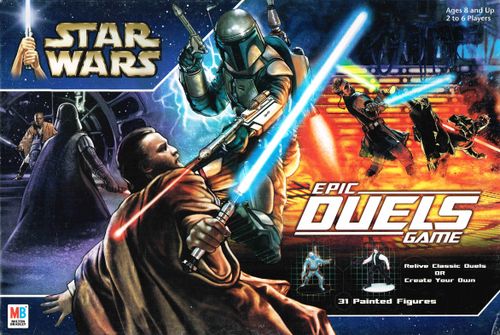
Star Wars: Epic Duels
Star Wars: Epic Duels Rulebook
Table of Contents
Table of Contents
Object
Each player controls one main character and 1 or 2 minor characters. The object of the game is to attack and eliminate your opponent's main character.
Contents
4 Battle Scenes (2 Gameboards double-sided) • 378 Cards • 28 Wound Markers • 31 Character Pawns • 12 Character Charts • 1 Die • Label Sheet
Assembly
- Tear the plastic bag into strips by pulling along the perforations. Then take the strips, and open each compartment. Remove the pawns and die from the compartments and discard the plastic waste.
- Take the box buildup from inside the box (it is lying upside down) and gently pop open the slots. Return it right-side up to the box and use it to hold the card decks.
- Carefully remove the gameboards, character charts, and wound markers from the cardboard parts sheets. Discard the cardboard waste.
- Remove the 6 Quick Guide cards from the card decks and set them within reach of all players. Then separate the remaining cards into 12 decks according to the picture(s) on the back.
- Apply the labels from the label sheet to the die.
The First Time You Play
If you are playing for the first time, we recommend beginning with a 2 player game. Select Obi-Wan Kenobi versus Count Dooku on the Geonosis Arena gameboard.
Choose Sides
Each player chooses a side. One will play to uphold good while the other plays to spread evil.
Each player then looks through the character charts and selects one main character. Main characters are shown on the top half of the character chart; minor characters are shown on the bottom half. If you decide to follow the good side, choose from: Yoda, Obi-Wan Kenobi, Mace Windu, Luke Skywalker, Anakin Skywalker, or Han Solo. If it is the dark side you seek, choose from: Darth Vader, Darth Maul, Boba Fett, Jango Fett, Emperor Palpatine, or Count Dooku. Take your selected character's chart, pawn, minor character pawn(s) and deck of cards. NOTE: Your main character card deck always includes cards for your minor character(s). (For example, if you selected Count Dooku, take the Count Dooku character chart, pawn, 2 Super Battle Droid pawns, and the deck of Count Dooku cards, which includes cards for your Super Battle Droids.)
IMPORTANT: Some minor characters have a number next to their picture on the character chart. This is because more than one of these characters can be in play at the same time. Choose the character pawn that has the same amount of notches on its base as the number indicated on the chart. This will help you keep track of your pawn during battle.
Shuffle the Cards
Each player shuffles his/her deck of cards and places it facedown within reach. This will be your draw pile. Leave room for a discard pile next to your draw pile.
Set Up the Board & Character Charts
- There are four battle scenes to choose from. Choose one and place that gameboard between the players.
- Each player places his/her main character on the space with its name.
- Now, in turn, roll the die. The player with the highest roll places his/her minor character(s), followed clockwise by the other player(s). The first player to place is also the first to play. Play passes to the left.
- Place your minor character(s) on any space adjacent (a space to the front, back, either side, or diagonal) to your main character. NOTE: Two characters cannot occupy the same space.
- Take a wound marker for each character (main and minor) you control and set them on the blue circle (on the character chart) for each character. These will be used to keep track of damage done to your characters.
- Draw the top four cards from your card deck. Look at them. You are now ready to begin.
2 Player Rules
What to Do on a Turn
Begin your turn by rolling the die and moving your character(s). You then get 2 actions (see Actions below). Once your actions are completed, your turn ends.
Moving
The die tells you whether one or all of your characters can move, and how far.
- You can move forward, backward and side-to-side. You cannot move diagonally.
- If you roll just a number, you move only one of YOUR characters. You choose which one.
- If you roll an "ALL" and a number, you may move one or more of YOUR characters, in any order you choose. Each character may move up to the number shown on the die.
- You do not need to move the full amount shown on the die and may choose not to move at all.
- You may choose to move some of your characters further than others. However, you cannot move any more than the number shown on the die.
- You cannot move onto or through fallen pillars, starships, water or mist.
- You cannot move through enemy characters. However, you can move through friendly characters (those on your team) provided you do not end a character's move on the same space as another character.
Moving Into Attack Position
In order to attack another character, your character must be in attack position. Characters may attack if they are on a space adjacent to an enemy character. This means they must be on an adjacent space in front of, in back of, to either side, or diagonal.
Some characters, those with an image of a blaster next to their picture on their character chart, may also attack from a distance. Characters that can attack from a distance may do so from any distance, provided you can draw a straight line forward, backward, sideways, or on the diagonal to the character you want to attack. This line cannot pass through any space with an obstacle (such as fallen pillars, or the starship) or another character on it. You can shoot over the water on the Kamino Platform and the blue mist in the Emperor's Throne Room.
Example (Emperor's Throne Room): Clone Trooper 1 can attack Count Dooku because an unobstructed straight line on the diagonal can be drawn between the two. Clone Trooper 1 can also attack Super Battle Droid 1 because it can shoot over the blue mist.
Example (Geonosis Arena): Clone Trooper 1 cannot attack any opponent because Super Battle Droid 1 is behind an obstacle, Super Battle Droid 2 is not in a straight line in front of Clone Trooper 1, and Count Dooku is not in a straight line on the diagonal.
Actions
There are 3 types of actions in the game: Drawing a Card is one action, Playing a Card is one action and Healing a Character is one action. On your turn you must choose 2 actions. For example, you may choose two of the same action, such as drawing 2 cards. Or you may choose to do any combination of two, such as draw a card and play a card. NOTE: You may look at a card you just drew before deciding what will be your second action.
Drawing a Card
Draw a card from your card deck. You cannot have more than 10 cards in your hand at one time. If you already have 10 cards in hand, you may still perform this action. First discard a card faceup to your discard pile and then draw a card.
If you go through your draw pile once, reshuffle your discards to form a new draw pile. If either player goes through his/her draw pile a second time, the game is over. The player whose main character has the least amount of damage wins. In rare cases, both players may have the same amount of damage. If this happens, the players tie and good and evil go on to fight again another day!
Playing a Card
There are 3 types of cards: Combat cards, Power Combat cards and Special cards.
Combat cards have an attack and defense value on them and are used to attack other characters and defend yourself against attacks. The picture indicates the character the card pertains to.
To attack with a Combat card, name the character that is attacking and the enemy character being attacked. (Be sure to specify which character is attacking, as more than one of your characters may be in attack position.) Then play a Combat card facedown in front of you. REMEMBER: You must be in attack position in order to attack.
Your opponent then has the option of defending. To defend, play a Combat or Power Combat card (see Power Combat cards below), matching the character being attacked, faceup in front of you. For example, if a Super Battle Droid is being attacked, the player can only defend with a Super Battle Droid Combat card. NOTE: The defending player does not have to defend (play a card), even if he/she has a defending Combat or Power Combat card in his/her hand.
The attacking player now turns over his/her card. If the attacker's attack value is higher than the defender's defense value, the defending character must take the difference in damage. Move the defending character's wound marker that many numbers toward the red circle on the damage track. If the defense value is equal to or higher than the attack value, the defending character has successfully blocked the attack and no damage is done. Both characters then discard their played cards, faceup, to their own discard piles.
Example: Count Dooku attacks Obi-Wan Kenobi by playing a Count Dooku Combat card facedown. Obi-Wan defends with an Obi-Wan Combat card faceup. Count Dooku's card is turned faceup to reveal an attack value of 5. Obi-Wan's defense value is unfortunately only a 3. Since 5 - 3 = 2, Obi-Wan must take 2 points of damage. The defending player moves Obi-Wan's wound marker 2 spaces closer to the red circle on Obi-Wan's damage track.
In another battle Count Dooku attacks Obi-Wan Kenobi by playing a Combat card facedown. Obi-Wan defends with an Obi-Wan Kenobi Combat card faceup. Count Dooku's card is turned faceup to reveal an attack value of 3. Obi-Wan's defense value is 4. Since Obi-Wan's defense value is greater than Count Dooku's attack value, Obi-Wan has blocked the attack. No damage is done.
Power Combat cards are played the same way Combat cards are, but they carry with them a few twists. Not all Power Combat cards have both an attack and a defense value but these cards do allow you to do additional things. Power Combat cards are played just like Combat cards. After damage is resolved the additional effects come into play. Effects from the attacker's card are resolved before the defender's.
Example card — Obi-Wan Kenobi, "Jedi Attack" (Power Combat, Attack 6): Play when Obi-Wan is attacking. After attacking, you may move Obi-Wan up to 6 spaces.
Special cards allow you to do special things. Some allow more movement, cause damage, the drawing of cards, or a peek at what your opponent's cards are. Some Special cards do not even count as an action, allowing you to play more than 2 cards in a turn! Special cards are played faceup and resolved immediately. After playing a Special card and resolving it, the card is discarded faceup to your discard pile. Special cards are played anytime on your turn after your die roll and character(s) movement (if any).
Example card — Obi-Wan Kenobi, "Jedi Mind Trick" (Special): Play anytime on your turn. Take any card from your discard pile and put that card in your hand.
Healing a Character
If all of your main character's minor character(s) have been destroyed and you have or draw any of their cards, you can use an action to discard these cards and heal damage on your main character. It takes 1 action to discard a defeated minor character's card and heal 1 point of damage. Place the card in your discard pile and move your main character's wound marker 1 space back toward the blue circle on the track. NOTE: If a character has been destroyed, you cannot heal him/her. This option can only be used for characters still in play.
When Characters Are Destroyed
A character is destroyed if it takes more damage than it has wound points available. In other words, when the wound marker is moved beyond the last number on that character's damage track, onto the red circle, the character is destroyed. Remove this character's pawn from the gameboard.
Winning
You win the game when you destroy your opponent's main character.
Game Variations
4 and 6 Player Team Game
The rules for this version are the same as the 2 Player game with the following exceptions:
- Divide the players into 2 teams of 2 or 3. When sitting down to play, alternate team members around the table.
- Each player controls his/her own main and minor characters.
- The game is over when all main characters on one team are destroyed, not just one.
- Players are not out of the game when their main character is destroyed (provided their partners' main characters are still in play). The player with the destroyed main character may continue to fight with minor characters.
- In addition to trading in defeated minor character cards to heal main characters, players may also trade in defeated main character cards to heal wounded minor characters.
- Players on the same team may discuss strategy but they may not look at each other's cards or tell each other which cards are in their hands.
- If a player rolls an "ALL," he/she may move one or more of his/her characters, not other team players' characters.
2-6 Player Free-For-All
The rules for this version are the same as the 2 Player game with the following exceptions:
- Players may choose any main character they want to fight with, light side or dark side. Note: It does not matter where players sit.
- As soon as a player's main character is destroyed, that player is eliminated. Remove that player's main and minor character from the gameboard.
- The game is over when one main character is left on the gameboard. The player controlling that character wins.
2-6 Player Free-For-All (Random Draw)
The only difference between this version from the standard Free-for-All game is that players place all 12 character charts facedown and pick the main character they will control randomly.
Master Play (2 or 4 Players)
The rules for this version are the same as the 2 Player game with the following exceptions:
- Each player controls 2 main characters and their corresponding minor characters. The characters can be chosen by the players or drawn at random. You can play light side versus dark side, or mix it up.
- Each player starts with 2 cards from each of the main character's card decks.
- You still only get two actions per turn, but if you choose to draw a card you must decide which card deck to draw from.
- You have only one hand of cards so your opponent can tell which deck you've drawn from by the card backs.
- If you roll an "ALL" you may move both of your groups of characters.
- If you are playing a 4 player game, play in teams of 2. When sitting down to play, alternate team members around the table. The game is over when both main characters of one player are destroyed. The opposite team wins immediately.
- For team play, players on the same team may discuss strategy but they may not look at each other's cards or tell each other which cards are in their hands.
Special Card Rules for Master Play
- Some cards say, "Pick a card at random from any player." In these cases, the player playing the card will be able to choose from either group because he/she will be seeing the backs of the cards.
- When playing the Emperor's "Future Foreseen" card, you may only look through the Emperor's draw pile.
Consumer Information
We will be happy to hear your questions or comments about this game. Write to:
Hasbro Games, Consumer Affairs Dept., P.O. Box 200, Pawtucket, RI 02862.
Tel: 888-836-7025 (toll free).
Canadian consumers please write to: Hasbro Canada, P.O. Box 267, Station A, Longueuil, Quebec J4H 3X6.
©2002 Lucasfilm Ltd. & ® or TM where indicated. All Rights Reserved. The HASBRO, MILTON BRADLEY and MB names and logos and these rules are ® & ©2002 Hasbro, Pawtucket, RI 02862. All Rights Reserved.