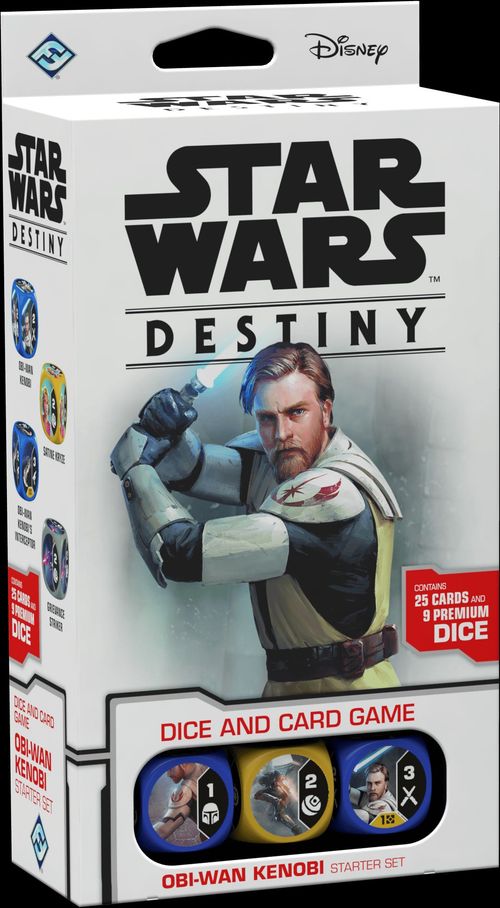
Star Wars: Destiny – Obi-Wan Kenobi Starter Set
Star Wars: Destiny – Obi-Wan Kenobi Starter Set Rulebook
Table of Contents
Table of Contents
Important Notes
Ready and Turned Cards
Important: Cards can be either ready (the standard position) or turned (activated). When you play a card, place it in the ready position. When an ability or rule requires you to turn a card, turn it 90 degrees clockwise. A turned card cannot be turned again.
Card Colors
Important: Each card has a color matching one of four aspects:
- Blue: Force
- Red: troops
- Yellow: adventurers and mercenaries
- Grey: everything else
To use some cards, you must have at least one card of a certain color or subtype in play. For example, to use the ability of the card «Направить Силу» (Direct the Force), you must have a Leader in play.
Example card: a blue card.
Resources and Cost
Important: To play a card, you must spend a number of resources equal to that card's cost. The cost is shown in the top left corner of the card. You receive 2 resources during each regroup phase, and you can also gain additional resources if a die shows a resource face.
Setup
Each player has their own deck. This starter set contains a deck for one player. Your opponent needs their own starter set so that you can play. Both players set up as follows.
- Find the character cards in your deck and lay them out in front of you together with the matching dice. This set has two character cards: Obi-Wan Kenobi with two dice and Satine Kryze with one die. In the General Grievous starter set, your opponent finds the Grievous cards and the Droid Commando cards with their matching dice. Set the remaining dice aside.
- Set aside your battlefield card (in this starter set, Death Watch Hideout) and your reference card, face up. Shuffle the remaining 20 cards of your deck. Draw 5 cards into your hand. If you do not like your cards, you may return any number of them to the deck, shuffle it again, and draw back up to 5 cards.
- Stack the identical tokens (damage, shields and resources) in three separate piles. Then take 2 resources and place them in front of you.
- Roll your character dice and add up the results shown (the white numbers). The player with the higher total chooses which battlefield the battle will take place on. If the totals are tied, roll the dice again. The player whose battlefield the battle will take place on takes control of that battlefield and places it next to their deck. Their opponent sets their own battlefield card aside, and their characters receive 2 shields (the opponent decides how to distribute these shields among their characters). After the roll, place the dice on the corresponding cards.
Example: the player using Obi-Wan Kenobi and Satine Kryze rolled 4 on the dice, and their opponent rolled 3. The first player chooses which battlefield the battle will take place on.
Turn Structure
Players take turns, starting with the player who controls the battlefield. On your turn you may take one action.
The available actions are listed below (each is described in detail later):
- play a card from hand;
- activate a character or support card;
- apply the result of your dice;
- discard a card to reroll your dice;
- use a card's action;
- capture the battlefield.
Passing
Important: If you do not want to take an action, you may pass. You do nothing, but you keep the option to take an action after your opponent's turn. If both players pass in a row, the regroup phase begins, during which both players prepare for the next round of the game.
Regroup Phase
During the regroup phase both players perform the following steps:
- Return all turned cards to the ready position. Return all dice still remaining in the pool to their corresponding cards.
- Gain 2 resources.
- Discard any number of cards from your hand and draw up to 5 cards.
Then the players take turns again, starting with the player who controls the battlefield. Keep taking turns and going through the regroup phase until one of the players wins!
Victory Conditions
You win if:
- all of your opponent's characters have been defeated;
- at the end of a round (after the regroup phase), your opponent has no cards left in hand or in their deck. If both players have run out of cards, the player who controls the battlefield wins.
Actions
Play a Card from Hand
There are four types of card you can play: events, upgrades, downgrades and support. The card type is shown above the card's ability text. To play a card, spend resources equal to its cost.
-
Play an event: follow the text of the card, then discard it face up to your discard pile (next to your deck).
-
Play an upgrade: attach the upgrade to one of your characters by placing the upgrade card under the character card. Upgrade cards are not discarded and can be used repeatedly. Most upgrades come with a die. Place the die of a played upgrade, taken from the dice you set aside, on the character to which the upgrade is attached.
A character can have no more than three upgrades. Once per round, when you play an upgrade, you may replace one of the upgrades already attached to a character with it. When you replace an upgrade, you pay the difference in cost between the two upgrades. Discard the replaced upgrade.
-
Play a downgrade: attach the downgrade to one of your opponent's characters by placing the downgrade card above the character card. Downgrade cards are not discarded and can be used repeatedly. A character can have no more than three downgrades.
-
Play a support card: place the support card next to your characters (do not attach it to them). Support cards are not discarded and can be used repeatedly. Some support cards also come with a die. Place the corresponding die on the support card.
Activate a Character or Support Card
You may activate only a ready character or support card. To do so, turn the card sideways and roll all dice that belong to it. Place the dice in front of your character cards. This is your dice pool. You may apply the results of the rolled dice during one of your later turns (see below).
- When you activate a character, roll all of that character's dice and the dice of the upgrades attached to it.
- When you activate a support card, roll only that card's die.
Apply the Results of Your Dice
With one action you may, in turn, apply the results of any number of dice in your pool that show the same symbol face up. After applying a die's result, return the die to its corresponding card.
Example: your dice show melee damage and ranged damage. On your next action you may apply the results of any number of dice showing either melee damage or ranged damage, but not both types at once. Each symbol type costs its own action.
The effects of each symbol are described below. As a rule, the white number on the face above the symbol gives the strength of that particular effect. For example, "2 melee damage" means you may deal 2 damage to a character, and "2 shield" means that character gains 2 shields.
Dice Symbols
- Melee damage: deal damage to any character.
- Ranged damage: deal damage to any character.
- Indirect damage: deal damage to the opponent's characters. The opponent decides how to distribute this damage among their characters.
- Shield: a character of your choice gains shields (place shield tokens on its card). A character cannot have more than 3 shields.
- Resource: gain resources.
- Sabotage: your opponent loses resources.
- Discard: discard random cards from your opponent's hand.
- Focus: turn other dice in your pool to the faces of your choice.
- Ability: activate the ability marked on the corresponding card with the ability symbol. Faces with an ability have a value of 0.
- Blank face: nothing happens. Blank faces have a value of 0.
Modifiers and Cost
On the blue faces of some dice, the value is preceded by a plus sign (+). You may apply such a result only together with the result of another die that shows the same symbol without a plus. In that case, the value of the plus face is added to the value of the other die's face.
Example: you rolled +2 ranged damage and 1 ranged damage. You may apply both results together to deal 3 ranged damage to any character. If you had not rolled the 1 ranged damage, you could not apply the +2 ranged damage result.
Some faces show a resource symbol on a yellow background. To apply the result of such a die, you must spend the number of resources shown.
Example: you rolled 2 melee damage, but this face also shows a cost of 1 resource. To deal 2 damage, you must spend 1 resource.
Discard a Card to Reroll Your Dice
Discard any one card from your hand to reroll one or more dice from your pool. Before rolling, you must choose all the dice you want to reroll.
Use a Card's Action
The abilities of some support cards, upgrades and characters are marked with the word "Action". To perform the stated action, follow the text of the card.
Power Action
Some cards have a special type of action, a power action. Each card's power action can be used only once per game round.
Capture the Battlefield
Only one player may capture the battlefield in each round. When you capture a battlefield, you may immediately use its "Capture" ability. If you did not previously control this battlefield, take it under your control and place it next to your deck. Until the end of the round you automatically pass. Your opponent continues to take actions until they pass, but they cannot capture the battlefield in this round.
Example, the Capture ability printed on the Death Watch Hideout battlefield card: "Capture: gain 1 resource. If you have Satine Kryze in play, put a card from your discard pile on the bottom of your deck."
Damage, Shields and Defeated Characters
Only one character takes ranged damage or melee damage from one die or from a die with modifiers. Indirect damage from a die or a card can be distributed among several characters. To track damage, use damage tokens (with values 1 and 3). If a character has shields, 1 shield blocks 1 damage, and the shield token is discarded.
A character is defeated if it has taken damage equal to its health value. Remove the character card, and all of its corresponding dice (the character's dice and those of its attached upgrades), from the game. Discard the upgrade cards attached to it. A defeated character can no longer be activated, chosen as a target, or used to play cards.
Game Terms
After reading this section you will be able to play your first game! Additional terms and frequently asked questions can be found in the reference on our website.
- After... Use these abilities after the event stated in the text has happened.
- Before... Use these abilities immediately before the event stated in the text happens.
- Cannot be blocked. When damage "cannot be blocked", it is not blocked by shields (do not remove shields).
- Unique. Unique cards are marked with an asterisk (*) next to their names. You may not have more than one copy of a unique card in play.
- Remove. When you remove a die, return it to its corresponding card without applying its result. You may remove dice only from your pool.
Keywords
Keywords are the names of abilities that appear on cards. When using such cards, follow these rules:
- Guardian. After you activate a character with the Guardian keyword, you may deal it damage equal to the value of a die in your opponent's pool that shows a damage face (melee, ranged or indirect) up. Then remove that die.
- Redistribute. Found only on upgrade cards. When the character to which this upgrade is attached is defeated, before that happens, you may move this upgrade to any other one of your characters. If its die was in your pool, return it to the corresponding card.
- Ambush. After you play a card with the Ambush keyword, you may gain 1 action.
Subtypes
Some cards show a subtype (for example, "Weapon" or "Vehicle"). Subtypes carry no rules of their own, but other cards may refer to them.
Building Your Deck
You can choose your favorite characters, upgrades, events, support cards and battlefields, and then test your deck against any opponent! To build a deck you need a team of characters, 30 game cards, 1 battlefield, and all the dice that match the cards you chose. Extra cards and dice are sold separately.
Assemble Your Team
The lower left corner of each character card shows its points and its affiliation: hero or villain. You may recruit characters up to a total of 30 points. You may not have both heroes and villains on the same team. Neutral characters may be added to any team.
Characters in your team may be of one color or of several colors.
You may include only one copy of each unique (*) character, and as many regular characters as you like. Regular characters always have one die. Unique characters have two point values. You may choose the lower value and use only one of the character's dice, or choose the higher value and use both of its dice.
When assembling your team you may also add exactly one plot card. Each plot card has a point cost, which must fit within the overall 30-point limit, as with characters. Plot cards are not shuffled into the deck; they are placed next to your characters at the start of the game. If a plot card has an affiliation or a color, you may choose it only if your team contains a character with the matching affiliation or color.
Build Your Deck
The starter set contains 20 cards, but a standard deck contains exactly 30 cards. You may build a deck from any cards, subject to the following restrictions:
- A deck may not contain more than two copies of the same card.
- Each card is marked as hero, villain or neutral. If you chose hero characters, your deck must not contain cards marked "villain", and vice versa. Neutral cards may be in any deck.
- You may put blue, red and yellow cards in your deck only if your team contains characters of those colors. Grey cards may be in any deck.
- Your deck may contain event, upgrade, downgrade and support cards. Characters, plots and battlefields are not placed in the deck: they are not counted when you count the cards in your deck.
Choose a Battlefield
Besides the characters and the cards in your deck, you must choose 1 battlefield card. Each player has their own battlefield, but only one of them will be used during the game.