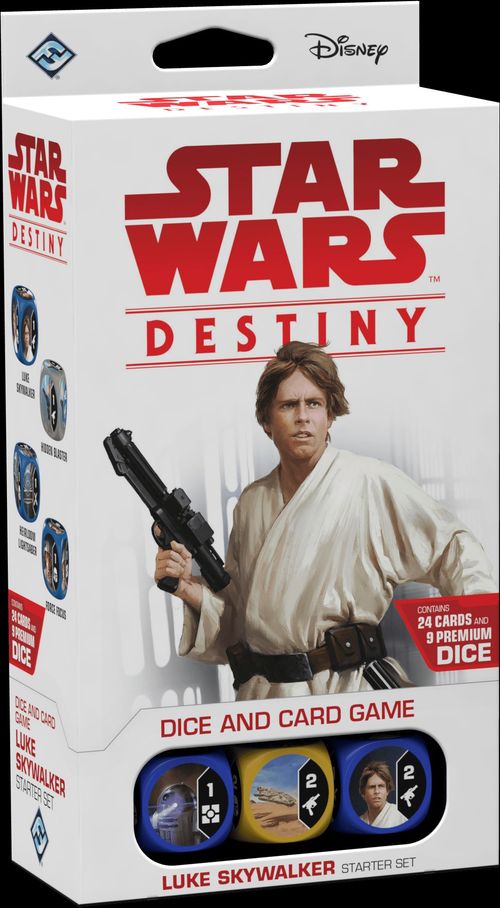
Star Wars: Destiny – Luke Skywalker Starter Set
Star Wars: Destiny – Luke Skywalker Starter Set Rulebook
Table of Contents
Table of Contents
Setup
Each player needs their own deck. This starter set contains one deck, which should be played against a deck from another starter set. Both players prepare the game as follows:
- Find your character cards and place them in front of you together with their matching dice. This starter set gives you two characters: Luke Skywalker and Han Solo, with their 2 Luke Skywalker dice and 1 Han Solo die. If your opponent uses the starter set with Boba Fett, they have Boba Fett with 2 dice and a Stormtrooper Veteran with 1 die. Each player sets aside all of their remaining dice.
- Place your battlefield card and your reference card in front of you, face up. The heroes' battlefield is Outpost on the Outer Rim, and the villains' battlefield is Barren Wastes. Shuffle the remaining 20 cards to form your deck. Draw 5 cards from it to form your hand. If you are not satisfied with the cards you drew, you may shuffle any number of them back into your deck, shuffle again, and draw the same number of cards (up to 5).
- Place the tokens (damage, shields and resources) in separate piles beside the play area. Then each player takes 2 resource tokens and places them near their cards.
- Each player rolls their character dice and adds up the values shown on them (the white numbers). If the totals are tied, roll again. The player with the higher total chooses which battlefield will be used for the duel. The player whose battlefield is used keeps control of that battlefield and places it beside their deck. The other player sets aside their battlefield card and assigns 2 shields to their characters (they decide how to split them: 2 shields on one character, or 1 shield on each of two characters). After the roll, place each die on the card it belongs to.
Example: in the situation above, the player controlling Luke Skywalker and Han Solo rolled a higher total (3 to 2). That player chooses which battlefield will be used during the game.
Playing the Game
During the game, the players take turns alternately. The player who controls the battlefield takes the first turn. On their turn, a player may take one action. Almost everything that can be done in the game is an action, from playing cards to rolling dice. The actions are:
- Play a card from hand.
- Activate a character or support.
- Resolve a die.
- Discard a card to reroll dice.
- Use an action from a card.
- Claim the battlefield.
Detailed descriptions of each action follow below.
If a player does not want to take an action, they may pass. When both players pass in succession, the upkeep phase begins to prepare for the next round.
Upkeep Phase
During the upkeep phase, both players do the following:
- Ready their exhausted cards. Return all dice from their dice pool (the dice they rolled but did not use) to the cards they belong to.
- Each gain 2 resource tokens.
- Discard any number of cards from their hand. Then draw from their deck until they have 5 cards in hand.
Afterwards, the players again take turns alternately, starting with the player who controls the battlefield. Continue taking turns and carrying out upkeep phases until one of the players wins!
Victory
There are two ways to win in Star Wars: Destiny:
- A player defeats all of the opponent's characters.
- At the end of a round (after the upkeep phase), a player has no cards left in their hand or their deck. That player loses, and their opponent is the winner. If both players would achieve victory in this way at the same time, the player who controls the battlefield wins.
Important Notes
Resources and Cost
Important: To play a card, the player must spend a number of resource tokens equal to that card's cost. The cost is shown in the top left corner of the card. During each upkeep phase a player gains 2 resource tokens, and additional resources can be gained when dice show resource symbols.
Colours and Designation
Important: Each card is assigned to one of four colours:
- Blue: the colour blue represents the Force.
- Red: the colour red represents Command.
- Yellow: the colour yellow represents Scoundrels.
- Grey: the colour grey represents everything else.
To use some cards, a player must designate a character of a specific colour. This means that the player must have at least one character of that colour in play.
Ready and Exhausted
Important: Cards may be ready (upright) or exhausted (turned sideways). When a card is played, it is placed in play ready. When any ability or rule requires a card to be exhausted, turn it sideways. An exhausted card cannot be exhausted again.
Actions
Play a Card from Hand
The game has three types of cards that players can play: events, upgrades and supports. The card type is shown above its ability text. To play a card, the player must spend resource tokens equal to the card's cost.
- Playing an event: follow the instructions on the card, then discard it to its player's discard pile. The discard pile is the face-up pile beside the deck on which a player places their discarded cards.
- Playing an upgrade: the player attaches the card to one of their characters by placing it beneath that character. Upgrades have reusable effects and remain in play. Most upgrades come with a die, and the card itself, like character cards, shows a summary of all six faces of the die linked to it. When a player plays an upgrade that comes with a die, they take the matching die from the dice they have set aside and place it on the character to which the upgrade is attached. A character cannot have more than three upgrades. When playing an upgrade, a player may choose to replace another upgrade already attached to that character. In that case they pay only the difference in cost between the two upgrade cards (the new upgrade is free if its cost is equal to or lower than the cost of the old upgrade). The replaced upgrade must be discarded.
- Playing a support: the player places the card in front of them on the table, beside their characters, but does not attach it to any character. Supports have reusable effects and remain in play. Some support cards come with a die. When such a card is played, the player takes the matching die from the dice they have set aside and places it on that support.
Activate a Character or Support
Activating a character or support means rolling its dice. A character or support must be ready in order to be activated. The activated card is exhausted, and all of its dice are rolled. After the roll, the player places the dice in front of their characters. These dice are now in the player's dice pool and can be used in later turns (see "Resolve Dice" below).
When activated, characters always roll their own dice together with the dice of their upgrades. When activated, supports roll only their own dice.
Resolve Dice
Resolving dice means using dice from your dice pool. A player may resolve any number of dice from their pool that show the same symbol. Those dice are resolved one at a time. After a die is resolved, it returns to the card it came from.
Example: the player rolled melee damage (k) and ranged damage (j). In their next action, they may resolve any number of dice showing melee damage, or any number of dice showing ranged damage, but not both. Each different symbol requires a separate action.
Each die symbol has its own effect, described below. On most dice faces, the value (a white number) above the symbol shows its strength. For example, 2 k means the player may deal 2 damage to a character, and 2 e means the player may place 2 shield tokens on a character.
Dice Symbols
- k Melee damage: deal the indicated amount of damage to any character.
- j Ranged damage: deal the indicated amount of damage to any character.
- y Indirect damage: force any opponent to deal the indicated amount of damage to their own characters. The opponent divides it as they choose; it may be split between several characters.
- e Shield: give any character the indicated number of shields (place shield tokens on that character). A character cannot have more than 3 shields.
- q Resources: gain the indicated number of resource tokens.
- f Disrupt: the opponent loses the indicated number of resource tokens.
- o Discard: discard the indicated number of random cards from the opponent's hand.
- t Focus: turn the indicated number of dice in your dice pool so that they show faces of your choice.
- S Special: activate the special ability marked on the card of that die with the symbol. The Special symbol has a value of 0.
- - Blank face: no effect. Blank faces have a value of 0.
Modifiers and Resource Cost
Some dice have one or two blue faces on which the value is preceded by a plus sign (+). A face with a plus can only be resolved at the same time as another die from the player's pool that shows the same symbol without the plus. When resolving them, the value after the plus is added to the other die to form a new value.
Example: the player rolled +2 j and also rolled 1 j. They may resolve +2 j together with 1 j to deal 3 ranged damage to one character. If the player had not rolled 1 j, they could not resolve +2 j.
Some dice have a resource symbol (q) on a yellow frame. To resolve such a face, the player must first pay the indicated number of resource tokens.
Example: the player rolled a face showing 4 y, with 1 q at the bottom. To deal 4 damage, the player must pay 1 resource token.
Damage, Shields and Defeated Characters
Ranged damage (j) and melee damage (k) from one die, or from one die resolved with a modifier, must be dealt to a single character. Indirect damage (y) from one die or card may be divided among several characters.
When a character is dealt damage, mark it with damage tokens (the damage tokens in the game have values of "1" and "3"). If a character has any shields, each shield token on that character blocks 1 damage. After a shield blocks damage, remove its token from the character.
A character is defeated when the damage tokens on it equal its endurance. Set that character's card and dice aside (this applies both to the character's die and to the dice of its upgrades), and discard all upgrades attached to it. A defeated character can no longer be activated, chosen as the target of effects, or designated for playing cards.
Discard a Card to Reroll Dice
The player discards a chosen card from their hand to reroll one or more dice from their dice pool. The player must choose all the dice to be rerolled before they start rolling.
Use an Action from a Card
Some support, upgrade and character cards list actions. These actions are preceded by the bold word "Action:". To use such an action, follow the instructions on the card.
Power Actions
Some cards have a special kind of action called a "Power action". Each power action is an action that can be used only once per round of the game. (Players may use extra tokens to mark that a power action has been used.) However, each power action on a different card may be used once.
Example: the player uses their action to use the Power action of Luke Skywalker. They cannot use that action again this round, but on their next turn they may still use the Power action of another card.
Claim the Battlefield
Only one player may claim the battlefield in each round. When a player claims the battlefield, they may immediately resolve its "Claim:" ability. If the player did not control that battlefield card, they take control of it by moving it so that it lies beside their deck.
For the rest of the current round, the player who claimed the battlefield automatically passes on all of their later turns. Their opponent continues to take actions until they pass, but can no longer claim the battlefield in this round.
Passing
Important: If a player does not want to take a turn, they may pass. The player does nothing but keeps the option of taking a new turn after their opponent. After both players have passed in succession, the upkeep phase begins.
Game Terms
Several important terms appear on cards.
- After...: abilities that are used after something has finished. Such abilities are used after the thing they refer to ends.
- Before...: abilities that are used immediately before something begins. Such abilities are used immediately before the thing they refer to starts.
- Unblockable: if damage is "unblockable", it cannot be blocked by shields (so it does not remove any shield tokens).
- Unique: unique cards have an asterisk (*) before their name. A player may not have more than one copy of a unique card in play at a time.
- Remove: when a die is removed, return it, without resolving it, to the character or support card from which it came. Only dice in the player's own dice pool may be removed.
- Reveal: when a card is revealed, show it to all players, then return it to its place.
After reading this part, players are ready to play their first game! More terms, and answers to the most frequently asked questions, can be found in the Rules Compendium available on the Galakta website.
Keywords
Keywords are shorthand for abilities found on many cards. When using such cards, the following rules apply:
- Guardian (Strażnik): before one of your characters with the Guardian keyword is activated, you may deal it damage equal to the value shown on one die with a damage symbol (k, j or y) in your opponent's dice pool. Then remove that damage die.
- Reassign (Przepisanie): this keyword appears only on upgrade cards. After the character to which this card is attached is defeated, you may move that upgrade to any of your characters. The upgrade's die moves to the new character card, even if it was in the dice pool.
- Ambush (Zasadzka): after you play a card with the Ambush keyword, you may take one additional action.
Subtypes
Some cards list subtypes above their ability text, such as "Bounty Hunter" or "Weapon". Subtypes have no rules of their own, but other cards may refer to them.
Building Your Deck
Although the starter sets provide excellent fun, the game becomes even more exciting when players customise their own decks with other cards and dice (sold separately). Deck customisation lets players choose their favourite characters, upgrades, events, supports and battlefields. They can then test their combination of cards and dice against their opponent!
When building a deck, each player needs a team, which consists of: characters, a deck of 30 cards, 1 battlefield and all the dice linked to the cards they have chosen.
Assemble Your Team
To prepare a team of characters, a player has a maximum of 30 points. A character's point value is printed in the bottom left corner of its card. To the right of it is a field reading "Hero" or "Villain". A player may not have both heroes and villains in one team. Neutral characters may be combined with any faction.
A player may have characters of one colour, or characters of different colours. A player may choose only one copy of a unique (*) character. For non-unique characters, the player may choose any number. Non-unique characters always use only one die. Unique characters have two point values, separated by a slash (/). The player may choose the lower value, to use only one die of that character, or the higher value, to use two dice of that character.
When building their team, a player may optionally choose one story card (but no more than one). Each story card has a point value, which counts toward the 30-point limit, like characters. A story card is not shuffled into the player's deck; at the start of the game it is placed beside the player's characters. This starter set contains no story cards, but they can be found in other products in the series, such as expansion sets. Story cards marked with a faction or colour may be chosen if the player's team contains characters from that faction or of that colour.
Build Your Deck
The starter deck in this set has 20 cards, but a standard deck has exactly 30 cards. A player may choose any cards for their deck, observing the following restrictions:
- A player may not have more than two copies of the same card in their deck.
- Each card belongs to "Heroes", to "Villains", or is "Neutral". If the player has chosen heroes for their characters, they may not have any villain cards in their deck, and vice versa. Neutral cards may be used in any deck.
- A player may include cards in blue, red and yellow only if their team contains a character of the same colour. Grey cards may always be used.
- A player's deck may contain event, upgrade and support cards. Character cards, battlefield cards and story cards cannot be placed in the deck, and they do not count toward the 30-card limit.
Choose a Battlefield
In addition to characters and a deck, the player must choose 1 battlefield card. Each player prepares one battlefield, and during play the battlefield of one of the players is used.