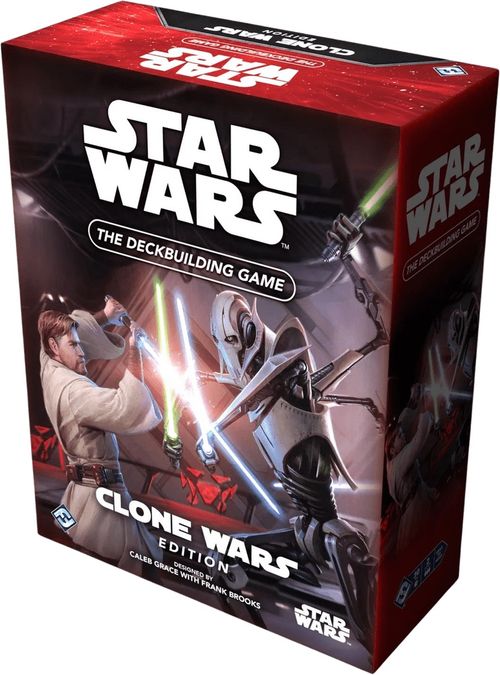
Star Wars: The Deckbuilding Game – Clone Wars Edition
Star Wars: The Deckbuilding Game – Clone Wars Edition Rulebook
Table of Contents
Table of Contents
Game Overview
"Begun the Clone War has." – Yoda
STAR WARS™: THE DECKBUILDING GAME – CLONE WARS EDITION is a competitive game for two players that brings the galaxy-spanning war between the Galactic Republic and the Separatist Alliance to your tabletop. You and your opponent each choose a side, playing as either the Republic or the Separatists. As the game progresses, you must strengthen the power of your starting deck by using resources to purchase cards that provide more firepower and increased resources so that you can successfully attack and defeat your opponent's base. The first player to destroy three of their opponent's bases wins the game!
Clone Wars Edition
The CLONE WARS EDITION can be played on its own or combined with any other STAR WARS: THE DECKBUILDING GAME product. The rules for this edition are mostly the same as the original, although the rules for Exile have been updated (see "Exile"). The rules for combining this product with the original edition are explained in the "Cross-Edition Play" section.
LEARN TO PLAY ONLINE! Find a tutorial video at FantasyFlightGames.com/star-wars-the-deckbuilding-game
This tutorial video is for the original edition. As stated above, outside of the small change to Exile, the rules are nearly identical. This video will still teach you how to play the game, but will make references to the Rebels and Imperials instead of the Republic and Separatists.
Components
- 10 Republic Starter Cards
- 10 Separatist Starter Cards
- 90 Galaxy Cards
- 10 Outer Rim Pilot Cards
- 20 Base Cards (10 Republic, 10 Separatist)
- 2 Reference Cards
- 1 Balance of the Force Track
- 50 Damage Counters (Purple)
- 1 Force Marker (White)
- 20 Resource Counters (Yellow)
Setup
To set up the game, you and your opponent perform the following steps. (When you are instructed to perform a step with your bases or your starter deck, your opponent does the same with theirs.)
-
Choose your faction: Republic or Separatist.
-
Find the five Republic base cards and the five Separatist base cards listed below. These are the Republic base deck and the Separatist base deck. (Leave the remaining bases in the box, these are only used with the advanced game rules found in the "Advanced Game" section.)
REPUBLIC BASE DECK
- Rishi (starting base)
- Anaxes
- Coruscant
- Kamino
- Ryloth
SEPARATIST BASE DECK
- Xorrn (starting base)
- Dac
- Felucia
- Geonosis
- Mygeeto
-
Place your starting base faceup in front of you, and place your remaining base cards facedown underneath it (the order does not matter).
-
Separate the 10 Republic starter cards and 10 Separatist starter cards (listed below) from the other cards. Take the cards that match your chosen faction and shuffle them together. This is your player deck. Place your player deck facedown near your base deck.
REPUBLIC STARTER CARDS
- Republic Shuttle x 7
- Clone Trooper x 2
- Jedi Knight x 1
SEPARATIST STARTER CARDS
- Separatist Shuttle x 7
- B1 Battle Droid x 2
- Dark Side Agent x 1
-
Shuffle the 90 galaxy cards together to form the galaxy deck. Deal the top six cards in a line to create the galaxy row. Orient Republic cards to face the Republic player and Separatist cards to face the Separatist player. Turn neutral cards sideways so both players can read them. Place the galaxy deck facedown at one end of the galaxy row.
-
Place the 10 Outer Rim Pilot cards in a stack faceup at the opposite end of the galaxy row. This is the Outer Rim Pilot deck.
-
Place the damage counters and the resource counters near the galaxy deck where both players can reach them.
-
Unfold the Balance of the Force track to the side with the Separatist and Republic icons. (The other side is used for "Cross-Edition Play", explained in that section.) Place it next to the Outer Rim Pilot stack with the Republic symbol facing the Republic player. Place the Force marker on the space all the way to the Republic side of the Balance of the Force track.
-
Draw the top five cards of your deck. You are ready to begin the game!
Sample Game After Setup
The play area contains the following zones: the Republic play area (Republic player deck, Republic player discard, Republic player exile pile, Republic base, Republic victory pile), the Separatist play area (Separatist player deck, Separatist player discard, Separatist player exile pile, Separatist base, Separatist victory pile), and the shared central area (damage supply, resource supply, galaxy deck, galaxy discard, galaxy row, Outer Rim Pilot deck, and the Balance of the Force track).
Core Concepts
The following section introduces the core concepts you need to know to play STAR WARS: THE DECKBUILDING GAME – CLONE WARS EDITION.
Deckbuilding 101
"A great leap forward often requires first taking two steps back." – Obi-Wan Kenobi
In this game, you and your opponent each begin with your own deck of 10 cards. These starter decks are not very powerful; they mostly provide resources. Early in the game, use these resources to purchase new cards and add them to your deck. This improves your deck, so that you can generate more resources and launch bigger attacks on future turns.
Pay attention to the abilities on the cards you are purchasing, so that the cards you add to your deck work well together. And keep a watchful eye on the cards your opponent purchases, as this will help you understand their strategy, so you can put together a plan to counter it.
The Balance of the Force
"Feel. Don't think. Use your instincts." – Qui-Gon Jinn
The balance of the Force can tip the scales between the Republic and the Separatists. During the game, various effects may cause the balance of the Force to shift between the two factions. The Balance of the Force track is used to track this shifting.
Some card abilities use the phrase: "If the Force is with you." These abilities can be used only when the Force marker is on one of the three spaces on your side of the Balance of the Force track.
- If the Force marker is on one of the three light side spaces, then the Force is with the Republic player.
- If the Force marker is on one of the three dark side spaces, then the Force is with the Separatist player.
- While the Force marker is on the neutral space in the middle, the Force is not with either player.
When you gain Force, move the Force marker toward you on the Balance of the Force track by the indicated amount. If the Force is all the way to your side at the start of your turn, you gain one additional resource that you can use that turn.
The Force is currently with the Republic player because it is on one of the three light side spaces.
Card Anatomy
STAR WARS: THE DECKBUILDING GAME – CLONE WARS EDITION has three card types: units, bases, and capital ships. This section details the symbols and information shown on each card.
COST — The number of resources that must be spent to purchase this card from the galaxy row
ATTACK — The amount of damage this card deals
RESOURCES — The number of resources this card generates
FORCE — The amount of Force this card generates
TITLE — The name of this card
TARGET VALUE — The total attack required to defeat this card
REWARD — The benefit for defeating this card
UNIQUE SYMBOL — Indicates this card is unique and may be referenced by other cards
FACTION SYMBOL — Indicates what faction this card belongs to
TRAITS — Flavorful attributes that may be referenced by other cards
ABILITY — This card's specialized means of interacting with the game
CARD TYPE — Determines how this card functions in the game
HIT POINTS — The amount of damage required to destroy this card while it is in a faction's play area
Faction Affiliation
"Today, we fight for more than the Republic. Today, we fight for all our brothers back home." – Captain Rex
STAR WARS: THE DECKBUILDING GAME – CLONE WARS EDITION is a battle between two factions: Republic and Separatist. Both factions have their own specific characters, vehicles, ships, and bases, giving each side its own Star Wars theme and play style! Additionally, there are neutral cards that represent ships, vehicles, and characters who are willing to align with either side…for a price.
Each card in the galaxy deck is designated as Republic, Separatist, or neutral. Only the Republic player can purchase Republic cards, and only the Separatist player can purchase Separatist cards. Both players can purchase neutral cards. A card that belongs to your opponent's faction is an enemy card.
These are the game's two faction symbols (the Republic Symbol and the Separatist Symbol). A card without either faction symbol is a neutral card.
Playing the Game
"Now this is podracing!" – Anakin Skywalker
The game is played over a series of turns. The Separatist player takes the first turn, followed by the Republic player, and turns alternate between the two sides until one player wins by destroying three of their opponent's bases.
Beginning of Turn
The following process occurs at the beginning of every turn.
First, if you do not have a base (because your opponent destroyed your base during their last turn), look at your remaining base cards and choose one to reveal as your new base.
Next, if the Force is all the way to your side, gain one resource by taking a resource counter from the supply and placing it in your play area.
Finally, gain the resources from each capital ship you have in play. (Early in the game, you will not have any capital ships in play, and will therefore skip this step.)
- To gain resources for a card, take resource counters from the supply equal to the card's resource value.
- Resources you gain on your turn are called your 'resource pool.'
Taking Your Turn
On your turn, you can do any or all of the following in the order of your choice, as many times as you would like:
- Play a card.
- Purchase a card.
- Use a card ability.
- Commit to an attack.
- Resolve an attack.
- End your turn.
Each of these is explained in detail in the following sections.
Play a Card
To play a card, take it out of your hand and place it faceup into your play area. The card is now considered 'in play.'
After you play a card, immediately collect resources equal to the resource value of the card.
Then, move the Force marker a number of spaces equal to the Force value of the card, toward your side on the Balance of the Force track.
The Separatist player plays Asajj Ventress, a unit with two Force. They gain two Force, and move the Force marker two spaces toward the Separatist side to indicate this.
Once a card is in play, you can use its ability and/or commit it to an attack (see "Commit to an Attack").
Unit cards remain in play until the end of your turn (see "End Your Turn"). Each of your capital ship cards remains in play until it has damage on it equal to or greater than its hit points (see "Resolve an Attack").
Purchase a Card
Cards in the galaxy row and in the Outer Rim Pilot deck are available for purchase.
- The Republic player can purchase Republic cards and neutral cards, but cannot purchase Separatist cards.
- The Separatist player can purchase Separatist cards and neutral cards, but cannot purchase Republic cards.
To purchase a card, spend resources equal to the card's cost. This is done by removing that number of resources from your resource pool and returning them to the supply. Then, remove the card from the galaxy row (or the Outer Rim Pilot deck) and place it faceup on top of your discard pile. The next time you shuffle your discard pile into your deck, that card will be a part of your deck, and you will be able to use it when you draw it on future turns.
- When a card is removed from the galaxy row, immediately replace it by revealing the top card of the galaxy deck and placing it faceup in the galaxy row.
Use a Card Ability
"You don't have to carry a sword to be powerful. Some leaders' strength is inspiring greatness in others." – Ahsoka Tano
To use a card ability on a card in play, indicate to your opponent which card's ability you would like to use, and then resolve the effects of the ability.
- Resolving the abilities on your cards is optional.
- While resolving an ability, perform as much of the effect as you are able, and ignore anything that cannot be performed.
- You can use the ability of each card that you have in play once during each turn.
- Card abilities can be used during the same turn the card was played.
- After using a card's ability, tilt the card slightly as a reminder that you have used its ability, and therefore cannot use it again this turn.
When a card's ability is used, tilt the card slightly as a reminder that you have used it.
Commit to an Attack
"Now you fall, as all Jedi must." – Asajj Ventress
You can use your units and capital ships to attack your opponent's base (which may be protected by capital ships they have in play). Additionally, you can use your units to attack enemy cards in the galaxy row through either sabotage for the Republic or bounty hunting for the Separatists (see "Bounty Hunting and Sabotage").
To commit your cards to an attack against the enemy base, group them together in your play area to indicate that they are doing so (some players may even want to place them directly in front of the base). To commit units to a bounty hunting or sabotage attack, place them in front of the target card in the galaxy row.
The Venator-Class Destroyer is attacking the Separatist player's base. The ARC Trooper is sabotaging the STAP in the galaxy row.
Each card you have in play can commit to one attack each turn. When moving a card to its committed attack position, maintain the proper orientation status that indicates whether or not you have used its ability. Maintaining a clear board state in this manner makes the turns much easier for you and your opponent to play accurately!
Note that committing a card to an attack does not cause that attack to immediately resolve. This is because multiple cards can be committed before you decide to resolve their attack together. Resolving attacks is explained in the next section.
Resolve an Attack
There are two types of attacks: attacks against an opponent's base, and attacks against cards in the galaxy row. Attacks against cards in the galaxy row are called bounty hunting or sabotage attacks. The rules for each of these attack types are described in the following section.
Attacking an Opponent's Base
To resolve an attack against an opponent's base, total the attack value of all of the units and capital ships you have committed to the attack. Take that many damage counters from the supply. This total is the amount of damage you deal to your opponent. This damage must be dealt and applied in the following manner:
- Each capital ship your opponent has in play must be destroyed before damage can be applied to their base.
- When a capital ship has damage counters equal to or greater than its hit points, it is destroyed and placed in its owner's discard pile.
- If your opponent has more than one capital ship in play, you decide how the damage is distributed among those ships.
- If you have any damage counters remaining after destroying all of your opponent's capital ships, that damage is dealt to their base.
- Damage counters placed on a base (or capital ship) remain there unless that damage is repaired by a card ability.
- When the number of damage counters on a base is equal to or greater than its hit points, that base is destroyed.
- When your opponent's base is destroyed, place it at your end of the Balance of the Force track; this is your victory pile. Return each damage counter on that base to the supply.
- When a player's base is destroyed, they choose a new base from their remaining base cards at the start of their next turn.
- Damage exceeding a base's hit points is returned to the supply. It is not applied to the next base.
After resolving an attack against the opponent's base, keep the cards that participated in that attack in a group until the end of your turn. This is to remind you that those cards have attacked, so that you do not commit them to a second attack.
Bounty Hunting and Sabotage
"I'll take on any job… for the right price." – Cad Bane
Bounty hunting and sabotage are thematic names for the same type of attack.
Each Separatist unit and Republic unit in the galaxy deck has a target value and a reward listed upside-down on the bottom of that card. While in the galaxy row, these are oriented so that the player who can target them is able to read them easily.
To resolve a bounty hunting attack (as the Separatists) or a sabotage attack (as the Republic), first target a card in the galaxy row from the opposing faction. Next, total the attack value of all of the units you have committed to that attack. If that total is equal to or greater than the target value on the card being attacked, the attack is successful. Discard the defeated card from the galaxy row (and place it in the galaxy discard pile), then replace that card with the top card of the galaxy deck. Lastly, you may choose to receive the reward on the card that was just defeated.
Admiral Trench has a target value of 5, and a reward of three resources and two Force.
The following rules also apply to bounty hunting and sabotage attacks:
- Capital ships cannot be committed to a bounty hunting or sabotage attack.
- Attack value exceeding the target value is lost.
- Damage is not placed on cards targeted by bounty hunting or sabotage. If the total attack on the units committed to the bounty hunting or sabotage attack is less than the target value, nothing happens.
The Republic player sends a Delta-7B and an ARC Trooper to sabotage for a total of six attack. This meets or exceeds the target value on Admiral Trench, so Admiral Trench is placed in the galaxy discard pile and replaced with the top card of the galaxy deck. The Republic player chooses to receive the reward on Admiral Trench, and gains three resources and two Force they can use this turn.
After a bounty hunting or sabotage attack resolves, keep the cards that participated in that attack in a group and place them to the side until the end of your turn. This is to remind you that those cards have attacked, and cannot commit to any more attacks this turn.
End Your Turn
When you have done all that you are able (or want) to do, indicate to your opponent that your turn is over.
When your turn ends, do the following:
- First, discard all of your unit cards from play.
- Then, return your base and each capital ship you have in play to their proper orientation in your play area.
- Next, discard any cards that remain in your hand and return any resource counters in your resource pool to the supply.
- Finally, draw five cards from your deck. If there are zero cards in your deck when you need to draw a card, shuffle your discard pile to reform your deck and continue drawing.
Example: At the end of your turn, you have three cards remaining in your deck. You draw those three cards into your hand, then shuffle your discard pile to create a new deck. Finally, draw two cards from the newly shuffled deck to bring your hand up to five total cards.
Winning the Game
"I am going to end this; once and for all!" – Mace Windu
The first player to destroy three of their opponent's bases wins the game! The game immediately ends after a player's third base is destroyed; no other cards or abilities can be played or resolved.
Additional Rules
"Impossible. Perhaps the archives are incomplete." – Obi-Wan Kenobi
This section contains the rules for important terms and situations you will encounter while playing the game.
Abilities
Some cards have abilities you can resolve on your turn. The ability text indicates when and how the ability can be used.
- Abilities that do not specify when they are used can be used at any time on your turn while that card is in play.
- Each of these card abilities can only be used once per turn.
- Resolving the abilities on your cards is optional.
- While resolving an ability, resolve as much of that ability as you are able.
- For example, if an ability instructs you to repair three damage from your base, but your base only has two damage, you repair two damage.
Choose
Some cards instruct you to choose from more than one ability. When you decide to resolve a 'choose' ability on your turn, you must pick an option that you can resolve. You cannot choose an ability that you cannot resolve.
Deal Damage
Some abilities allow you to deal damage to the enemy base. This damage is dealt directly to the base, ignoring capital ships.
Destroy
Some abilities allow you to destroy a capital ship your opponent has in play or in the galaxy row. Destroyed capital ships are immediately discarded and placed in their respective discard pile.
- If you destroy a capital ship in your opponent's play area, it is placed in their discard pile.
- If you destroy a capital ship in the galaxy row, it is placed in the galaxy discard pile.
Discard
Some abilities allow you to discard cards from your hand, your opponent's hand, or the galaxy row.
- When you discard from your hand, you choose the card that is discarded unless the ability instructs you to discard a random card.
- Discarded cards are always placed in their respective discard piles:
- If a card is discarded from your hand, it goes into your discard pile.
- If a card is discarded from your opponent's hand, it goes into their discard pile.
- If a card is discarded from the galaxy row, it goes into the galaxy discard pile.
- When a card's ability discards another card from the galaxy row, do not gain the rewards listed on the discarded card.
Gain
Some abilities allow cards to gain additional attack, resources, Force icons, or hit points. The circumstances under which these are available are indicated by the ability text.
- Each value on a card can be used only once each turn.
Hutt Fighter can gain extra attack.
If
Some abilities use the word 'if.' These abilities are called 'conditional abilities' because they can be used only when their condition is met. For example, some cards have an ability that begins: "If the Force is with you…" These abilities can only be used while the Force marker is on your side of the Balance of the Force track.
Must
Some abilities use the word 'must.' If the card is in play, these abilities are not optional.
Exile
Some abilities allow you to exile cards. This can help remove low-powered cards from your deck and thereby increase your chances of drawing more powerful cards in the future. When you exile a card, it is placed in your personal exile pile, which is an out-of-play area that you cannot normally recover cards from.
The Separatist player specifically has access to several abilities that can exile their own cards from their hand, their discard pile, or even the galaxy row. Additionally, they have other abilities that can allow them to recover cards from their exile pile. Understanding how to utilize their exile pile to their advantage is an important skill for the Separatist player.
- When you play a card that has an ability that exiles itself, you can use that card's attack, resources, and Force before exiling it.
- When a card ability instructs you to exile a card from your hand or discard pile, the chosen card must be in your hand or discard pile at the time you resolve the exile ability.
- If you exile a card from your hand, you will not be able to play that card that turn.
- Cards in exile piles are not "in play" and are not in a discard pile for the purposes of abilities. Only abilities that specifically refer to exiled cards can interact with cards in exile piles.
- Each player has their own exile pile, and some abilities allow each player to interact with their own exiled cards.
- You can look through any exile pile at any time.
Example: Over the course of the game, the Separatist player has used several abilities to exile cards. Those cards have been removed from play and placed in the Separatist player's exile pile. Since they now have a has a Droid Control Ship in play, they can look at the cards in their exile pile and purchase one with the Droid trait.
Repair
Some abilities allow you to repair damage from your base. To repair damage, remove a number of damage counters equal to the number indicated by the repair ability.
Reveal
Some abilities instruct you to reveal the top card of a deck. When you reveal a card, flip it over so everyone can read it. If you are not instructed to discard the card, return it to the top of that deck, facedown.
When
Some abilities use the word 'when.' These abilities are called 'triggered abilities' because they trigger off a specific moment. For example, some bases have an ability that begins with: "When you reveal [this base]…" These abilities can be resolved only at the moment you first reveal them.
- Triggered abilities are not limited to once per turn. They can be resolved each time their timing trigger is met.
- If a 'when' ability conflicts with resolving a Reward ability, resolve the Reward first.
While
Some abilities use the word 'while.' These abilities are called 'constant abilities' because their ability is always active while the specified condition is true. When a card with a constant ability leaves play, its effect immediately ends.
Example: While you have Dreadnought-Class Cruiser in play, it provides an attack boost to your neutral units. That boost ends as soon as it leaves play.
Empty Deck
If a deck is ever empty when a card needs to be drawn from it, or the top card needs to be revealed, shuffle that deck's discard pile to reform that deck.
- Do not reform a deck from its discard pile just because it is empty. Wait until you need to interact with the empty deck.
- If your player deck is empty, wait until you need to interact with that deck to shuffle your discard pile back into your deck.
- If the galaxy deck is empty, wait until a card needs to be added to the galaxy row to shuffle the galaxy discard pile back into the galaxy deck.
Advanced Game Modes
"It's not a story the Jedi would tell you." – Emperor Palpatine
STAR WARS: THE DECKBUILDING GAME – CLONE WARS EDITION comes with 10 Republic bases and 10 Separatist bases. However, the setup instructions have each player put five of their bases back in the box for the beginner game. Once you have mastered the basics of the game, you are ready to play one of the advanced game modes listed below.
Full Galaxy
This is the game as it is intended to be played. It is the same as the beginner game in every way except that you and your opponent each begin the game with all 10 bases from your faction in your base deck. When choosing a new base in this mode, you have more options available, allowing you to better adapt your strategy to the current moment in the game.
- When playing full galaxy mode, we recommend playing to four bases as described in the adjustable game length rules.
Cross-Edition Play
If you have the previous edition that includes the Rebel and Imperial factions, you can use them together with this product. Start by separating each edition's galaxy deck by faction. There will be 6 decks of 30 cards each: Empire, Rebel, Republic, and Separatist as well as 1 deck for each edition's neutral cards.
You and your opponent each choose a different faction and take your respective starting deck and bases. Choose 1 of the 2 neutral decks or select randomly if you cannot decide. Combine that neutral deck and each of the chosen faction's corresponding galaxy cards into a new galaxy deck. Like a normal game, this galaxy deck has 90 cards: 30 for each faction and 30 neutral cards. Then, proceed with setup normally using either Outer Rim Pilot deck and using the gray side of the Balance of the Force Tracker. Randomly determine a first player. The other player starts with the Force all the way to their side.
2v2 Multiplayer
Multiplayer mode is a two-on-two battle for control of the galaxy that requires two copies of STAR WARS: THE DECKBUILDING GAME to play. This can be two copies of the same edition or one copy of each edition. For all the rules and diagrams demonstrating how to play multiplayer mode, please visit FantasyFlightGames.com/star-wars-the-deckbuilding-game
Optional Rules
"My lord, is that… legal?" – Nute Gunray
STAR WARS: THE DECKBUILDING GAME – CLONE WARS EDITION has a modular design that allows you to alter the rules to better suit your tastes. Combine one or more optional rule(s) with any of the game modes to craft the experience you like best.
Adjustable Game Length
In the beginner game, the first player to destroy three of their opponent's bases wins. This number can be adjusted to increase or decrease the length of the game. Players who desire deeper strategy and more deck customization can increase the victory condition to four or five bases. Players who prefer a faster game can decrease the goal to two bases instead. Players should agree on the number of bases needed to win at the beginning of the game.
Paying Off Neutral Cards
"Traitors. Scum! I'm so proud… but so betrayed." – Hondo Ohnaka
You cannot bounty hunt or sabotage neutral cards in the galaxy row, but with this optional rule you can pay them off. To pay off a neutral card in the galaxy row, you must spend resources equal to that card's cost; you then discard the card (by placing it in the galaxy deck discard pile). This allows you to remove unwanted neutral cards from the galaxy row without adding them to your deck.
When playing with this optional rule, either player can spend their resources to discard the Aurore-Class Freighter or the Assassin Droid from the galaxy row.
Frequently Asked Questions
These are answers to some frequently asked questions about the rules for STAR WARS: THE DECKBUILDING GAME – CLONE WARS EDITION.
Q. Do I have to play every card in my hand? A. No. You can choose which cards to play or not play, but cards you don't play are still discarded at the end of your turn.
Q. Do I have to resolve a card's ability immediately after I play it? A. No. You can choose when to resolve a card's ability, unless it begins with the word 'when' (see "When").
Q. Do I have to use the card abilities on my base or cards I play? A. No. Each card ability is optional.
Q. Can I choose to resolve only part of an ability? A. No, if you choose to resolve an ability, you must resolve as much of that ability as you can.
Q. Can I use an ability that exiles a Separatist card from the galaxy row even if I cannot resolve the entire ability? A. Yes. As you must resolve as much of the ability as possible, you can exile a card even if you cannot resolve the rest. For example, you can use Tri-Fighter's ability even if there is no enemy capital ship.
Q. If a card ability says I can exile cards from my hand or discard pile, can I exile cards from both places? A. Yes. You can exile cards from your hand, from your discard pile, or a combination of both.
Q. Do I have to resolve the reward when I defeat a bounty? A. No. Rewards are optional.
Q. Can I look at any discard pile or exile pile whenever I want to? A. Yes. All three discard piles and both exile piles are open information. You cannot change the order of the cards in discard piles, but can change the order of cards in exile piles.
Q. If my opponent's base is destroyed by a card ability, can I still attack their capital ships? A. Yes. You can resolve an attack against an opponent's base even if it has already been destroyed. This will allow you to damage any capital ships they have in play. Any damage that would be applied to their base is lost.
Q. If Geonosis is my base, can I spend 0 resources to purchase a 0 cost card? A. Yes. You can purchase a Droid from your discard pile that has a cost of 0 by spending 0 resources, such as a B1 Battle Droid.
Q. If Mygeeto is destroyed, do I have to return any unspent resources to the supply? A. Not immediately. As Mygeeto prevents them from returning at the end of your turn, you can still spend them during your next turn.
Reference Card
Turn Sequence
At the start of your turn, gain resources from your capital ships in play. If the Force is all the way to your side, gain 1 resource.
On your turn, you may do the following as many times as you can (in any order):
- Play a card from your hand.
- Use resources to purchase a card from the galaxy row.*
- Use an ability on your card in play.
- Commit units with attack to bounty hunt / sabotage a target in the galaxy row.*
- Commit units and capital ships with attack to attack the enemy base.
- Resolve an attack.
At the end of your turn, discard all your resources, units, and your hand. Then, draw a new hand of 5 cards. (Do not discard your capital ships.)
* Note: When a card leaves the galaxy row it is immediately replaced with the top card of the galaxy deck.
Quick Reference
Icons: Attack, Resources, Force, Unique
Terms:
- Target: The amount of attack required to defeat a card in the galaxy row. This target value faces the player who can attack it.
- Cost: The number of resources required to purchase a card (found in the upper left of units and capital ships).
- Exile: The card is placed in that player's exile pile.
- Hit Points: The amount of damage required to destroy a base or capital ship (found on the bottom of those cards).
- Reward: The benefit granted to the player who defeats the corresponding target.