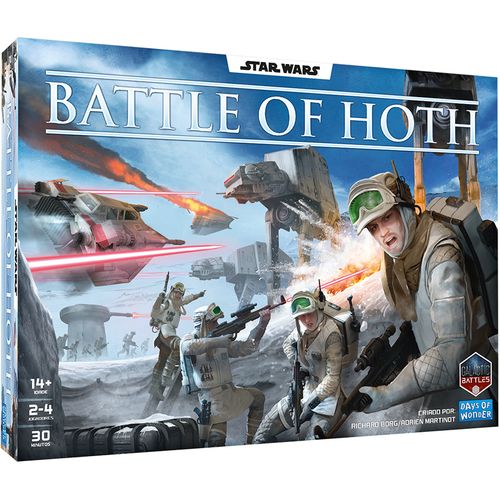
Star Wars: Battle of Hoth
Star Wars: Battle of Hoth Rulebook
Table of Contents
Table of Contents
Components
- A double-sided board
- 1 scenario book
- Cardboard components, including:
- 19 double-sided terrain hex tiles
- 6 double-sided victory medals
- 10 special forces badges
- 3 structure pieces
- Campaign Material:
- 10 support cards
- 4 campaign books
- 1 set of dark gray miniatures for the Galactic Empire army, containing:
- 2 cardholder sections
- 32 snowtroopers
- 3 AT-ATs
- 4 Imperial probe droids
- 1 set of light gray miniatures for the Rebel Alliance forces, containing:
- 2 cardholder sections
- 24 Echo Base troopers
- 9 Snowspeeders
- 2 Rebel artillery
- 25 Galactic Empire command cards: 16 standard cards, 9 leader cards
- 25 Rebel Alliance command cards: 16 standard cards, 9 leader cards
- 6 attack dice
- 1 rulebook
- 3 summary sheets: 2 unit summary sheets, 1 terrain summary sheet
Setting Up the Game
- Select a battle from the scenario book.
- Place the board in the center of the table.
- Place the necessary terrain hexes, as indicated by the battle scenario.
- Place the miniatures on the board, matching their positions to the scenario's battle map:
- Imperial infantry units contain 4 snowtrooper miniatures
- Imperial vehicle units contain 1 AT-AT miniature
- Imperial special units contain 2 Imperial probe droid miniatures
- Rebel infantry units contain 3 Echo Base trooper miniatures
- Rebel vehicle units contain 3 snowspeeder miniatures
- Rebel special units contain 1 Rebel artillery miniature
- Add any special unit badges to individual units and victory medals to specific, on-the-map objectives, if required by the scenario's special rules.
- Place the summary sheets next to the board.
- Assemble the cardholder sections and place them on the board edges. The card holders are not mandatory, but are particularly useful when playing in teams of multiple players to a side.
- Choose each player's side and sit in front of the board accordingly.
- Each player takes the 16 standard command cards for their side (each player can choose a leader and add the 3 command cards for this leader to their deck, if players agree) and shuffles their command card deck thoroughly. Then they draw as many command cards as indicated in the scenario briefing notes. Each player places these cards in their respective cardholder or their hand, keeping them secret from the opposing player.
- Each player places the remainder of the deck face down, next to them.
The starting player, as indicated in the scenario's briefing notes, plays their first card and takes their first turn.
Object of the Game
The object of the game is usually to be the first to claim a set number of victory medals (usually 4 to 5, depending on the selected battle scenario's victory conditions).
In Battle of Hoth a victory medal is gained for each enemy unit entirely eliminated from the battlefield. Each medal won this way is designated by placing the last miniature of the eliminated unit on any of the available medal stands located on the bottom left of each side of the board.
In some scenarios, additional medals may be gained from the board itself, for capturing or holding certain terrain hexes or battlefield objectives.
Some scenarios may outline special victory conditions, described in the scenario special rules section.
Battlefield
Battles are fought over a hexagonal game board 10 hexes wide by 7 hexes deep. The battlefield is divided into three sections by two red dotted lines, giving each player a left flank, a center and a right flank section. Where a dotted line cuts through a hex, the hex is considered to be a part of both the flank and center section. Any time the rules reference "baseline" hexes, that is the row of hexes closest to the player being talked about.
Game Turn
Each scenario indicates which side plays first. Players then alternate taking turns, until one of them reaches the number of victory medals indicated in the scenario's victory conditions.
On your turn, follow the sequence below:
- PLAY A COMMAND CARD from your hand, face up.
- ORDER. Announce all units you intend to order, within the limits of the command card just played.
- MOVE the ordered units, one at a time and in any order you choose.
- ATTACK with one ordered unit at a time, in any order you choose.
- DRAW a new command card.
Play a Command Card
Units may only move and/or attack when given an order. Command cards are used to order your troops and/or execute a special command.
At the start of your turn, play one Command card from your hand. Place it face up in front of you, and read it aloud.
There are two types of command cards: Section cards and Tactic cards.
Section cards
Section cards are used to order units in one or several specific sections. These cards indicate in which section(s) of the battlefield you may order units and how many units you may order.
Tactic cards
Tactic cards allow you to make special moves, attack in a specific way or take special actions, as explained on the card.
Note: On some command cards, you will read "If you do not command any infantry/vehicle… units, order 1 unit of your choice."
When doing so, the one unit of your choice does not benefit from the bonuses given by the card and is ordered normally anywhere on the board.
Order Units
After playing a command card, announce which corresponding unit(s) you choose to order.
Only those units that are issued an order may move, attack, or take a special action, later in the turn.
Units on a hex with a red dotted line running through it may be ordered from either section.
You may not give more than one order to each unit. If the command card allows you to issue more orders in a given section of the battlefield than you have units in that section, those additional orders are lost.
If you do not have any units in the section(s) where a card is played, you simply play the card and draw a new one without ordering any units.
Move Units
Moves are made successively, one ordered unit at a time, in the sequence of your choice. A unit may only move once per turn. An ordered unit does not have to move.
The number of hexes an ordered unit can move depends on its type. For example, an infantry unit can move 1 hex and still attack that same turn, or move 2 hexes without attacking. A snowspeeder unit can move up to 3 hexes and still attack. All units' moves are detailed in Appendix 1 and on the unit summary sheets.
- You must complete one unit's movement before beginning another.
- Ordered units may move from one section of the battlefield into another.
- Two units may not occupy the same hex. When moving, a unit may not move through a hex occupied by another unit.
- You may not split off individual miniatures from a unit; they must stay together and always move as a group.
- Units that are reduced through casualties may not combine with other units.
- Some terrain features affect movement and may prevent a unit from moving its full distance or from attacking (see Appendix 2).
- Retreat movement rules vary slightly from regular movement (see the Retreat section).
Attack
Once all unit movements are completed, attacks are checked and resolved sequentially, one ordered unit at a time, in the sequence of your choice.
To attack an enemy unit, you will roll a certain number of attack dice, depending on the type of unit attacking, the distance to the targeted enemy unit and terrain protections (see Attack Procedure below).
- A unit may normally only attack once per turn.
- A unit that is ordered does not have to attack.
- A unit may not split its attack dice between different enemy targets.
- The number of casualties a unit has suffered does not affect the number of attack dice it rolls when attacking. A unit with a single miniature left retains the same firepower as a unit at full strength.
- An attack on an enemy unit in an adjacent hex is a close combat attack.
Attack Procedure
- Announce the ordered unit you want to attack with, and select its target.
- Check attack range: Verify that your target is within attack range.
- Check Line of Sight: Verify that you have a clear line of sight to your target.
- Count down the number of attack dice to roll, based on the type of unit you are attacking with and its distance to the target.
- Determine terrain modifiers, if any. Reduce the number of attack dice rolled accordingly.
- Resolve attack: Roll the attack dice and resolve resulting faces.
Attack Range
The attack range of a unit type is calculated like the following example:
This is the infantry attack range. It shows that an infantry unit may attack any enemy unit 3 or fewer hexes away. An infantry unit will roll 3 dice attacking an enemy unit in any adjacent hex (close combat), 2 dice on an enemy unit that is 2 hexes away, and 1 die on an enemy unit that is 3 hexes away. This is the base number of attack dice for this type of unit and is counted down 3/2/1 as you move away from the attacking unit's hex.
All units' attack ranges are detailed in Appendix 1.
Line of Sight
All units must have "line of sight" to attack an enemy, meaning they are able to see their target.
Imagine a line drawn from the center of your attacking unit's hex to the center of the hex containing its target. The line of sight is considered blocked if any hex intercepting this line contains an obstruction. Obstructions include:
- Units (friends or foes)
- Terrain hexes and structure tiles that block line of sight (see Appendix 2 and 3). Terrain in the hexes of both the attacking unit and its target never block line of sight.
Note: You can find more details on line of sight rules in Appendix 7 - Specific Cases.
Terrain Modifiers
The different types of terrain and how they influence the attack are detailed in Appendix 2. Refer to that section or the corresponding summary sheet and reduce the number of attack dice rolled accordingly.
These modifiers may be terrain protections for the unit located on it; for example, an infantry unit attacking an enemy unit standing in a rocks hex will roll 1 die less. Modifiers can also be attack restrictions, including attack penalties for the unit attacking from terrain; for example, a Vehicle unit attacking from a building hex will suffer a 2 dice penalty.
Terrain protection and terrain attack penalties are cumulative.
Resolving Attacks
Roll the attack dice. Hits are resolved first, followed by any retreats.
Hit
The attacking unit scores 1 hit for each dice symbol rolled that matches the unit type targeted. Each blast rolled is also 1 hit for all unit types.
For each hit scored, the targeted unit suffers one casualty and 1 miniature is removed from it. When the last miniature in a unit is removed, the attacking player places it on one of the empty medal stands on their side of the board.
If an attacking player rolls more hits than the number of miniatures in the targeted unit, these additional hits have no effect.
Dice Faces
- Infantry icon — Score 1 hit on infantry (snowtrooper or Echo Base trooper).
- Vehicle icon — Score 1 hit on a vehicle (AT-AT or snowspeeder).
- Blast icon — Score 1 hit on any unit type: infantry, vehicle or special.
- Cross icon — This counts as a miss.
- Retreat icon — After all hits have been resolved and casualties removed, retreats are resolved.
Any die that fails to match the unit type, a blast or a retreat is also a miss.
Retreat
For each retreat rolled, the targeted unit must retreat 1 hex: It moves one hex back toward its baseline. Two retreat icons push the unit back two hexes, etc.
The player controlling the unit decides which hex their unit retreats onto using the following rules:
- Unless told otherwise by the scenario special rules, a unit must always retreat toward its controlling player's baseline.
- Terrain has no effect on retreat movements, therefore a retreating unit may move through rocks or ruins without stopping. However, impassable terrain may not be moved through, even during a retreat move.
- A unit may not retreat onto, or through, a hex already containing another unit (friend or foe).
- If a unit cannot retreat or is forced to retreat off the edge of the battlefield, it suffers one casualty for each retreat move that cannot be completed.
- Some types of terrain allow certain units to ignore one retreat rolled against them.
- You may not "choose" to lose a miniature if there is a clear path of retreat available to you that will fulfill all the retreat icons your opponent has rolled on a unit.
Draw a Command Card
After resolving all hits and retreats, discard the command card played faceup, next to your deck, and draw another card. Your turn is now over.
If your draw deck ever runs out of cards, the discard pile is shuffled to form a new draw deck.
Appendix
1 / Units
Standard units follow the rules described in the previous pages with each one having some of their own unique rules. Please look carefully at the unit recap below.
Rebel Alliance Units
Echo Base Trooper — Infantry Unit
- Number of miniatures: 3
- Move: 0-1 hex and attack or 2 hexes and no attack.
- Attack: 3 / 2 / 1
- Is hit on: infantry, blast
Snowspeeder — Vehicle/Flying Unit
- Number of miniatures: 3
- Move: 0-3 hexes. Can move onto crevasse hexes.
- Attack: 4 / 2
- Is hit on: vehicle, blast
Rebel Artillery — Special/Artillery Unit
- Number of miniatures: 1
- Move: cannot move.
- Attack: 4 / 3 / 2 / 1
- Is hit on: blast
- Rebel artillery units must ignore all retreats rolled against them.
- IMPORTANT: Eliminating a Rebel artillery unit does not grant a victory medal.
Galactic Empire Units
Snowtrooper — Infantry Unit
- Number of miniatures: 4
- Move: 0-1 hex and attack or 2 hexes and no attack.
- Attack: 3 / 2 / 1
- Is hit on: infantry, blast
AT-AT — Vehicle Unit
- Number of miniatures: 1
- Move: 0-1 hex. Cannot move onto ridge hexes.
- Attack: 3 / 3 / 3
- Is hit on: vehicle, blast
- Dice that are hits must be re-rolled for a confirmation roll: The AT-AT is eliminated if at least 1 blast is rolled on the confirmation roll.
- AT-AT units must ignore all retreats rolled against them.
- AT-AT units never benefit from terrain protections.
Imperial Probe Droid — Special/Droid Unit
- Number of miniatures: 2
- Move: 0-2 hexes.
- Attack: 2 / 1
- Is hit on: blast
- IMPORTANT: Eliminating an Imperial probe droid unit does not grant a victory medal.
Special Forces Units
Special forces units are identified on the scenario setup map and on the board with badges. They behave in the same way as standard units, with the exception of the special capabilities described below. A unit can never have more than one special forces badge.
Assault (infantry) — These special troops are highly trained to operate in hostile environments and battle enemy forces in close combat.
After resolving a close combat attack, if an ordered assault unit succeeded in eliminating an enemy unit or forcing it to retreat, the assault unit may conduct a breakthrough: It moves into the vacated hex, and attacks again.
- An assault unit may conduct only one breakthrough per turn.
- The breakthrough attack must be completed before another unit may attack.
- Terrain movement and attack restrictions still apply for the breakthrough. For example, an assault unit that conducts a breakthrough by moving into a vacated wreckage hex will not be able to attack again.
- The breakthrough attack may target any enemy unit in range.
E-Web (infantry) — This heavy repeating blaster can cause a lot of damage. But the soldiers need time to set it up after moving…
- E-Web units start every battle with the badge on its "in place" side.
- After this unit has been ordered and has moved, put the badge on its "moving" side.
- After this unit has been ordered and has not moved, put the badge on its "in place" side.
- An E-Web unit with the badge on the "moving" side behaves like a standard infantry unit.
- An E-Web unit with the badge on the "in place" side may, every time it attacks, re-roll any number of the attack dice one time.
Scout (infantry) — These special forces can give a significant battle advantage to friendly units by providing information on the enemy troops.
When a scout unit occupies a ridge hex and has line of sight (from any distance) on an enemy unit, any other friendly unit attacking this enemy unit rolls 1 extra die.
Elite Troops (infantry) — These are veteran troops that have learned the importance of mobility during battle.
Elite infantry units may move 0-2 hexes and still attack. However, terrain movement and attack restrictions still apply.
Elite Squadrons (snowspeeder) — Elite snowspeeder squadrons are formed from the best pilots in the Rebellion.
Elite snowspeeder units start with 4 miniatures per unit.
2 / Terrain
Ridges
- Movement: AT-AT units cannot move onto ridges. No movement restrictions for other units.
- Attack: no restrictions.
- Protection: when attacking an enemy unit on a ridge, units reduce the number of attack dice rolled by 1, unless they are also on a ridge.
- Line of Sight: ridges block line of sight.
- Special: line of sight between 2 units on ridges is only blocked by other units that are also on ridges, and by seracs (see Appendix 7).
Rocks
- Movement: a unit that enters a rocks hex must stop and may move no further on that turn.
- Attack: a unit may not attack the turn it moves onto a rocks hex.
- Protection: when attacking an enemy unit that is on a rocks hex: Vehicles reduce the number of attack dice by 2; other units reduce the number of attack dice by 1.
- Line of Sight: rocks block line of sight.
Seracs
- Movement: seracs are always impassable terrain.
- Line of Sight: seracs always block line of sight.
Buildings & Wreckage
- Movement: a unit that enters a buildings/wreckage hex must stop and may move no further on that turn.
- Attack: a unit may not attack the turn it moves onto a buildings/wreckage hex. A vehicle unit on a buildings/wreckage hex reduces the number of attack dice it rolls by 2.
- Protection: when attacking an enemy unit that is on a buildings/wreckage hex: Vehicles reduce the number of attack dice by 2; other units reduce the number of attack dice by 1.
- Line of Sight: buildings/wreckage block line of sight.
Trenches
- Movement: no restrictions.
- Attack: no restrictions.
- Protection: when attacking an infantry unit on a trenches hex, all units reduce the number of attack dice rolled by 1. In addition, an infantry unit on a trenches hex may ignore 1 retreat rolled against it. Other units get no protection.
- Line of Sight: trenches do not block line of sight.
Crevasses
- Movement: crevasses are always impassable terrain, except for Flying units such as snowspeeders.
- Line of Sight: crevasses do not block line of sight.
3 / Structures
Structures are terrain tiles that are placed on the board as indicated in the scenario maps. They can be attacked and destroyed but are never considered units.
Shield Generator / Ion Cannon
- Movement: shield generator and ion cannon are both always impassable terrain.
- Protection: shield generator and ion cannon benefit from the protection of the terrain hex they are on top of.
- Line of Sight: shield generator and ion cannon block line of sight.
4 / Objectives
The following terms are used to describe some common Battle of Hoth victory conditions that allow players to gain additional victory medals from the map:
Temporary Medal Objective — The victory medal in this objective hex is captured and held only as long as a unit of the appropriate side holds the hex. If the unit vacates the hex for any reason (movement, retreat or elimination), the medal is immediately lost and placed back in its original position.
Permanent Medal Objective — The victory medal in this objective hex is held and permanently gained the moment a unit of the appropriate side enters this hex. The medal is not returned or put back in play, even if the unit later vacates this hex.
Sudden Death Objective — As soon as the designated side fulfills the sudden death conditions set forth, the scenario immediately ends and that player wins the game.
5 / Playing with Leader Cards
Battle of Hoth includes 6 sets of leader cards: Darth Vader, Maximilian Veers and Firmus Piett for the Empire and Leia Organa, Luke Skywalker and Han Solo for the Rebel Alliance.
If you want to play Battle of Hoth with the help of a leader, each player chooses one leader from their side and shuffles the 3 corresponding cards into their command deck. These cards are all tactic cards and are played like standard cards.
6 / Team Mode for 3-4 Players
Battle of Hoth offers the possibility of having a team of two players play on one or both sides. Follow these steps:
1 - Form Teams
Make two teams of up to 2 players each; if you have 3 players in total, a team of 2 players will face a player on their own.
On each team of 2 players, choose a person to be 1st player who sits on the left side of their team. Each team player will take 1 cardholder section.
2 - Setting Up the Game
Set up the scenario as usual. However, on step 9 follow the procedure below:
- For a single player, follow the standard instructions.
- For a 2-player team, shuffle their side's command cards and deal 8 face down command cards to each of them to form their personal decks. Then each team player draws half the number (rounded-up) of command cards indicated by the scenario from their deck and places them in their personal hand or in their personal cardholder.
- When playing with leaders, players in a team each add the 3 cards from one leader to their personal deck after the side's command card deck has been split between them; a single player adds the 3 command cards of one leader to their deck before shuffling and drawing as usual.
3 - Game Turn
During the game, sides alternate turns, starting with the side indicated in the scenario setup, no matter the number of players on each team. Within a team, however, players take turns alternating for their side.
Note: The player taking the turn in a team is the active player.
In a 4-player game, the 1st player of the starting team will go first, followed by the 1st player of the other team. Then the 2nd player of the starting team gets a turn, followed by the 2nd player of the other team.
In a 3-player game, the player on their own takes a turn after each player on the team with 2 players.
For example: In a scenario with an individual Imperial player vs. a Rebels team with 2-players, where the Rebels 2-player team moves first, play will be carried out as follows: Rebels 1st player - Imperial individual player - Rebels 2nd player - Imperial individual player, etc.
Game turn rules apply normally, with the following exceptions for 2 player teams:
- The active player can only play a command card from their own hand.
- At the end of the active player's turn, the command card that was played this turn is put in a personal discard pile and their new command card must be drawn from their personal deck.
- Players on the same team can show their command cards to each other. They may also discuss their strategy and plans for future turns but they must do so openly, allowing the other team to hear them. The active player has the final say on what to actually do on their turn.
- When playing the Deploy the Fleet card: the active player may discard any number of command cards and draws the same number +1. Their teammate may discard any number of command cards and draws the exact same number.
7 / Specific Cases
Line of Sight along Hexes Edges
When checking line of sight between two units, the line between the centers of these units' hexes may run along one or several hexes containing obstructions, without crossing them. In this case:
- Line of sight is not blocked if the obstruction(s) the line is running along is/are on only one side of the line.
- Line of sight is blocked if the obstructions the line is running along are on both sides of the line.
Line of Sight and Battlefield Limits
Half hexes along the side edge of the battlefield also block line of sight.
Line of Sight on Ridges
For units standing on ridges, line of sight rules are slightly modified. Between two units that are both on ridges, line of sight is only blocked by:
- Other units on ridges
- Seracs
Between two units, including only one on a ridge, line of sight rules apply normally.
Game design - Richard Borg and Adrien Martinot
Illustrations - Benjamin Carré, Christophe Duhaze, Tony Foti, and Clément Masson