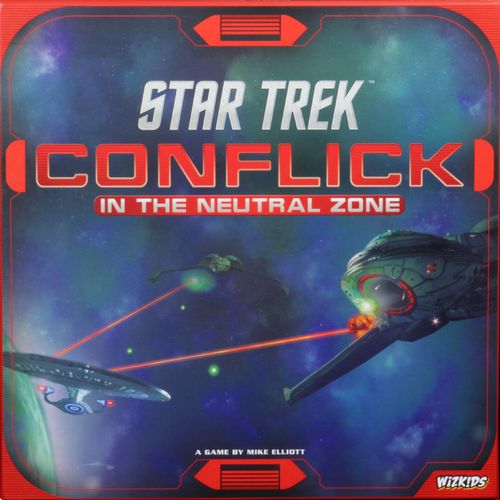
Star Trek: Conflick in the Neutral Zone
Star Trek: Conflick in the Neutral Zone Rulebook
Table of Contents
Table of Contents
Components
- 16 Starting Ship cards (4 per player)
- 24 Ship cards: Federation (blue), Neutral (beige), Klingon (red)
- 8 Klingon collector ships (red circular discs)
- 9 Klingon attack ships (red octagonal discs)
- 8 Federation collector ships (blue circular discs)
- 10 Federation attack ships (blue octagonal discs)
- 3 Neutral collector ships (beige circular discs)
- 2 Neutral attack ships (beige octagonal discs)
- Double-sided board (2- and 4-player board; 3-player board)
- Range Ruler
- 40 Dilithium Crystals
- 8 Asteroids
- 46 Command Points
- Ship stickers: apply 1 sticker to each disc according to its color, size and shape. Discs should ONLY have a sticker on one side. (An additional sheet of stickers is provided as extras for replacements.)
Setup
For 2 Players
Lay out the board using the 2-player side in between the players.
Remove the Starting Ship Cards from the deck, and place them to the side. After shuffling the remaining Ship Cards, reveal 4 cards from the top and place them in a horizontal row next to the board. This is the Display.
Each ship card has a corresponding disc. Keep the ship discs easily accessible, sorting them any way you want. When you purchase a Ship Card you will need to find the corresponding disc.
Place the yellow Dilithium Crystals and purple Command Points in piles near the board. These form the supply. Note that these tokens are not intended to be limited in quantity.
Randomly determine a starting player. That player will decide whether they will play as Federation or Klingon.
The Federation 1 player starts with their basic Fleet of two blue collector discs (circular in shape) and two blue attack discs (octagonal in shape). They also get the corresponding Federation 1 cards that match the image and number of each disc. These are placed in their Fleet area, which is the area in front of a player, off the board.
The Klingon 1 player does the same, with the red colored discs, and the "Klingon 1" cards.
Next to each player's Fleet area will be a Shipyard area - this is where destroyed ships will go (see Attacking).
Finally, give each player two Asteroids.
The game begins. Engage!
Gameplay
Cards and Discs
Each ship is represented by both a card and a disc. Throughout these rules the terms "ship" and "disc" are used interchangeably.
Collectors: Every ship with a circular disc is a 'collector'.
Attackers: Every ship with an octagonal disc is an 'attacker'.
Ship Card Anatomy
A ship card shows: Ship Name, Cost, Image, Ability Name, Ability, Ship # and the Associated Disc. Example: U.S.S. Enterprise-E, Federation Attack Starship, cost 4, ability Resilient: "Once per turn, if this ship is destroyed by an opposing ship, reset both ships to original positions and the opponent must succeed with a second shot to destroy it." Ship # 025, associated disc: large blue octagon.
Ship Disc Anatomy
Discs denote several important items about the ship they represent.
- First, the shape of the disc denotes the type of ship as either collector (circular) or attacker (octagonal).
- Second, the color of the disc matches the color of the faction it belongs to: The Federation (blue), the Klingons (red), or a neutral faction (beige).
- Then the Ship name, cost, and ship number all match the information shown on the ship's card.
The disc examples shown in the rulebook represent:
- U.S.S. Enterprise-E is a Federation large attack ship.
- Bioship Alpha is a neutral large collector ship.
- I.K.S. Ch'Tang is a Klingon small attack ship.
Turn Sequence
A player's turn consists of 6 steps, taking place in the following order.
- REASSIGN: Pick up any of your ships you wish to return to your Fleet.
- COLLECT: Collect one Dilithium Crystal plus one Dilithium Crystal for any circular ships on yellow planets. Collect purple Command Points for any circular ships on a purple planet.
- PURCHASE: Purchase a new ship to add to your Fleet from the Display. If you purchase a ship, a new ship card is flipped up to replace it.
- DEPLOY AND MOVE: In any order, you can bring up to two new ships into play from your Fleet and flick them immediately as well as flick as many of your ships currently in your territory.
- ASTEROIDS: Place or move an asteroid.
- REBUILD: All ships in your Shipyard are placed into your Fleet.
After the last step is done, the next player goes.
Winning the Game
The game end triggers when someone has collected at least 10 Command Points. Continue playing until everyone has taken an equal amount of turns. Then the player with the most Command Points wins.
Feel free to adjust the Command Point goal for a longer or shorter game.
1. Reassign
You may pick up any of your ships from the board and return them to your Fleet. This is mainly done to recover a ship on the opposing side of the board that you want to use this turn. They can be Deployed later this turn or on a future turn (see Step 4).
2. Collect
Collect one Dilithium Crystal plus one Dilithium Crystal for each collector ship (circular) that is on a yellow planet. You also collect one Command Point token for each collector ship on a purple planet. Note that the effects of certain ships may change the amount collected and the time a ship can collect (see their card for details).
Collecting example: On the Klingon player's turn, they will collect 2 Dilithium Crystals and 1 Command Point. One Dilithium Crystal is automatically earned each turn plus an additional Dilithium Crystal from I.K.S. QhonDoq being located on a yellow planet. One Command Point is earned from the Klingon 1 ship being on the purple planet.
3. Purchase Ships
Each turn a player may purchase one ship from the Display and if a ship is purchased, a new Ship Card is flipped to replace it.
The cost to buy any of the four ships is listed on the top right of the card and represents the amount of Dilithium Crystals that must be spent to buy the ship. The type of ship, collector or attacker, is written underneath the ship name and also referenced by the disc shape (circular = collector, octagonal = attacker).
When you purchase a Ship Card, take the corresponding disc that matches the Ship Card and add it to your Fleet. In a typical game, there is only one ship disc corresponding to each card and the owner of the card controls that ship.
4. Deploy and Move
You can Deploy new ships in this step, as well as Move (flick) existing ships you own that are in your territory (your half of the board). These actions can be done in any order, and also in between each action. For example, you can flick two ships, deploy and flick a new ship, flick another existing ship, then deploy and flick another new ship.
When you Deploy a new ship, you can immediately flick it. There are two restrictions to Deploying: placement of new ships and types of new ships.
The restriction for placement is as follows: you can only Deploy in your territory, the ship must be placed entirely within range from the edge of the board in front of you (not the sides of the board).
The restriction of ships that can be brought out is as follows: you cannot Deploy two basic ships of the same type: you cannot bring out two basic collector ships or two basic attack ships on the same turn. You can, for example, bring out a basic attack ship, as well as a named attack ship.
When you Move, you want to flick your circular discs onto the planets to collect their resources (Dilithium Crystals or Command Points). You want to use your octagonal discs to destroy your opponent's discs.
Deploy and Move example: The Klingon player may only flick the I.K.S. Somraw Klingon ship (1) and the Ni'Var Federation ship (3) that that player owns. The Klingon player cannot flick the U.S.S. Defiant Federation ship it does not own. In addition, before, after, or in between flicking those two ships, the Klingon player may deploy and flick up to 2 ships from the edge of their territory within Range of their board edge (2 & 4).
If you miss with a flick when Deploying a new ship, and it goes off the board, it is placed into your Shipyard, but still counts as one of your two new deployed ships for the turn, even though it missed and is not in play. If you miss with a ship that is already in play and it goes off the board, it is placed in the Shipyard with no other penalty.
Range
Some ships reference a range. To determine if something is in range, use the Range Ruler. Place one end of the ruler to the edge of a ship and if any part of the ruler touches the target, it is considered in range.
Collecting
Circular discs are collector ships. If a circular ship ends up on a yellow planet, the player will collect one Dilithium Crystal at the start of their turn. If a circular ship ends up on a purple planet, the player will collect one Command Point at the start of their turn. If any portion of the ship is touching a planet, the ship is considered to be on that planet.
Circular ships cannot be used to destroy other ships. If a circular ship hits an enemy ship in a way that would destroy it, the circular ship is destroyed instead (and placed in your Shipyard), and the opposing ship is returned to its original position. If the circular ship hits another ship and does not destroy it, it is considered incidental contact and both ships survive.
Attacking
Octagonal ships are attack ships. Only octagonal ships can hit other ships to destroy them. Octagonal ships do NOT collect Dilithium Crystals or Command Points from being on a planet.
Ships can be destroyed in two ways. If a ship is on a planet, it can be destroyed by being knocked off the planet. If a ship is not on a planet, it can be destroyed by being knocked off the board. (Of course, being on a planet and getting knocked off the board is considered being destroyed!)
Whenever you destroy an opposing ship, you gain 1 Command Point. If the opponent does an action that destroys their own ship (flicking their own ship off the board, having a circular ship destroy itself due to destroying another ship, etc.), the opposing player does not gain a Command Point.
If you hit an opposing ship and destroy it, place the destroyed ship into the owning player's Shipyard. The attack ship that destroyed the other ship may be picked up and placed in your Shipyard.
Attack example: The Federation player flicks the U.S.S. Defiant and hits the Klingon player's I.K.S. Somraw, knocking it off the yellow planet. Because the Somraw was knocked off of the planet it is destroyed and sent back to the Klingon player's Shipyard. The Federation player gets 1 Command Point for destroying the ship. Then the Federation player may choose to place the Defiant back into their Shipyard or leave it on the board. Since the Defiant is still in its own territory, they decide to leave it.
(The Defiant's ability, Tractor Beam, appears on the page as an example card: "At the start or end of a move with this ship, you may move an opponent's asteroid within range of this ship.")
5. Asteroids
Asteroids can be used as obstacles to prevent the opponent from destroying your ships. In this step, you may place an asteroid on the board or move an existing asteroid (even if it belonged to the other player) to another location.
Asteroids must be placed so that they are at least the width of the Range Ruler away from any ships. You may check this by placing the Range Ruler between the placed asteroid and a ship to see if it is too close. Picking up and placing an asteroid does not count against your new ship deployment limit.
You cannot move an asteroid that was moved in the previous turn by an opponent.
6. Rebuild
Any ships in your Shipyard may now be returned to your Fleet, available to be Deployed next turn.
Variants
For 3 Players
Use the 3-player side of the board showing 4 planets. Each player starts in an area between two of the yellow planets, the deployment borders are defined in the image in the rulebook (Federation 1 territory, Klingon 1 territory, and Player 3 territory).
The third player will choose to be Klingon or Federation and takes the four ships in their color and the cards marked either "Federation 2" or "Klingon 2".
For 4 Players
Use the 2-player side of the board. There will be two teams each with two players per team. One team will be the Federation players and each player will start with four basic ships as outlined in the 2-Player setup above. One member of the team will have the "Federation 1" cards and discs while the other, the "Federation 2" cards and discs. The Klingon team will do the same using the "Klingon 1" and "Klingon 2" cards and discs.
Each team will sit on their side of the board (like in a two-player game). However, each player's deployment territory is one quarter of the board instead of half, bordered by lines depicted in the rulebook (Federation 1, Klingon 1, Federation 2, Klingon 2 territories). Each player may only flick their own, or their teammate's ships, from their territory.
Each team takes turns. For example, if Federation is first, then one member of the Federation team will take their turn, then one member of the Klingon team will take their turn, then the other member of the Federation team will take their turn, etc.
Also, each player can only Deploy one new ship on their turn. The team collects Command Points as a team, but collects Dilithium Crystals as individual players, thus spending them individually. When a ship collects Dilithium Crystals, they are given to the owner of that ship.
In team play, the game ends when one team has collected 20 Command Points and both teams have taken an equal number of turns.
Reference
Collector Ship / Attack Ship
All circle discs are collector ships. All octagonal discs are attack ships.
Turn Order
- REASSIGN: Pick up any of your ships to return to your Fleet.
- COLLECT: Collect 1 Dilithium Crystal plus 1 Dilithium Crystal for any collector ships on yellow planets. Collect 1 Command Point token for any collector ships on a purple planet.
- PURCHASE: Purchase a new ship to add to your Fleet from the Display. If you purchase a ship, a new ship card is drawn to replace it.
- DEPLOY AND MOVE: In any order, you can bring up to two new ships into play and flick them immediately as well as flick as many of your ships currently in your territory.
- ASTEROIDS: Place or move an asteroid.
- REBUILD: All ships in your Shipyard are placed into your Fleet.
Purchase Ships of Any Faction
There is no restriction on which ships you can purchase.
Federation:
| Name | Cost | Ability Name | Ability |
|---|---|---|---|
| U.S.S. Dauntless | 2 | Shields Up | You may put a finger on this ship during an opponent's turn. |
| U.S.S. Reliant | 2 | Static Charge | If you hit a friendly ship when moving, gain 1 Dilithium Crystal. |
| U.S.S. Yosemite | 2 | Course Correction | Before moving this ship, you may reposition it up to one disc length from its current position. (You may not hit an opposing ship when using this ability.) |
| Ni'Var | 3 | Calculating | When collecting with this ship, gain +1 Dilithium Crystal. |
| U.S.S. Defiant | 3 | Tractor Beam | At the start or end of a move with this ship, you may move an opponent's asteroid within range. |
| U.S.S. Excelsior |
Neutral:
| Name | Cost | Ability Name | Ability |
|---|---|---|---|
| Tholian Ship | 1 | Tholian Web | When this ship moves, you must stand it on edge. If it lands face up in play, gain 1 Dilithium Crystal. Otherwise, destroy it. |
| Kreechta | 2 | Eternal Greed | When collecting with this ship, if it is the only ship on a planet, gain +1 Dilithium Crystal. |
| Bio-ship Alpha | 4 | Advanced Planning | When collecting with this ship, gain +2 Dilithium Crystals. |
Klingon / Romulan:
| Name | Cost | Ability Name | Ability |
|---|---|---|---|
| IRW Haakona | 3 | Destroyer | Ships destroyed by this ship are not removed from the Shipyard their next turn. (Flip disc face down as a reminder.) |
| IRW Praetus | 4 | Coordinated Attacks | While in play, gain +1 Command Point whenever another one of your ships destroys an opposing ship. |
| IKS QhonDoq | 2 | Attack Vector | When this ship moves, you may flick it twice in succession. |
| IKS Korinar | 3 | Sharp Blade | When collecting with this ship, gain +1 Command Point. |
| IKS Maht-H'A | 3 | Sharp Eye | When this ship lands on a planet, immediately gain 1 Command Point. |
| IKS Somraw | 3 |
Source note: the reference table's ship names and spellings are transcribed as printed (for example "Kreechta"; the ship card itself reads "Kreetchta"). The Ship Card Anatomy and example illustrations are described in words, since they are images in the rulebook.