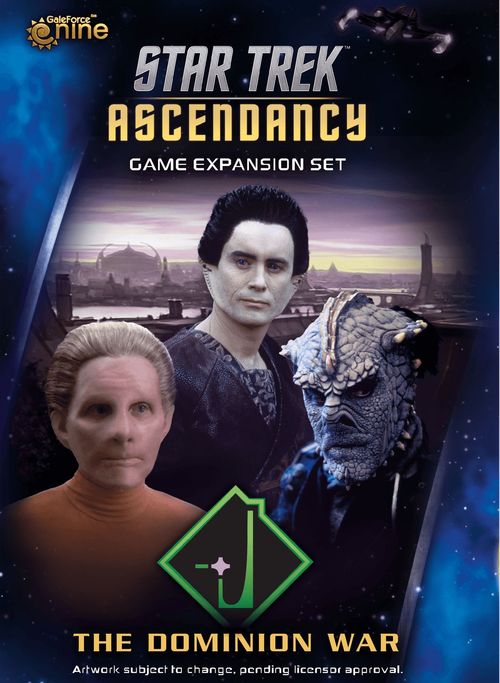
Star Trek: Ascendancy – The Dominion War
Star Trek: Ascendancy – The Dominion War Rulebook
Table of Contents
Table of Contents
Expansion Contents
This set includes everything you need to add the Dominion and Gamma Quadrant to your games of Star Trek: Ascendancy and to play the Dominion War variant. The set includes:
- 20 New Exploration Cards
- Bajoran-Idran Wormhole Systems Piece
- 16 Gamma Quadrant System Discs, including The Great Link
- 30 Dominion Ships with 3 Fleet Markers & Cards
- 10 Dominion Control Nodes
- 15 Dominion Advancements
- 3 Dominion Trade Agreements
- Dominion Turn Summary Card
- Dominion Command Console with 2 sliders
- 19 Resource Nodes
- 76 Tokens & 27 Space Lanes
- 5 Dominion Infiltrator Figures
- 8 Alliance Selection Cards
- 50 Alliance Cards
- 30 Resistance Cards
Adding the Dominion to Your Game
To integrate the Dominion into your games of Star Trek: Ascendancy, shuffle the 20 new Exploration Cards into your Exploration Deck.
Adding the Dominion to your game increases the number of possible players by 1. Each additional player adds about an hour to the game's duration. The Dominion player begins with a fully-developed Home System with 3 Ships on it as normal.
Gamma Quadrant
The Bajoran-Idran Wormhole Systems and the Gamma Quadrant System Discs allow you to add the Gamma Quadrant to your game. Use the Gamma Quadrant rules for this.
Alternatively, you can just use The Great Link as a normal Home System and ignore the Gamma Quadrant pieces.
The Dominion War
The Alliance Selection, Alliance, and Resistance cards allow you to play the Dominion War variant. Use the Dominion War rules for this. If you are not playing this variant, put these cards aside.
The Dominion Set Up
The Dominion's Founders are changeling shapeshifters. They can take the form of any race. They sent these out in order to understand the Alpha Quadrant and prepare it for invasion.
At the start of the game, the Dominion player places five Infiltrators on The Great Link.
Command Console
Like the three factions included in the core set, the Dominion have a unique Command Console with two Special Rules that apply to the Dominion.
Ketracel-White
The Dominion keep their Jem'Hadar soldiers fiercely loyal through Ketracel-White, a substance essential to keep them alive. The Jem'Hadar ensure that the rest of the Dominion follows the Founder's orders.
The Dominion player may Exhaust 1 Command Token to reroll all their failed To Hit Rolls in a single Round of Combat in a Space Battle of Planetary Invasion [sic]. They may do this in any player's turn, and may do so in each Round of Combat in a Battle or Invasion.
Example: The Federation player initiates a Space Battle against a Dominion Fleet of 4 Ships. The Dominion player still has three Command Tokens left from their turn. In the first Round of Combat, only one Dominion Ship Hits, so the Dominion player Exhausts a Command Token (even though it is not their turn) and re-rolls the 3 misses, scoring another 2 Hits. The Federation scores 1 Hit. In the second Round of Combat, the 3 remaining Dominion Ships score 2 Hits. The Dominion player elects not to use their Ketracel-White rule. The Federation player scores 1 Hit. In the third Round of Combat, the 2 remaining Dominion Ships both miss, so the Dominion player Exhausts another Command Token and re-rolls both dice, scoring two Hits. The Federation player does not score any Hits. At the end of the Combat Round, the Federation player Retreats, ending the Space Battle.
Domination
The Dominion is paranoid. It prefers cowed subjects to allies and will only trade on favorable terms.
The Dominion may not attempt Cultural Hegemony of a rival's System. They can still use Cultural Hegemony to control an independent System.
Founder Infiltrators
The Dominion sends out changeling infiltrators to study other races and prepare the way for the Dominion's forces.
The Dominion player may Exhaust 2 Command Tokens to move an Infiltrator from The Great Link to any System, even if that System is not Connected to The Great Link. They may have up to 5 Infiltrators in play at any one time. They may Exhaust 1 Command Token to move an Infiltrator to any System Adjacent to their current System or back to The Great Link.
Rival players may return a Dominion Infiltrator to The Great Link during their Command Phase by Exhausting 2 Command Tokens.
Many of the Dominion Advancements allow them to perform actions in Systems where they have an Infiltrator.
Example: The Dominion player has an Infiltrator on New Bajor which is Controlled by the Klingons and Occupied by a Klingon Fleet. In the Dominion player's turn, they use their False Orders Advancement to move the Klingon Fleet. They Exhaust 2 Command Tokens to activate the False Orders Advancement. They can now move the Klingon Fleet as if they controlled it. They Exhaust another Command Token to put the Fleet into Warp, then move it at the Klingon Warp Speed, then Exhaust a final Command Token to bring it out of Warp at Idran. Because they ended their movement in a Hazardous System, they must Brave the Hazard. If they survive, the Klingon player will take the Research Token as normal.
The Dominion player is now free to move their invasion fleet into New Bajor and add it to the Dominion.
False Orders (Advancement card text): During your Command Phase, you may Exhaust 2 Command Tokens to Move a rival Fleet or Ship that is in Orbit of a System with an Infiltrator as if it were under your control. It retains the Warp speed of its owner.
Dominion Tactics
The Founders of the Dominion created the Jem'Hadar to protect them from the 'solids'. They are superb fighters, especially when you spend Command Tokens to boost their combat capabilities with Ketracel-White. Since researching new combat abilities for your Jem'Hadar gives you additional Command Tokens, this can be a great strategy for an aggressive Dominion player.
The Founders are shapeshifters with the ability to travel at Warp speeds without the need for ships. This allows them to infiltrate other civilizations. These infiltrators influence their host civilizations in ways beneficial to the Founders. Researching infiltrator abilities gives you better Warp capability. The combination of slowing down your opponents, along with faster movement for your own ships, gives plenty of strategic options for a canny Dominion player.
Specified Civilization Tech
Bajor and some Exploration Cards specify the Weapons Hit Roll, Shield Modifier, and Hegemony Resistance of a System. Use these ratings rather than the standard Civilization Tech Levels for that System. Once a player takes Control of the System, these Tech Levels no longer apply and have no further effect.
If you are playing with The Dominion as a civilization, you can add the Gamma Quadrant, the home of The Dominion, to the game. The Dominion will make contact with the Federation, Klingons, Romulans, and other civilizations of Alpha Quadrant through the Bajoran Wormhole.
Gamma Quadrant Systems
Gamma Quadrant Systems are marked with the Gamma Quadrant symbol on both sides. Keep these separate from the normal Alpha Quadrant Systems.
Setup the Wormhole Systems
Place the Wormhole Systems piece with Bajor in the center of the table and Idran closest to The Great Link. These are Fixed Systems, so cannot be moved during the game.
The Bajor System starts the game as a Warp Capable Independent Civilization with 3 Warp Tokens, a Weapons Hit Roll of 5+, and a Shield Modifier of 3. Place 2 Culture Nodes on Bajor.
Unlike most Independent Civilizations, Bajor also has a Starbase (Deep Space Nine). When a player takes Control of Bajor (either through a Planetary Invasion or Cultural Hegemony), they gain control of the Starbase and gain a Command Token as if they captured a Starbase from another player. Note, the Starbase increases the Hegemony Resistance of Bajor by 1.
If you have the Cardassian Expansion, remove the Bajor System from the normal (Alpha Quadrant) Stack. The Bajor disc on the Wormhole Systems piece replaces it.
Setup the Gamma Quadrant Stack
Then, prepare the Gamma Quadrant Systems at the same time as you prepare the normal (Alpha Quadrant) System Discs during game setup.
Separate the Interstellar Phenomenon System Discs from the Planetary System Discs. Next, set aside a stack of two random Planetary System Discs. Shuffle the remaining Planetary Systems with all the Gamma Quadrant Phenomenons, then place the starting Gamma Quadrant Planetary Systems on top, creating a stack of all the System Discs with the starting Planetary Systems on top.
Building Gamma Quadrant
When exploring from a Gamma Quadrant System place a Space Lane as normal, but it must connect with a Gamma Quadrant System or if placing a new System Disc, draw the System from the stack of Gamma Quadrant Systems rather than the normal (Alpha Quadrant) Systems.
Resolve the discovery of the Planetary System or Phenomenon as normal. Planetary Systems in Gamma Quadrant use the same Exploration Deck as the normal ones (from Alpha Quadrant).
Space Lanes may never connect a Gamma Quadrant System to a normal (Alpha Quadrant) System.
Players may not place Space Lanes and Systems in a way that makes it impossible to Connect a normal (Alpha Quadrant) System to Bajor or a Gamma Quadrant System to Idran.
Sidebar: Normal (Alpha Quadrant) Systems can only connect to other Alpha Quadrant Systems — including Bajor in the Wormhole Systems.
The Wormhole Systems
The Wormhole Systems piece consists of two Systems: Bajor and Idran, linked by a Wormhole. Bajor is a normal System in Alpha Quadrant, while Idran is a Gamma Quadrant System. These Systems are NOT Adjacent, but are Connected.
Sidebar (Wormhole Systems piece): Place 3 Warp Tokens and 2 Culture Nodes on Bajor. Until a player takes Control of Bajor, it has: a Weapons Hit Roll of 5+, a Shields Modifier of 3, and a Hegemony Resistance of 3. Exhaust 1 Command Token to move a Ship or Fleet from one side of the Wormhole to the other.
Moving Through the Wormhole
You cannot move through the Wormhole while in Warp. Ships must exit Warp at Idran or Bajor first. You must Exhaust 1 Command Token to move a Ship or Fleet from one side of the Wormhole to the other. You may always move between the two Wormhole Systems, even if the System on the other side of the Wormhole is held by a Hostile rival. They cannot prevent you from entering the System via the Wormhole. Nor can a rival use Ships in a System to prevent you from leaving that System.
No Dominion?
If your game does not have The Dominion as a civilization, you can either leave the Gamma Quadrant Systems out of the game or use the following rules.
Do not place the Wormhole Systems at the start of the game. Instead, whenever a player draws a Phenomenon, roll the Space Lane Die. If the result is 4, replace the Phenomenon with the Wormhole Systems with the Space Lane connected to Bajor.
Players can now explore through the Wormhole to the Gamma Quadrant beyond.
Sidebar: Gamma Quadrant Systems like the Dominion's The Great Link can only connect to other Gamma Quadrant Systems. The only route to the normal (Alpha Quadrant) Systems is through Idran and the Wormhole to Bajor.
Sidebar (illustration caption): The Wormhole Systems piece is placed in the center of the table with Idran pointing towards The Great Link.
The Wormhole Systems piece is not a Fixed System when placed, but becomes Fixed when another Space Lane is connected to either Bajor or Idran.
Dominion Without Gamma
If your game has the Dominion as a civilization, but you are not using the Gamma Quadrant rules, ignore the Gamma Quadrant symbol on The Great Link and treat it as a normal (Alpha Quadrant) System. Do not use the Wormhole Systems piece or the Gamma Quadrant System Discs.
The Dominion War Variant
In Star Trek: Ascendancy, each civilization is vying to become the ascendant culture or to militarily dominate their rivals. The Dominion War variant changes the playing field by dividing the civilizations into two rival Alliances. Civilizations no longer stand or fall alone. Instead, they must strive to see their Alliance dominate over the opposing Alliance.
You need at least four players to play The Dominion War. It is recommended that you have an even number of players.
The rules for The Dominion War are the same as the normal Star Trek: Ascendancy rules with the following exceptions.
Setting Up
The Dominion War starts with two Alliances already created and at war. Each player starts with a civilization already created and connected with their neighbors.
Forming the Alliances
There are two types of Alliance Selection Cards: Red and Blue. Form an Alliance Selection Deck with the same number of cards as players, with an equal number of each type.
Before placing their Home Systems, each player draws an Alliance Selection Card to see which Alliance they are part of. All of the players in an Alliance should sit together on one side of the table.
Illustration captions: RED ALLIANCE and BLUE ALLIANCE.
Building Civilizations
Each player starts the game with their Home System connected to four explored and colonized Planetary Systems. A player rolls the Space Lane dice and connects the top Planetary System from System Discs stack to their Home System, then places a Control Node on the System. They repeat this three more times, connecting each System directly to their Home System.
If they draw a Phenomenon rather than a Planetary System, discard it and draw again until they draw a Planetary System.
Once all players have done this, shuffle any Phenomenons into the System Discs stack. Do not build the stack with only Planetary Systems on top as you normally would.
Illustration caption: Each player starts the game with four Colonized Planetary Systems connected to their Home System.
Connecting Each Alliance
Once all of the players have four Systems connected to their Home Systems, they connect their Alliances. Each player that has an Ally to their right connects to them by rolling a Space Lane dice and connecting the System they Control that is closest to their Ally to the nearest Allied System (if they can reach it) or the top System (whether Planetary or Phenomenon) from the System Disc stack (if they cannot yet connect to their Ally. They continue doing this to create the shortest connection they can to that Ally.
Place an Encounter Card face down on each Planetary System placed this way. Players must stop in an Unexplored System and discover the Planetary System or Phenomena there. They cannot navigate around an Unexplored System.
Illustration caption: They connect with their Ally to their right.
Connecting Adversaries
Once each Alliance has been connected, the remaining players follow the same procedure to connect with the member of the opposing Alliance to their right. All of the Home Systems should now be connected in a ring.
Building Nodes
Each player now builds the three Resource Nodes on their Home System, and nine additional Resource Nodes on the adjacent Systems that they Control. If they cannot build all of their Resource Nodes on those Systems, they place as many as they can on those Systems.
They then choose one of the Unexplored Systems adjacent to the Systems they Control and reveal it, discarding the Exploration Card. If it is a Phenomenon, discard it and replace it with a random Planetary System from the System Disc stack. Place a Control Node on this System and place the remaining Resource Nodes on it.
Illustration caption: Each player starts the game with their Home System's Resource Nodes and 9 additional Resource Nodes.
Sidebar: If the Dominion player chooses to be in the Gamma Quadrant, they place the Wormhole System adjacent to the center-most of their Systems. Their links to their Allies will be from Bajor.
Trade Agreements
All of the players start the game having made contact, and may exchange Trade Agreements with their Allies before the game begins. Each player may only hold one Trade Agreement at a time. If these Trade Agreements would normally come into play Exhausted, then they are Exhausted.
If a civilization has additional requirements for exchange Trade Agreements, these must still be met. For example, the Breen require their trading partners to Control a System adjacent to Breen Territory before they can trade.
Gamma Quadrant (Dominion War)
If a player is the Dominion, they can use the Gamma Quadrant expansion. To do this, their four colonized Planetary Systems are drawn from the Gamma Quadrant System Disc stack. The Idran end of the Wormhole System is then connected to the System closest to the center of the table with the Bajor end pointing towards the center of the table. All connections to their Allies and the opposing Alliance will be from Bajor.
Illustration caption: Table Center.
Fleets and Starbases
In Dominion War, players may have all three of their Fleets and all three of their Starbases in play regardless of their Ascendancy level.
Alliances and Allies
The players in your Alliance are your Allies. You are always at Peace with your Allies and cannot Initiate a Space Battle with them, nor Invade or attempt Cultural Hegemony against a System that they Control. You can enter or move through Sectors and Systems containing their Ships, and Form Fleets (but not Build Ships) at their Starbases. As an Ally, you do not need to ask permission to move your Ships through these Sectors and Systems.
Allies in Space Battles
When a player initiates a Space Battle, they do not Attack Allied Fleets and Ships in the Sector that they are Attacking. A player may Exhaust an additional Command Token when initiating a Space Battle to have Allied Fleets and Ships in or adjacent to the Sector that they are Attacking join in and Attack with them.
If they then win, only the player who initiated the Space Battle can make a Tactical Maneuver to move their Fleets and Ships. Any Allied Fleets and Ships remain where they were, but still gain any benefits their civilization gains from winning a Space Battle.
Fleets and Ships remain under their own player's command and may Retreat after a Round of Combat if the player wants them to, even if an Allied player continues to fight.
Example (illustration caption): The Romulan player Exhausts a Command Token to initiate a Space Battle with the Breen Fleet. They do not attack the Klingon Fleet as they are their Allies.
Example (illustration caption): The Romulan player can Exhaust a second Command Token to have the Klingons join their attack.
Allies in Planetary Invasions
A player may Exhaust an additional Command Token when Invading a Planet to have Allied Fleets and Ships in the System join in and Attack with them.
If they then succeed in the invasion, the player who Invaded the Planet takes Control of the System, and Captures any Research or Starbases.
Fleets and Ships remain under their own player's command and may Retreat after a Round of Combat if the player wants them to, even if an Allied player continues to fight.
Example (illustration caption): The Romulan player Exhausts a Command Token to Invade Aradna. They Exhaust a second Command Token to have the Klingons join in the Attack with them.
Example (illustration caption): If they win, the Romulan player Controls Aradna, even if only Klingon Ships survive the fight.
Allied Starbases and Occupation
An Allied Starbase adds a dice to Allied Ships and Fleets fighting a Space Battle in its System, even if the player that Controls the System does not have any Ships there.
If the only Ships In Orbit of a System are Allied, then each player in that Alliance counts as Occupying that System.
Example (illustration caption): The Klingons and Romulans are both In Orbit of Dakala. As there are no Adversary Ships In Orbit, they both Occupy Dakala.
Adversaries
The players in the opposing Alliance are your Adversaries. You are always Hostile to your Adversaries. There are some exceptions to this if you are Conquered. You cannot hold a Trade Agreement from an Adversary.
Initiative Stage
Players may not seize the Initiative in the Initiative Stage. Turn order for each Game Round is always random.
Execution Stage
The Execution Stage is broken into separate Building and Command Phases.
Building Phase
In the Building Phase, every player spends Resources as usual to develop their Civilization, taking their Building Phases in turn order. Each player draws two Alliance Cards at the start of their Building Phase.
Command Phase
In the Command Phase, every player exhausts their Command Tokens to move their Ships and Fleets, Explore, fight Space Battles, Invade Planets, and use Cultural Hegemony to take over Systems. They take their Command Phases in turn order.
Recharge Stage
The Recharge Stage takes place at the end of the Game Round as normal.
Alliance Cards
Each Alliance has a deck of Alliance Cards. There are two types of Alliance Cards: one-use and on-going. One-use cards remain in the player's hand until they are played, and are then discarded. On-going cards are placed in front of the player when they are played and remain in effect.
Sample card (illustration caption): Alliance card "Fleet Repair" (On-Going): At the end your Building Phase, add 1 Ship to each of your Fleets that has an empty space.
At the start of each player's Building Phase, they draw two Alliance Cards into their hand. If they have more than three Alliance cards in their hand or in play, they must immediately discard down to three cards.
A player can play an Alliance Card from their hand at any time by spending 1 Culture Token.
If either Alliance deck runs out of cards, shuffle the discard pile to form a new deck.
Conquest
If an Adversary would take Control of a player's Home System through a Planetary Invasion, by Cultural Hegemony, or by Colonizing it after it has been razed by a failed Invasion, that player has been Conquered. The player Controlling their Home System is the Conquering player (also referred to as the Conqueror).
Control of Home Systems
Even though the Conquered player's Home System has their Conqueror's Control Node on it rather than their own, it remains their Home System and the Conquered player still Controls it. The Conqueror's Control Node simply marks the Conquest.
Peace at a Price
A Conquered player is at Peace with the Adversaries' Alliance. They cannot Initiate a Space Battle with their Adversaries, nor Invade or attempt Cultural Hegemony against a System that their Adversaries Control. Neither can their Adversaries Initiate a Space Battle with nor Invade or attempt Cultural Hegemony against a System they Control.
If an Adversary initiates a Space Battle, the Conquered player's Fleets and Ships will not take part. A Conquered player's Fleets and Ships cannot prevent an Adversary from Invading or attempting Cultural Hegemony against a System, even if they are In Orbit of that System.
The Conquered player must discard all Alliance Cards in their hand and that they have in play, and must revoke all Trade Agreements with their Allies. They cannot draw Alliance Cards or make Trade Agreements while Conquered.
The Conquered player immediately draws a hand of three Resistance cards.
The Spoils of Victory
When the Conqueror takes Control of a Conquered Player's Home System, the Conquered player must immediately give half (round up) of the Resources they currently hold to the Conquering player.
Example: The Federation has been Conquered by the Andorians. Since they haven't had their turn yet, they have lots of resources: 8 Production Tokens, 5 Research Tokens, and 7 Culture Tokens. The Andorian player takes 4 Production Tokens, 3 Research Tokens, and 4 Culture Tokens as the spoils of victory.
Remember, if there are any Research Nodes on their Home System, the Conquered Player must give one of their Active Projects to the Conqueror for each Research Node captured.
Paying Tribute
A Conquered player must give half (round up) of the Resources they gain in Resource Generation to the Conquering player.
Example: The Cardassians have been Conquered by the Dominion. They generate 7 Production Tokens, 3 Research Tokens, and 4 Culture Tokens each turn. They must pay 4 Production Tokens, 2 Research Tokens, and 2 Culture Tokens to the Dominion player as tribute each turn.
Stolen Research
A Conqueror can use all completed Advancements of a player they have Conquered as if they were their own. Any reference to the Conquered player's civilization becomes a reference to the Conqueror's civilization when they are using the Conquered player's Advancements.
The Conqueror does not benefit from additional Warp Speed, Command Tokens, or Culture granted by the Conquered player's Advancements.
Free Passage
A Conquered player must allow their Conqueror's Ships to enter Systems that they are In Orbit of. They do not have to allow other Adversaries to enter those systems.
Victory from the Shadows
Even while Conquered, a player remains part of their original Alliance. They win if their Alliance wins, and lose if the Adversaries' Alliance wins.
Resistance Cards
Resistance Cards allow a Conquered player to fight back against their Conqueror. When a player is Conquered, they draw three Resistance Cards.
At the start of a Conquered player's Building Phase, they draw two Resistance Cards instead of Alliance Cards. If they have more than three Resistance cards in their hand, they must immediately discard down to three cards. If the Resistance deck runs out of cards, shuffle the discard pile to form a new deck.
Sample card (illustration caption): "Spark Rebellion" (Resistance). Exhaust 1 Command Token to play this card. Roll a dice for each of your Conqueror's Fleets or separate Ships In Orbit of your Home System. Each 4+ destroys one Ship. Liberate yourself if this leaves no Adversary Fleets or Ships In Orbit of your Home System.
Playing Resistance Cards
A Conquered player plays Resistance Cards in their own Command Phase unless the card states a specific timing. Each Resistance Card shows the number of Command tokens that must be Exhausted to play that card.
Active Resistance
Some Resistance Cards allow one of your Fleets to Initiate Space Battles against your Conqueror. You may add Ships to this Fleet as normal. If this Fleet initiates a Space Battle, and you have other Ships and Fleets that could join that Battle, they may do so. This does not allow you to Initiate Planetary Invasions or attempt Cultural Hegemony.
Liberation
A player that has been Conquered is immediately Liberated when a member of their Alliance Occupies their Home System. The Liberated player replaces the Conqueror's Control Node with their own. They are no longer Conquered and discard all Resistance Cards.
Recovering Research Projects
If there are any Research Nodes on their Home System when they are Liberated, they capture those Research Nodes and their Conqueror must give them one of their Active Projects for each Research Node captured as if they had successfully Invaded the Planet.
Rebellion
If a Conquering player ends their Command Phase with three or fewer Ships In Orbit of a Conquered Home System, the Conquered player can Rebel. If they do so, they roll a dice for each of the Conqueror's Ships In Orbit. On a roll of 4+, a Ship is destroyed. If there are no Adversary Ships In Orbit of their Home System after they rebel, they Liberate themselves.
The Conqueror Conquered
A Conquered player remains Conquered, even if their Conqueror is in turn Conquered by another member of their Alliance. In this case, they must free themselves through Rebellion.
Declaring Neutrality
A player that has not been Conquered may Declare Neutrality. If they do so, the Adversary Alliance chooses one of their players to Conquer them and places that Adversary's Control Node on their Home System. They are now Conquered and discard their Alliance Cards and draw Rebellion Cards as normal for a Conquered Civilization. The Conqueror may immediately move any Ships or Fleets from one System they Control to the Conquered Home System for free.
Assistance Rebuilding
If an Ally Colonizes your Home System after it has been razed by a failed Planetary Invasion, you immediately take Control of the System, replace their Control Node with your own.
No Elimination
Players cannot be eliminated in The Dominion War variant. Even if they don't Control any Systems, they still have their turn and can play Resistance Cards while waiting for their Allies to Liberate them.
Winning the Game
As with Star Trek: Ascendancy, there are two ways to win the game. You win a Supremacy Victory if your Alliance has Conquered all of your Adversaries' Home Systems.
Alternatively, you can win if your Alliance has Conquered at least half of your Adversaries' Home Systems and a member of your Alliance meets the conditions for an Ascendancy Victory, an Agenda Victory, or another alternative way of winning a game of Star Trek: Ascendancy.
Uneven Sides
If you don't have an even number of players, add an extra card to the Alliance Selection Deck so that there are equal numbers of Red and Blue cards. Once the cards are drawn, one Alliance will have one more player than the other.
Building Nodes
The smaller Alliance builds 3 Nodes on their Home System and 9 additional Nodes on the adjacent Systems. Add up the number of Nodes that Alliance has built. The larger Alliance then splits the same number of Nodes evenly between its players. Each builds 3 Nodes on their Home System, then the rest of their Nodes on the adjacent Systems.
Example: In a game with 2 players in the smaller Alliance, their Alliance will have 24 Nodes. The larger Alliance will then split these between their 3 players, giving each player 8 Nodes, 3 on their Home System and 5 in the adjacent Systems.
Starting Command Tokens
Players of the smaller Alliance start with an additional Command Token, giving them 6 Command Tokens (7 if they are Cardassian).
Alliance Cards
Players of the smaller Alliance can hold an extra Alliance card, giving them 4 cards in their hand and in play.
Winning the Game
The smaller Alliance wins a Supremacy Victory if their Alliance has Conquered as many of their Adversaries' Home Systems as there are players in their own Alliance.
They also win if their Alliance has Conquered at least half as many of their Adversaries' Home Systems as there are players in their own Alliance and a member of their Alliance met the conditions for an Ascendancy Victory, an Agenda Victory, or another alternative way of winning a game of Star Trek: Ascendancy.
Rules Conflicts
With the Dominion War variant changing a number of the game's core rules, there is an increased chance of rules on cards conflicting with the game rules. If this happens, the rule on the card takes precedence over the game rules. If any further conflicts result, the Dominion War rules take precedence over the core rules.
Example: A player discovers a Planetary System that has the Diplomatic Summit Exploration card on it. The Diplomatic Summit card allows the player to exchange Trade Agreements with any of their rivals. Since they already have Trade Agreements with their Allies, the only way to use this card is to exchange Trade Agreements with their Adversaries. This conflicts with the Dominion War Adversaries rule that prevents players from holding a Trade Agreement with an Adversary. Since the Exploration card overrides other rules, this allows the player to swap Trade Agreements with their Adversaries. It does not change any of the other rules, so the player still remains Hostile to the Adversaries they hold Trade Agreements with, and must return the Trade Agreement if they Attack or attempt Cultural Hegemony against that Adversary.