Star Trader's Luck
Star Trader's Luck Rulebook
Table of Contents
Table of Contents
Material
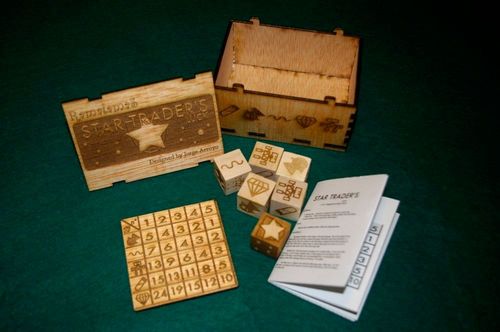
- 5 Goods Dice – Each has a picture of a good on each side.
- 1 Police Die – With 2 faces showing a Police symbol, the rest blank.
- A piece of paper and a pencil for each player.
Goal
Become the wealthiest trader within the allocated time.
Gameplay
Randomly decide which player will start playing. The active player then takes their turn and play passes the player that has spent less total time. In case of a tie, the turn passes to the tied player closest to the active player to their left. Note that a player may in some cases play two turns in a row if everyone else spent more time than they did.
Decide how long the game is going to be in game days. A turn can take between 1 and 5 days of game time. A short game can be played with a limit of 25 days, and 50 days are recommended for a normal game. Each player notes their starting amount of money: 10 credits.
On their turn, a player must take the following steps.
Step 1 – Traveling
The player must decide how much time to spend to travel to their next planet. They can spend 1, 2 or 3 days. By spending more time, a bigger planet will be reached, so a player can either reach a Small, a Medium or a Big planet.
Alternatively, a player can choose to travel to the planet that the last player went to. Before picking the dice up, they must say so and spend one more day than the time required for a planet of that size. So if the last player went to a medium planet, the next player must spend 3 days instead of 2. If this option is chosen, no re-rolls are possible, and the player gets the exact same buying and selling options that the last player got.
Step 2 – Determining Available Goods and Prices
If exploring a new planet, the player now rolls a number of Goods dice: For a Small planet, roll 3 dice, for a Medium planet, roll 4 dice and for a Big planet roll 5 dice.
After rolling, the player must set aside at least one die (which can't be re-rolled anymore), then can re-roll the rest. This procedure can repeated, keeping at least one die each time until the player is happy with the result or no more dice can be rolled.
The Goods shown in the dice are the available goods on that planet, and they're also available in those quantities. So, if three Robot faces are up, three actual Robot units are for sell on that planet.
If the player has cargo from another planet, they can sell all of it by spending 1 day. Then if they want to, they can buy any number of goods (limited by the availability) of one type by also spending 1 day. Note that only one type of goods can be carried so if the player already had cargo and didn't sell it, they will either have to buy from the same type or discard their last cargo. To determine the selling and buying price (which on any one planet are the same), use the following table:
Goods price table (rows: good icon; columns: number of that good's faces showing on the planet dice)
| Good | 1 | 2 | 3 | 4 | 5 |
|---|---|---|---|---|---|
| Creature icon | 5 | 4 | 3 | 2 | 1 |
| Wave icon | 7 | 6 | 4 | 3 | 2 |
| Robot | 13 | 9 | 6 | 4 | 3 |
| Capsule icon | 15 | 13 | 11 | 8 | 5 |
| Luxury (diamond icon) |
Transcriber's note: the printed table shows the goods as icons only. The rules text names only Robot and Luxury (and mentions Food, in the Illegal Goods example in the expansion sheet), so the other three icons are labelled here by their appearance; the printed sheet does not name them.
For example, if 3 Robot faces are up, the price for 1 Robot good is 6 credits. The player can buy up to 3 Robot goods and all the goods bought that turn will have the same price, no matter how many the player buys. The cargo limit is always 5 units.
Once this step is done, the player notes what they bought and at what price. Also, the player must track the amount of credits they have at all times and the total amount of time spent. It's good to note the time and money spent as the turn is played, then at the end note the total for both. This way, mistakes are easier to avoid.
Illegal Goods
If the Goods roll doesn't show a particular good, then that good is considered to be illegal on that planet. A player wanting to sell that type of good must roll the Police die. If the roll shows a police symbol, then the police notices the illegal activity and confiscates all the illegal goods from the player. The player is still free to buy goods. Note that the player must spend 1 day anyway for the sell even if it wasn't completed. The selling price of an illegal good is always 2 times what the player payed for it (that's why buying price has to be tracked). If goods were bought at different times, use the buying price for each part of the cargo separately (so if you bought first 1 Luxury good at 25 and later 1 at 19, the illegal selling price is 2x19+2x25=88).
Transcriber's note: the printed example gives a buying price of 25 for a Luxury good, which is not a value on the price table above (the highest is 24). It is transcribed as printed.
End
Once all the players have spent the total time agreed on at the start (no one can't take more time after reaching the limit), the game ends and the player with most money wins. Note that a player doesn't have to use all the allocated time. If there's not enough time left to do anything useful, they may declare their game finished.
Optional Rules
-
Free Buying and Selling: The players may buy goods even if they have other goods on their ship (up to the maximum 5). They may also buy different kinds of goods if they want on a planet. When selling they also can sell any number of goods from any type. If playing with this rule, players should track both goods bought and goods sold on each turn. This rule can be combined with the one below.
-
Expanding the Cargo Bay: Players start with a limit of 3 goods that can be carried on their ships (4 for a short game). Once each turn, they can, if they want, expand their cargo bay by 1 unit. This takes 1 extra day and the price is 5 times their current limit.
Dice
Print this page on light cardboard, cut, fold and glue to build the required dice.