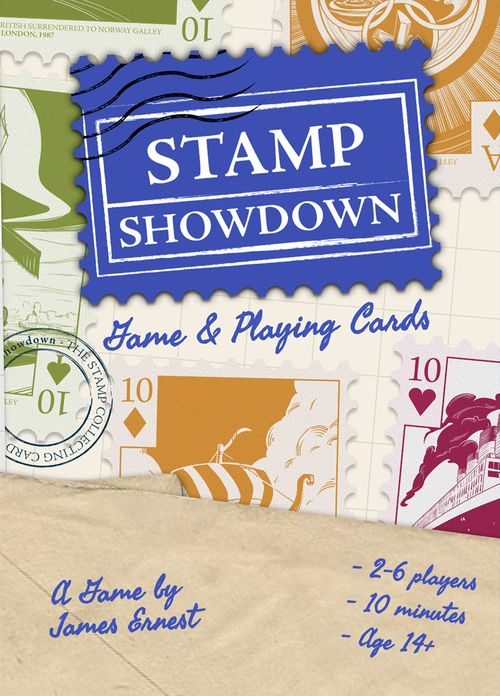
Stamp Showdown
Stamp Showdown Rulebook
Table of Contents
Table of Contents
Components
54 playing cards, 2 player aids, rulebook. Not included: score sheet.
Introduction
In Stamp Showdown, you upgrade a starting hand of four cards into the best five-card poker combination by clever trading with the Market. The game is played over four Competitions of seven Rounds each (players may agree to play fewer Competitions). Scores carry over between Competitions, and the highest total score wins.
Start of a Competition
For all player counts, remove the two Jokers from the deck. Additionally:
- 6 players: Keep all cards.
- 5 players: Remove the 2s from the deck.
- 4 players: Remove the 2s and 3s from the deck.
- 3 players: Remove the 2s, 3s, and 4s from the deck.
- 2 players: Remove the 2s, 3s, 4s, and 5s from the deck.
Shuffle the deck and deal four cards to each player. This is their starting hand.
A Competition consists of seven Rounds and ends with a Showdown.
Playing a Round
Deal four cards from the deck into the center of the table, face up. This is the Market. Each player chooses one card from their hand and plays it face down. These cards are revealed simultaneously, and players take turns to trade these with the Market as follows:
- Player turn order for the Round is determined by the rank of the cards they played, from highest to lowest (Aces are high). Cards of the same rank are resolved in the reverse alphabetical order of their suit: Spades ♠ are first, then Hearts ♥, Diamonds ♦, and Clubs ♣.
- On your turn, you add to your hand all Market cards that match the card you played: all that match the rank and all that match the suit. For example, playing the 9♠ lets you take all the 9s and all the ♠s. You are not limited to five cards in your hand. If no Market cards match your card, you may take any single card of your choice from the Market.
- After taking a card (or cards) to your hand, the card you played is added to the Market, and the next player in turn order takes their turn.
Example: the printed illustration shows a Market of four cards, with arrows indicating the player taking the matching cards into hand and the played card being placed into the Market.
Next Round & Final Round
The Round is over after the last card has been traded with the Market. Cards that are left in the Market are discarded, and the next Round begins with four new cards in the center. When you cannot fill the Market because the deck is empty, it is time for the Showdown.
Showdown & Scoring
Showdown
To determine the Competition placings, each player now makes the best poker combination of five cards. This is the Showdown. If you have more than five cards in your hand, select the best poker hand of five cards. Reveal this combination to the other players and determine the scoring.
Scoring
Score each Competition as follows:
- The best poker hand scores points equal to the number of players.
- Each poker hand in order scores one less point, except for the worst poker hand, which scores zero.
For example, the scores in a four-player game would be 4-3-2-0.
Write down the scores to keep track over the four Competitions.
Ties are broken as in poker, with true ties splitting the available points (rounded down).
For poker hand rankings, see Poker Ranking (page 8 of the printed rulebook).
Poker Ranking
Hand ranks from highest to lowest:
- Straight flush: Five consecutive cards of the same suit (e.g., 5♦, 6♦, 7♦, 8♦, 9♦).
- Four of a kind: Four cards of the same rank (e.g., 9♠, 9♦, 9♣, 9♥). The fifth card is any other card.
- Full house: Three cards of one rank and two cards of another (e.g., Q♠, Q♠, Q♥, 5♣, 5♠).
- Flush: Five nonconsecutive cards of the same suit (e.g., A♥, 7♥, 5♥, 3♥, 2♥).
- Straight: Five consecutive cards but from different suits (e.g., 4♦, 5♠, 6♣, 7♠, 8♥).
- Three of a kind: Three cards of the same rank (e.g., 8♠, 8♥, 8♣) and any two unrelated cards.
- Two pair: Two sets of two cards of the same rank (e.g., 10♠, 10♣, 4♦, 4♥) and one unrelated card.
- One pair: Two cards of the same rank (e.g., K♠, K♣) and three unrelated cards.
Highest card: When no better combination is available, the poker hand is ranked by the highest single card (e.g., an Ace beats a King).
Example Poker Hand: Full House. The printed example shows five cards: three Queens and two Kings.
Poker Ranking Overview
Examples, from high to low:
- Straight flush: 5♦ 6♦ 7♦ 8♦ 9♦
- Four of a kind: 9♦ 9♠ 9♥ 9♣, with 5♠ not part of the hand
- Full house: 5♦ 5♣ Q♣ Q♠ Q♦
- Flush: Q♦ 5♦ 9♦ 2♦ K♦
- Straight: 4♦ 5♠ 6♣ 7♠ 8♥
- Three of a kind: 5♦ 5♠ 5♣, with Q♦ and 8♥ not part of the hand
- Two pair: 9♥ 9♣ 6♣ 6♦, with 4♦ not part of the hand
- Pair: 8♦ 8♥, with 6♣, K♦, and Q♣ not part of the hand
- High card: K♦ is the highest card; the other cards shown (5♦, 6♣, 8♥, Q♣) are not part of the hand
In the printed overview, cards not part of the example hand are shown greyed out.
Tiebreakers
Straight flushes, Flushes, and Straights
When both parties have the same ranking poker hand, the highest card decides the winner. If the highest card is the same for both parties, look at the second highest, then the third, then fourth, and lastly the fifth card. If all five are of equal ranks, it is a true tie.
Full houses
When both parties have a full house, the highest three of a kind in them wins.
Two pairs and Pairs
If two players have the same poker hand in the same value (e.g., a pair of 8s), the value of the highest additional card decides. If both poker hands have the same highest card, compare the second-highest card, then the third, and so on until the tie is broken. In the case that all five are of equal ranks, it is a true tie.
True ties
True ties are broken, as in poker, by splitting the available points (rounded down).
Card Order
The order of ranks from high to low: A, K, Q, J, 10, 9, 8, 7, 6, 5, 4, 3, 2.
End of a Game
Repeat the above process for a total of four Competitions (unless players have agreed to play fewer). Count up the player scores of all the Competitions. The player with the highest total score wins.
Strategic Tip
You will want to get some options for trading. So in the early stages of the game, it is usually smart to try to pick up more cards than you play, regardless of how well they build your poker hand. At some point you will have to start tuning your hand with more precise plays, but only when you have enough cards to trade from.